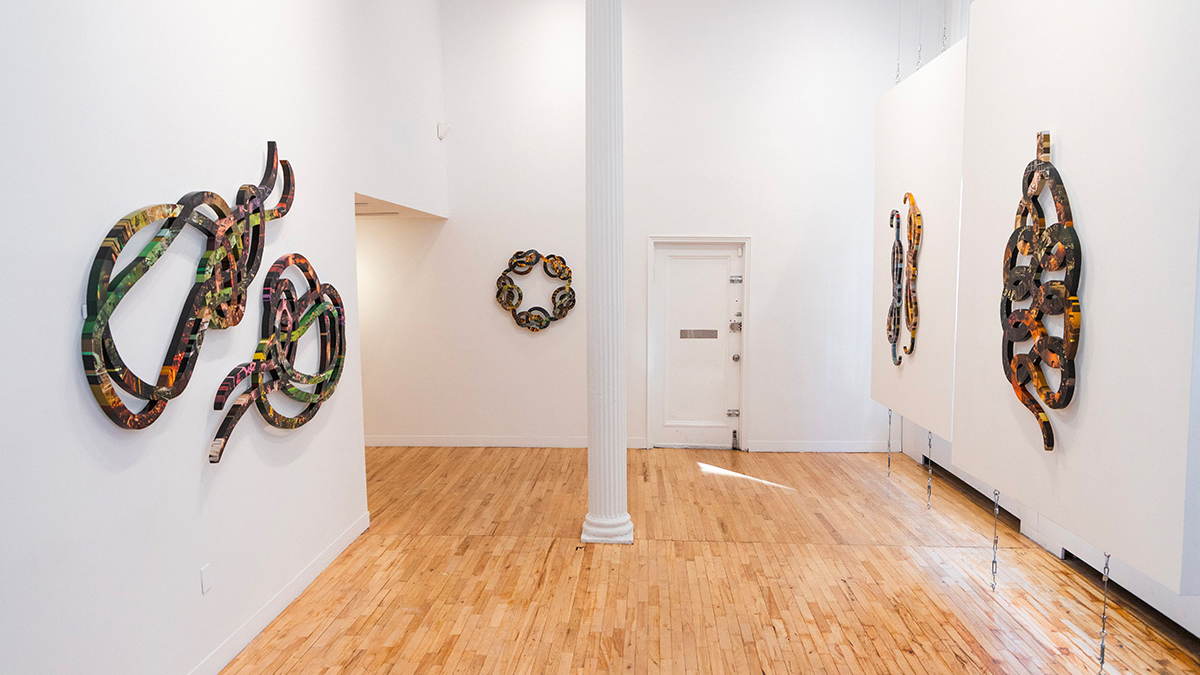
In Unreliable Narrators, Rochelle Voyles’s collages hold both a capacious nihilism and a hope to build stories from the void. From this fulcrum, I think of Joan Didion’s classic essay The White Album, and its opening truism: “We tell ourselves stories in order to live.” Voyles’s compositions of found photographs extend to viewers, a branch, a bone, a tool in making sense of the randomness that seems to rule our lives. Cutouts layered into loops capture chaos, but the care in each cut, the curation, and the collision of hyperspecific images betray a belief in an idiosyncratic order. These works are at once figurative mazes of manifold meaning, and objects calculated to short-circuit our thinking and experience pure sensation.
“Flash pictures in variable sequence, images with no ‘meaning’ beyond their temporary arrangement.” That’s how Didion describes a mental break; it sounds eerily familiar to anyone who scrolls through social media. Voyles describes this dissonance, this dissociation with her dense mix of eclectic images. Yet color and composition cohere the components into an unruly whole.
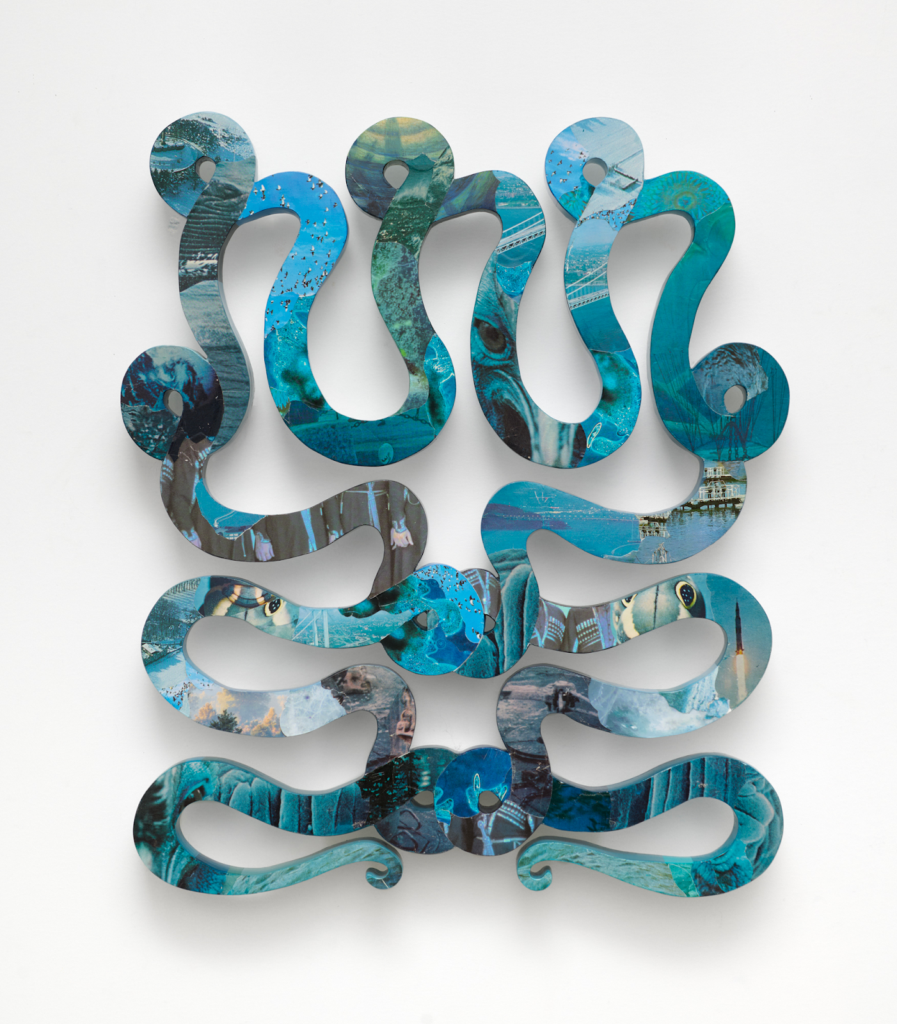
Look past the tentacular form of the instantly aquatic Neptune in Pisces. What are we to make of the menacing bird camouflaged into the curls, or the rocket ship blasting into cerulean sky? The specificity of blue disguises these aerial items within the submarine scheme, while their shapes keep our eye in motion. These embedded tensions disrupt the setting and produce a wave of compounding, fluid jolts.
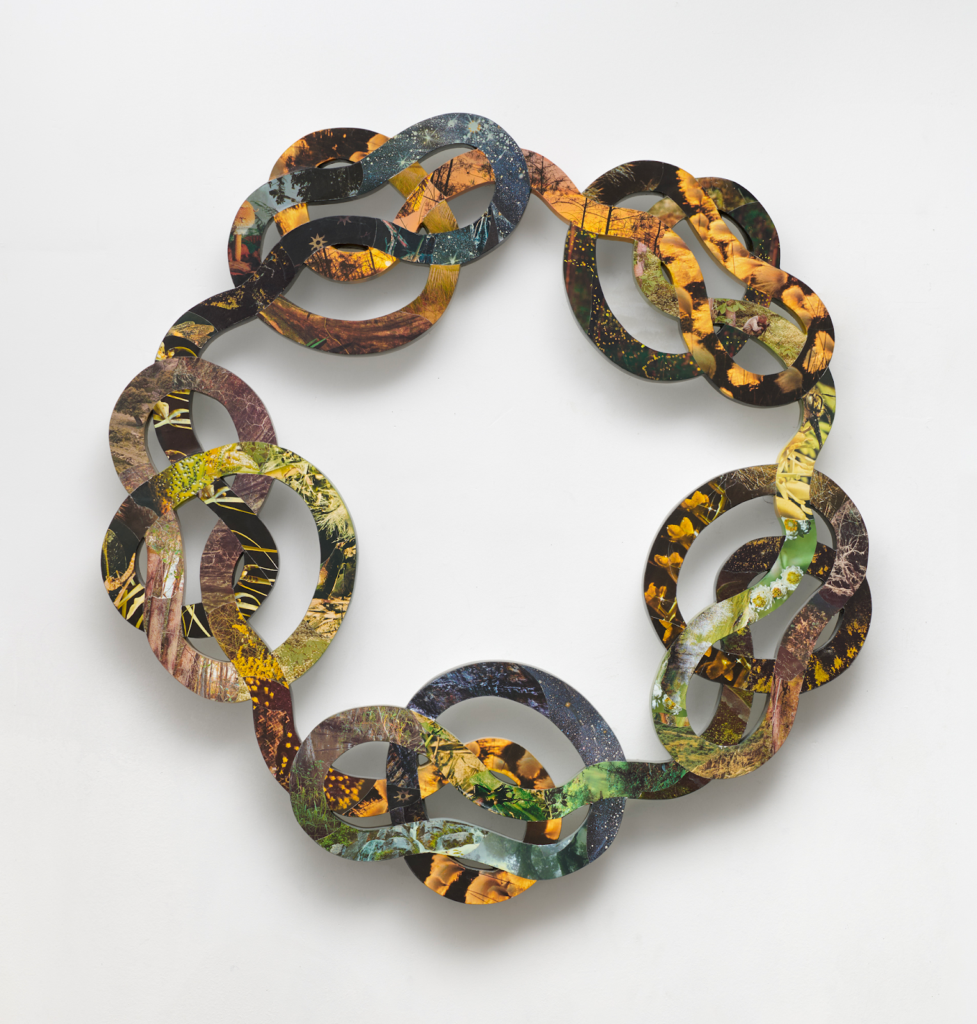
“Not a movie but a cutting-room experience,” as Didion calls it. And oh, how Voyles cuts! She slices her materials in gestural shapes, ignoring an object’s contours. A photograph’s subject stays intact with its background. The whiff of context, of individual wholeness is most likenable to the surreal dislocation of channel surfing. Juxtapositions of wide scenes against close-up textures spark a stutter between mind and eye. Recognition and sensory memory are pitted against each other. At the bottom of The Bowline at Dusk, a close-up of leaves butts up against a forest. The razor-thin line of white paper pulp peaks at the seam. The hint of friction between pictures reminds us that we are looking at just that: pictures, collages, cuts.
To conduct and contain this unstable current, Voyles uses stitching and knotwork diagrams as a sculpture’s starting point. She jigsaws the traced form from a sheet of plywood: “Drawing with a blade,” she says. Although referential, the carved curves are the most direct manifestation of Voyles’s hand as a creator. In covering the facade in collage, Voyles complicates her authorship with an inherently collective vision, albeit one she shapes as a singular maker. Invention and intervention.
“We live entirely, especially if we are writers, by the imposition of a narrative line upon disparate images,” Didion says. In Voyles’s works, the narrative line is the carved substrate– both a container for images and their penetrating thread. Literally, these are designs of physical binding, a means of joining things together. Equally textile as they are neural.
Didion casts doubt on this connective impulse, on “the ‘ideas’ with which we have learned to freeze the shifting phantasmagoria which is our actual experience.” This is one of art’s greatest aims: to let a still image resonate deeper than “ideas.” Equal parts frozen and phantasmagoric. At its highest power, an artwork can cut through thought and open up pure experience unbridled by narrative or words. The Abstract Expressionists, for example, pursued this by abandoning figuration and embracing the physicality of scale and gesture; of course, many words—in essays, or slurred together at the Cedar Bar—were spent scaffolding their efforts.
Remarkably, Voyles’s hyperfigurative works accomplish both this climactic burst of sight and the slippery promise of meaning. The swarm of nearly nameable pictures is subsumed but not constricted by formal elements. Take the emberlit Slithering Ruin. Does it matter that the testifying man is Nixon’s White House Counsel, John Dean, photographed at the Watergate Trial? Need we recognize a statue of Shiva the Destroyer or the adjacent photo of a flooded New Orleans? The answer is no.
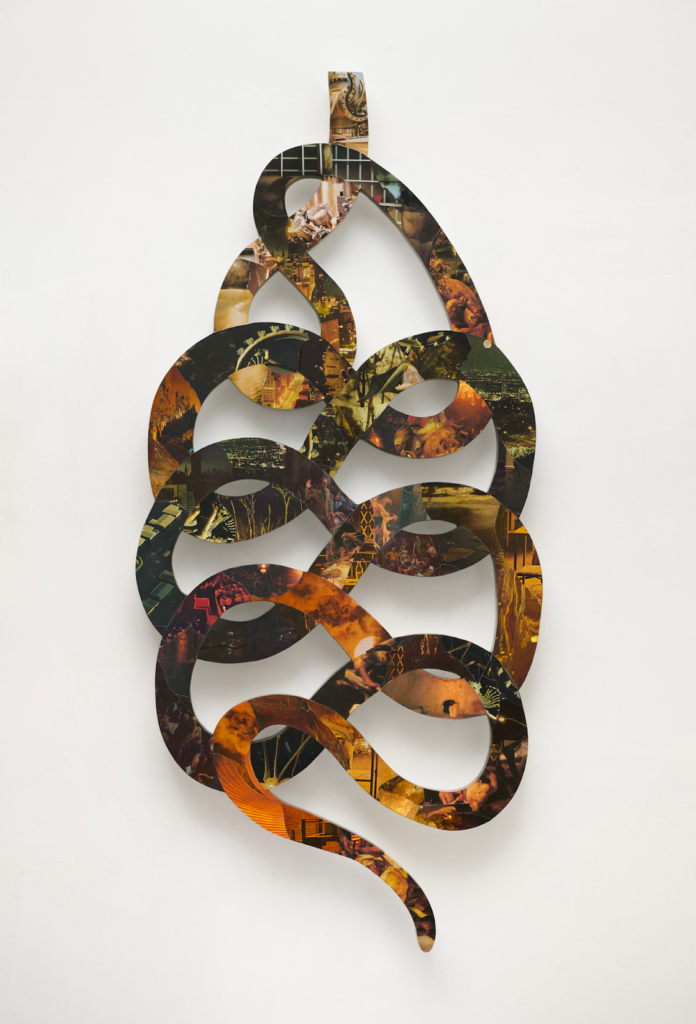
What matters is the rhythm of writhing lines with negative space, and how the collective color and perspective create a composition that we can immediately register, and in turn seizes us. The shapes within each snippet echo each other to the millimeter. The strands of pictures appear to snake behind each other, performing the organ-like curling of the knotwork. Each photo’s information may refine the “ideas” implied by the titles, but the vibration between image and form commands a somatic looking that surpasses interpretation without subordinating the impulse either.
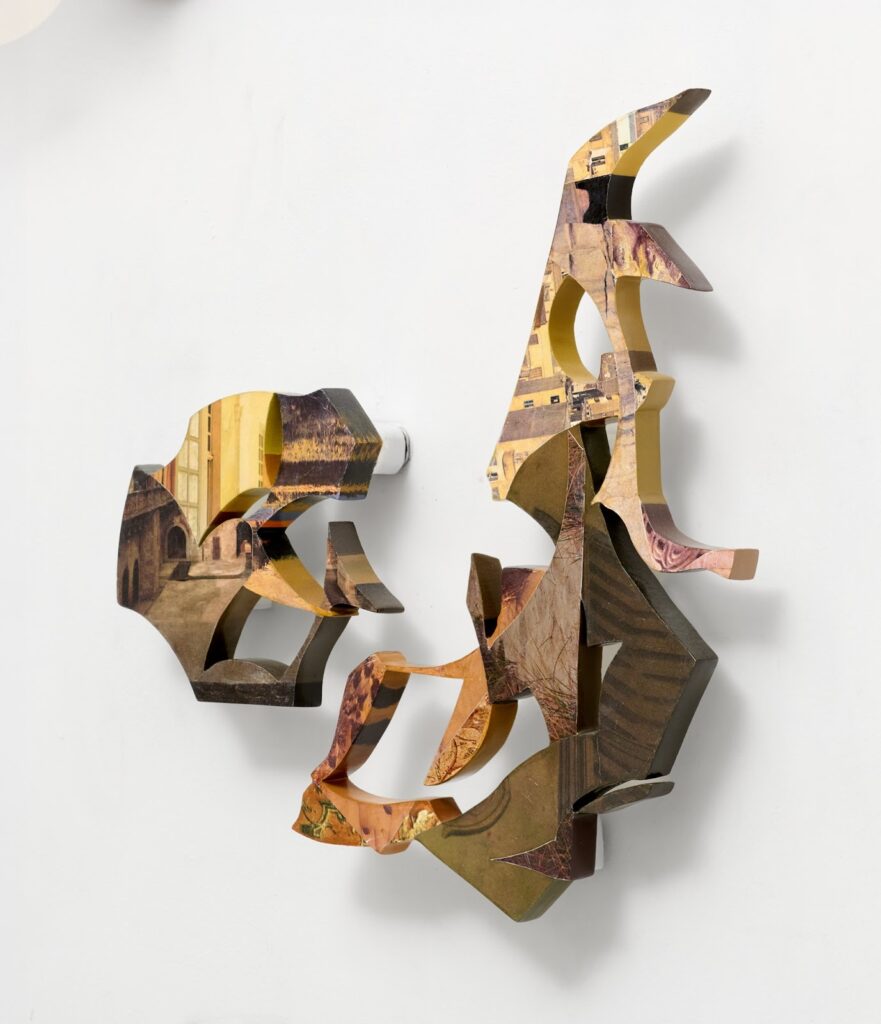
The small works invert this tension of sight and significance. Jagged compositions like Shadowed Passage begin as offcuts from the carved knotworks. “Shrapnel,” Voyles calls them. Without the thread diagrams as a conceptual device, these gathered fragments develop aesthetically rather than thematically. Still, the control of color and space on the surfaces of these meta-scraps yields a sensory experience of mystery.
With unifying precision, Voyles paints the sides of each work to color match the image at the surface edge. A dancer’s leg in Pinser Movement streaks off the corner like a Barnett Newman “zip” of color. Alone, the edges look like miniature color field paintings. From an angle, the trompe l’oeil edges accentuate the collage’s literal substance — printed pictures of something, not the real thing itself. The chromatic sides make the works zoom forward, as if they have risen from some liquid pool, and dragged these colors forth as they emerged.
To imagine this pool is to conceive of a collective consciousness, a psychic soup which Voyles pulls from in exacting shapes. She free-associates to plumb the universal. Didion, wrestling with her underlying nihilism, reflects: “I wanted still to believe in the narrative and in the narrative’s intelligibility…” Winding along with the serpentine curves of Unreliable Narrators, it is our choice to form a story of their shards to simply experience the charge they provoke. Didion continues, “….to know that one could change the sense with every cut was to begin to perceive the experience as rather more electrical than ethical.” Unreliable Narrators is an exercise in balancing both.
Unreliable Narrators, 81 Leonard Gallery, 81 Leonard Street, New York, NY, 10013. On view through April 11th, 2026, Tues – Sat, 12 PM – 6 PM.
About the writer: Queens-based-writer and artist Will Kaplan combines different mediums, techniques, and text to probe boundaries. In addition to his studio practice, he reviews new music and documents the city’s art scene. Kaplan has had several solo shows in venues such as D.D.D.D, Pete’s Candy Store, and on Governors Island. His work has appeared at Spring/Break Art Fair, the New Art Dealers Alliance, and Pete’s Candy Store. He has written for Two Coats of Paint, Passing Notes, Tussle Projects, and Peer Review.