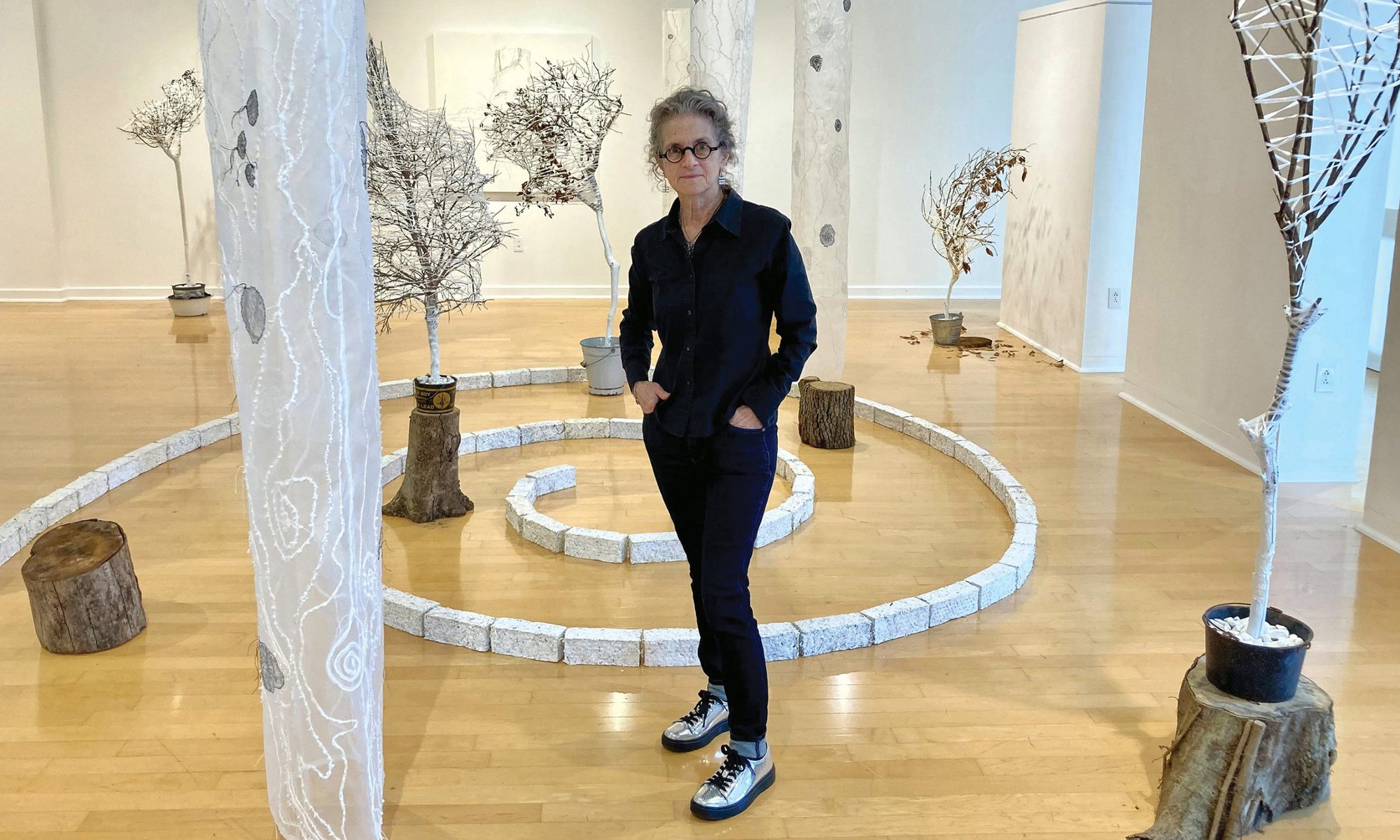
For two decades, Babs Reingold has reflected throughout her mixed media work on the intersections of poverty, climate change, and beauty in the environment. In her current solo show, Forest Bathing at Leepa-Rattner Museum of Art, Tarpon Springs, Florida, brings together two ongoing series, Hair Nest and Lost Trees. Both series mark a deliberate shift toward celebrating the beauty and resilience of nature. Whether confronting social inequities, ecological destruction, or the persistence of beauty amid crisis, her work arises from a deep belief that art can create both awareness and change. By transforming unconventional materials—human hair, salvaged wood, silk organza—into immersive environments, Reingold invites visitors to think about their place within larger systems of survival, destruction, and renewal. We discussed this exhibition in the context of her larger body of work.
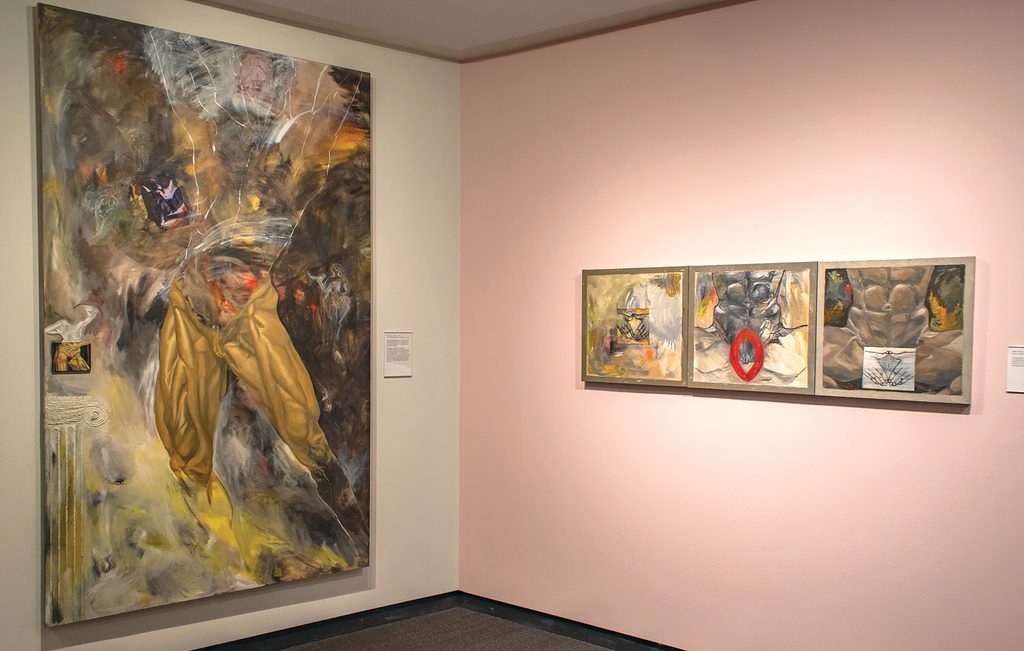
Your Hair Nest and Lost Trees work is on view in Forest Bathing at the Leepa-Rattner, its run overlapping with After Venus at MFA St. Petersburg, your 1990–1998 paintings of women bodybuilders. So, two bodies of work three decades apart share the same moment and region. Across that span, you’ve said you examine the intersections of poverty, climate change, and beauty. How do you understand the through-line from the body of the Amazon to the body of the forest?
It’s a rare opportunity for an artist to have two solo museum exhibitions featuring work made three decades apart in the same region. I liken it to a retrospective with the middle cut out. The transition between these bodies of work happened gradually over years. Seeing them together has allowed me to look at my earlier work in a new way, and I’m still thinking about what that juxtaposition means.
I use art to explore subjects that fascinate me, whether it’s climate change, poverty, social inequities, or women’s roles in society. I’ve always been curious about our existence and the interconnectedness of all life. That curiosity hasn’t changed, although my focus has evolved.
In the late 1980s, I began the After Venus series after watching women’s bodybuilding competitions on cable television and became fascinated by the muscular female body. I saw these women as symbols of power and autonomy. I wanted to challenge how Western art history, particularly the male canon, defined women’s beauty and portrayed women as desirable objects. As I was trying to understand my own identity, I questioned what defines beauty and how those ideals change over time. My research led me to ancient fertility figures and symbols, the Sheela-na-Gig, the Yoni, and images of female Amazons, whose muscular bodies challenged traditional ideas about women’s roles and power.
My current work in Forest Bathing brings me back to my early fascination with trees. During three of my teenage years, my family lived in a housing project where I could see the one and only tree from our third-floor window. I drew it repeatedly. From early on, I’ve seen trees as anthropomorphic and loved drawing them, but it wasn’t until the early 2000s that I began researching their essential role in our survival. Over the past two decades, I’ve come to understand just how deeply all living things are interconnected.
I use my own hair, salvaged wood, and a variety of repurposed objects and materials to explore these connections. The focus has expanded from the power and autonomy of the female body to our relationship with the natural world, but the underlying questions remain: how do we define value, what do we take for granted, and how are we connected to the world around us?
In Forest Bathing, you describe a deliberate shift toward celebrating the beauty and resilience of nature. After years of confronting social inequity and ecological destruction, what prompted that turn toward celebration, and does it feel like a departure or a continuation?
Although there’s a deliberate shift toward celebrating the beauty of nature, I see the work as a continuation of what I’ve always done. My goal is to affect people viscerally and make a case for protecting the environment, whether I’m focusing on destruction or celebrating nature’s beauty. I believe there’s an inherent power in beauty and fragility that may be even more effective in conveying that message. I’m not entirely sure, though. After seeing The Last Tree, a darker installation focused on destruction, a viewer was so moved that she had trees planted in my name and sent me the certificates. I was truly touched by her gesture.
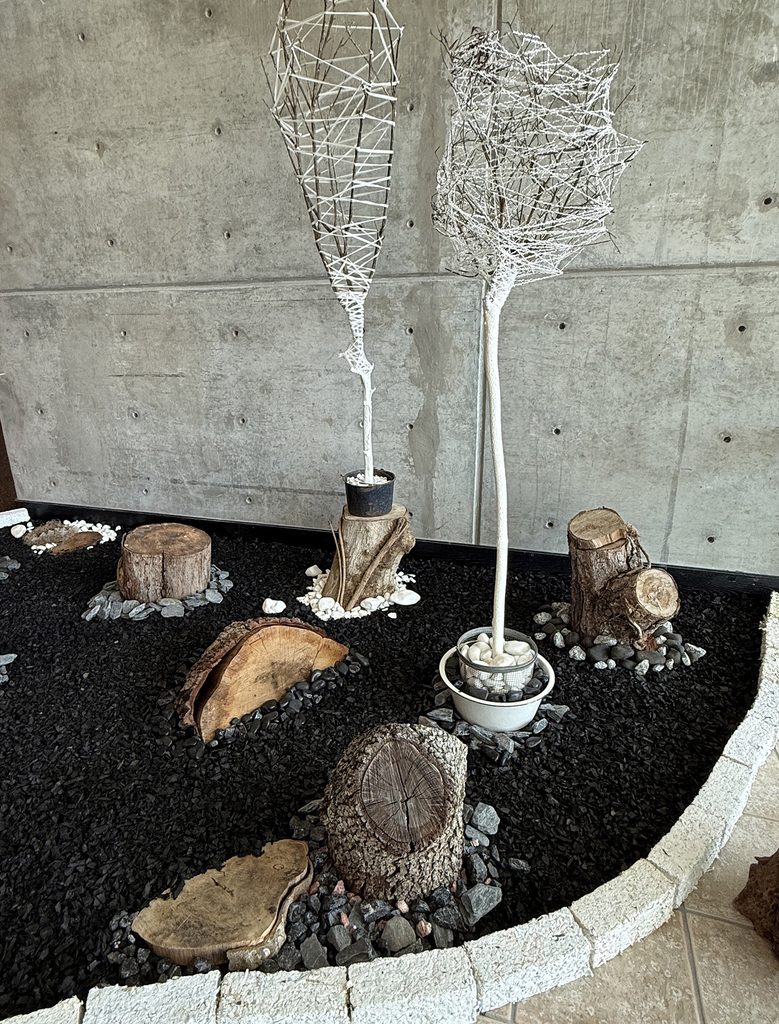
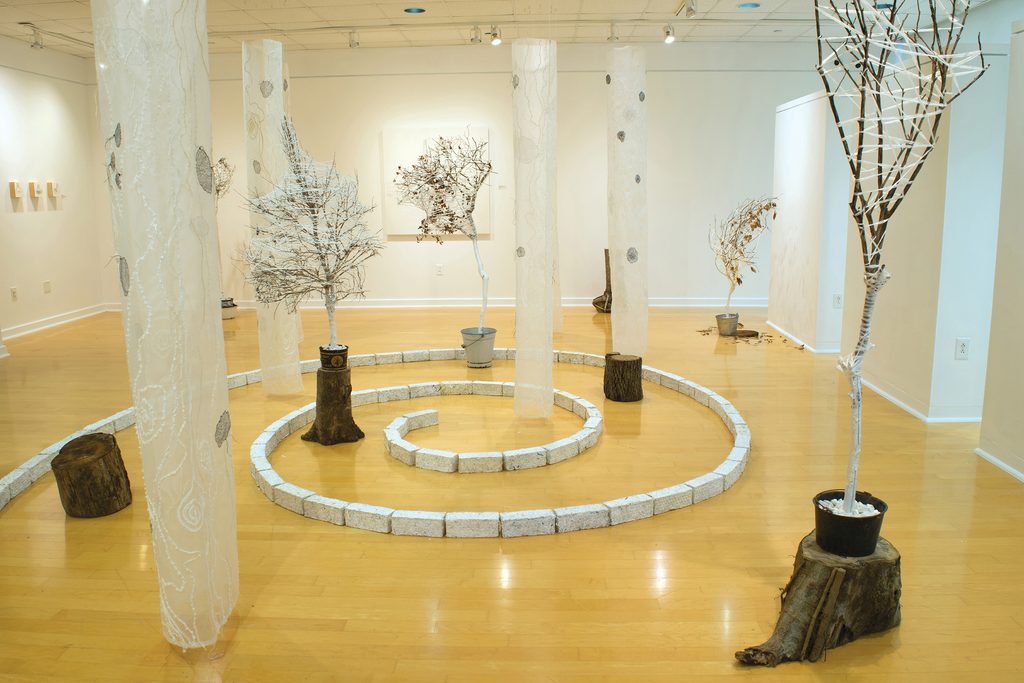
The Lost Trees installation reads as a “ghost forest,” hand-stitched silk organza columns hung from the ceiling, dead trees wrapped in yarn with roots in battered pails, a downed tree from Hurricane Irma, and at its center a spiral path of bricks cast from your own shredded tax records and junk mail. Could you walk us through how a visitor moves through that space?
When I conceived Lost Trees, I knew I wanted to create a ghost forest. I chose translucent white silk organza for the hanging tree columns and white yarn to wrap the dead trees. The color white has always felt beautiful and light to me. Wrapping the dead trees was almost an attempt to save them, even though I knew they were already dead. Once I installed the work, I knew the idea was effective. Viewers walk among the hanging columns and move toward and around the spiral of paper bricks, much as they might wander through a forest on a meditative walk. I wanted the space to invite people to slow down, explore, and experience the work physically and viscerally.
That spiral of bricks made from your old tax files and junk mail keeps recurring in your work. What draws you to transforming your own discarded paperwork into something that reads like ancient ruins, and how does it connect to your themes of destruction and renewal?
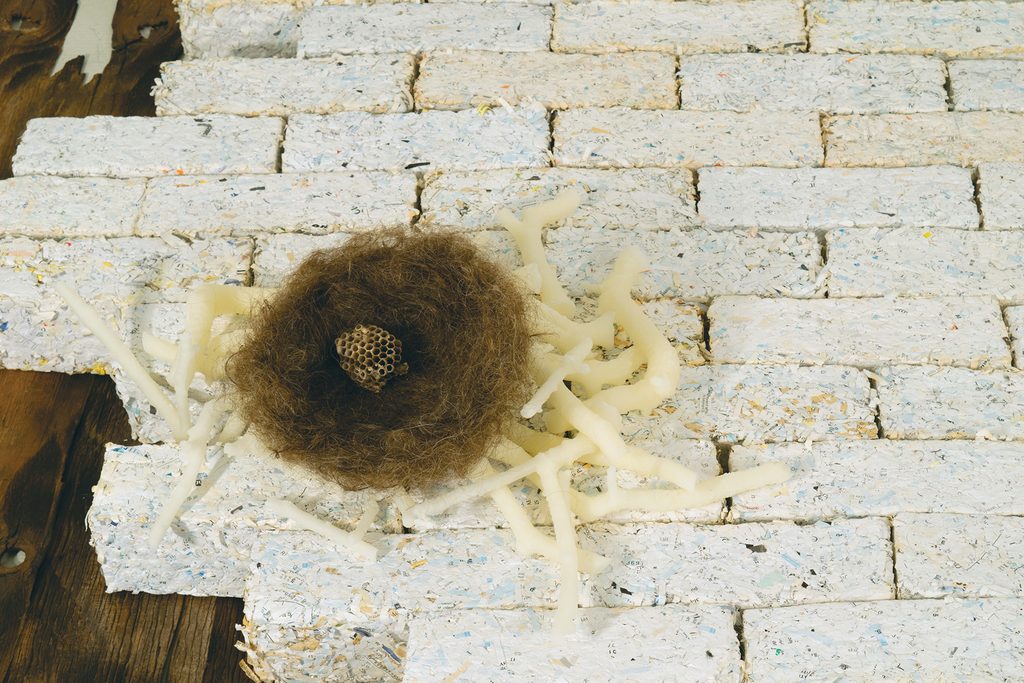
When I first conceived the idea of shredding old files, tax records, and junk mail to make paper bricks, I didn’t expect the process to bring up so many memories and emotions. As I sifted through and shredded the papers, each one reminded me of a particular time or place. I realized I have a hard time letting go of things from the past, perhaps because of my childhood, when we never lived in one place for more than a few years. There was something surprisingly satisfying about this process, and it allowed me to put a lot of myself into the work.
I like taking materials that have outlived their original purpose and giving them a new life and meaning. Transforming discarded paperwork into something that resembles ancient ruins speaks to the cycle of destruction and renewal. The materials no longer useful in their original form become something new that carries meaning for others. Whether using my tax records, personal papers, or my own hair, I physically incorporate pieces of my life, creating an intimate connection between me and the work.
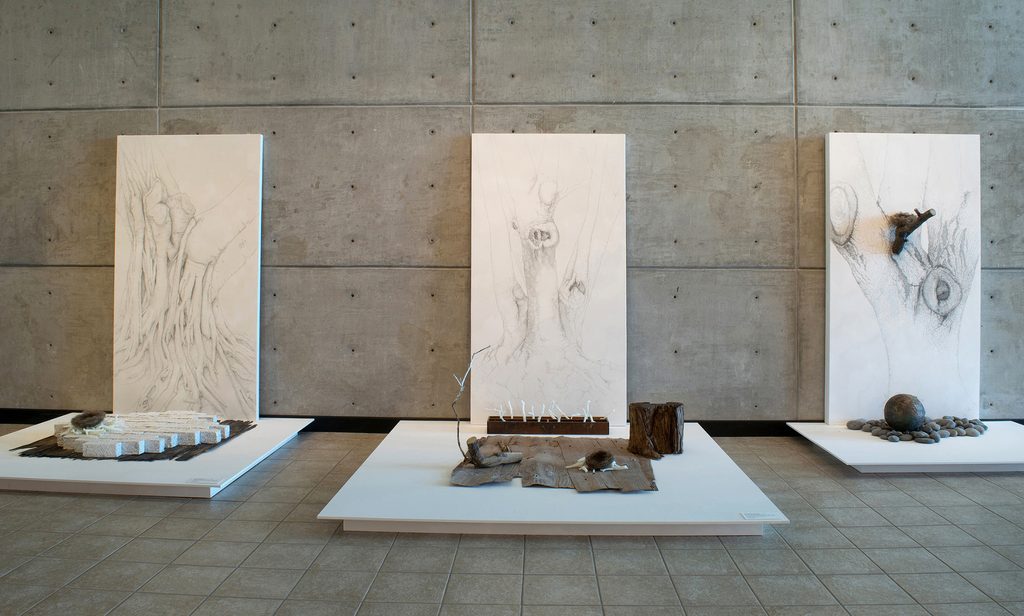
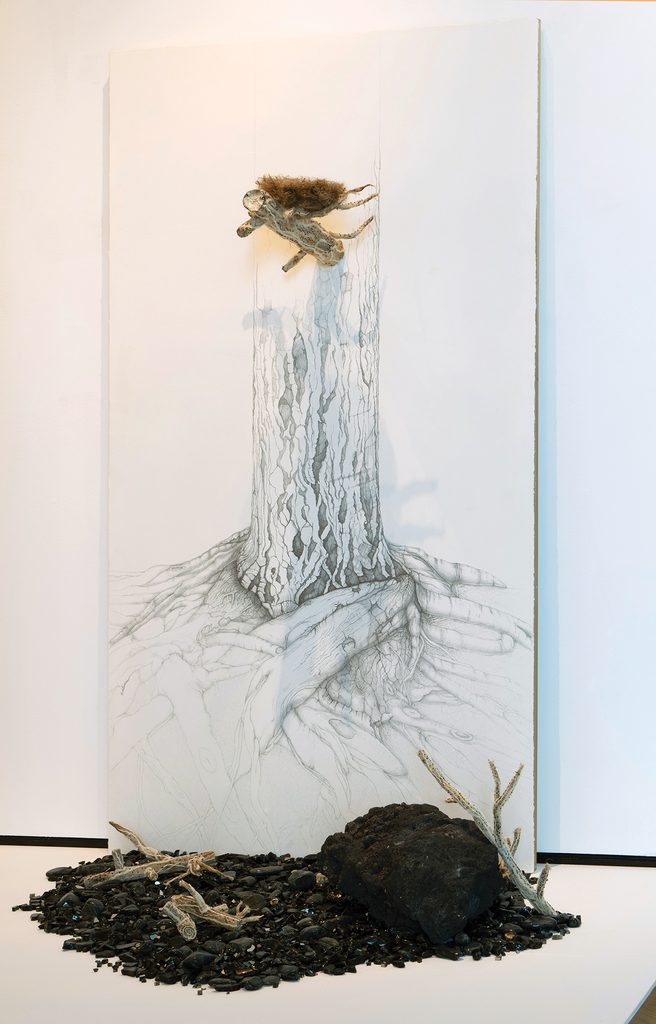
Each Hair Nest begins with a graphite drawing of a tree section on a seven-foot panel, and at its heart sits a nest made from a full year of your own hair loss, collected since 1998 because of a thyroid condition and dated by year. What does it mean to build these works from something so intimate and bodily, and why mark them by the specific year the hair was lost?
Throughout the 1990s, I made work about women’s power and beauty. Although I had moved away from depicting women bodybuilders by the 2000s, I continued to explore ideas about women’s beauty. In 1998, I began losing a significant amount of hair due to a thyroid condition. It was upsetting because I associated my hair with my beauty, and losing it felt like losing part of myself. I began collecting my hair loss, initially unsure what I would do with it. I wanted to document and preserve it, so I collected and stored it in jars by year.
In 2005, I began the Fallout: Beauty Lost and Found series to examine beauty, its loss, and its potential resurrection through my daily hair loss. I manipulated each day’s hair into a doodle, placed it in a dated zip-lock bag, and created large graphite drawings documenting a month of the daily hair doodles throughout 2005.
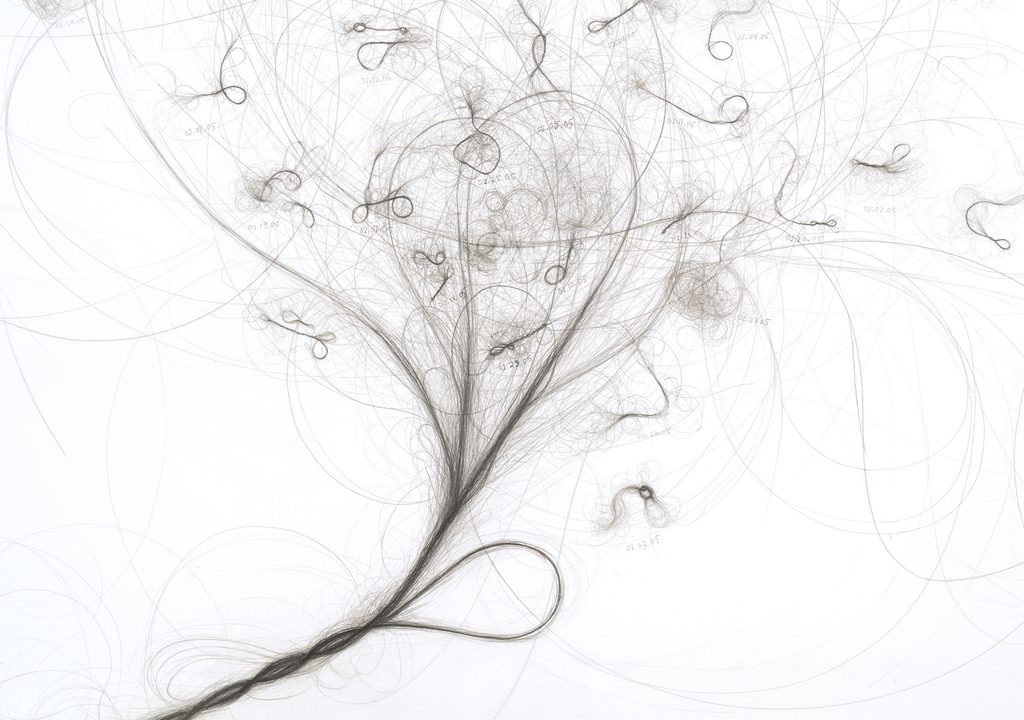
Over the past two decades, I have used my hair loss in different bodies of work. Creating a nest from a year’s worth of hair became a natural extension and a perfect metaphor for environmental beauty and preservation. The nest is a powerful symbol of nature and nurture. Hair is deeply intimate; it contains DNA, and using my own connects me to the work both physically and metaphorically.
Each nest year carries personal significance: 2000 marked the turn of the century, 2001 I was in New York City during 9/11, 2015 and 2016 were years of personal health challenges, and 2020 was the year of COVID. Dating each nest ties the work to my personal history while connecting it to the larger events happening in the world.
You frame Forest Bathing through shinrin-yoku and Edward O. Wilson’s idea of biophilia, and you’ve said the impulse to expand Lost Trees came from a viewer who felt the installation calm her after a hard day. How much do you think about the healing effect of the work on the people who walk through it, and how does that shape what you make?
In 2022, while I was working on Lost Trees, I was also reading and thinking about forest bathing. After the exhibition opened, a viewer tagged me in a social media video about her visit. She had arrived feeling upset after a difficult work meeting and almost decided not to come. She began describing how the beauty of the installation drew her in, calmed her, and changed her day. She was grateful for the sense of peace it gave her and thanked me.
I was surprised by her response. I hadn’t fully considered how the work might affect people emotionally or have a restorative quality. Her experience made me realize how art, like Forest Bathing, can slow us down to reconnect with ourselves and feel more grounded. It also inspired me to expand Lost Trees into a larger installation that viewers could become immersed in and even lose themselves.
Since then, I’ve become more aware of the potential for the work to offer a sense of calm and connection. I don’t set out to make art that heals, but I do hope to create an environment that reflects the restorative qualities of nature and invites people to slow down and reconnect with the living world.
Forest Bathing at Leepa-Rattner Museum of Art, Tarpon Springs, Florida, June 27 – November 30, 2026.
Make your tax-deductible donation today and help Art Spiel continue to thrive. DONATE
About the artist: Venezuela-born American artist Babs Reingold creates sculptures, assemblages, drawings, and installations focusing on beauty, the environment, and poverty.
Reingold has an extensive showing history, including 20 solo exhibitions and over 80 group exhibitions ranging from museums, universities, and galleries. Solo exhibits in museums and galleries include New York City, Los Angeles, Atlanta, Savannah, St. Petersburg, FL, Jersey City, Tarpon Springs, FL, and Buffalo, NY. Museum exhibits include the Newark Museum, NJ; Jersey City Museum; Albright-Knox, Buffalo, NY; Burchfield Penney, Buffalo, NY; Tampa Museum; and MFA St. Petersburg. She has work in museum and private collections across the United States.
Awards: 2026 St. Petersburg Arts Alliance Visual Arts MUSE award, Florida State Fellowship, two Pinellas County fellowships, and a New York Foundation for the Arts Fiscal Sponsorship. Guest editor for the arts journal New Observations New York City, Atlantic Center for the Arts residency, and Joan Mitchell Fellowship nominee.
Reingold has an MFA from SUNY Buffalo and a BFA from the Cleveland Institute of Art. She lives and works in St. Petersburg, FL, with a viewing space in New York City. @babsreingold