
Botany, I read in Zoë Schlanger’s bestseller The Light Eaters: How the Unseen World of Plant Intelligence Offers a New Understanding of Life on Earth, is full of groundbreaking discoveries these days (Schlanger 2024). We now know that plants have cellular conduits that allow propagation of electrical charges, that some plants release chemicals in the air to alert neighbors of insects, and that evening primrose increases its nectar’s sweetness when it senses the frequency of the hum of bee wings. While such plant-feeling, plant-talking, and plant-listening are not sustained by the same biological apparatus as ours, the functional parallel is apparent. Perhaps it is time to broaden our understanding of intelligence.
It is from this expanded horizon that the 15th Shanghai Biennale poses its central question: “Does the Flower Hear the Bees?” At one level, this is a call for humans to “attune” themselves to a wider array of intelligences: to recognize, like the flower, that survival depends on sensing what lies beyond the self. At another, it could gesture toward a more familiar imperative within contemporary art—to slow down, to attend closely, and to recalibrate one’s senses in relation to the world. For a biennale staged in Shanghai, this invitation also raises a more specific question: through which intellectual traditions, and toward what ends, is this expanded notion of intelligence being articulated?
What emerges from the exhibition, however, is less a sustained engagement with diverse forms of intelligence than a familiar global biennial grammar—one that privileges slow sensing, perceptual recalibration, and postcolonial redress. While these frameworks have become central to contemporary biennials and remain useful in challenging Western-centric capitalism, they are only loosely anchored in the intellectual or historical conditions of Shanghai. The result is a gap between the promise of a more radical challenge and the delivery of a familiar, bounded one.
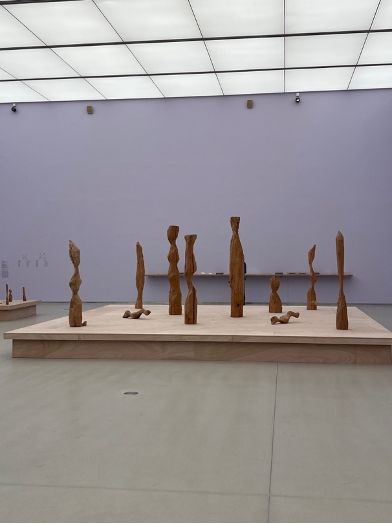
Of the 67 artists invited to the exhibition, only a few address non-human intelligences directly. In Aki Inomata’s How to Carve a Sculpture (2018-ongoing), what at first looks like a collection of abstract sculptures turns out to be wooden poles gnawed by beavers. Nearby, the artist’s replicas—scaled three times larger—stood alongside the originals. The work is calm to stand by—abstract forms in wood, giving off something like a forest feeling—and that calm itself feels like part of the point: there is no need to announce authorship, as there is no competition between forms of intelligences. Yet in rendering beaver activity legible as sculpture, the work ultimately absorbs nonhuman intelligence into an existing aesthetic framework rather than unsettling it.
In Lina Lapelyté’s The Speech (2024-ongoing), children aged 5 to 17 are invited to use imagined animal languages to vocalize their thoughts. The clips are shown in a dark room, where the imitated howls and pants are played on repeat to bring out an eerie, tense atmosphere. What is being communicated? Are the sounds languages? The invoked confusion and light trepidation give rise to a desire to comprehend, which points toward the limits of human understanding. This is probably the strongest work of the biennale that pushes into the realm the theme invites you to explore, yet even here, the encounter feels staged, which undermines the uncertainty such exploration brings about, however slightly.
Sound plays an important role in Tania Candiani’s Prólogo. 7 Campanas (2024), where wicker and rattan pods drape from the ceiling to human height like exaggerated hats, each embedding a speaker playing soundtracks from nature: bird chirping, cows mooing, creeks murmuring. In the artist’s own words, her intention was to “create spaces where attention slows, where the body tunes itself to frequencies often ignored” (Candiani 2025).

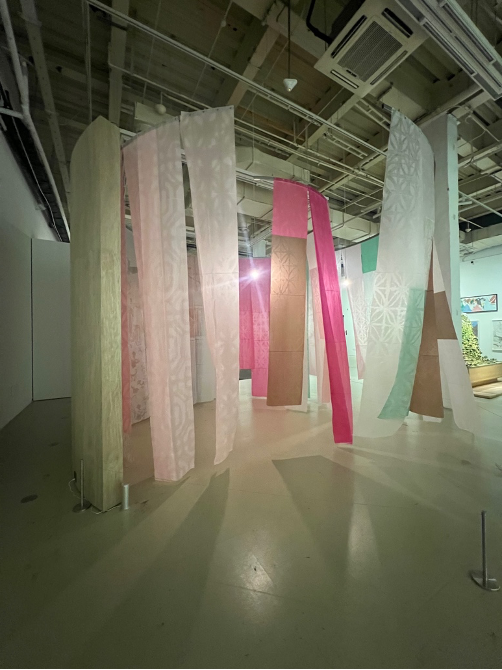
Here, instead of exploring the unknown, the biennale threads more familiar terrain. Slow sensing, immersion, the recalibration of perception against the capitalist linear time—these are by now a recognizable biennale idiom, a kind of institutionalized counter-rhythm that has its own conventions as settled as the ones it purports to resist. Works like Lotus L. Kang’s Azaleas II (2025), a kinetic sculpture rotating to the meter of Kim Sowol’s eponymous poem written during Japanese colonial rule over Korea, or Tan Jing’s Second Skin (2025), where paper strips hang from the ceiling and enclose a circle, each steeped in aromatic oil and inviting visitors close, are formally refined and carefully constructed; these works nonetheless rely on a “ways of seeing” mode of exploration whose terms have already been set elsewhere.
Exploration of nonlinear time is another well-traversed route on the international circuit, and so is fragmentary selfhood. Along these routes, the biennale has works like Ho Tzu Nyen’s Timepieces (2023), where each of the 43 flat screens mounted on the same wall in a dark room plays a video of time measurement that follows a different rhythm. Additionally, in Hu Xiaoyuan’s Carpel I (2024), a rickety replica of her workstation is assembled using fragmentary materials like insect wings, shells, and conch fossils, upon which her own poems and manuscripts are placed. Again, clever in conceptualization and well-done in implementation, but their impact is blunted by their placement within a biennale that has already asked so much of the same. Deceleration, fragmentation, perceptual openness: these have become a recognizable language of international contemporary art (Smith 2012), and deploying them without probing their meanings in this specific context is its own kind of conservatism.
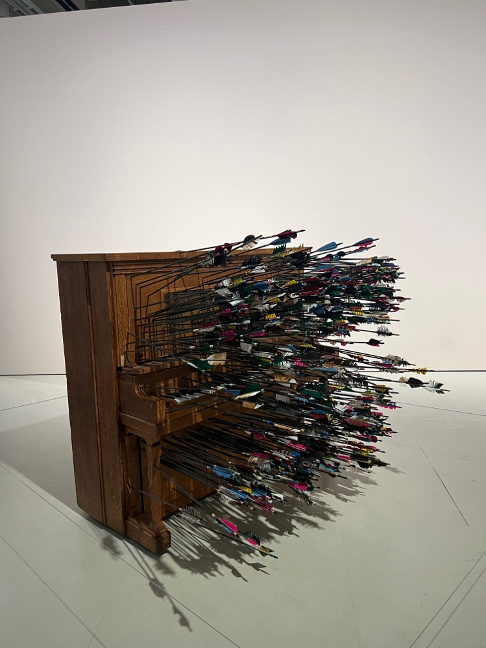
This reliance on established grammars extends to another familiar trope: postcolonial redress. There is Brett Graham’s Ka Wheeke (2024), a sculpture modeled on the gun turrets of a warship but freighted with meanings of Māori sovereignty; there is Brian Jungen’s Pull to Refresh (2025), where a piano, the symbol of bourgeois cultural taste, is impaled by tens of Aboriginal arrows. Both again operate within a recognizable grammar: an indigenous counter-gesture is made against a colonial instrument. While the works are effective on their own terms, the terms themselves are already familiar.
On a similar frequency, there is Cheng Xinhao’s Musica Proibita (2024). It is a single-channel video showing the eponymous Italian song being played to a Rhododendron delavayi on a Yunnan mountaintop. Its backstory is that an American plant hunter once used music to lure Naxi villagers into photographs. The video is paired with a branch of the same species that Cheng had “stolen” back to China. Whereas Graham and Jungen go for overt confrontation, Cheng performs a quieter form of return. But the postcolonial grammar is the same: a prior act of extraction or domination is answered with reversal.
This grammar feels disconnected from the context. Postcolonial theory, as we know it, emerged from a specific historical situation: colonial subjects addressing Western epistemic authority from within Western institutions. China’s trajectory—semi-colonial, socialist revolution, Third-World solidarity—does not fit this situation neatly. When a biennale in Shanghai adopts this framing wholesale, it adopts a Western-derived critical vocabulary to critique the West, thereby reinforcing the very epistemic center it seeks to provincialize. State censorship might foreclose direct critique of China’s own power, but it need not foreclose thinking differently about the postcolonial condition altogether. Cheng’s work hints at themes like layered histories of extraction, internal difference, and botanical circulation, but none of these tensions gets further exploration across the three floors of the Power Station of Art, where the biennale is held.
This wholesale transplantation of dominant themes across biennales in the West, I come to realize, is the key reason why I leave the biennale with a sense of lack. In posing a question on more-than-human intelligence, the 15th Shanghai Biennale joins an already established conversation, one that has been explored in venues such as the Serpentine, Venice, Gherdëina, and Montreal. That Shanghai joins this conversation relatively late matters less than that it joins without adding something distinctly its own. The biennale could have looked closer to home. Daoism, after all, has long called for the unity of human life and nature—not as a romantic proposition but as a cosmological one, with its own rigorous internal logic. Traditional Chinese agricultural practices, some dating back millennia, relied on symbiosis between species to fix nitrogen—a form of ecological intelligence. Yet such possibilities remain largely unengaged.
By checking the boxes of slow sensing, immersion, fragmentation, and postcolonial critique, the 15th Shanghai biennale plays it safe but misses the edges its location could have offered. Judging by the questions it asks and the works it presents, it does not need to be hosted in Shanghai; it could happen anywhere else in the world.
The 15th Shanghai Biennale, Does the Flower Hear the Bees?, was on view at the Power
Station of Art, Shanghai, from November 8, 2025, to March 31, 2026.
About the writer: Hantian Zhang is a writer and data scientist based in San Francisco. His writing has appeared in Afterimage: The Journal of Media Arts and Cultural Criticism, AGNI, Prairie Schooner, West Branch, and elsewhere. @ hantian_zhang
References
Candiani, Tania. 2025. Artist statement, 15th Shanghai Biennale wall text.
Schlanger, Zoë. 2024. The Light Eaters: How the Unseen World of Plant Intelligence Offers a New Understanding of Life on Earth. Harper, New York.
Smith, Terry. 2012. Thinking Contemporary Curating. Independent Curators International, New York.