At the Hammond Museum and Japanese Stroll Garden in North Salem, New York, art doesn’t stay inside the galleries. Since 1964, the museum has staged exhibitions that move from its gallery walls to its patio, tea hut, and garden paths, with about fifteen shows a year and the number growing. Contemporary and historical, drawn from many styles and cultural traditions, the exhibitions often aim to build cross-cultural understanding, while those set outdoors open a dialogue between art, nature, and personal reflection. This fall, five shows fill the grounds: Tomoko Amaki Abe’s Heaven Come Down in the Main Gallery, Meg Hitchcock’s Fang in the Hays and Goelet Galleries, Soli Pierce’s Poetry of Place in the Tea Hut, Matthew Weber’s Ground Shift on the Patio, and Kurt Steger’s In the Garden along the Japanese Stroll Garden. In this conversation, the museum team talks about how the Exhibition Committee selects its shows and how each one carries the museum’s mission forward.
Can you walk us through each of the shows? Let’s start with Meg Hitchcock’s large wall installation, Fang. The artist says, “Like the Buddhist deity Yamantaka, who bears his fangs to ward off self-delusion, my shrine, Fang, invites viewers to detach and be free from doctrines, dogmas, and personal dramas.” How does the installation embody this idea?
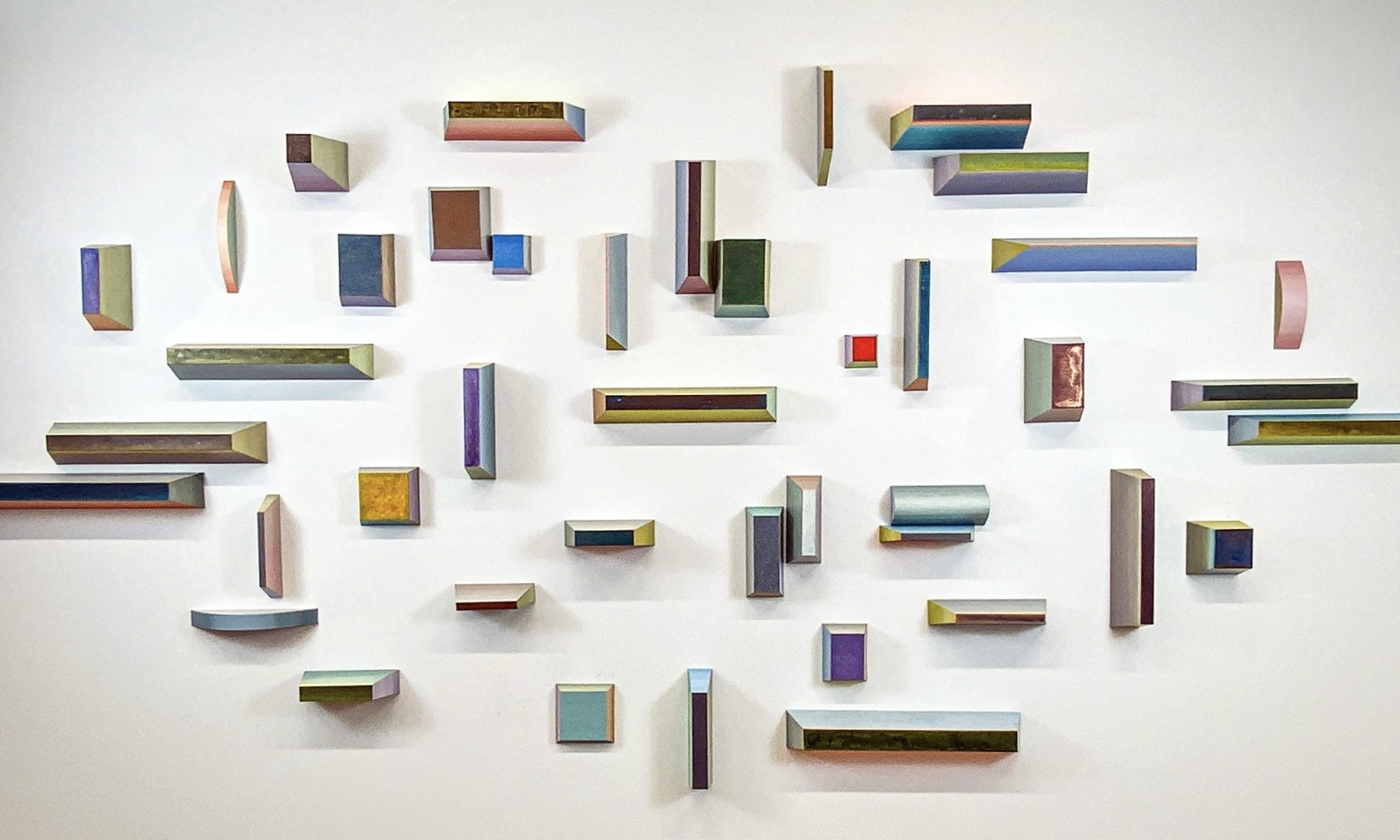
Upon entering our Hays Gallery, you first see on the back wall Meg Hitchcock’s Fang, which consists of 42 precisely placed, three-dimensional constructions made of matboard and bright acrylic paint. Arranged with no obvious focal point, each form projects outward into the gallery. Referencing Yamantaka, the fierce-looking but enlightened Tibetan Buddhist deity, Hitchcock describes these works as exploring “religious shrines as a site for focused self-awareness.” Like Yamantaka, whose ferocity is used to ward off self-delusion, Hitchcock’s Fang invites viewers to detach and free themselves from doctrines, dogmas, and personal dramas.
The level of care and attention Hitchcock brings to her work reflects a rare degree of devotion. Her practice is deeply informed by religious imagery and symbolism, yet she quietly shifts these references away from their original meaning. Her focus is on emptying out the religious content and examining what remains. Her aim is to create work that is emotionally responsive without the distraction of religious subject matter. By borrowing the forms, colors, and light of religious shrines, she creates a space that is stripped of religiosity and instead becomes a place for personal reflection and self-awareness.
Let’s look at Soli Pierce’s site-specific installation, Poetry of Place, exhibited in the Hammond Museum’s Tea Hut.
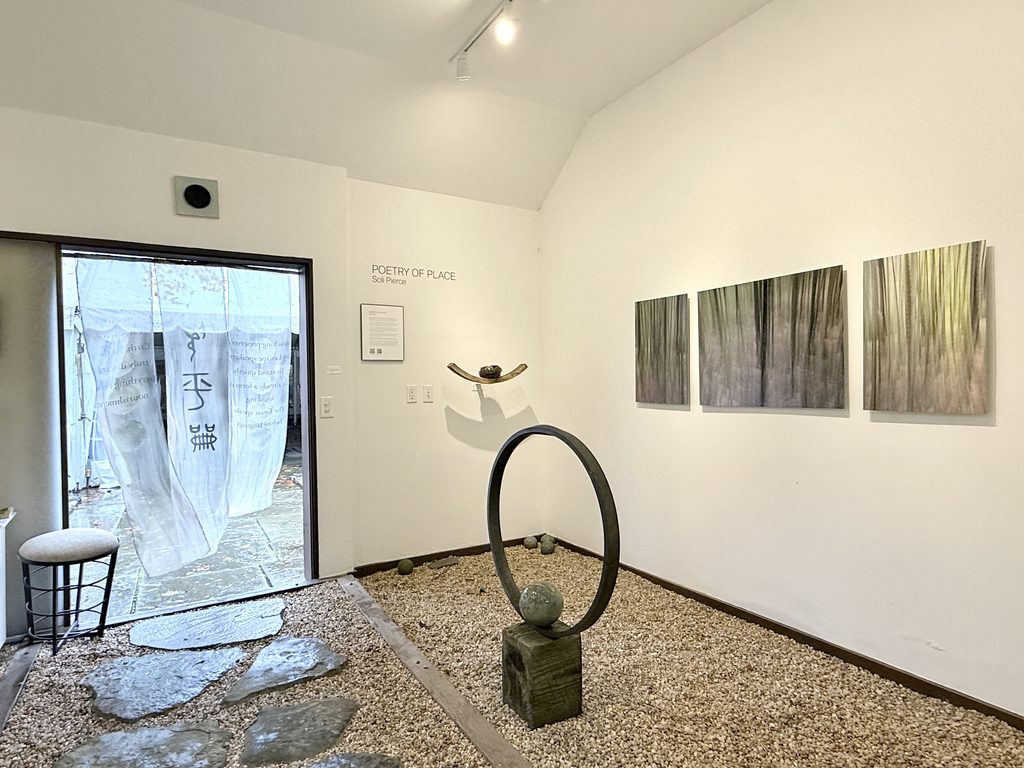
Soli Pierce’s installation, Poetry of Place, in the Tea Hut is an expression of her deeply rooted connection to the Hammond Museum and Japanese Stroll Garden. Pierce brings together organic forms, natural materials, light, and images to create a contemplative environment that invites visitors to pause and reflect. To enter the installation, you pass through sheer, wispy silk curtains printed with poetic imagery in English and ancient Chinese. Alongside the path, one encounters Moon Rising, a large metal ring cradling a ceramic sphere balanced on a piece of salvaged wood. Behind it hangs Bamboo Dreams, a triptych of long-exposure photographs of the garden’s bamboo grove. Here, Pierce brings together solid, grounded forms with fleeting, shifting images. Many of her materials are salvaged and carry with them their own histories and origins, while some of the ceramic orbs were made at the Hammond’s Adams School of Art. Her palette of soft browns and greens further connects the work to the natural environment.
Throughout the installation, Pierce creates moments of balance and transition—between movement and stillness, the solid and the ephemeral, the natural and the constructed. These ideas are central to her practice. Pierce often speaks about her connection to the circle as a continuous, dynamic cycle of energy. Orbs and circles appear throughout her work, often seeking a point of balance, or what she calls a “still point” or “anchoring presence.”
The text for Tomoko Amaki Abe’s Heaven Come Down indicates that the work “suggests both the possibility that the sacred resides within the material world and the growing sense that the boundary between heaven and earth is collapsing as the changing environment reshapes the conditions of life. Throughout the exhibition, materials bear the traces of this instability while also imagining new forms of coexistence.” Can you give us an example of a work that conveys that idea?
Tomoko Amaki Abe works fluidly across a range of media, including video, clay, paper, wood, glass, cyanotypes, porcelain, sculpture, and installation. Across these varied disciplines, her investigations remain consistent. She is interested in the point at which materials transform—both as a physical process and as a metaphor for memory.
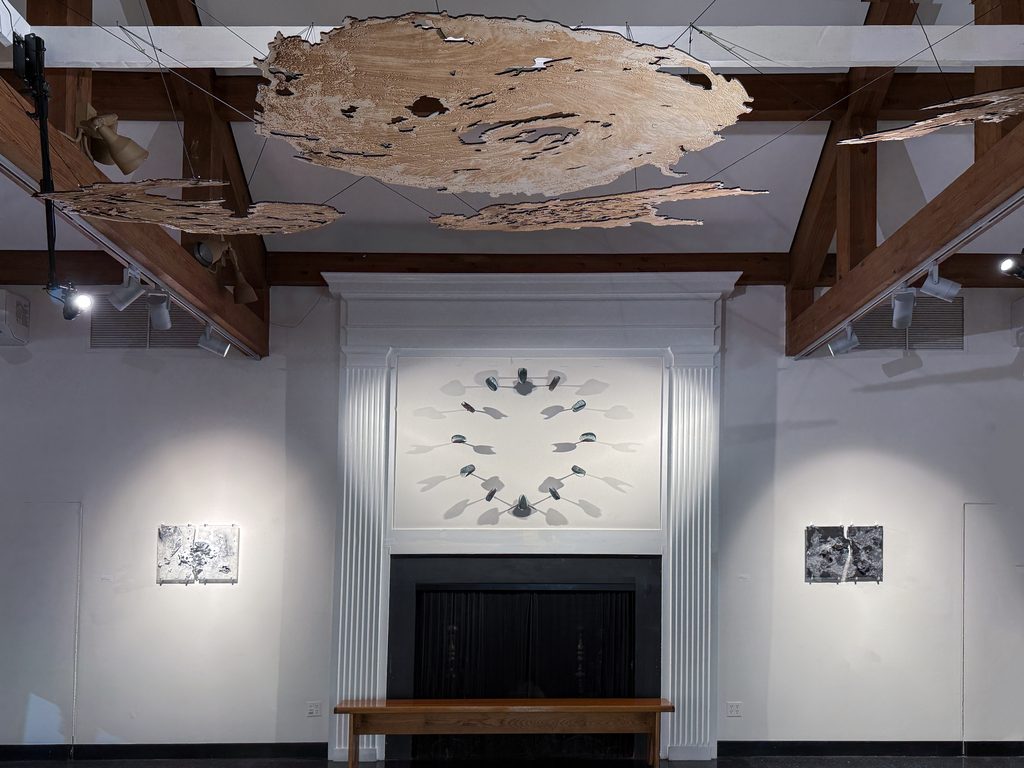
Her artwork that lends its name to the exhibition, Heaven Come Down, hovers above the gallery. For this piece, Abe sourced NASA images of cloud formations and laser-cut the forms into six wood panels, each representing an animal whose natural habitat has been encroached upon by humans: bear, wolf, coyote, raccoon, fox, and deer. Suspended above our heads, the work asks us to consider the precariousness of our environment while also inviting us to marvel at its beauty. By bringing sky and land together on a single surface, Abe reflects on the urgency of our current environmental moment while holding open the possibility of coexistence.
Throughout the exhibition, Abe fuses and combines dissimilar materials and techniques, emphasizing their inherent instability while suggesting the possibility that seemingly incompatible elements can exist side by side. Transparent White and Transparent Black extend this idea. In these works, she fused multiple layers of glass with silkscreened glass powder and subjected them to repeated firings. The results are unpredictable and bear the visible traces of both the materials and the process that transformed them.
Outside the gallery space, you feature Matthew Weber’s Ground Shift and Kurt Steger’s work In the Garden. Can you describe what their works look like and how they sit within the garden?
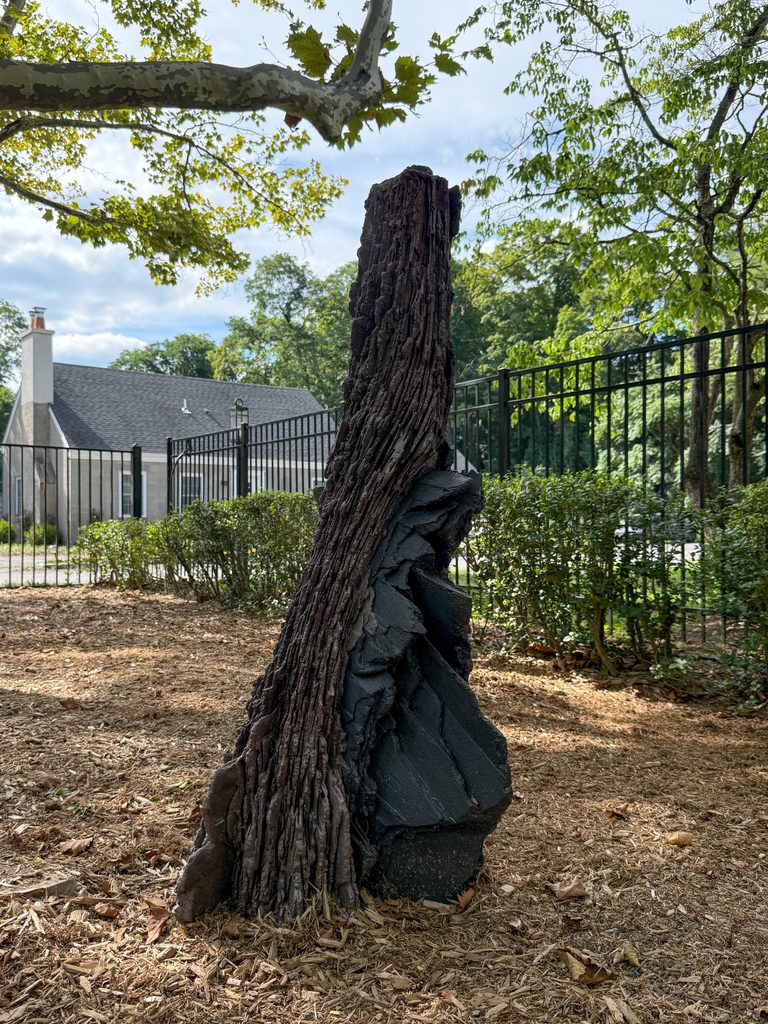
On our patio, Matthew Weber presents Ground Shift, six stained-cement sculptures that sit naturally among the grasses and London plane trees that occupy the space. Process-driven, Weber’s work explores the instability and continual flux of the natural world. The sculptures resemble tree trunks with rough and irregular “bark” that seem to emerge from the ground, appearing to rise and crumble at the same time. Their surfaces suggest opposing forces of nature colliding: jagged, abrasive areas meet smooth, eroded ones, which bring to mind the shifting and weathering of geological formations and Earth’s tectonic plates.
Weber recently commented that he felt the Hammond Museum’s Patio completes his works in a way he has not previously experienced. Here the sculptures engage directly with the grasses, trees, soil, and changing conditions of the garden to become part of a larger landscape shaped by both growth and erosion. The bed of dried autumn leaves that now surrounds Weber’s sculptures heightens their sense of belonging in the current environment.
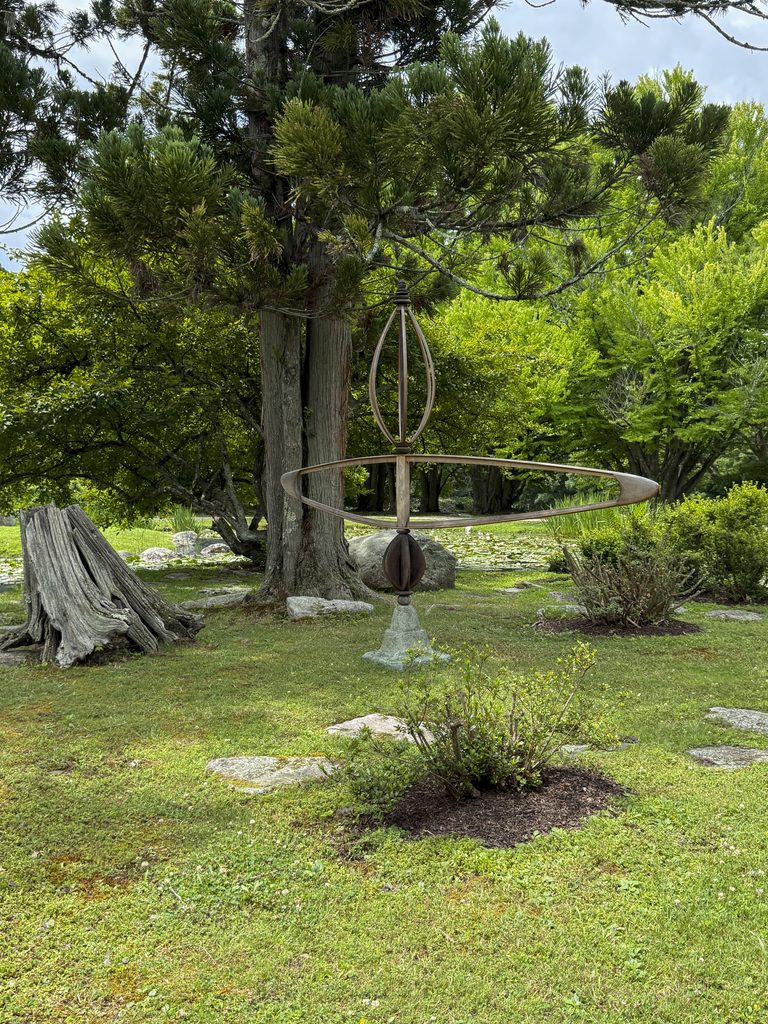
As you leave the Tea Hut and make your way into the Japanese Stroll Garden, you will see several sculptures by Kurt Steger nestled among the trees and plants. Sensitively installed to complement the beauty of the garden, they quietly converse with their surroundings. Situated next to the Stroll Garden’s pond, the silhouette of Lotus, with its vertical ellipse positioned atop an elongated one, calls to mind the blossom and broad leaves of real lotus and resonates with the pond’s water lilies. Similarly, the different kinds of wood used to create Lotus are at home amongst the surrounding Hinoki Cypress and crabapple trees.
Steger is an exquisite woodworker who incorporates natural materials such as stone, rock, and twine. Designed to weather and age, these materials gradually develop a soft patina, allowing the sculptures to change in tandem with their surroundings. The care and attention he brings to each work reflects a deep awareness of our relationship to the natural world. Steger’s sculptures do not simply sit in the garden—they live there.
Hammond Museum in North Salem was founded in 1957 by Natalie Hammond, where world cultures could be appreciated, and visitors could enjoy nature. The Hammond includes an art museum with changing exhibitions and programs. The Adams School of Art offers varied art classes. A highlight is the Japanese Stroll Garden.
@hammondmuseum.art
Heaven Come Down: Tomoko Amaki Abe
Main gallery
August 8-November 15, 2026
Fang: Meg Hitchcock
Hays and Goelet Galleries
September 12-November 15, 2026
Poetry of Place: Soli Pierce
Tea Hut
Sept 12-November 15, 2026
Matthew Weber: Ground Shift
Patio
August 8-November 15, 2026
Kurt Steger: In the Garden
Japanese Stroll Garden
June 27-November 15, 2026
Make your tax-deductible donation today and help Art Spiel continue to thrive. DONATE
About the writer: Etty Yaniv is a Brooklyn-based artist, writer, curator, and founder of Art Spiel. She works in installation, painting, and mixed media, and has shown her art in exhibitions across the United States and abroad. Since 2018, she has published interviews and reviews through Art Spiel, often focusing on underrecognized voices and smaller venues. More about her art can be found at ettyyanivstudio.com and on Instagram @etty.yaniv