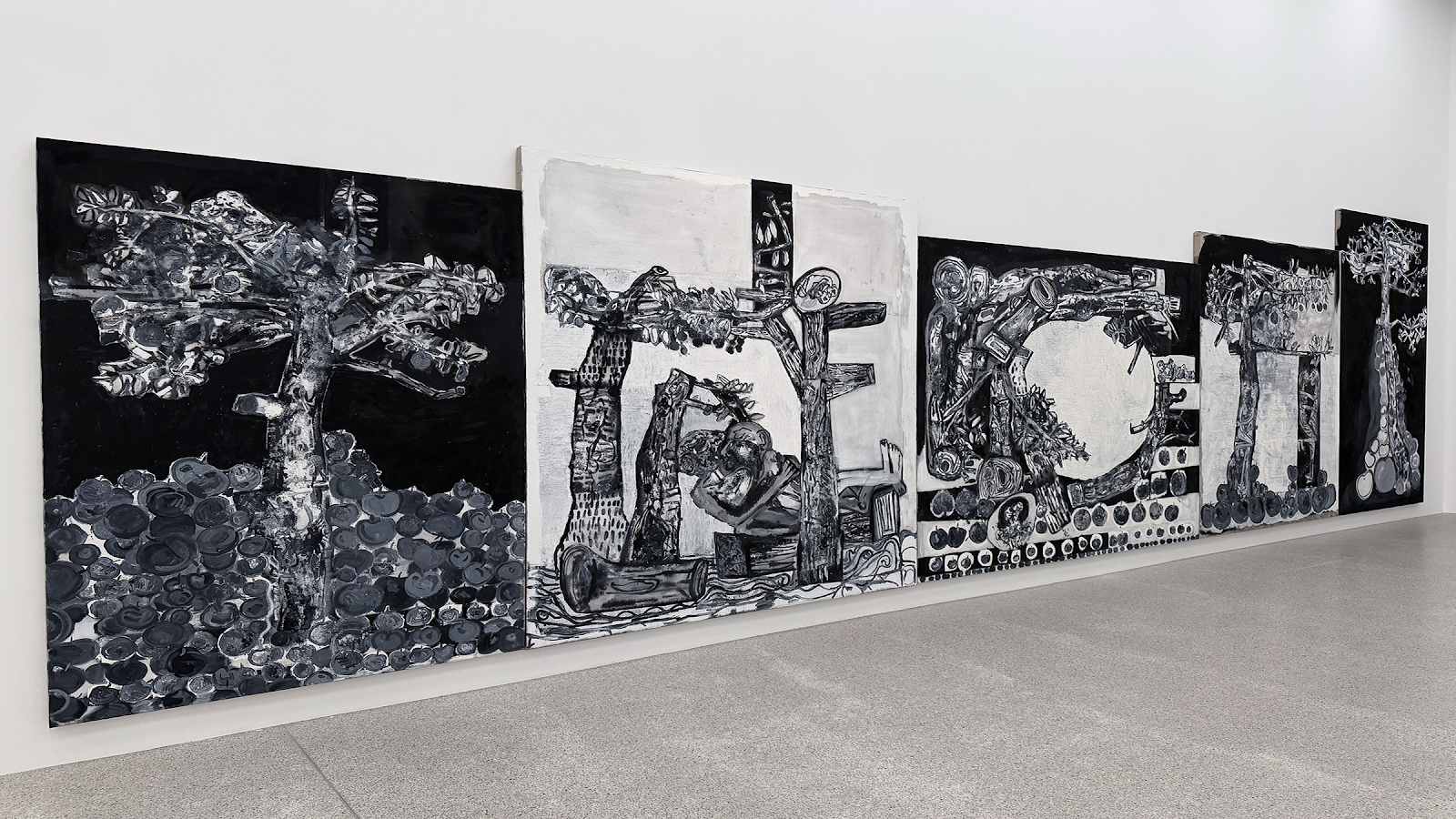
Tobias Pils’s paintings do not give themselves up quickly. It took me two long visits to begin to grasp his extensive solo exhibition at Mumok, curated by Manuela Ammer across two floors and ten years of work. The show traces a practice rooted in personal experience and daily life, charting a shift from floor to easel painting and revealing how drawing and painting remain in constant dialogue throughout. The layout rewards sustained attention and makes the changes over time visible. I viewed the exhibition in reverse, starting with the floor of Pils’s most recent works.
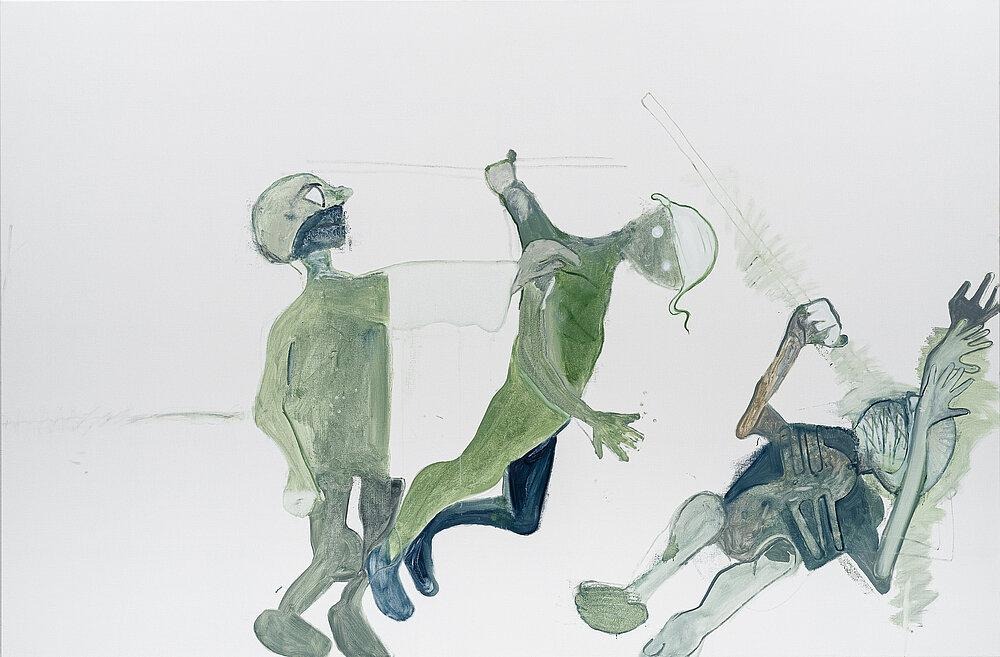
The first painting at the entrance, Blindensturz, echoes the iconic 1568 painting The Blind Leading the Blind by Pieter Bruegel the Elder, in which five blind beggars follow their leader. Here, the landscape is gone. In its place, three greenish, helmeted figures fall in sequence across a vast void. One lies on the ground, its ribcage exposed, almost diagrammatic, a recurring image in Pils’s work. The scene is impossible to view right now without thinking of war. Yet the painting does not dwell on aggression. Its force lies in the spaces between the figures, where they touch or nearly touch. These tense intervals make me physically feel holding, being held, and falling. I picture these characters as anonymous protagonists in a play by Samuel Beckett or Eugène Ionesco. Their grotesqueness is unmistakably human.
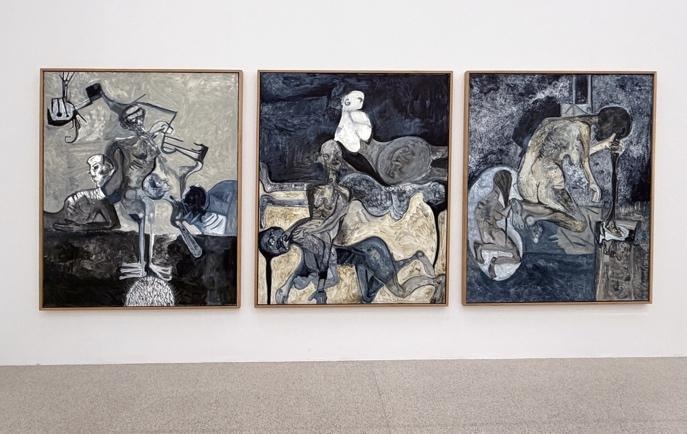
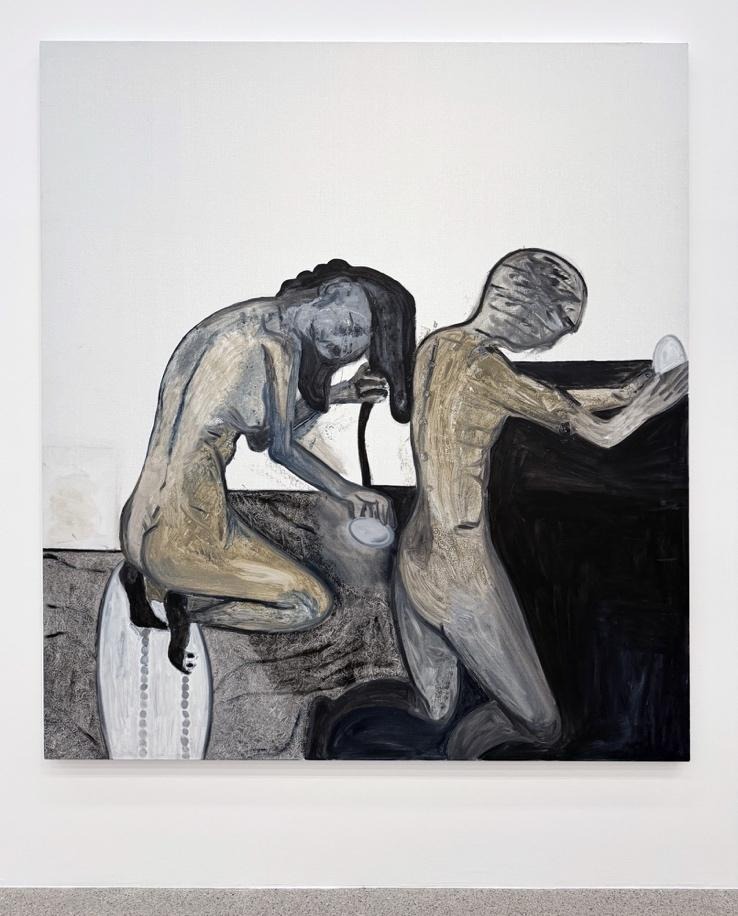
Nearby, Happy Days (2023) — a title taken directly from the Samuel Beckett play — confirmed what I had already sensed standing in front of Blindensturz: Pils thinks within this tradition too. It is a large triptych whose panels also stand alone. Bodies intertwine, touch, and turn away. In the third painting, a kneeling woman washing her long hair appears twice, slightly altered, evoking intimate domesticity and self-nurturing. This recurring image introduces a redeeming note. Are these images of psychological states? Where do the external and internal begin and end? Pils’s paintings hold intimacy and distance at once. Their ambiguity draws me in, and their evolving iconography moves me back and forth between images.
Further down this floor, the mood darkens and so does the personal history behind it. Before making Happy Days, Pils had a serious bicycle accident in which he broke his right shoulder and was unable to paint. This led to Shh, a group of four paintings depicting vulnerable figures with exposed bones and prosthetic limbs intertwined within a vast empty space. They emerge from the lower edge, pulled down by gravity. In one, the figures form a precarious diagonal that reaches upward, but in vain; they seem destined to fall like the blind beggars. The group conveys helplessness, alienation, and frustration. Shh is also the exhibition title, a sound that calls for pause and silence. For me, these paintings center on a moment of suspension, where inner and outer life converge through the artist’s hand.
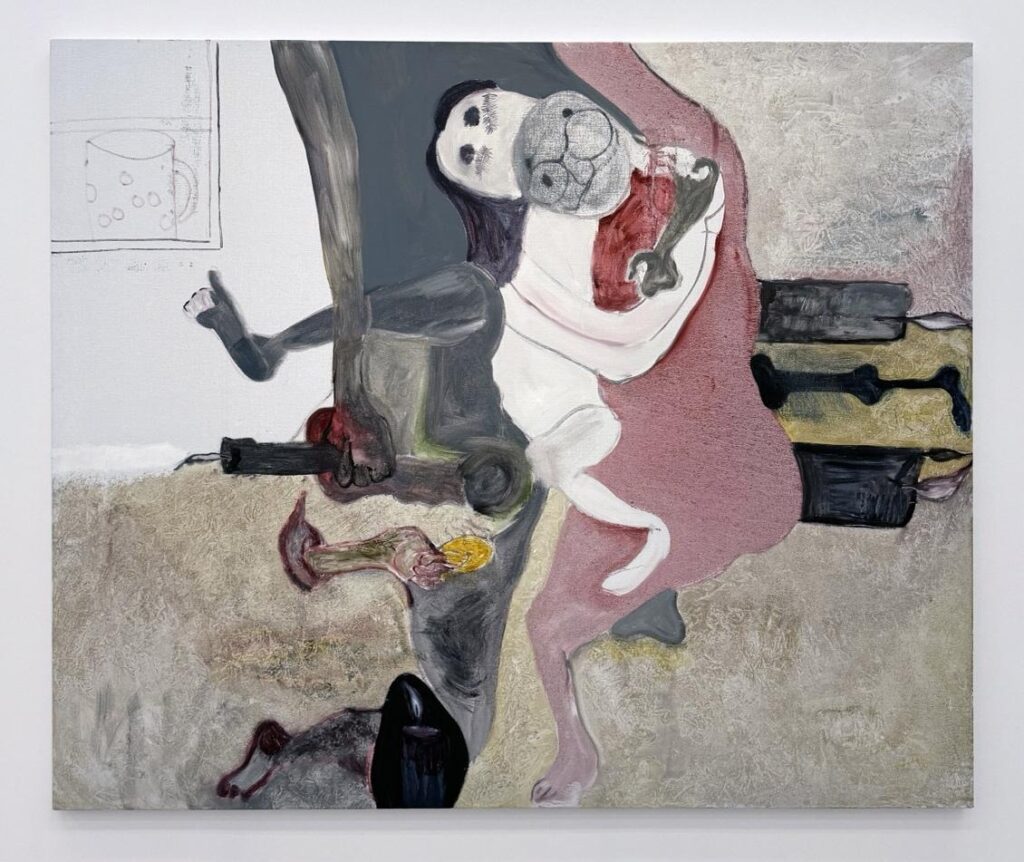
After so many paintings with limited monochromatic palette, discovering a wider range comes as a surprise. Color came to Pils later, he says, by chance. From the greenish Geist group, I am drawn to the more corporeal, pinkish Licht (Geist) from 2025. A goofy, ghostly couple, slightly off center, anchors the image vertically, while candles — some lit and some burned down — run parallel to the horizon. A line drawing of a framed mug (Ikea?) gives the painting a sense of place. Not a void but a room, perhaps a home, an interior where the self meets its other. The composition holds chaos and safety, life and death, danger and shelter at once.
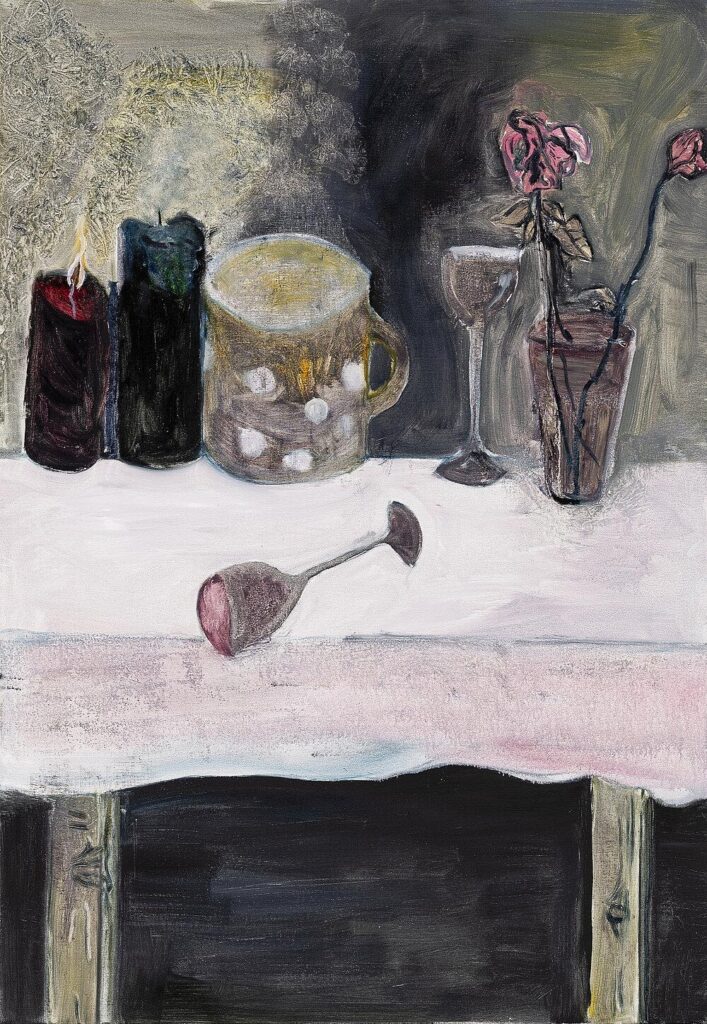
In Hmm (2025), another work from this expanded palette group, the polka-dotted mug and candles reappear on a stage-like table, alongside two pink roses in a vase and two wine glasses, one upright and one fallen toward the edge. Diluted directional marks intersect with thicker, textured paint. Nothing here is “still”. The objects face us, poised between the risk of falling and its aftermath, animated from within.
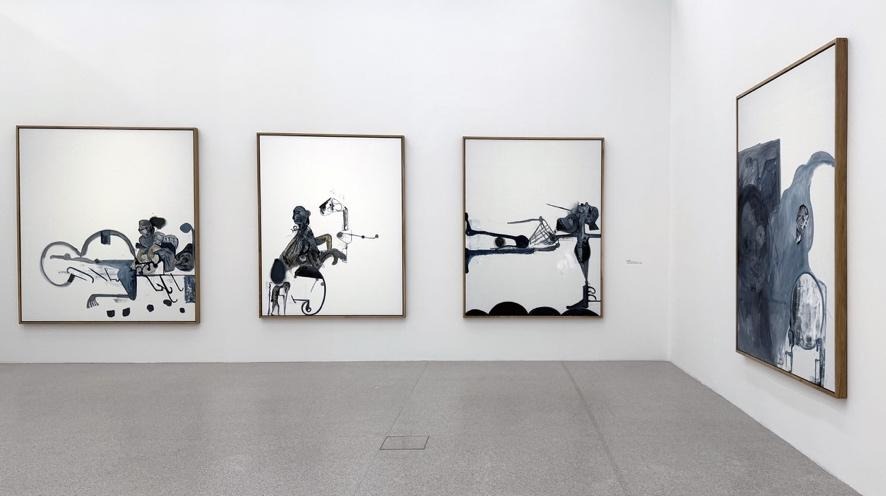
I continued to the second exhibition floor dedicated to Pils’s earlier work. Here, I learned that all these earlier paintings were made on the floor. Only later, between 2020 and 2022, did Pils shift from working on the floor to the easel. Working on the ground produces a distinct process: the painter moves around the surface, often on all fours, marking from all sides as one gesture leads to the next. The body directs the work, and the image is never fully visible from a single vantage point.
This earlier body of work begins with a milestone group of paintings made in Marfa, Texas (2016), where Pils responded to the vast, flat desert and adobe architecture using diluted acrylics. Across these ten paintings, faces, eyes, and body parts begin to surface for the first time. Pils calls this a “personification of a place.” Space is flattened and compressed. The images read like pictograms we are challenged to decipher. At times they remind me of Paul Klee’s zigzags, eyes, and triangles, where each mark feels like a step in the image’s construction.
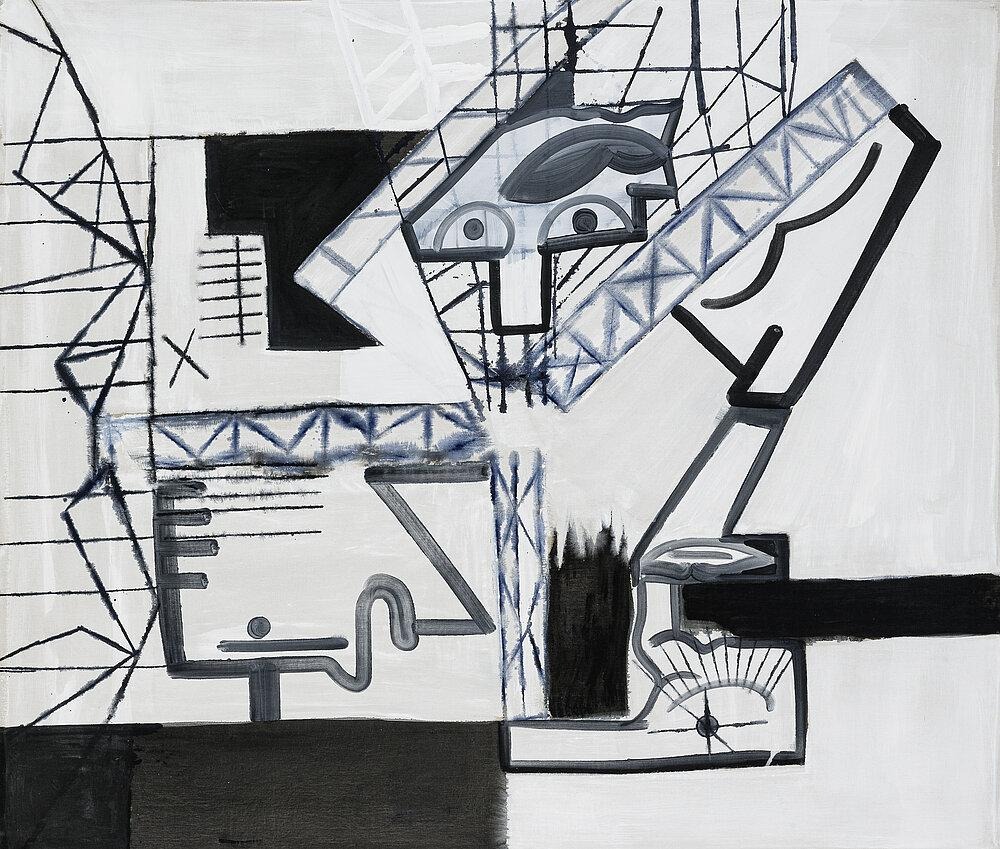
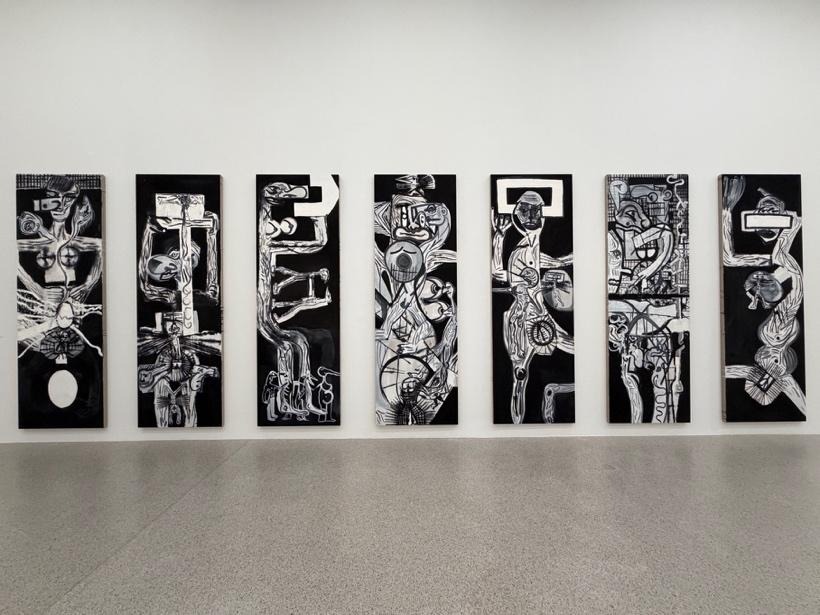
Further down, this vocabulary of recurring, mutating signs extends into Seven Days, painted two years later. Across seven canvases, Pils stages the genesis of his painting world: an egg, a bird-man, a mechanical angel take form and recur in later works. The group centers on a figure that mutates through contact with one of Franz West’s Adaptives — portable plaster and papier-mâché sculptures by the influential Viennese artist (1947–2012) — a fitting dialogue for an Austrian painter based in Vienna. These props disappear; the figure continues to transform. West’s Adaptives offer an entry into the image but do not stay; they dissolve as the image asserts its own logic.
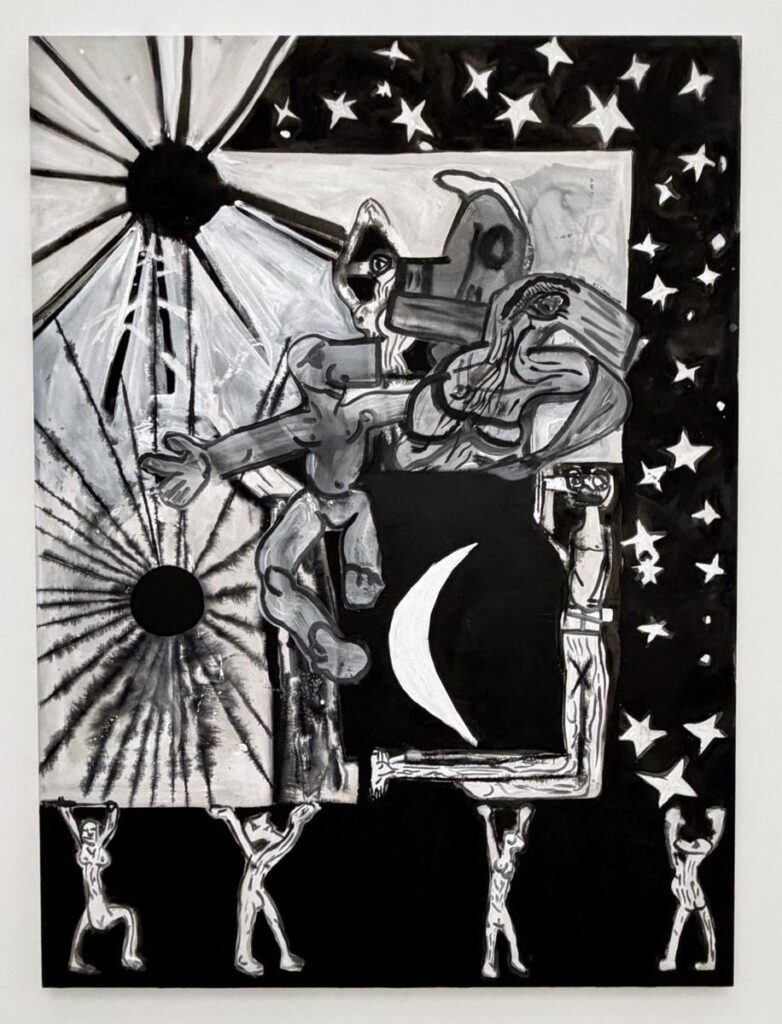
The figures from Seven Days reappear in Night on Earth, another remarkable group from 2018. If the earlier work hinted at large, cosmic questions, Night on Earth makes them explicit. The space recalls illuminated manuscripts: dense, patterned, extending in all directions. Titanic figures, stars, moons, and suns float in an enigmatic, half-lit universe. Having visited the Prater the day before, I couldn’t help but sense its carnivalesque spirit here — grotesque characters, wild rides, a world unto itself. It struck me as distinctly Viennese, a thread that runs from Pils’s dialogue with West to this half-lit cosmos.
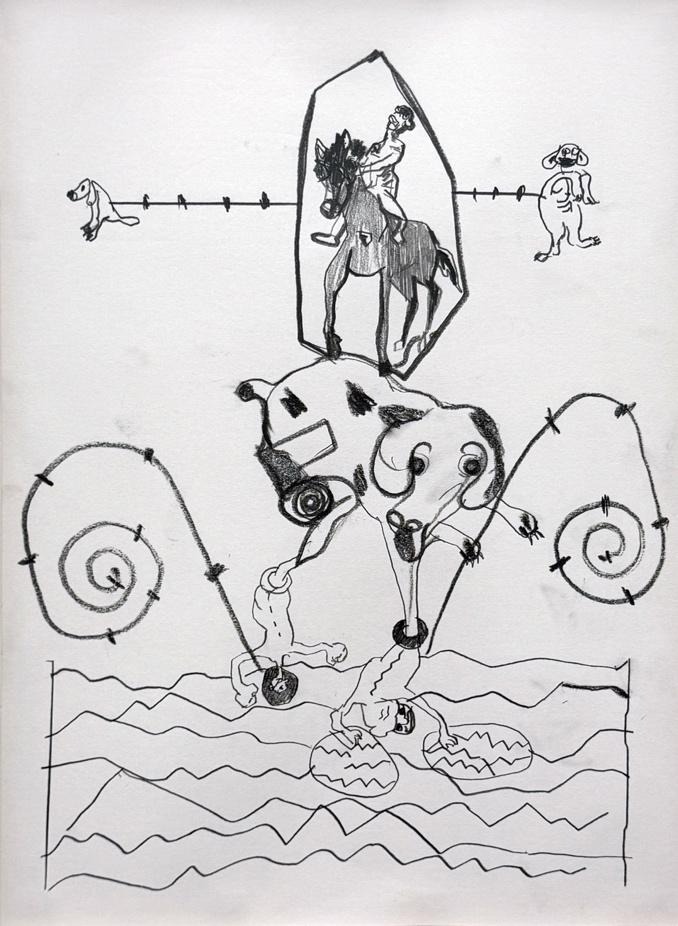
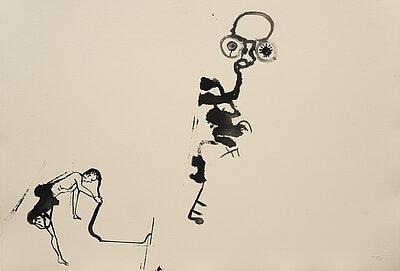
Underlying all of this is drawing, the pulsating heart of Pils’s art, and its relation to painting is clearly articulated throughout, sometimes as blueprints for new paintings (Alphabet, 2020–2022), sometimes as meditations on finished ones. Until 2005, Pils worked exclusively in drawing, beginning with small ink works, before moving to large-scale pencil pieces. In his mid-thirties, he turned to painting, and by his own account, it took several years to find his voice in the medium.
After spending time with the earlier paintings, I returned to the first floor to look at Pils’s recent work again. With the earlier work now in mind, the shift became clear: the later paintings open into wider voids, helmeted figures recur, and the mood darkens. Frank Wasser, writing in Flash Art, argues that Pils’s work operates through ambiguity. It carries a political charge but does not settle into a clear stance, leaving the viewer between witnessing and looking away. For Wasser, Shh keeps open the question of whether it calls for silence or exposes it, making that uncertainty the work’s central condition and risk.
I agree with this emphasis on ambiguity and with placing Pils within an existential tradition. Where I diverge is on the expectation of an explicit political position. The work draws from personal experience and stays with vulnerability. At a moment when images of violence are constant and easily consumed, a work that slows you down and keeps the question open may be more demanding than one that declares a position. The paintings hold the question, and in that holding, I am brought back to the present moment. That is where the work meets me.
Tobias Pils: Shh at Mumok, Museumsplatz 1, 1070 Vienna, Austria. On view through May 17th, 2026, Tue – Sun, 10 AM – 6 PM.
About the writer: Etty Yaniv is a Brooklyn-based artist, writer, curator, and founder of Art Spiel. She works in installation, painting, and mixed media, and has shown her art in exhibitions across the United States and abroad. Since 2018 she has published interviews and reviews through Art Spiel, often focusing on underrecognized voices and smaller venues. More about her art can be found at ettyyanivstudio.com and on Instagram @etty.yaniv