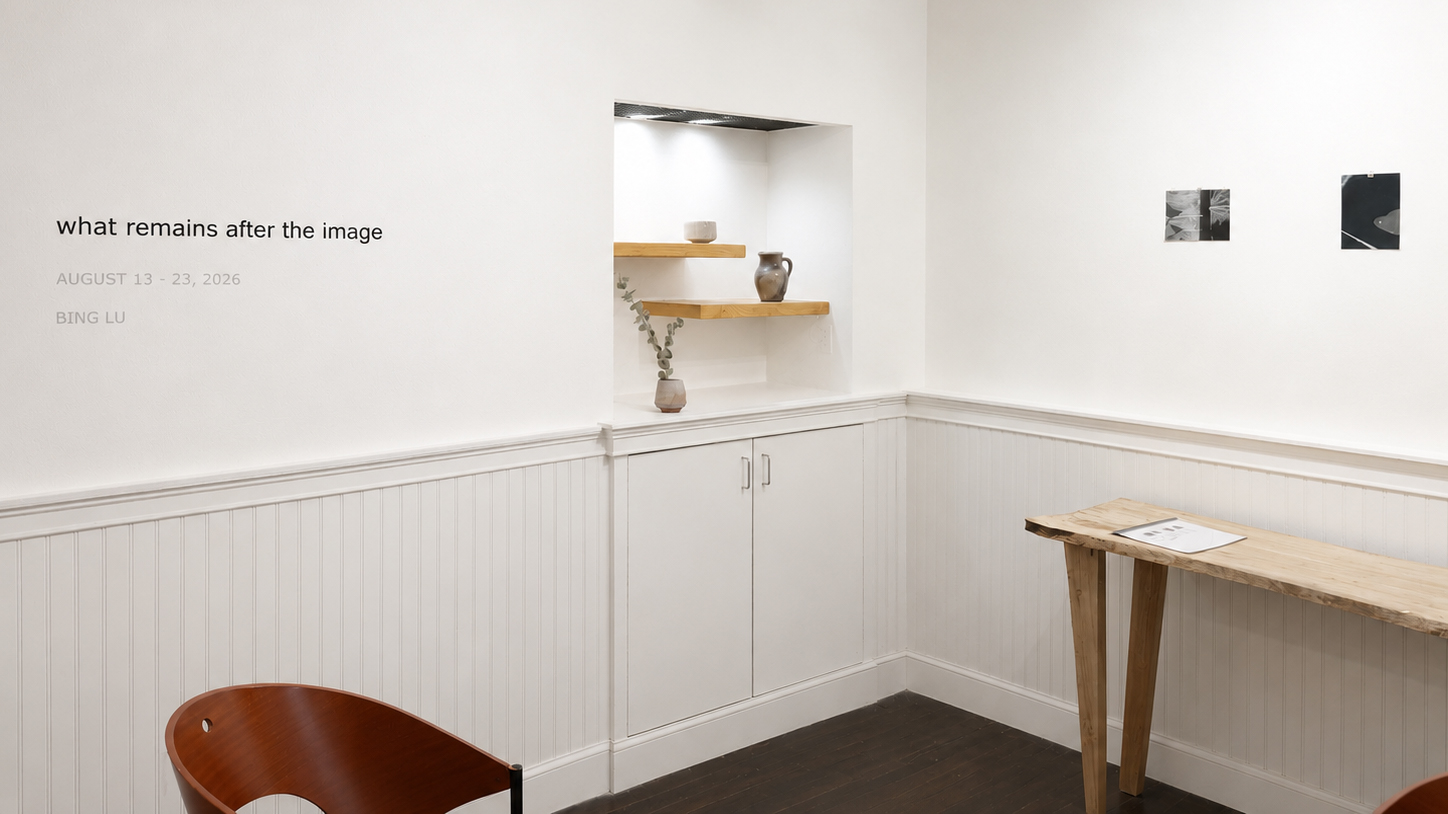
Bing Lu’s solo exhibition, “what remains after the image,” at Gallery 60 NYC is an endeavor of multifaceted inquiries concerning the nature of photography and image production, abstraction, and the artist’s own personal life. Featuring 13 photographic works that utilize digital collaging and color manipulation techniques, the exhibition is an exercise in experimental spirit for Lu to continually push the boundaries and investigate the abstract and experimental language of photography.
Continue reading “Bing Lu: The Queries that Remain After the Image”Andreas Schulze’s exploration of color in the cool pastures of cake
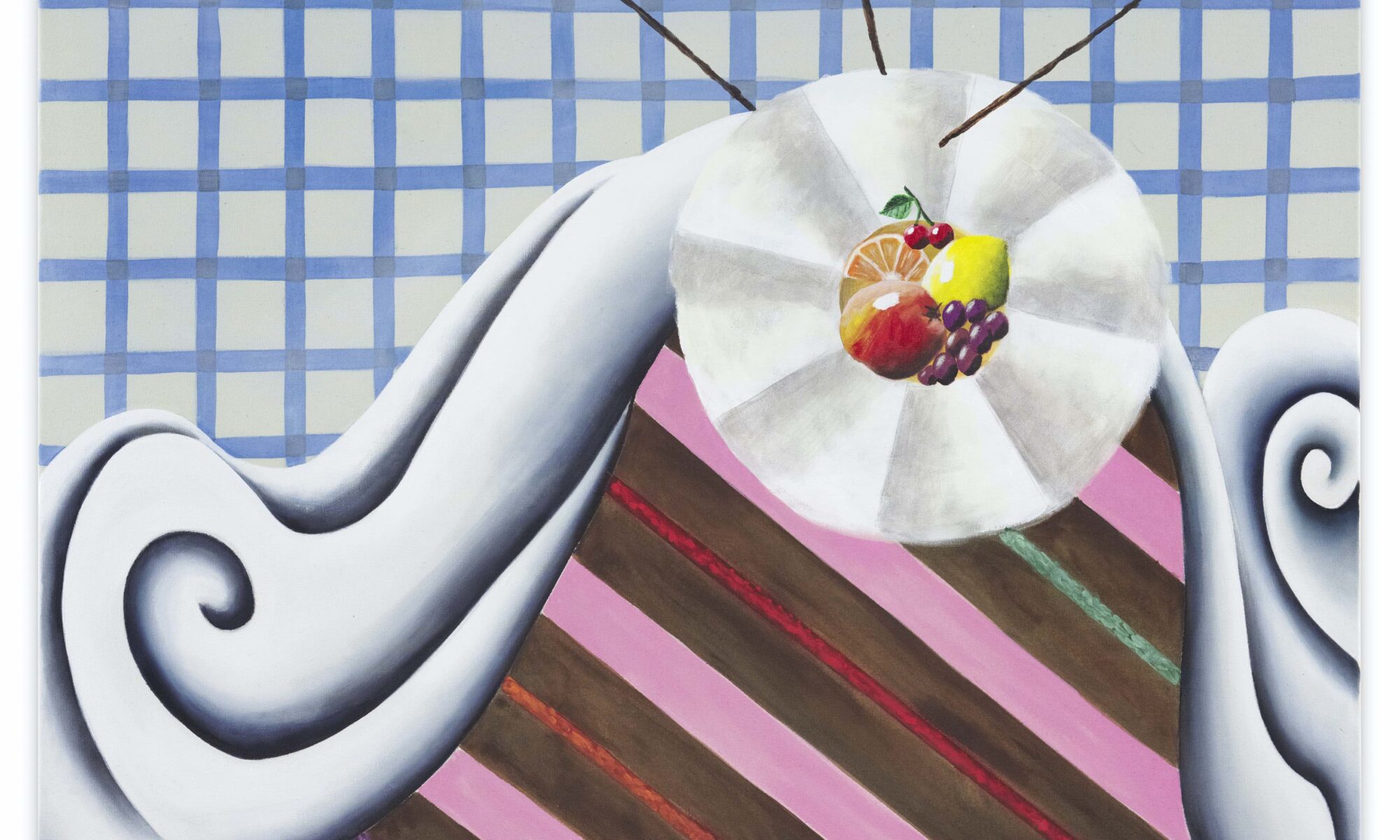
In his show Cake (2026) at Sprüth Magers, New York, Andreas Schulze explores the visual effects of saturated color and geometric form, using cake as the setting for his investigation.
In his paintings, Schulze creates an inner three-dimensional universe, which serves as a bell jar. In his imaginary pastures, Schulze creates surreal interiorscapes, built of geometric shapes and flat backdrops of color-gradient skies, juxtaposed with rounded spheres and spirals painted in three-dimensional perspective, with depth and shadow. The pictorial space he builds gives a stage for him to explore various phenomena, in this case, cake, and he does so with a playful seriousness, experimenting with the basic forms and images that make up cakes: candles, frosting, fruit, sprinkles, and layers.
Continue reading “Andreas Schulze’s exploration of color in the cool pastures of cake”Maria Gil Lucientes: Letting the Materials Misbehave
Maria Gil Lucientes paints in the slim margin where a system starts to come undone. She begins with a constraint, a single color, a periodic screen, a piece of medical gauze, then lets the materials misbehave. In Pareidolia, gauze shifted by air becomes the suggestion of a face. A Spanish-born painter who studied mathematics, physics, and computer science before a decade in tech, Lucientes brings a system-builder’s discipline to a practice that hinges on chance. Here, she reflects on the path from science to painting, the dialogue between control and surprise in her process, and the new Moiré series taking shape in her studio.
Continue reading “Maria Gil Lucientes: Letting the Materials Misbehave”Kosuke Kawahara’s Without Innocence, Dissecting and Reassembling at RAINRAIN Gallery
Stepping into the exhibition Without Innocence at RAINRAIN gallery, you are greeted with a plethora of various mediums, ideas, influences, and experimentations. The paintings carry with them several levels of looking, small details to explore, and multiple dimensions within the edges. The photographs set the scene, allowing you to enter another space just as the paintings do, left to explore the worlds that Kawahara creates and builds within it all. The press release introduces a quote from Donna Haraway’s A Cyborg Manifesto, “…we are living through a movement from an organic, industrial society to a polymorphous, information system—from all work to all play, a deadly game (p 28).” This statement lingers alongside my thoughts throughout the exhibition, as I begin to notice more details, connections, and mechanisms that make this exhibition immensely similar to a cyborg in the making. Kawahara takes pieces of the body and fractions of different spaces within the canvas to build something entirely new out of all of these information systems.
Continue reading “Kosuke Kawahara’s Without Innocence, Dissecting and Reassembling at RAINRAIN Gallery”Unreliable Narrators: Rochelle Voyles
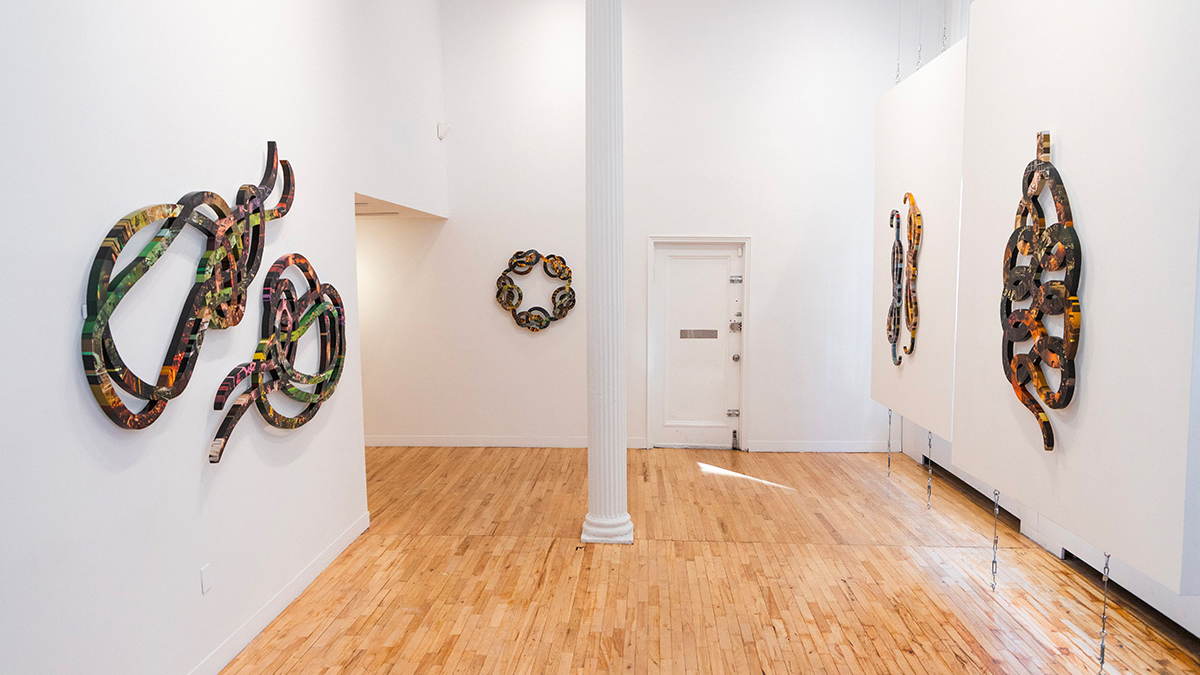
In Unreliable Narrators, Rochelle Voyles’s collages hold both a capacious nihilism and a hope to build stories from the void. From this fulcrum, I think of Joan Didion’s classic essay The White Album, and its opening truism: “We tell ourselves stories in order to live.” Voyles’s compositions of found photographs extend to viewers, a branch, a bone, a tool in making sense of the randomness that seems to rule our lives. Cutouts layered into loops capture chaos, but the care in each cut, the curation, and the collision of hyperspecific images betray a belief in an idiosyncratic order. These works are at once figurative mazes of manifold meaning, and objects calculated to short-circuit our thinking and experience pure sensation.
Continue reading “Unreliable Narrators: Rochelle Voyles”Gary Petersen: The Shape of Walking at McKenzie Fine Art

For artists working within the realm of geometric abstraction, understanding the weight of art history is vital. The hard-edge lines, a keen understanding of color theory, and structured patterns—all form part of a visual language that has evolved over a century. Artists today, when approaching geometric abstraction, face a unique tension. On the one hand, they inherit the legacy of giants such as Piet Mondrian, Wassily Kandinsky, Josef Albers, and Kazimir Malevich, whose works laid the foundation for what we understand as “geometric art.” On the other hand, the question looms large: How does one continue to make geometric abstraction in 2024?
Continue reading “Gary Petersen: The Shape of Walking at McKenzie Fine Art”Let the silence take over: On words, inner compass, and patience
Looking at Art

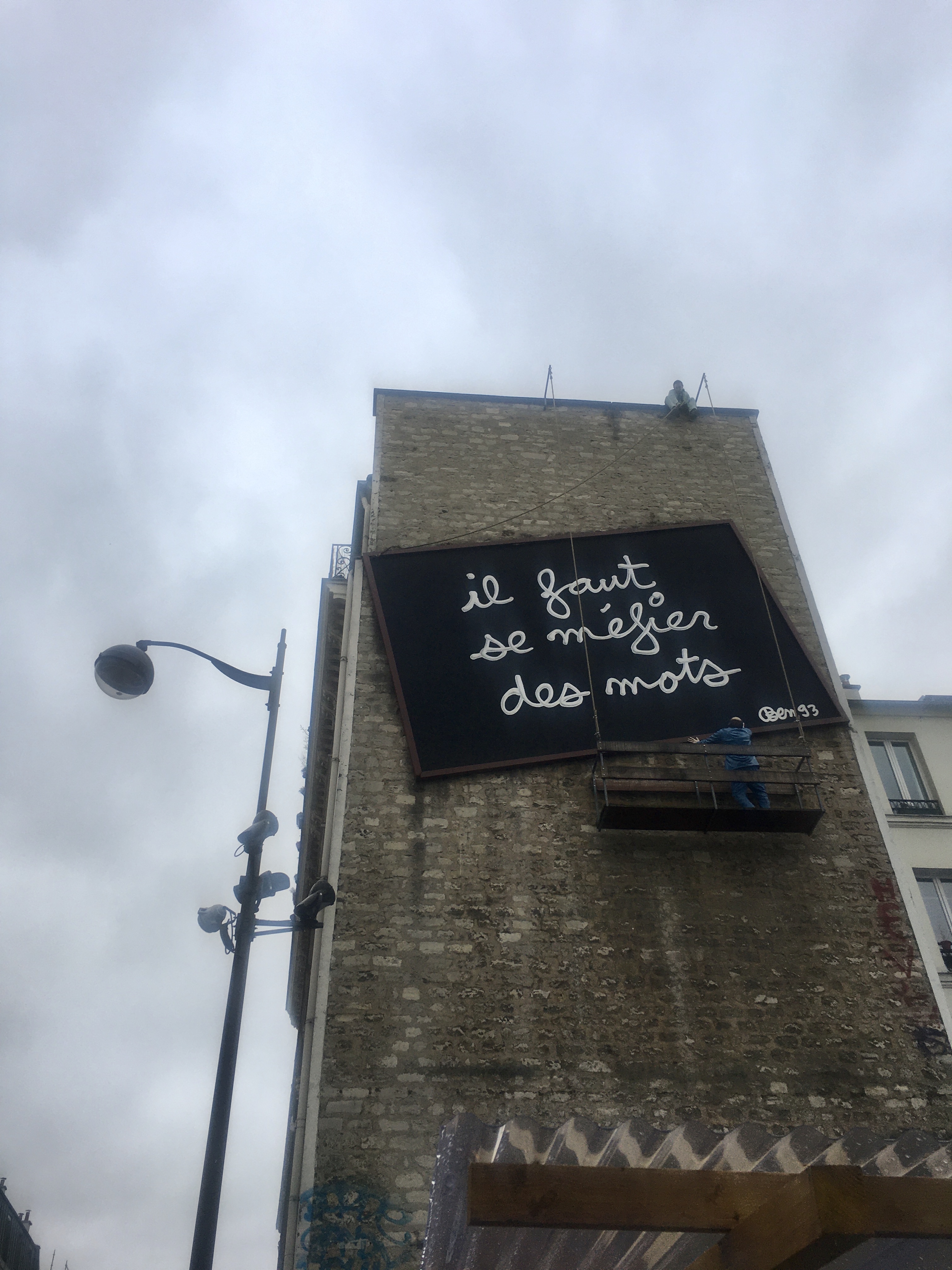
Il faut se méfier des mots (Beware of words), Ben, 1993. Belleville, Paris, France. Photo: Astrid Dick
To make a painting is not easy. To look at a painting is not an easy matter either, as it requires the viewer’s disposition and willingness to engage with it beyond words and labeling. Our brains like to pin things down, using minimum resources to move on to the next task as quickly as possible. They latch on to words. Yet the moment words enter our minds, we’re not really looking anymore.
Continue reading “Let the silence take over: On words, inner compass, and patience”Artists on Coping: Miles Hall
During the Coronavirus pandemic, Art Spiel is reaching out to artists to learn how they are coping.

Deconstructing the Apocalypse in her own Image, 72 x 84, Oil on panel, 2018. (in studio)
Miles Hall is a painter and draftsman. He has lived in California, Massachusetts, Japan, and New York, but now resides in Richmond, VA. His work explores the mythological relationship between the landscape and human figure. The science and psychology of visual perception is important to his practice. He currently teaches in the Communication Arts Department at Virginia Commonwealth University and maintains a critical visual arts review for the Richmond area called Lucid.
Continue reading “Artists on Coping: Miles Hall”