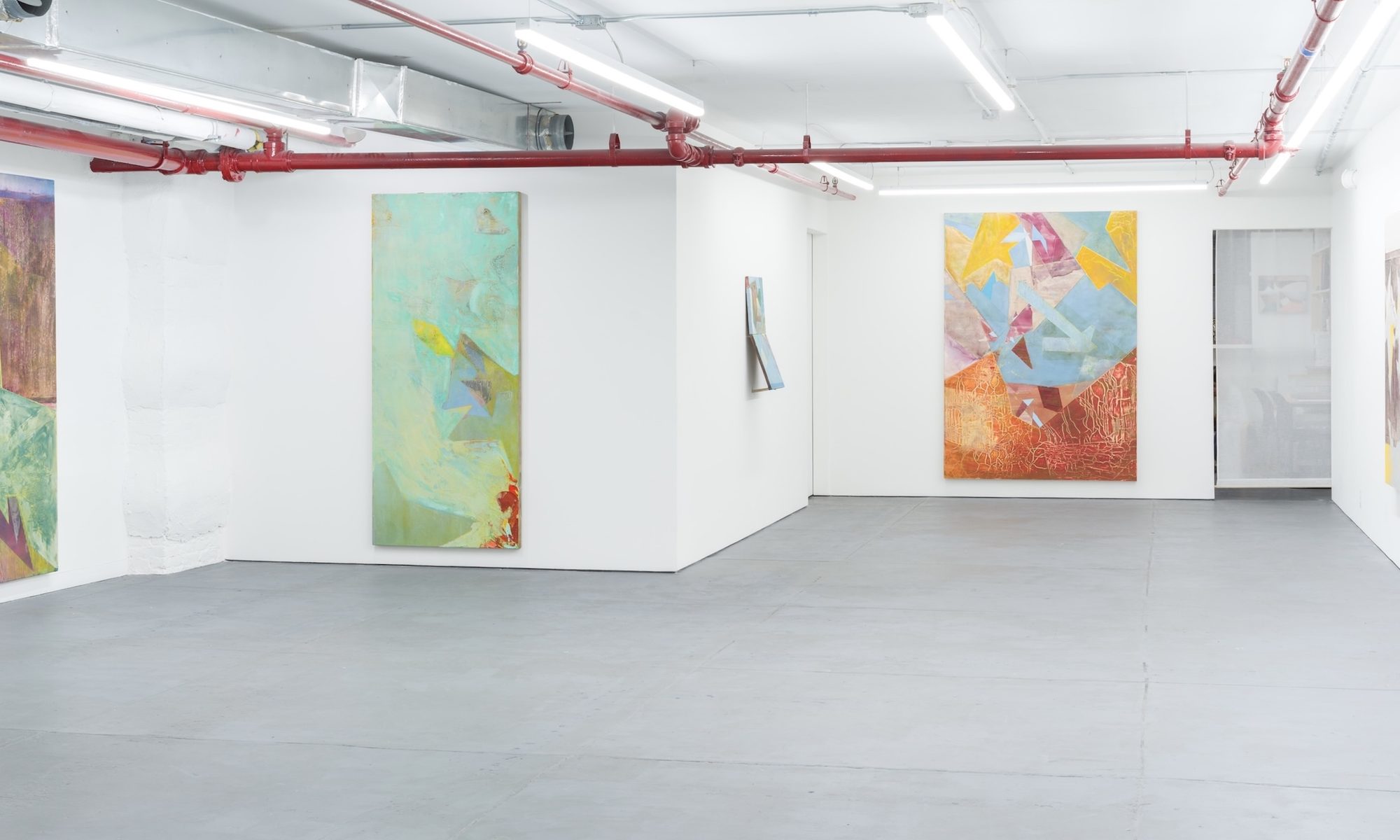
In the basement of 79 Leonard Street, Jan Dickey’s paintings arrive as an eruption of color, as luminous and insistent as stars against a night sky. For Dickey, who grew up on a U.S. military base in Germany, the star was never a neutral emblem; it was a reminder of home. Dickey writes, in his artist statement, that he resists fixing the star to a single metaphor and chose it for its “open-endedness” and ability to “spark a highly specific range of symbolism and feelings.” In Compression, his current solo exhibition at D.D.D.D., Dickey subjects the star’s familiar geometry to processes of fragmentation, displacement, and recombination, testing how a single form can evoke disparate meanings as its material and pictorial contexts shift. His paintings thus become a kind of map, charting nostalgia, geography, and history across their tactile surfaces.
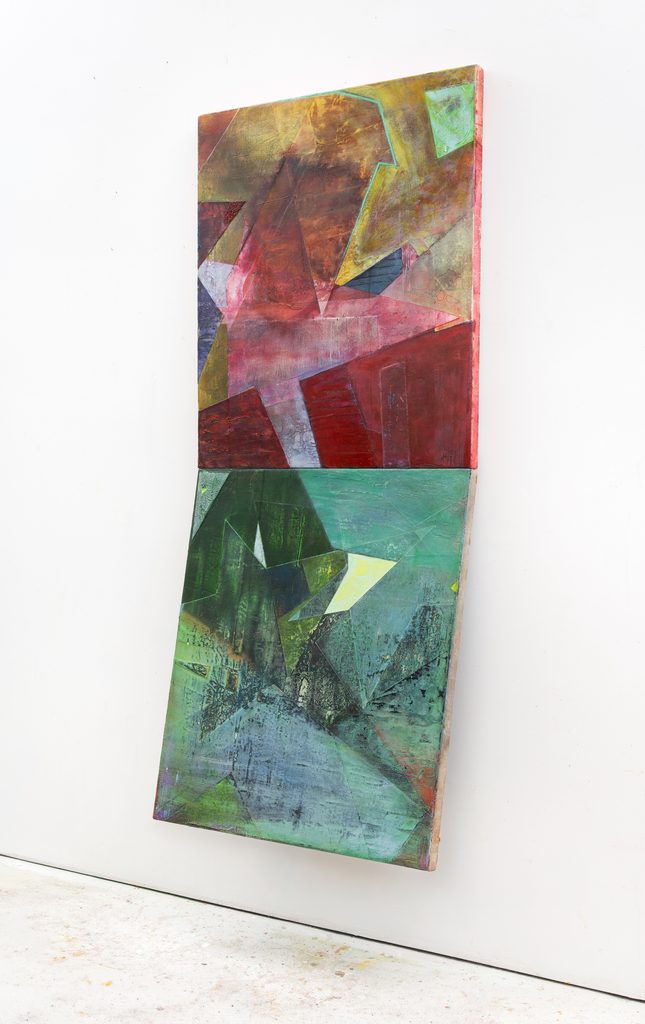
Descending into the gallery, one is struck first by the chromatic intensity of Dickey’s large-scale works against the subdued walls, then by something stranger: several canvases are conjoined, propped outward from the wall, resisting the flatness of traditional display. In Border Towns (2026), Dickey unites two square canvases into a single installation. Their distinct palettes, one green and one red, announce their separate origins, yet the stars within each composition mirror one another in form. Dickey explains that his practice involves joining two independent paintings and then reworking them with distemper, oil, acrylic, and black walnut. The same technique is utilized in Border Lands (2026), where two paintings are hinged together, the lower panel tilting away from the wall. A light milky blue migrates from one canvas to the other, and the corner of a star from the upper panel continues into the lower half. Dickey stitches fragments from different canvases into one coherent image, abstracting the star to resemble maps of buildings, mountains, and shifting terrains. Titled after borders and the partitioning of land, these works carry the star’s function as an emblem of homeland and territorial identity, recalling Dickey’s childhood on foreign ground: a life of movement across borders and nations.
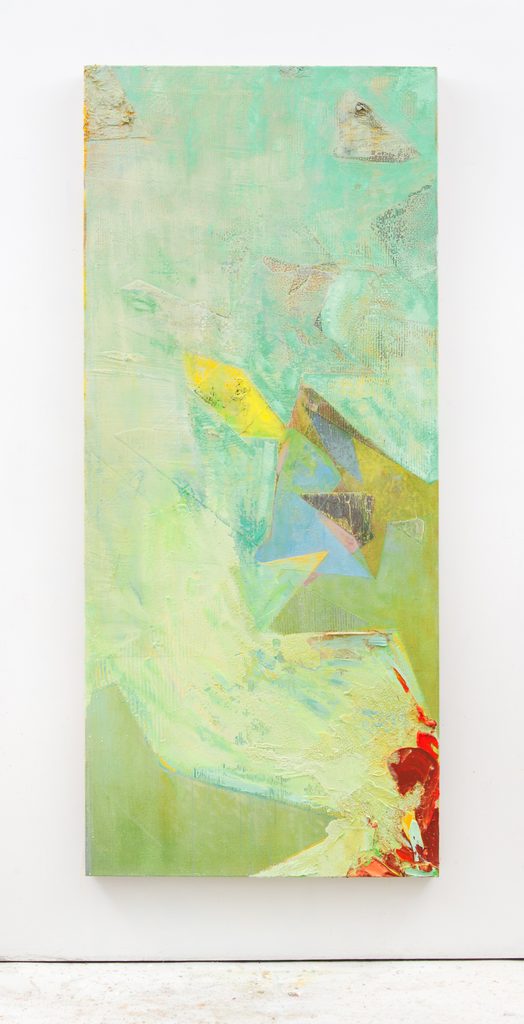
Jungle Atlas (2026) is rendered in buoyant pastels of lime green, interrupted by a flash of red in one corner that gestures toward a continuation beyond the frame. The palette’s brightness recalls the whimsical illustrations of childhood picture books, yet the same splash of red resurfaces in Subduction Atlas (2026), a darker work in which, among earthy tones and gunpowder black, it reads instead as dirt and blood. Here, Dickey’s star takes on an ominous quality, evoking the iconography of nationalism and war. This shift in meaning parallels Dickey’s treatment of his canvases, where in Subduction Atlas (2026), a rugged, umber-toned terrain is interrupted by a band of violet along its upper edge. Dickey recounts how he removed the canvas from its original stretcher, altered its proportions, and reworked the composition in a different palette. The painting thus becomes a material palimpsest, in which successive iterations coexist within the final composition. Moving through the space, viewers encounter every meaning of the symbol simultaneously, compressed into surfaces that had originally carried their own independent stories.
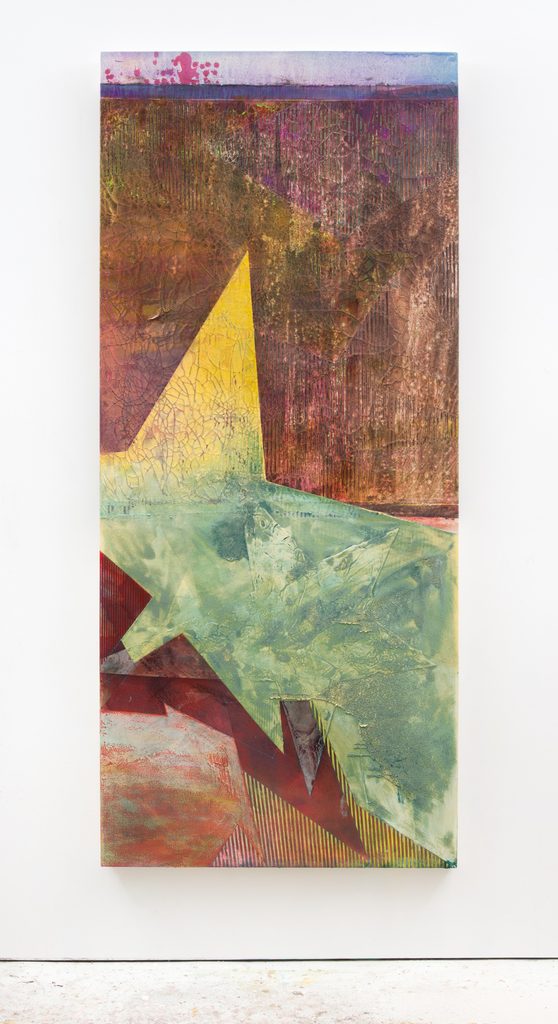
Working in distemper, oil, acrylic, and cochineal pigment, Dickey builds rocky, terrestrial surfaces that echo the exhibition’s cartographic sensibility. In Mist (2026), a collage of stars emerges from wrinkled layers of impasto, striations, and crackled paint. Their corners collide and consume one another, yielding abstracted forms that, alongside each rocky surface, begin to resemble aerial landscapes. Along the top of the painting, parallel stripes introduce the pattern of the American flag into Dickey’s fractured topographies. This texture is particularly pronounced in Shadow (2026), where a luminous striated yellow star seems to resemble strips of tape applied onto the canvas. Yet the texture comes from the paint itself. As Dickey recounts, he first applied thin strips of tape, painted over them, then peeled them away, allowing the acrylic and distemper to form raised impressions in the negative spaces. The tape also carries a material history of its own: originally sourced from Rainbow Tape, a supplier in Long Island City whose closure was attributed to the Trump-era trade wars, it was salvaged from the factory floor and sent to Dickey before the business shut down. In Shadow (2026), the tape’s history becomes embedded in the painting. The resulting relief preserves the tape through its absence, inscribing the remnants of a shuttered business into the star’s surface. In this way, Dickey’s paintings also put the production of symbolic value in tension with the material processes of obsolescence.
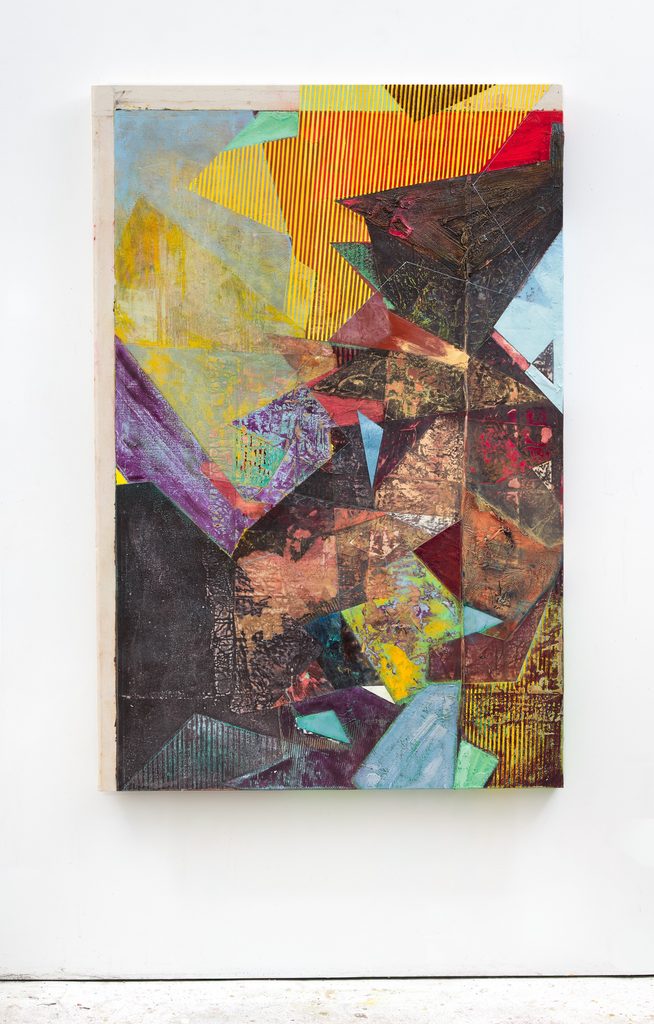
In Compression, the star remains legible even as its contours fracture, its colors erode, and its material foundations are reworked. Across the exhibition space, viewers trace the star’s passage from an intimate emblem of home to a symbol burdened with deeper cultural and political narratives. To compress, in Dickey’s sense, is not to flatten but to hold multiple histories within a single surface.
Jan Dickey: Compression is on view at D.D.D.D. through November 14, 2026, at 79 Leonard Street, SBE, New York, NY 10013. Gallery hours are Wednesday through Saturday, 11 AM–6 PM. @dddd.pictures @jan.dickey
Make your tax-deductible donation today and help Art Spiel continue to thrive. DONATE
About the writer: Zoe Zheng is a New York-based writer working in contemporary art and cultural criticism. Her research examines the exchange between Eastern and Western art histories, with particular attention to emerging artists of the diaspora in New York. She is currently pursuing a degree in Art History at Barnard College, Columbia University, and has held positions at Eli Klein Gallery, White Cube, and Pace Gallery. @zoeezheng