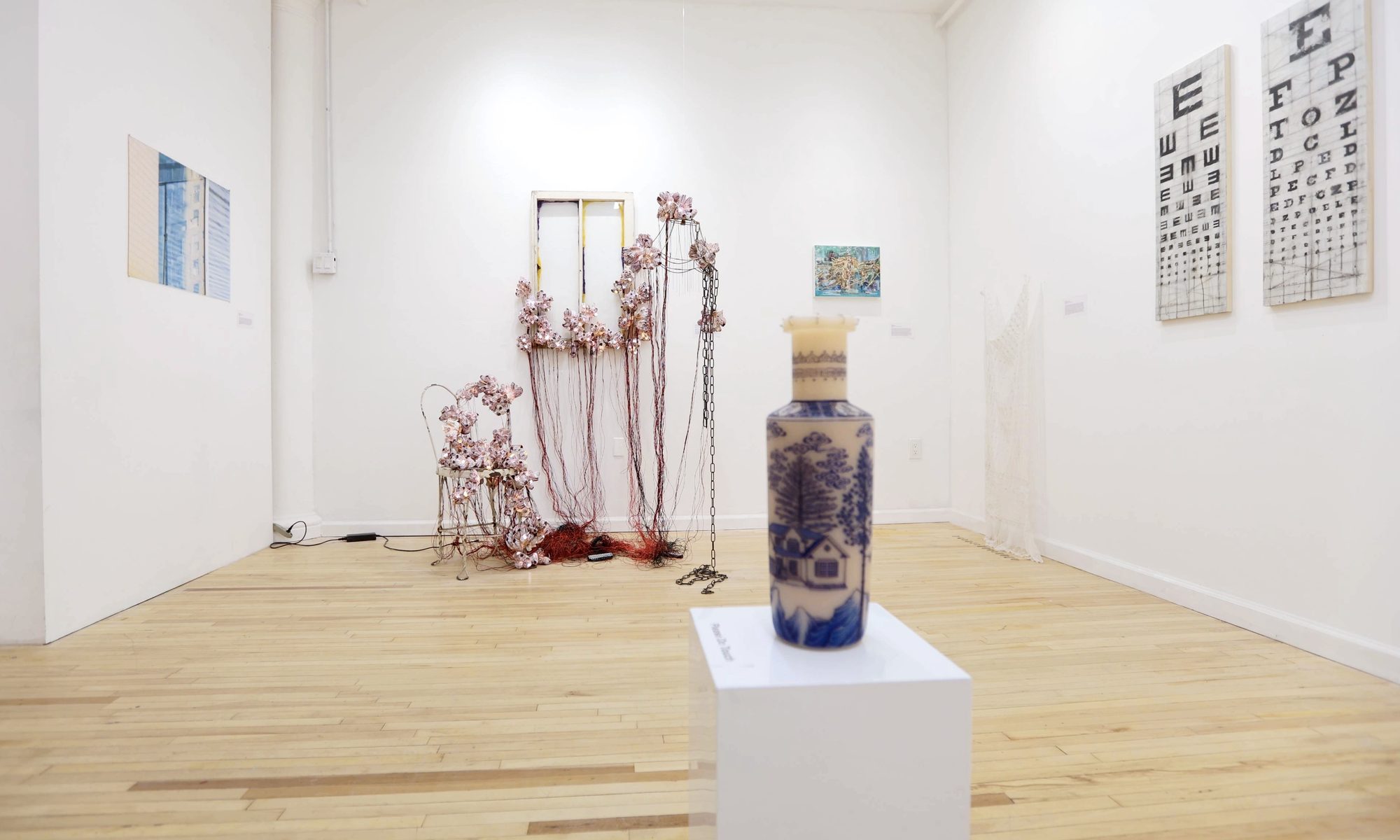
It is difficult for anyone to tell a story about being Chinese. On the surface, we have consummatory trends like “At A Very Chinese Time of My Life”; otherwise, we often see over-sensationalized narratives about geopolitical maneuverings. Yet, in the undertow, Chinese people work and make in conditions full of positional and situational complexity, and they belong to nuanced communities. Under the Common Sea is a group exhibition where artists and cultural workers came together to showcase the range and diversity of experiences, relationalities, and perspectives on identity among Chinese and Sinophone diasporic peoples in NY and across the United States.
For years, journalist Muyi Xiao noticed a growing interest in the details of everyday life for Chinese people. She founded Hǎi 海, a new project from Asia Society’s ChinaFile, as a platform to recover ordinary stories within the wider scheme of journalism about China. Together with Amy Yuanchen Qian of Accent Sisters, they curated an exhibition that pays homage to “ordinary day-to-day life”.
The title of the exhibition is a nod to The Undercommons: Fugitive Planning and Black Study by Fred Moten and Stefano Harney, which can “help us grasp how … institutions, organizations and capitalist mechanisms (including the State as an agent of capital) reduce our ability to empathize, our capacity for true learning and our ability to love.” Under the Common Sea asks: in the ungovernable realm of social life, how can Chinese people from a medley of diasporic generations and experiences – first-generation immigrants, young people who grew up in the US, those who came a generation earlier – make meaning and be in community with each other?
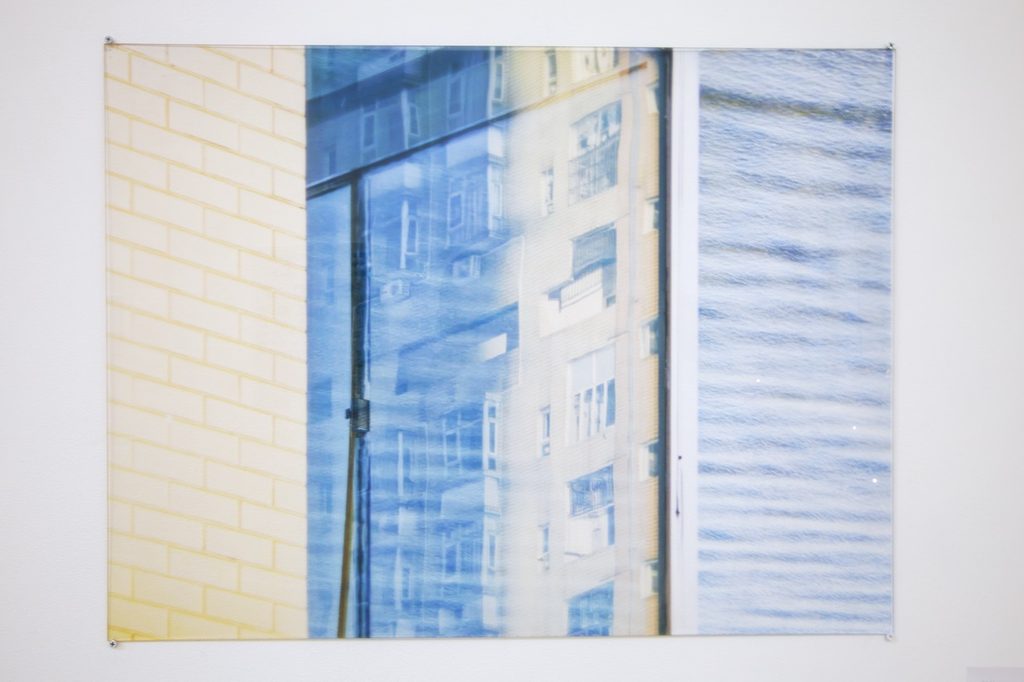
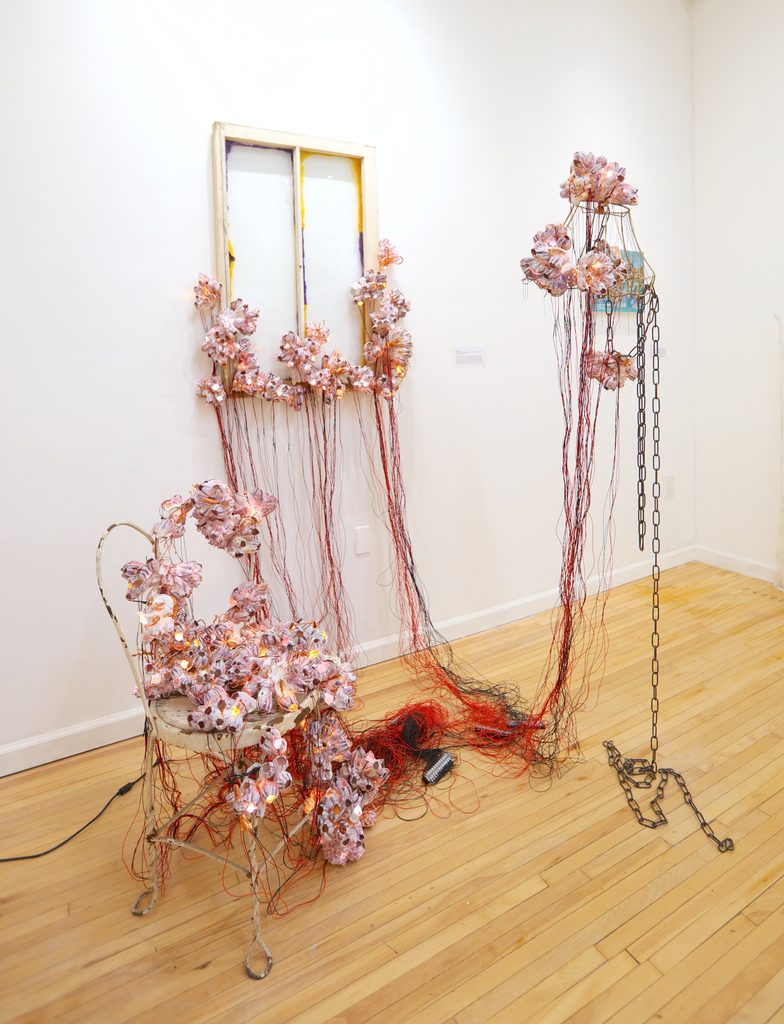
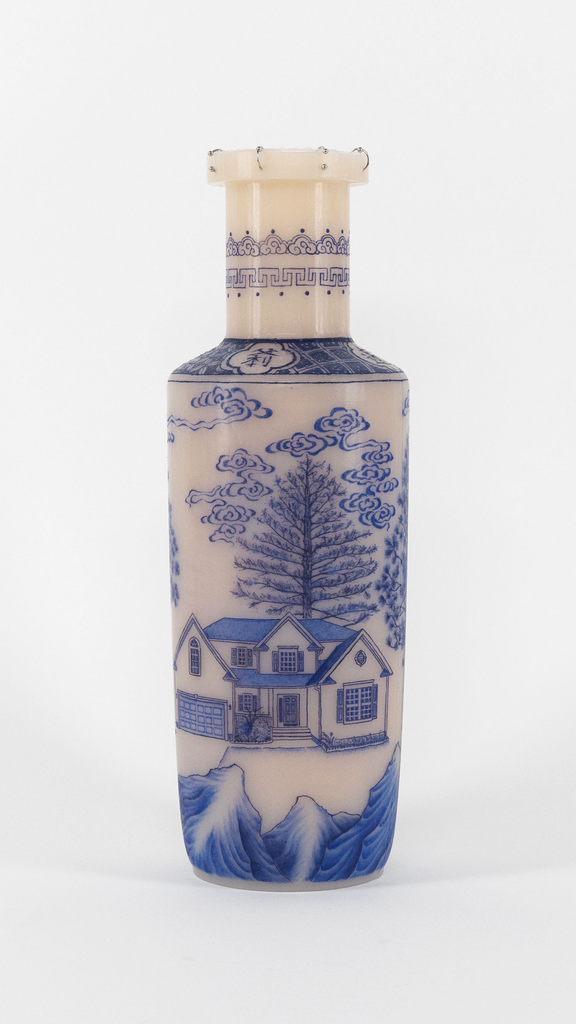
One of the first pieces you’d notice in the space is Kyla Liang’s wall, wave, window, a vision of views from her home in Zhuhai, Guangdong. Beside the work is Holdfast by Artemis Lyu, a sculptural reenactment of the lifecycle and homemaking of barnacles, and Object no. 1 by Sara Xu, a tattooed silicone Ming Dynasty vase with deliberately archetypal mountain and cloud motifs. The artist turns to the ocean, at once a universal view and a conveyor of distances, to embrace the disquieting interior of the self and the hazy visions of a future on the other side. Ostensibly a collaged photograph, Liang’s work is one whole photograph. In a single lucky moment, the artist captured her home, the exterior wall facade, and the sea in one shot, then traced the image onto acrylic with UV. Private, intimate, belonging to all yet no one in particular. Liang, Lyu, and Xu’s works all have a soft, transcendental quality, each operating on its own rationale of dimensional planes, making it hard to distinguish where the self ends and the collective begins.
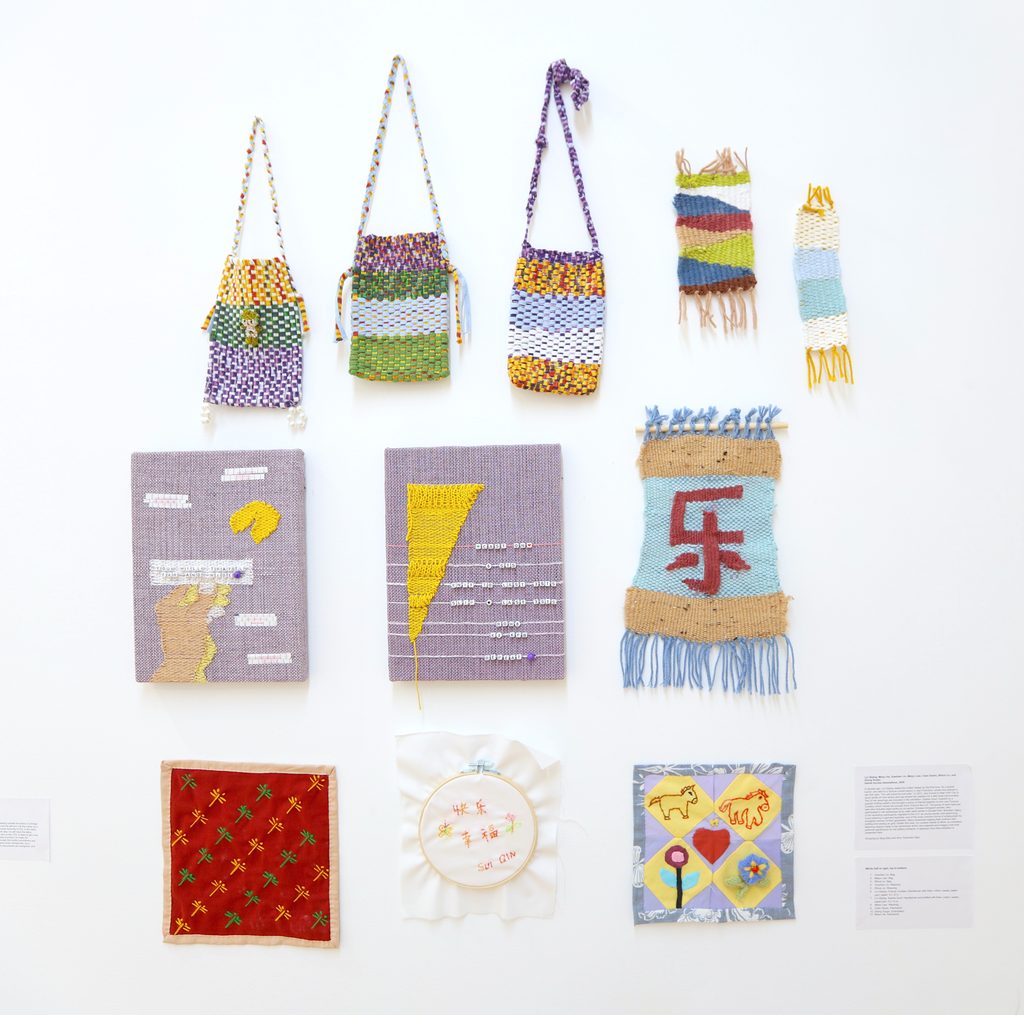
Throughout the exhibit, the language of the handmade emerges as an underground vernacular. In the textile series Hands Across Generation, curators Xiao and Qian assembled eight weaving and embroidery works by six senior Chinese immigrant women who participated in workshops at an older adult center in Sunset Park, Brooklyn. The workshops were facilitated by Lin Qiqing, a textile artist herself. The collection also includes two of her weavings, Sophie Scarf and Fortune Cookie. Many of the workshop participants migrated to the U.S. as young women and spent long hours working in garment factories. As diaspora creatives like Lin continue to explore community-oriented work, they run into a conundrum: What elevates their creative or intellectual labor above the manual labor China is synonymous with? Across the many kinds of knowledge held within the Chinese diaspora community, this constellation of textile work disrupts the hierarchies we’ve come to expect – placing them, side by side, as equally valuable.
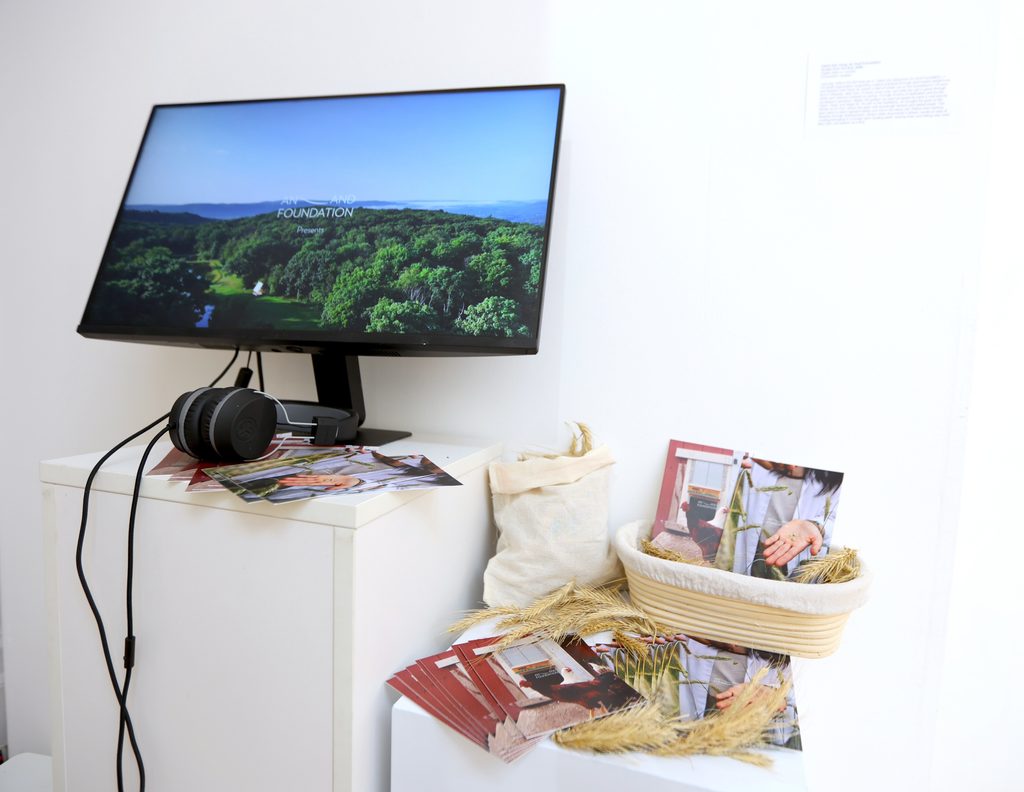
Next to the vibrant, lively textile works is a video an unexpected pile of rye and a video. The work comes from the only organization in the exhibition, the An And Foundation, a Farm in Wassaic, New York, that hosts art, architecture, and culinary residencies. Last year, artist Claire Ziyi Jiang sowed a field of winter rye on the An And Foundation’s 170-acre farm. An artistic practice that echoes the legacy of Agnes Denes’s Wheatfield, of planting and social practice. However, Jiang is working with an entirely different context. As part of her residency, Jin brought the grain to the kitchen at An And, where she grew wild sourdough starters and baked bread. The team plans to plant highland barley and rice in the same soil. Now re-presented in Under the Common Sea, what comes forth is not the story we expect of displacement and dislocation from immigrant communities, but a connected and overlooked connection directly to the land. Tending the earth, sharing food, and letting new roots take hold, one season at a time. Belonging in immigrant communities can feel contingent on institutional validation, divided by pressures such as the model minority myth. The usefulness and status of one’s work, after all, is how immigrants are ‘chosen’ to be here. But Jiang’s work is remarkably generous. It subverts the professional, survival-driven relationships we’ve come to expect, and asks whether we can imagine reciprocal relationships where we’re simply open to giving.
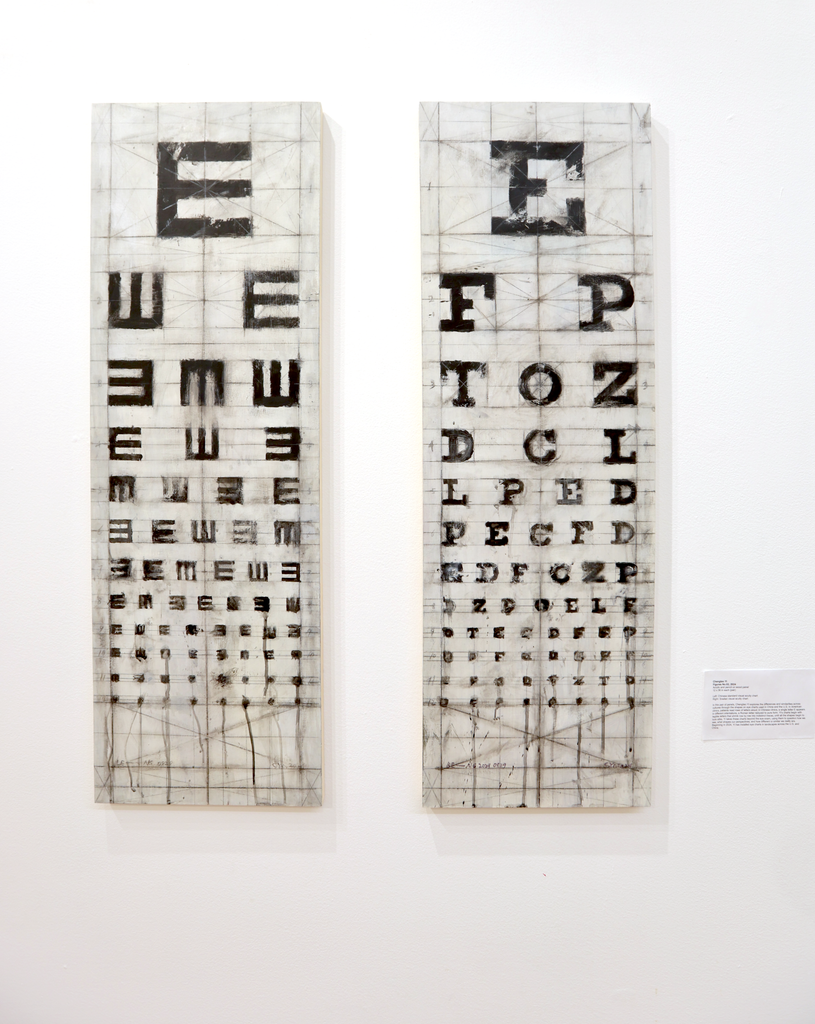
Across the room is one of the pieces that guided Xiao and Qian’s curatorial vision for the show. Figures No.2 is a panel drawing series, the long-term project of artist Chengtao Yi, examining the collectivity and divisiveness of vision and optics. Beginning in 2024, Yi has installed eye charts in landscapes across the U.S. and China, noting especially how the two countries use different charts for vision screening. The artist paints a double-seeing, two different systems of objectivity. In the context of Under The Common Sea, it mirrors how Chinese diaspora communities in the United States are individuals tasked with providing counter-narratives to an oversweeping, standardized view. ‘Ordinary people’ offer their personal stories while living in and entangled with institutional conditions. From the perspective of the undercommons, the gravity and impact of stories are like these charts, enlarged and distinct as individuals, but unified as a collective whole.
With the same curiosity and rigorous authenticity of investigative journalism, curators Xiao and Qian pulled out sliver after sliver of individual experience to reveal itself through sharp storytelling. When mainstream platforms find stories too minute, we turn to art for the coverage of ‘human stories’. We turn to art to imagine new ways of being with and believing in each other. It’s as Jack Halberstam wrote in The Undercommons: “It ends as it begins, in motion, in between various modes of being and belonging, and on the way to new economies of giving, taking, being…”
Under the Common Sea 海的下面还有海 is on view from 10/15 to 11/5 at Accent Sisters, NYC. Thurs – Sun, 2- 9 PM.
Courtesy of Accent Sisters
About the writer: Arete Xu is an artist, writer, and cultural producer. She has worked with the RISD Museum and Pao Arts Center, and is currently a fellow at Accent Sisters. She is based in Brooklyn, New York, and Tāmaki Makaurau (Auckland), Aotearoa New Zealand. Drawing on her background living across Asia, South America, and Oceania, Arete works and thinks in Mandarin, Brazilian Portuguese, and English. Her research and writing primarily examine diaspora visual cultures, embodied transnational experiences, and multilingual publishing. Arete received her BFA from the Rhode Island School of Design and was previously editor-in-chief of volume 1.