
History has always depended on materials. Marble, oil paint, bronze, woodcuts, engravings, museum vitrines, and photographic reproductions preserve the past as well as determine how events, ideas, and narratives are represented. Over time, images become durable, gaining a certain kind of truth value because they acquire material permanence and spread through copies. Mythological heroines, biblical women, allegorical figures, and historical subjects return across centuries through the persistence of artistic media, carrying with them the assumptions, hierarchies, and ideologies embedded in their forms. Melora Kuhn‘s solo exhibition, The Legacy of Disembodiment, on view at Private Public Gallery, starts with the recognition that if representation has helped naturalize and proliferate the narratives these images and forms carry, then materials themselves can be a site of political intervention.
Kuhn’s work is remarkable for the ease with which it slips between mediums without allowing any of them to settle into certainty. Painting, sculpture, digital modeling, and drawing remain in constant conversation, each borrowing the logic of another. Mediums resist being part of a discrete category, as she allows them to become transitional states in an ongoing process of reconstruction. The exhibition is consequently less concerned with representing history than with reconfiguring the mechanisms through which history continues to appear authoritative. With that, Kuhn brings her penchant for defacing, removing, or toppling history’s morally compromised figures.
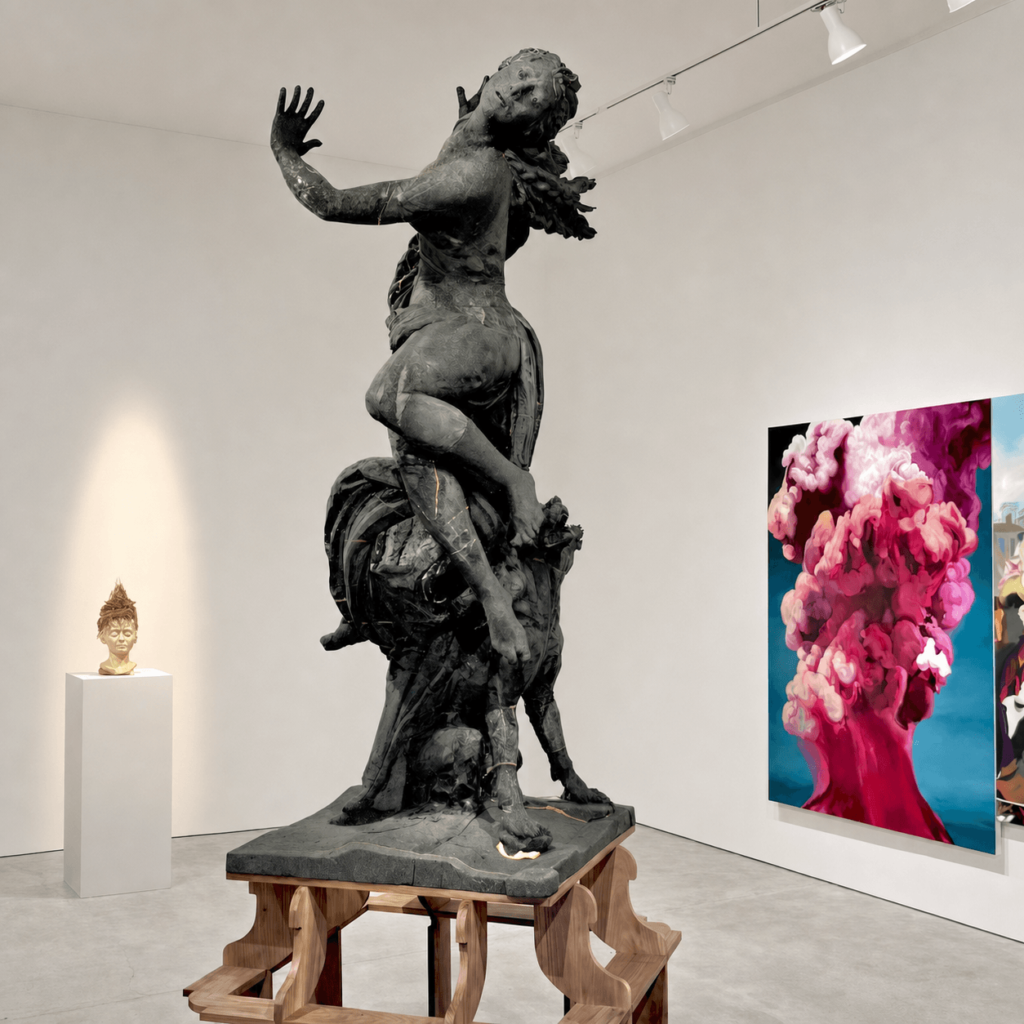
The exhibition centers on a massive sculpture of the Greek goddess Persephone, modeled after Gian Lorenzo Bernini’s The Rape of Proserpina (1622), only her attacker, Hades, has been completely removed. This is one of several works that originate from a historical image. In this case, the two-dimensional reference image and its corresponding narrative of violence are dematerialized in three-dimensional digital space before returning to physical form. This intermediary stage becomes both a conceptual and creative space in which inherited images temporarily lose the fixity of their original material conditions. There, relationships that once appeared immutable become malleable. Bodies can be separated from their aggressors, fragments repositioned, forms enlarged, details isolated, and visual hierarchies can be undone. This transformative space functions as a kind of provisional territory where the clutches on history’s dominant narratives are loosened, edited, and reimagined.
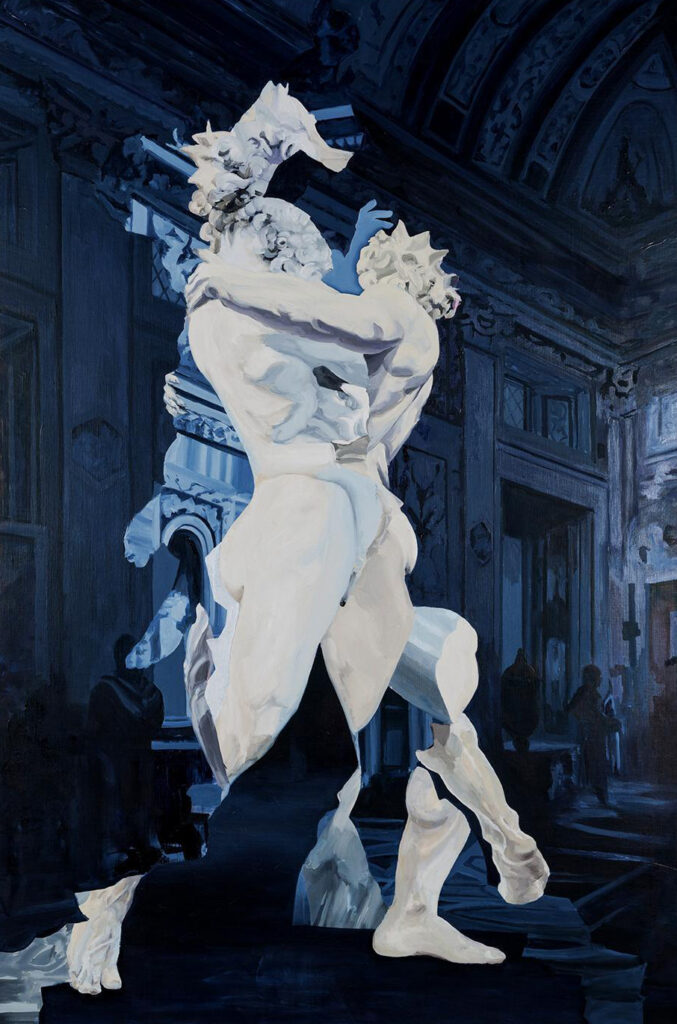
The significance of this process extends well beyond the novelty of appropriation and iteration. Kuhn employs these tools for productive disassembly, intervening in the histories that have long appeared anchored, and exposing historical narratives as contingent constructions rather than settled facts. The exhibition’s engagement with mythology and the history of art makes this strategy especially compelling. Figures whose identities have been secured through centuries of patriarchal representation are released from the visual structures that have historically contained them. Persephone, for example, no longer exists primarily through the violence of her abduction and physical assault, rejecting a resemblance to the canonical images that have transformed such events into aesthetic spectacle. Once separated from her aggressor, she appears unexpectedly whole. The absence of Hades exposes the extent to which her identity had been organized around his presence; her outstretched arms read differently as a result. What initially registers as subtraction gradually reveals itself as restoration, with Persephone emancipated from male domination and violence. Kuhn’s bold choice interrupts the inherited structures of control, creating gaps within this sculpture and empty spaces in some of the paintings, giving way to new narratives. The removed Hades appears elsewhere and alone, providing a respite from the usual presentation of gendered violence as inevitable—even heroic—decorative, and incidental to larger cultural myths.
Kuhn also disregards other traditions of classical sculpture, understood as an art of subtraction, where the figure is revealed through the gradual removal of material until an ideal form emerges. She radically inverts this logic. Her sculptures are assembled rather than uncovered. Sutures remain visible, and joints are held together with adhesive that slightly drips at the edges. None of this suggests indifference to craft. The works are remarkably precise, and their anatomical complexity leaves little doubt about Kuhn’s technical command. Yet the evidence of their construction is left open, allowing it to become part of the work’s visual vocabulary. We come upon Persephone as if in media res, leading us to read its seams as healing wounds.
In Every Rape in the Met Museum, Macushla Robinson describes the institutional normalization of sexual violence as “all the unspectacular, ordinary violence that takes place in and around the museum.” Her observation is particularly resonant here because Kuhn’s work reveals how violence is often made to appear almost banal, as if embedded within the habits of representation themselves. We see it in the compositional decisions that subordinate women, the narratives that naturalize their suffering, and the museum displays that continuously elevate artistic mastery while rendering violence historically ordinary. Kuhn at once critiques these traditions as she reconstructs the visual conditions through which they continue to operate.
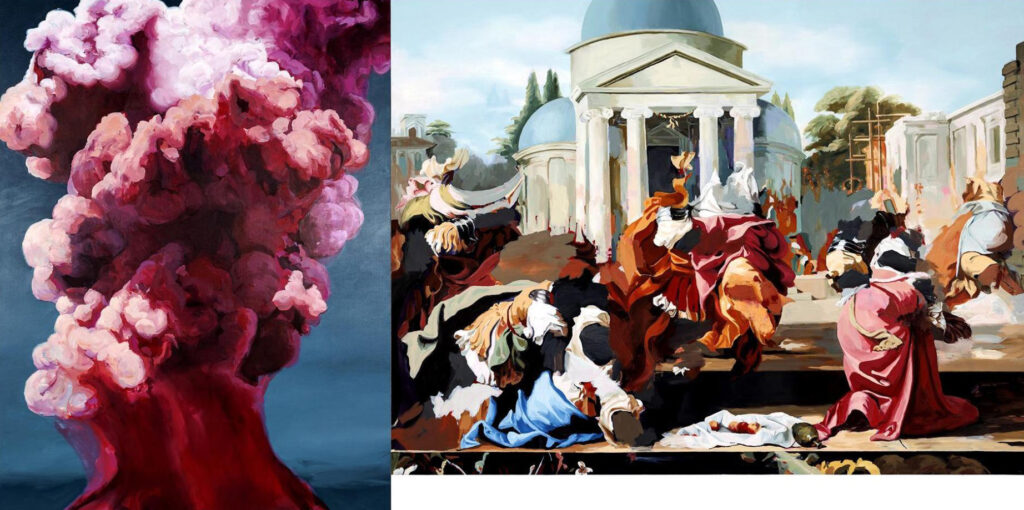
The exhibition is therefore also about perception. It reminds us that every image is shaped by earlier images and mythologies, inheriting visual conventions that often pass unnoticed. Mythological narratives survive through storytelling and through their continual reproduction in paintings, sculptures, illustrations, and museum displays. As these representations accumulate, the institutions of art history confer upon them an aura of permanence. Kuhn unsettles this authority by treating these inherited visual languages as materials rather than monuments. Alongside these critiques, she incorporates instances of palpable release in the form of large-scale depictions of detonations in Eruption (2025-26) and Eruption II (2025). The former is one of two panels in a diptych. The other panel reworks Sebastiano Ricci’s Rape of the Sabine Women (1702-03), again excising the male aggressors and softening the lines that once defined the bodies caught in the chaos of physical assault. Enough of Ricci’s composition remains, making this source recognizable, but its internal logic has fundamentally shifted. Like the sculpture of Persephone, the work reveals how familiar these scenes are, and how readily that familiarity has obscured the violence they depict.

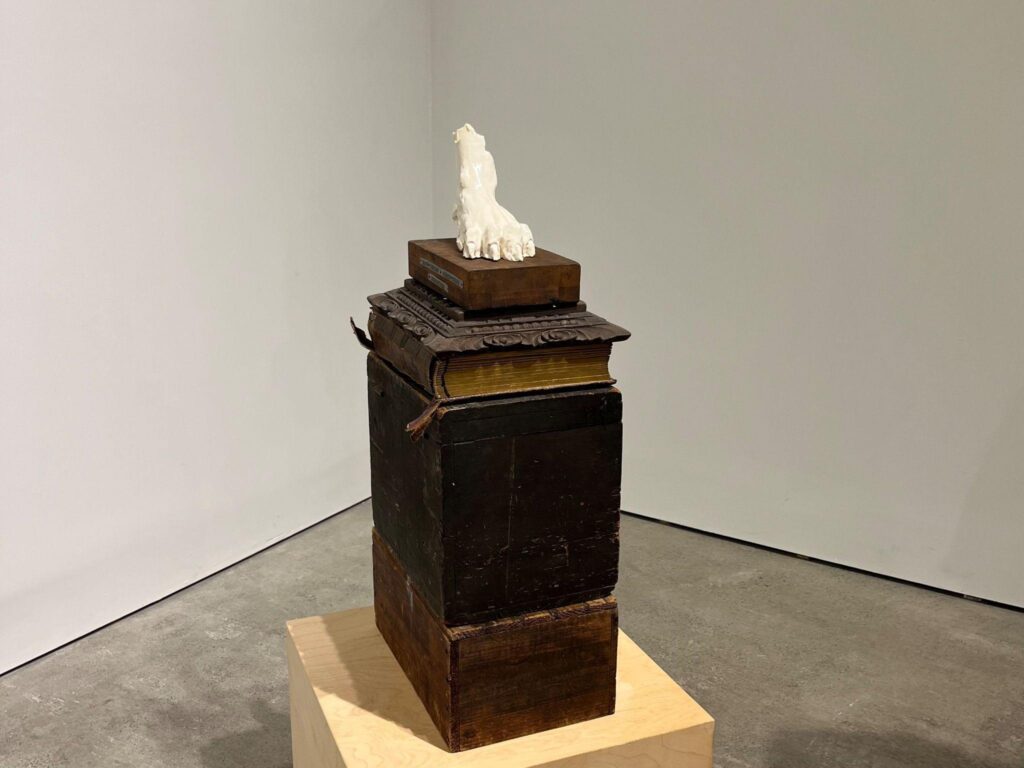
Rather than presenting self-contained narratives, Kuhn creates an environment in which meaning is distributed across multiple works and discovered through their relationships to one another. The paintings command attention through their scale, color, and emotional intensity, allowing them to stand alongside the sculptural centerpiece with equal force. Elsewhere, smaller sculptural fragments create visual echoes that move the eye from one work to the next. A paw, a gesture, a bust of the Greek goddess Demeter, the distraught mother of the abducted Persephone, each appears as a visual echo, encouraging viewers to connect disparate elements and recognize how fragments imperfectly accumulate into a larger image or narrative. Titles of works deepen this sense of openness, offering hints at historical, literary, and mythological associations that complicate first impressions and extend the exhibition’s process of reconstruction. Smaller works fill the adjacent room, showing sketches and studies of the larger works on view and related themes, including one titled Phaethon’s Hubris (2026). The depth of Kuhn’s research is evident throughout, yet it never feels didactic.
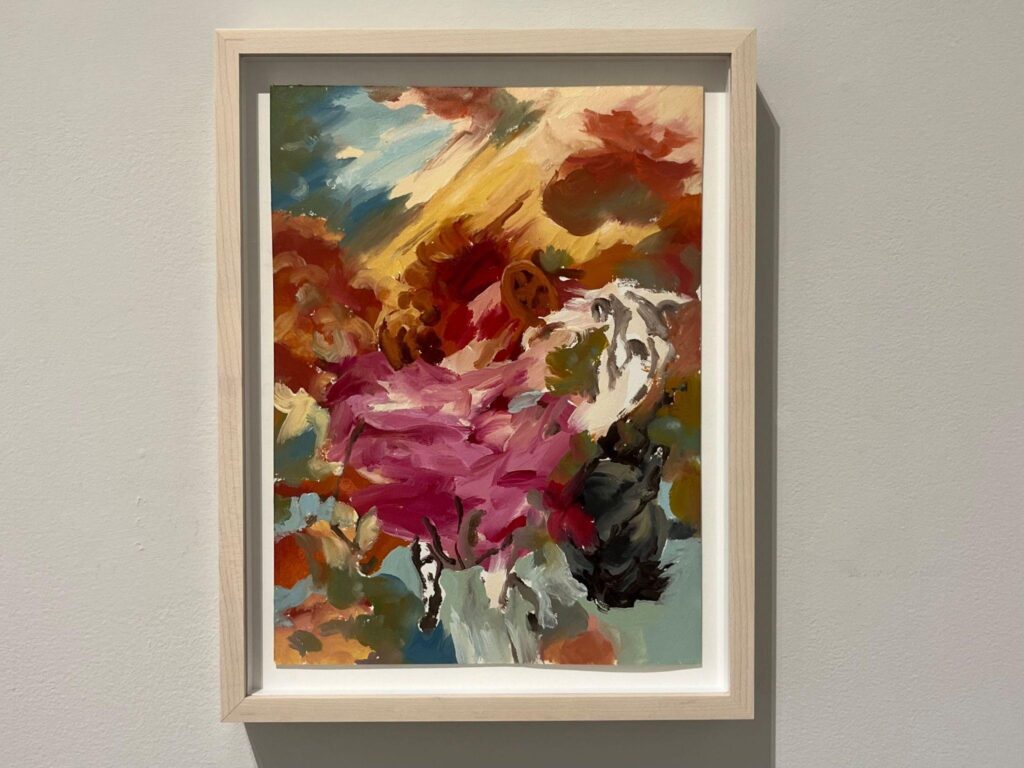
Apart from the exhibition’s conceptual rigor, what lingers most is its extraordinary power. The works possess a formal generosity that never allows critical urgency to eclipse aesthetic experience. The paintings’ bold use of color, commanding scale, and visual rhythm draw viewers into an encounter that is at once seductive and unsettling. Bodies appear incomplete yet whole, fragments repeat across the gallery, and familiar stories feel both recognizable and newly uncertain. One is compelled to piece these parts together, almost answering a call to reflect. This appeal encourages viewers to sit with the work long enough to eventually feel the collapse of ideological structures being dismantled before them. As they do, the gallery seems charged with an improbable combination of grief, rage, tenderness, and hope. Kuhn suggests that while inherited histories cannot be undone, they are also not beyond transformation.
Ultimately, the exhibition suggests that history’s narratives persist because they are continually remade through images, objects, and institutions. Kuhn reaches back into the visual archive of art history, retrieves familiar figures from the narratives that have long defined them, and returns them to us with new possibilities intact. The works ask us to recognize that even the most enduring myths are neither fixed nor inevitable, and that by reimagining them we may begin to imagine ourselves differently as well.
Melora Kuhn: The Legacy of Disembodiment is on view at Private Public Gallery, 530 Columbia Street, Hudson, NY, July 11 through August 9, 2026. @melorakuhn @privatepublicgalleryhudson
Make your tax-deductible donation today and help Art Spiel continue to thrive. DONATE
About the author: Natasha Chuk, PhD, is a media theorist, arts writer, educator, and independent curator whose work examines the intersection of art, philosophy, and creative technologies. She is the author of Vanishing Points: Articulations of Death, Fragmentation, and the Unexperienced Experience of Created Objects (Intellect, 2015) and Photo Obscura: The Photographic in Post-Photography (Intellect, 2025). @natychuk