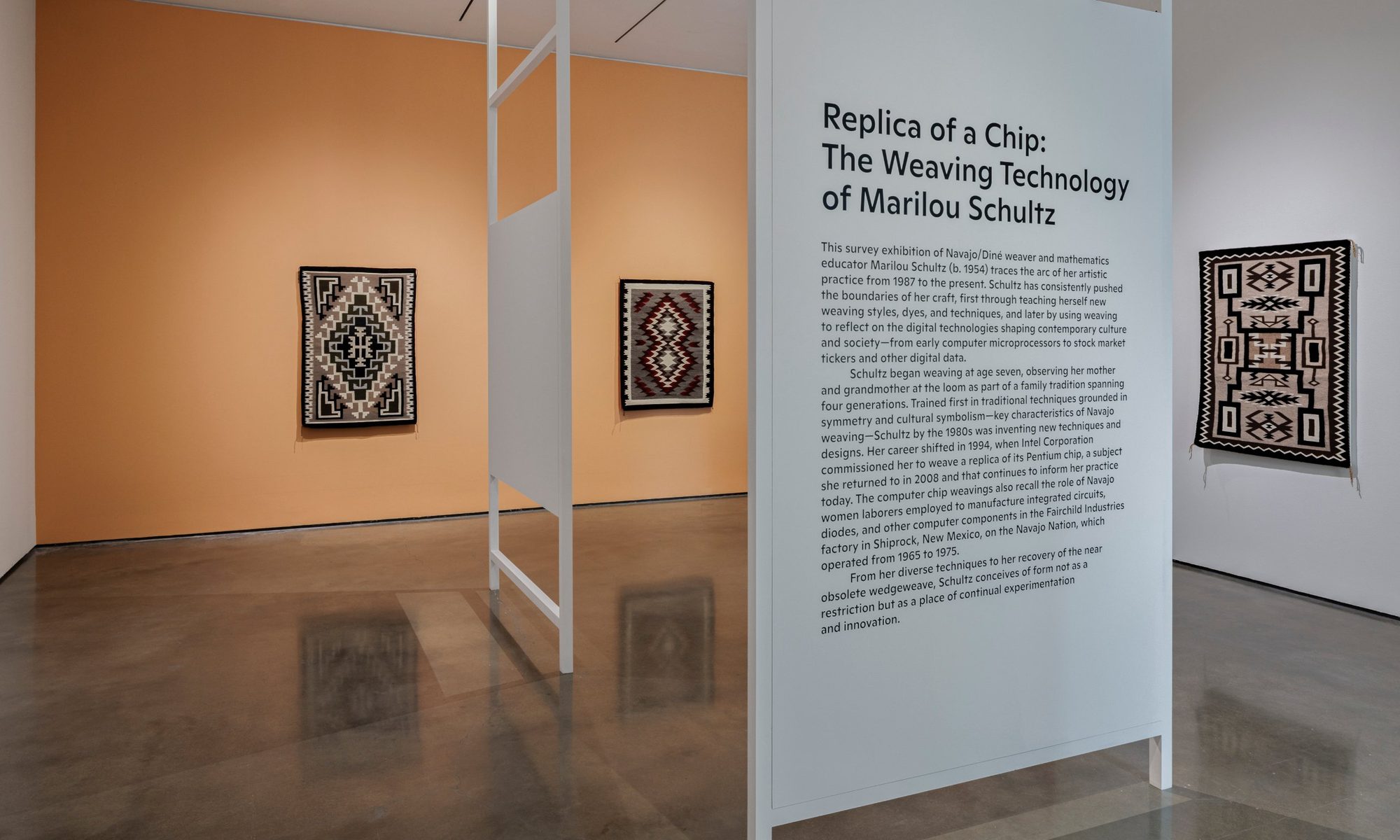
A microchip replicated in hand-spun Churro wool sounds like a conceptual provocation, but the actual object is even more compelling. The title of Marilou Schultz’s exhibition, Replica of a Chip: The Weaving Technology of Marilou Schultz, refers both to the artist’s feat and an unlikely pairing between computer architecture and Diné (Navajo) weaving. In 1994, Schultz was commissioned by Intel to reproduce the company’s Pentium microprocessor as a textile, translating its intricate geometry into interlaced threads. She followed through, replicating a device associated with the precision and abstraction of computing through the material intelligence of the loom. The success of this artistic translation inspired the replication of other chips in wool thread — Nizhóní AMD (2008), Integrated Circuit Chip & AI Diné Weaving (2024), Popular Chip (2025), and Golden Computer Chip Diné Weaving (2026) are included in the exhibition — and to a body of work translating complex systems and new ideas into color and pattern.
Continue reading “The Artist, the Loom, and the Microchip: Marilou Schultz’s Replica of a Chip”The Artist, the Loom, and the Microchip: Marilou Schultz’s Replica of a Chip