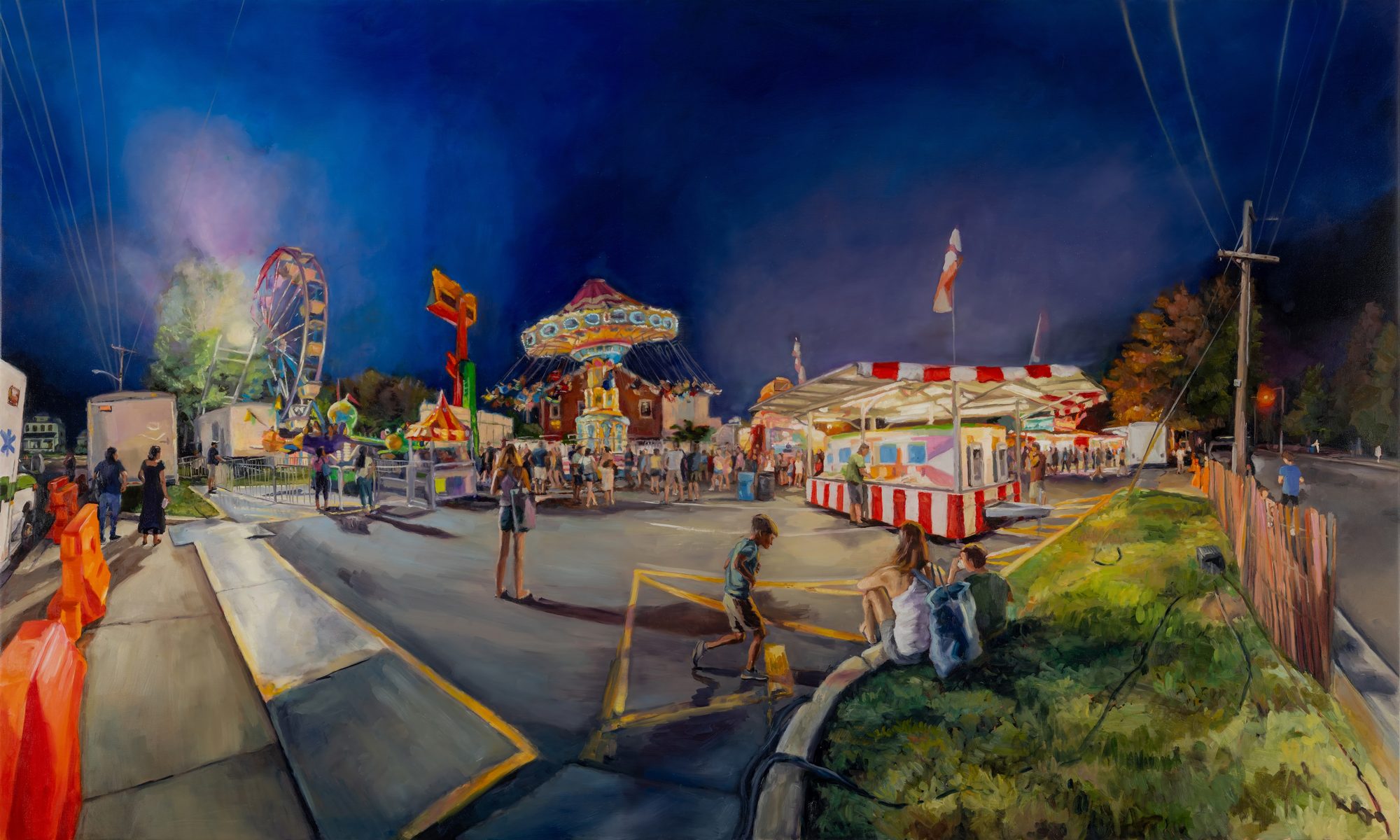
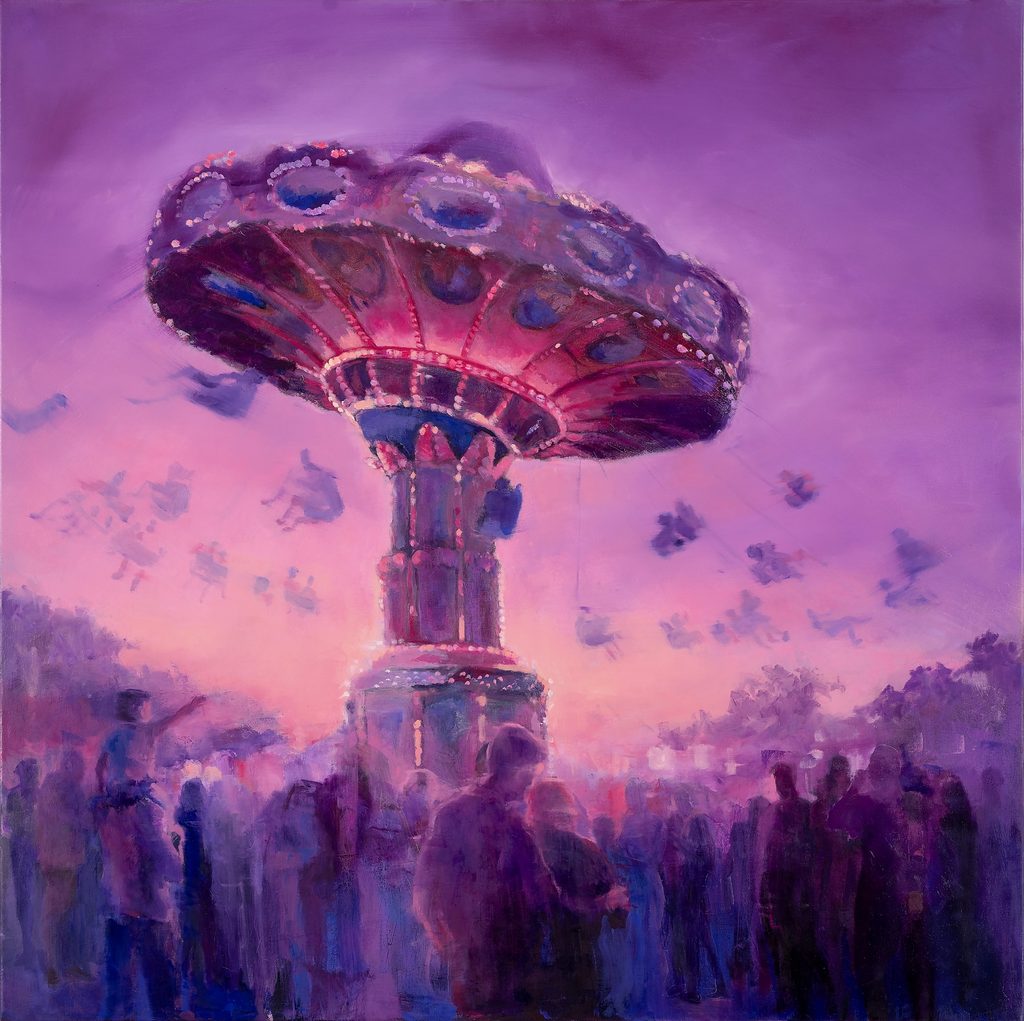
Painter Kathleen Beausoleil is enamored by her backyard, literally. The fair grounds and beaches that are synonymous to her home state, New Jersey, form her primary subjects. Visiting local fairgrounds each summer, she paints plein air, out in the open, and on view in her latest solo show at The Painting Center are works that beautifully capture the light, vibrancy, and togetherness of these places. After speaking with the artist, I understand that Beausoleil’s scenes are not only advanced in their painterly technique, but created through perspectives cleverly scaffolded by sociological terms around gathering and group behaviour.
What is your favorite fairground ride?
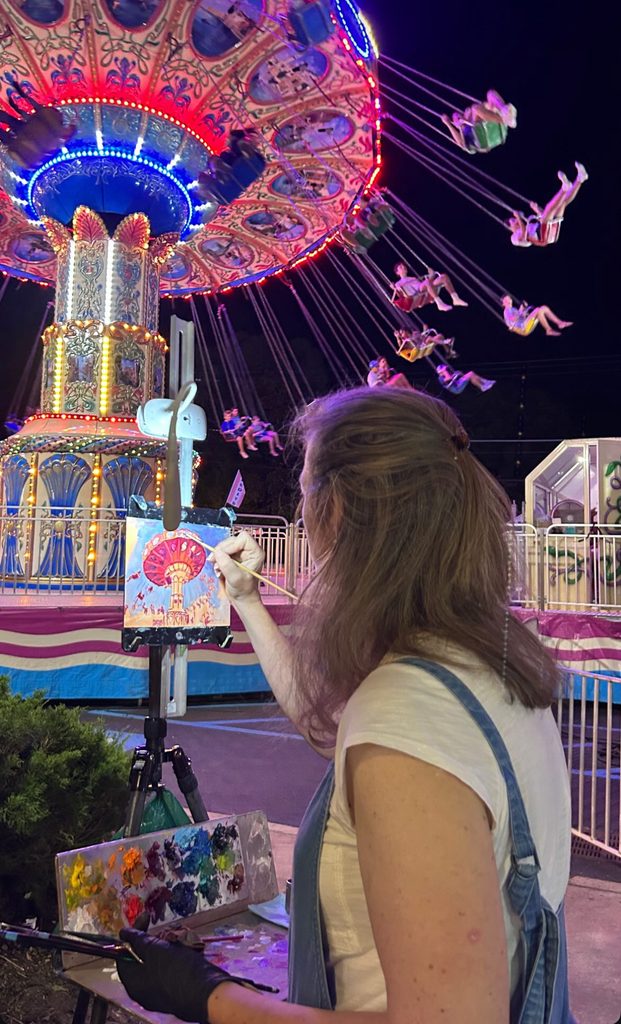
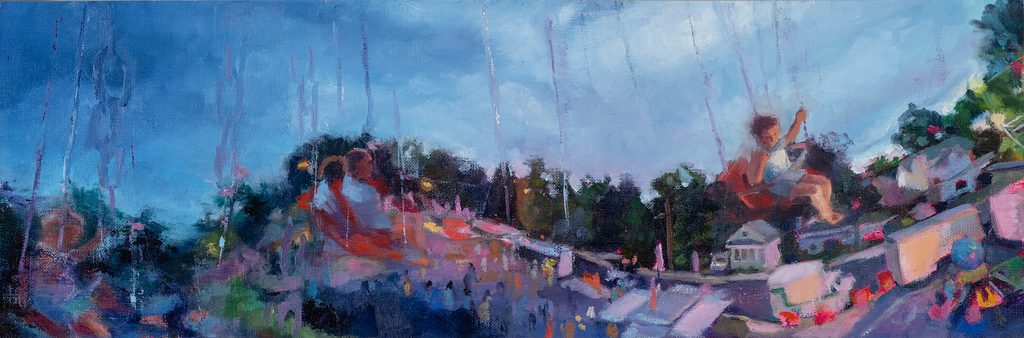
When I was younger, I loved the Sizzler and anything that made my stomach drop. But recently, it’s been the swings. You can kick off your shoes and feel the wind in your hair and against your feet. Many of these swing carousels are works of art in their own right, beautifully hand-painted in Italy.
Light is central to this body of work—stark sunlight, day becoming night, and the spill of artificial lights onto the night sky—what are your thoughts on light?
All painting is about light, isn’t it? We see the world through the light reflected off objects. Light changes color, creates atmosphere, and changes how we feel about what we’re seeing.
What drew you to plein air painting? How does one learn and develop this technique?
Painting from life was part of my training, so working outdoors was a natural extension of that. It was parenthood that led me to painting outdoors. Trying to figure out how to keep painting while raising children, I realized I could hire a babysitter and go paint outside. Painting outdoors forces you to work faster. As I became more interested in crowds and community, I started looking for places where people gathered. There’s a sociological term, collective effervescence, that describes the energy and connection we feel when we come together as a group. That’s what I’m trying to capture.
As a child, I remember visiting October Fest in my hometown, Dalian, in northeast China. Modeled after the German beer fest it hosted drinking and performances in tents. It was a source of city pride for me—our city is considered leisurely, which was unconventional at the time. Looking back, October Fest reinforced the imaginary of our city being more than just hustle culture.
I love that my paintings brought back that memory for you. I think that’s one of the wonderful things about fairs and community celebrations. Almost everyone has experienced some version of them. Importantly, they bring together people who might not otherwise cross paths. Different generations, different backgrounds, different political beliefs, all sharing the same space. Sociologists call those connections between different groups bridging social capital. We’re increasingly isolated and divided, and these community traditions give us a reason to come together.
You paint beaches too. Dalian also has this amazing beach side playground area. You are taking me down memory lane! I always chuckle when I come across Slavoj Žižek’s thoughts on nature and the beach, as meaningless until we humans project our desires onto it. What are the different considerations that you have as you paint beach scenes versus fair grounds?
I love your reference to Žižek because the desire I’m projecting onto these places is the desire to belong. I live on the Jersey Shore, so beaches, boardwalks, and fairs are very much part of my culture. At the beach, I’m fascinated by the relationship between public and private space. Families carve out these little worlds of their own within this enormous public landscape. At the fair, something similar happens. A temporary world is created. Have you noticed people naturally form circles? I’ve been collecting photographs and thinking I’ll do something with that soon.
What are you reading right now?
I’m rereading A Court of Thorns and Roses by Sarah J. Maas. I also read a lot of social psychology, which probably isn’t surprising. I’m a big fan of Adam Grant, and his newest book is next on my list. So, I bounce between fantasy and trying to understand why people do what they do.
There is something beautifully vintage about many of your works. Impressionist? Belle Époque? Of course, this was also when plein air painting was made possible through paint sold in tubes. Degas, Toulouse-Lautrec, and Renoir all painted scenes of spectacles. Is this something you connect with?
Absolutely. I feel a connection to the Impressionists, particularly in how they approached light and color. I think about that when I’m painting, and I use some of those same ideas about the color of light. But art historically, I’ve probably been more influenced by the Dutch painters, particularly Pieter Bruegel the Elder and Hendrick Avercamp. I love their scenes of people gathering on the ice, all those little figures going about their lives, each with their own story within this much larger scene. Ironically, I’m interested in panoramic painting, particularly its history of depicting battles. We’re living through a time of enormous division, and I’m painting places where people come together despite their differences.
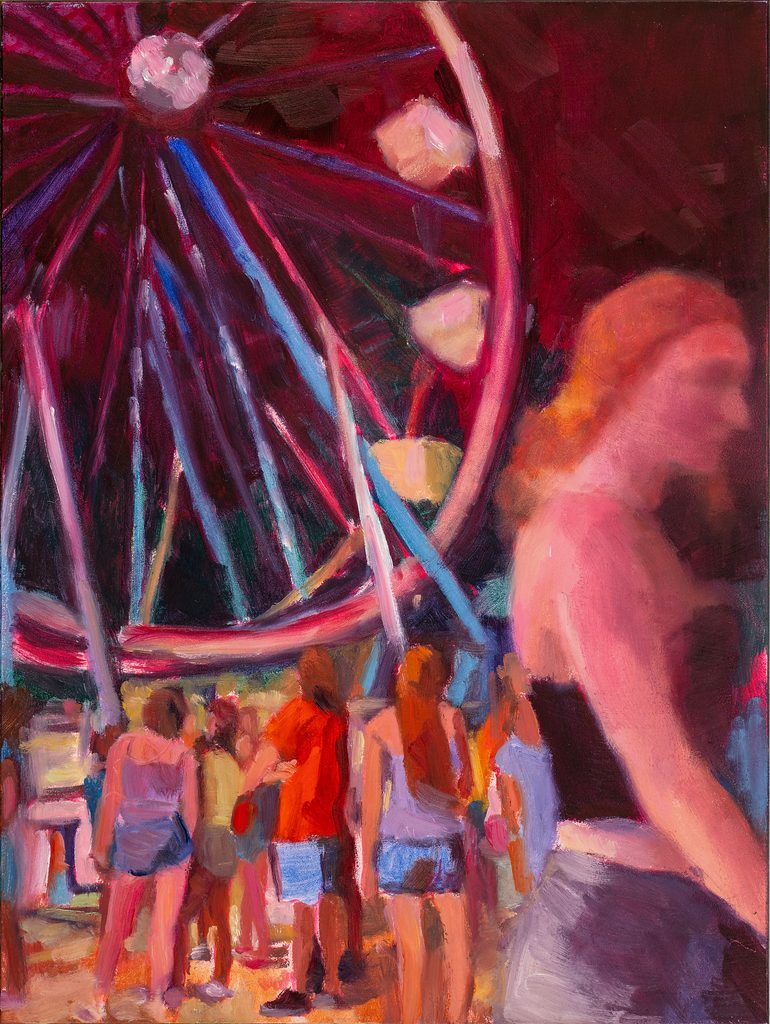
Do you paint portraits of real people? I love how some of your subjects seem to be moving or vibrating, from the buzz of being at the fairground, perhaps, so they are blurred while others are caught in awkward facial expressions. It really creates life in the work.
I do. Occasionally people recognize themselves, which is always fun. But I’m less interested in traditional portraiture than in the relationships between people and all the little stories unfolding around me, and once people realize they’re being watched, their behavior changes. At the fair, I love finding funny little moments. A dad waiting for his kids, a mother taking a much-needed break, the awkwardness of people just standing around.
Do you sell pieces when you are at the fair grounds themselves? How do you engage with the public in situ?
I don’t sell paintings directly at the fair, although I’m happy to give people my card when they ask. Painting at the fair is one of the ways I connect with my community. I get to catch up with friends and neighbors I haven’t seen in far too long. We all lead such busy lives, and suddenly we’re all in the same place. I can paint and talk at the same time, so it’s a lot of fun. Of course, I’ve also had kids bump into my easel, paintings fall into the sand, and all sorts of interruptions. That’s just part of it.
Congratulations on this touching and vibrant show. Visiting it extended summer for me.
Oh, I love that. I hope you were able to get some cotton candy!
Courtesy of the writer
Kathleen Beausoleil: Meet at the Ferris Wheel, at The Painting Center, 547 W 27th St Suite 500, 5th Floor, New York, NY 10001. On view from September 29th through October 24th, 2026. Instagram: @kathleenbeausoleil
About the writer: Xuezhu (Jenny) Wang is a writer and editor focusing on contemporary visual art, culture, and media theories. She approaches multidisciplinary art and design through a theory-based, experimental, and critical lens. She is the founder and Editor-in-Chief of IMPULSE Magazine, and she contributes to esteemed, cutting-edge publications such as Vogue Scandinavia, Cultbytes, Art Spiel, COPY, Artslooker, and Odalisque.