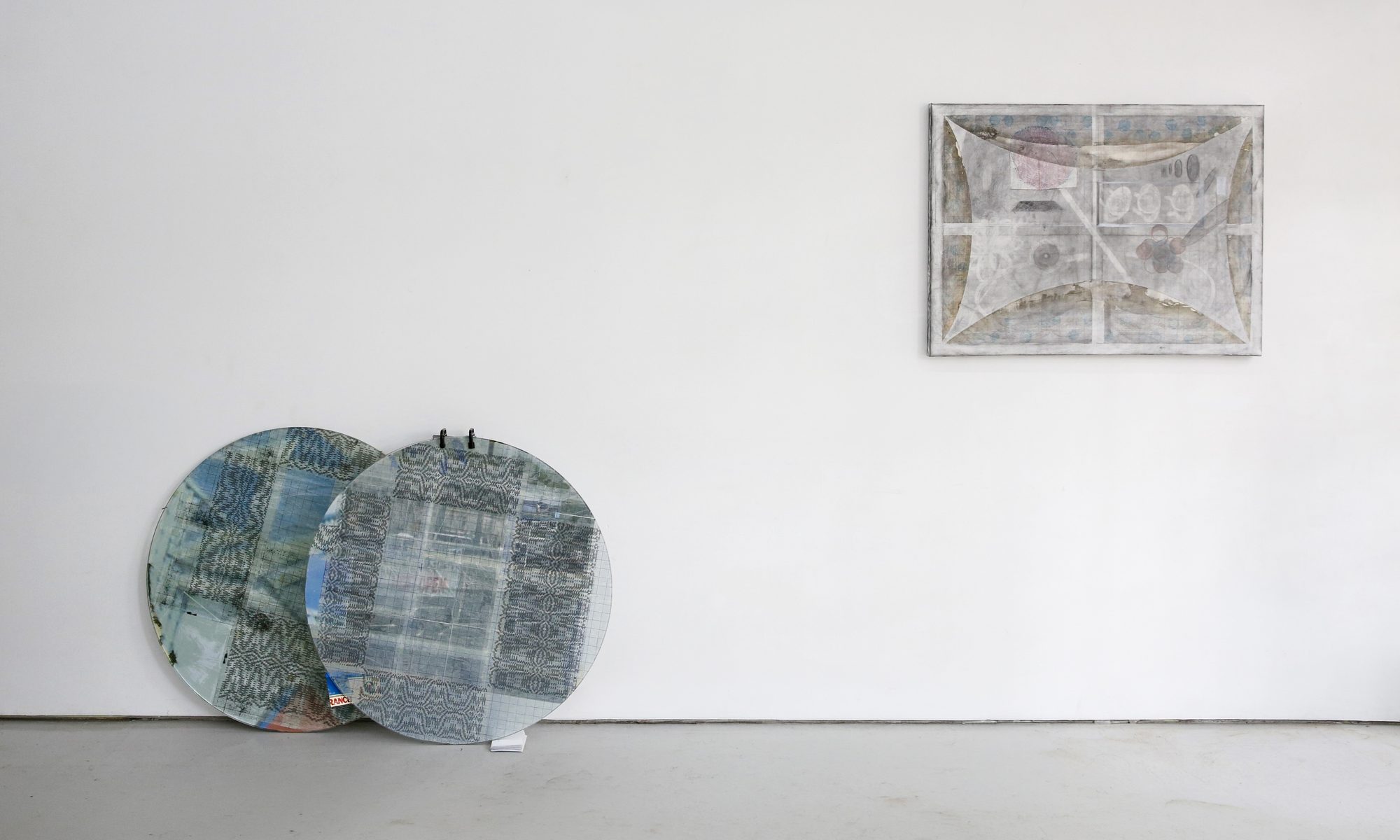
For artists Clare Hu, Tianyi Sun, and Shaan Ken Rao, their residency-then-exhibition is already well past its expiration date. Entering the group show Best by 07/21/2026 may feel more like intruding on a gallery’s installation or deinstallation than attending its finished presentation. Moving blankets are spread across the walking path, with splashes of white paint visible on the quilted fabric. Glass tables lean on white walls. Enter the back room, and you may trip over one of many sandbags, or duck your head under the arm of a swinging C-stand.
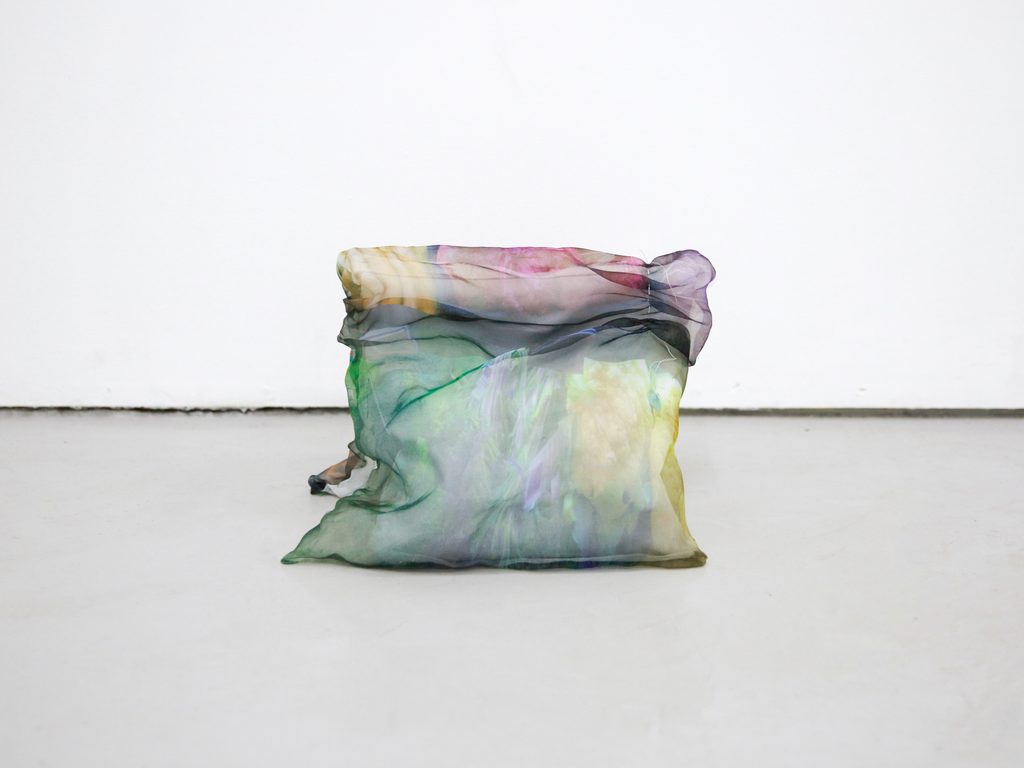
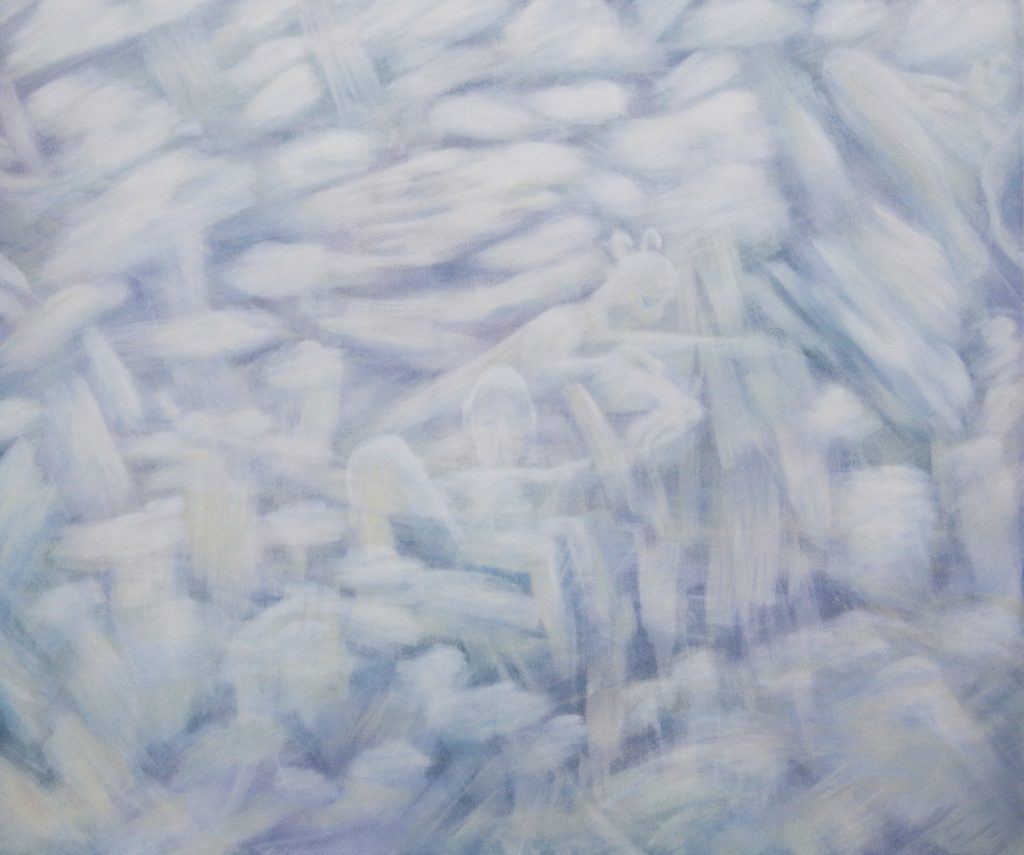
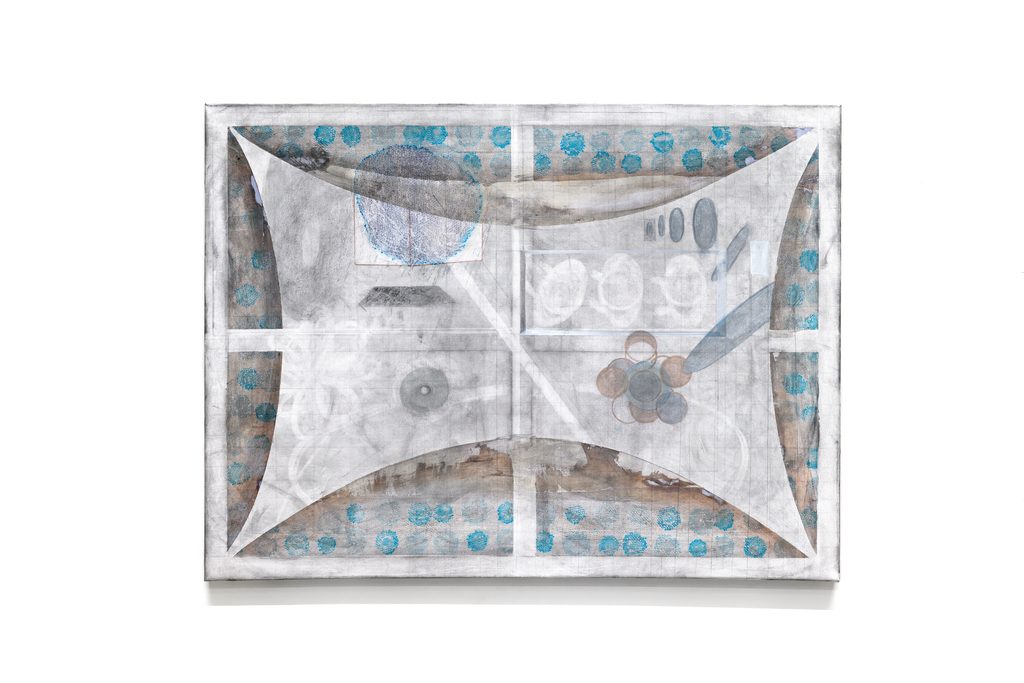
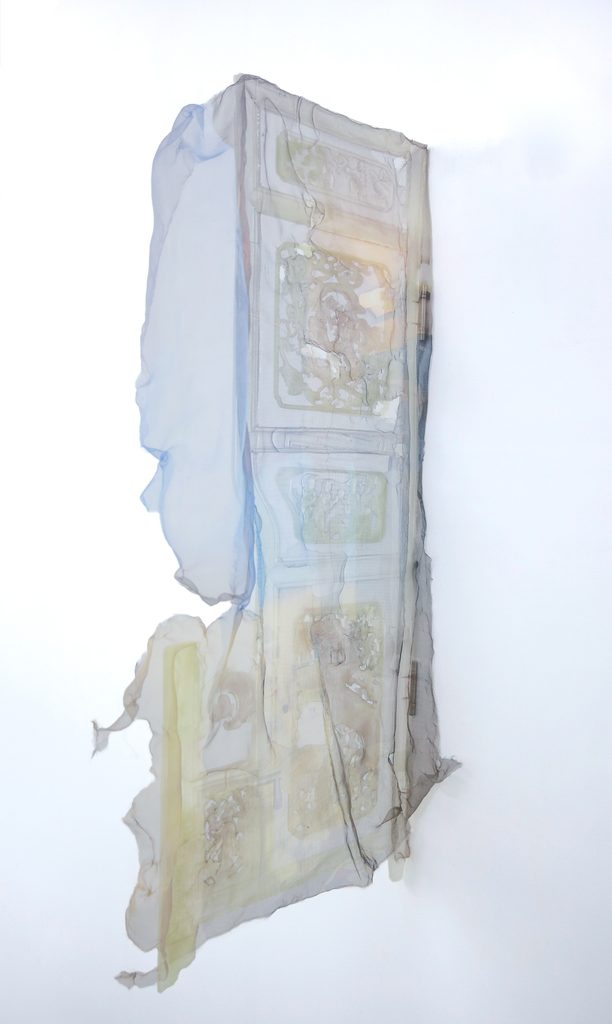
Best by 07/21/2026 is the result of the sophomore residency by Eli Klein Gallery, and the date in the title demarcates its very beginning. Each artist varies in their chosen medium– Hu a weaver, Sun a sculptor and filmmaker, and Rao a painter. The resulting works from the residency however overlap ideas, strategies, and aesthetics in curious ways. Hu’s table series includes five “Lazy-Susans,” ubiquitous in Asian culture, sat atop grid paper and graphite screen prints, their geometric rigidity interwoven with digital prints– a reinvention of her quilt motif in mixed media. Sun experiments with digitally printed semi-transparent material as well. The artist’s central installation Disposable Utensils [Scene 2], (2026) appears in diaphanous gradients of lavender and green, interspliced with digitally printed images hung on C-stands. The gradients are generated spectrogram prints on organza and diffusion silk, translating audio recordings the artist took from Mott and Canal, and 71 Henry Street. Sun’s Pillows which dot the floor, also use digitally printed organza, while red beans and sand give them a hefty, obstructive form; one must step around or risk knocking the whole formation over. Shaan Ken Rao’s two-dimensional paintings follow this interest in transparency by layering graphs, pencil, and acrylic. Rao’s imagery floats dreamily above and below the canvas, as seen in Inside a Pixel (2026) and A Creation (2026), while weaving between aqueous grid lines in Landscape (2026), created by a five-line musical staff pen.
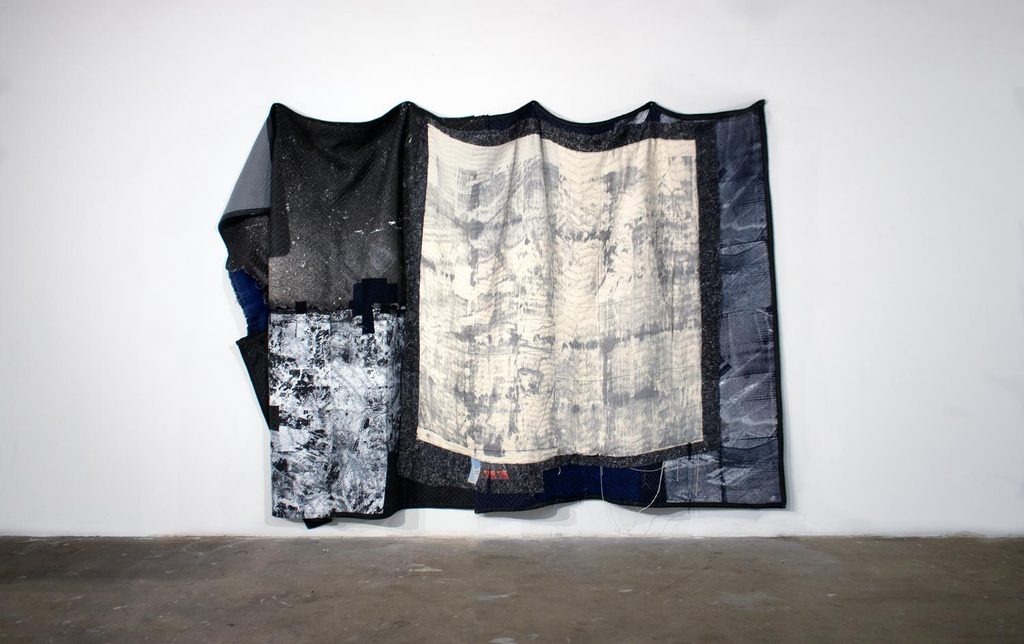
Across the exhibition, pre-residency works provide the origin of the artists’ most recent pieces. Hu’s obsidian textile work Debris (2025) hangs from a wall ledge, allowing a view of raw embroidered threads from the back or along the front, but denying a view comfortably facing its main surface. By the front window, Sun’s resin works Still 03, TC 03:18:25:18 (2026) preserve impressions of old windows, molds created from found antiques.
“Best by” labels are used to suggest a date in which quality will peak, then plateau, or else nosedive. The title of this show considers the gallery show’s own lifespan and expiry: installation takes a week, presentation lasts four to six weeks, and deinstallation occurs as quickly as possible. The result is a six-to-eight-week window– roughly the same length as the gallery’s summer residency. The previously teleological and elegant explanation of art production known as “produce, select, and present” rings less true in the increasingly transparent systems of the art world. In a climate of rising costs, contracting budgets, and institutional retrenchment, to remain in the art world is to attend to its mythological being– both its consumption and parturition, and its excretion and decay. The exhibition exists in ephemera, in diaphanous traces echoes of recorded sound, the transitory play of shadows, the peripatetic arrangement of clamps and moving blankets, film equipment waiting to be used or taken down. Best by 7/21/2026 seemingly points out a missing verb in the transparent model of ‘produce, select, and present’– that is, to discard.
“Best by” is also a mere suggestion, not a definitive; we do not equate it with the imperative “Use by” date. If “Best-by” marks a peak, it also demarcates a time after this period, one which we do not typically allow ourselves to face, but nevertheless exists. Perhaps what follows “Best” is not the fall, but Reconsideration, or Generation, or Experimentation beyond the binaries of product/waste, and un/finished work. Rather than continuing the cycle of produce, select, and present, Best by 7/21/2026 make room for byproducts that have yet to find use– old windows, found images, Lazy Susans, and moving blankets are repurposed as elements of the installation. What comes after the peak? Best by 7/21/2026 suggests it need not be the fall; in fact be the most interesting place for artists to land.
Best by 7/21/2026, exhibits Clare Hu, Tianyi Sun, and Shaan Ken Rao at Eli Klein Gallery, 398 West Street, New York, NY 10014. On view from July 21st through October 31st, 2026. Tue – Sat, 10 AM – 6 PM.
Make your tax-deductible donation today and help Art Spiel continue to thrive. DONATE
About the writer: Chloe Alto is a New York-based writer and founder of CRITCLUB, an organization holding formal studio critiques for artists. She received her BA in art history from Columbia University. Her writing centers on contemporary art, with a focus on Asian and Asian American artists.