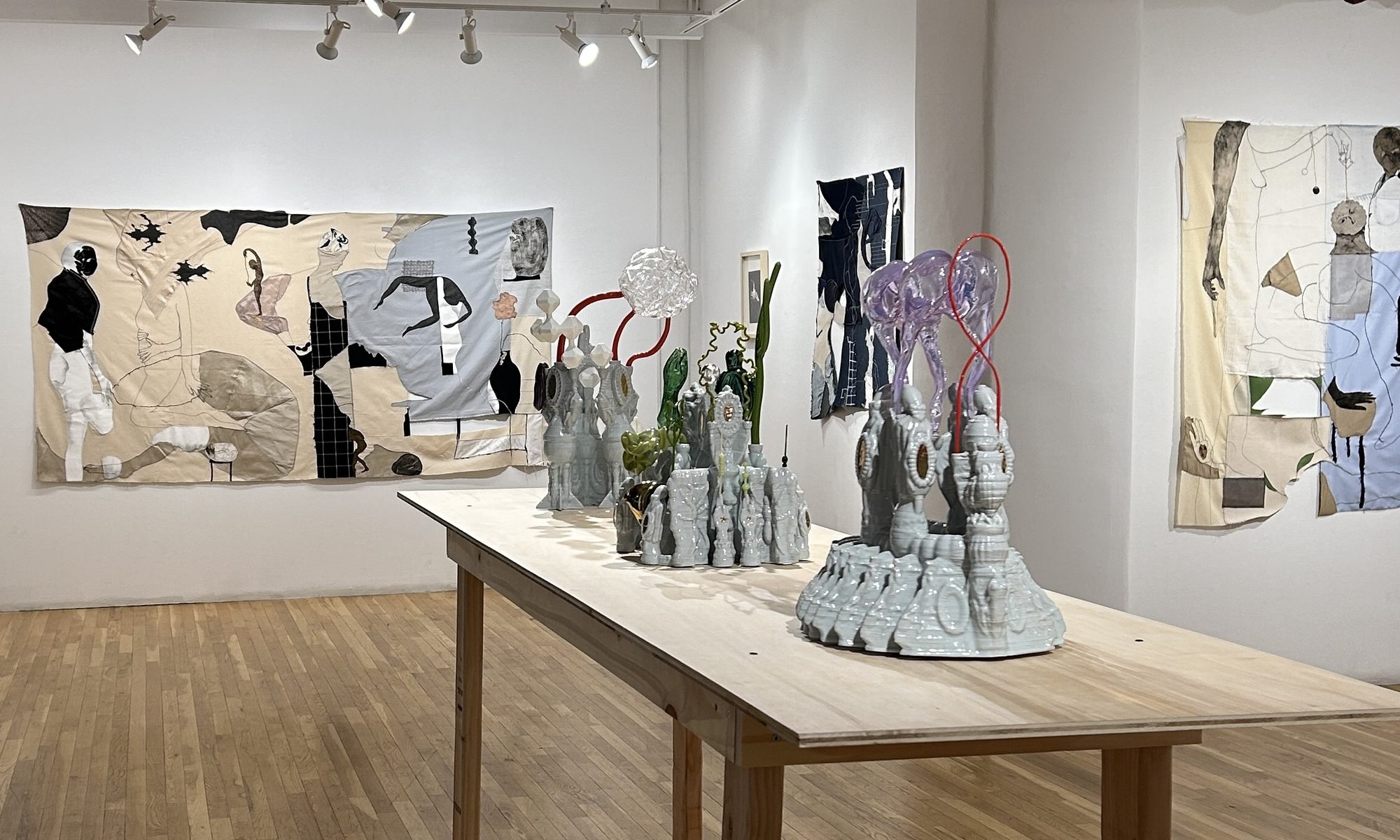
The concept of a vessel offers multiple realities and interpretations that can vary, grow, and expand. In this exhibition titled Vessels: Bodies, Tales & Machines, the idea of a vessel takes the shape of both three-dimensional and two-dimensional works–all of which flow throughout the meandering Westbeth Gallery space. The term vessel itself can be considered a container: its external surroundings, the content, and the internal parts that are often unseen are included with it. These visible aspects of form and material, along with the invisible stories that are nested within the forms, are present throughout the works of the four artists: Jeanne Verdoux, Fanny Allié, and the collaboration between Nicolas Touron and Amy Lemaire. Each artist’s interpretation of a vessel connects the inside to the outside in their own ways and allows viewers to experience each artist’s narrative within their work.
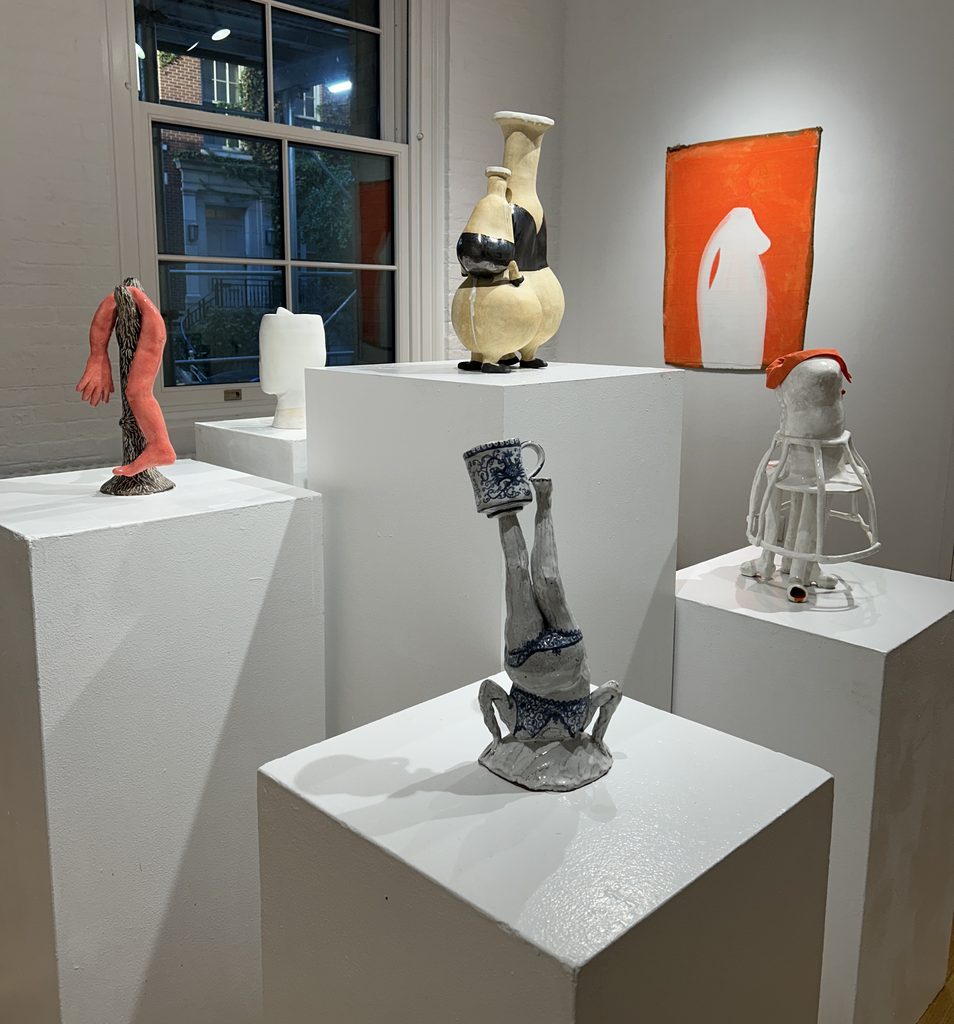
Vessels and bodies are the exhibition’s main foundations. Here, a vessel is not merely a physical one, but also an emotional and mental one. Jeanne Verdoux’s work explores loss, grief, and resilience through surrealistic interpretations of the feminine body. Verdoux is balancing deep emotional weight with humor, placing a figure’s head first in the sand, suspending their body as if they are either floating upward or an unknown force is trying to free them.
Faces, limbs, torsos, and other bodily elements appear to merge, repeat, or resist a clear anatomical reading that we are used to. While it may feel uncanny, it also feels relatable, and provokes a deep sense of empathy within me, especially in the piece with a hand that is melding into a foot, draped over a tree. In this piece, I feel the weight, the heaviness of the body seeking rest, whilst fighting to avoid sliding right between the branches to the ground. Her sculptures fight with gravity to keep their balance, but are anchored by their weight as well as their vibrant colors and tactile textures. Here, the brevity of emotions that are behind the pieces is uplifted with some humor, and the lightheartedness lives on in these vessels just as prominently.
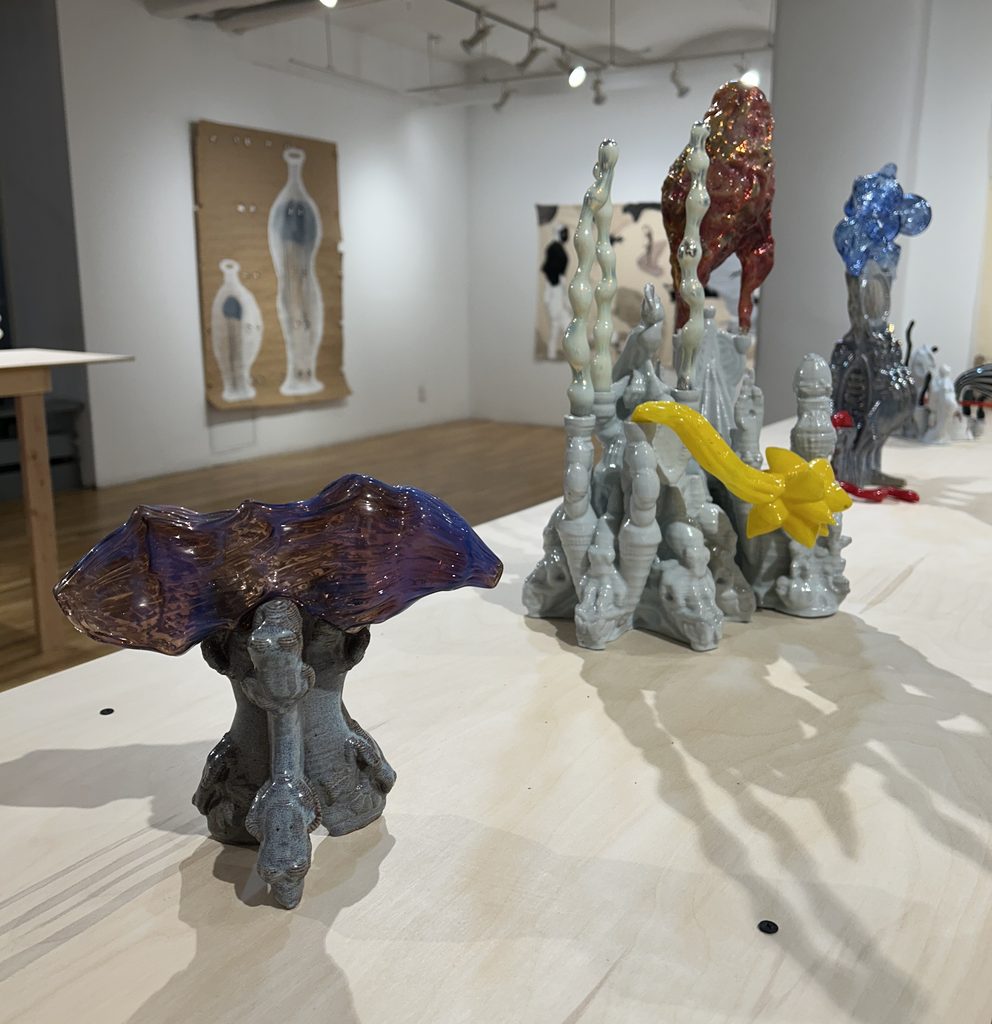
While we may consider vessels to be mostly hollow forms with the potential of being filled-either with life or the rest of the body- many of these works turn that expectation another way- both in the three-dimensional sense and within the two-dimensional works as well. Touron’s 3D-printed forms are vase-like, but he is expanding on the traditional ceramic forms. The shape and foundations are what we come to expect from traditional vessels: a container that is built up and curved. Yet, as we approach, we see the intricate details of the real forms of these vessels- often animals or a combination of several creatures, all of whose bodies are the foundation of a vessel that is already filled by colorful, mystical glass and gilded forms. Allié’s fabric-assembled wall collages throughout the gallery carry the shapes and outlines of the body, either sewn on or attached in other ways. Many of the pieces also show the overlapping of several bodies – insinuating the presence of the form without being fully three-dimensional, and the shape of the cardboard or canvas on the wall becomes the vessel. Here, Allié places bodies, lines, shapes, and other pieces of fabric or found objects into the composition. The composition becomes the vessel, the container for the narrative as the characters move in several directions across the tapestry. Allié is creating a place for these bodies to overlap, move, and lie.
Another aspect of this exhibition that I found really intriguing was the use of hard and soft shapes and edges, as well as how they seemed to seamlessly blend together. While the ceramics and metal works do not necessarily have a definitive place to stop, they still have an edge; it is just unseen, and we assume it is there because the forms stop as the vessel itself. However, in the wall works, especially from the soft canvas and tapestry-like pieces, the edge is definitive. The figures stop moving within the composition when they reach the edge of the canvas or other substrate. This difference in softness and hardness is a constant contrast amongst all the works, which seems to seamlessly pull them all together. The sculpture and drawing with flowing lines, as well as softer canvas pieces, counterbalance the ceramic and glass forms, creating a push and pull. This is felt between the individual works, as the motion of one ends and the motion of another begins; the energy of each seems to flow effectively throughout the room.
The way each artist depicts bodies and varying forms related to it is a testament to how the body and vessels can be so much more than just the traditional forms we know. Allié’s works are layered receptacles made out of discarded materials, with their inner lining turned inside out, as the interior is brought to the outside world. I found it very poetic that she finds stories within the discarded remnants that she uses, as everything does have a story, and once connected to another story, that narrative grows along with the object. Connections become important, and these found objects stand as relics of ephemerality, memory, passage of both stories and time, as well as loss.
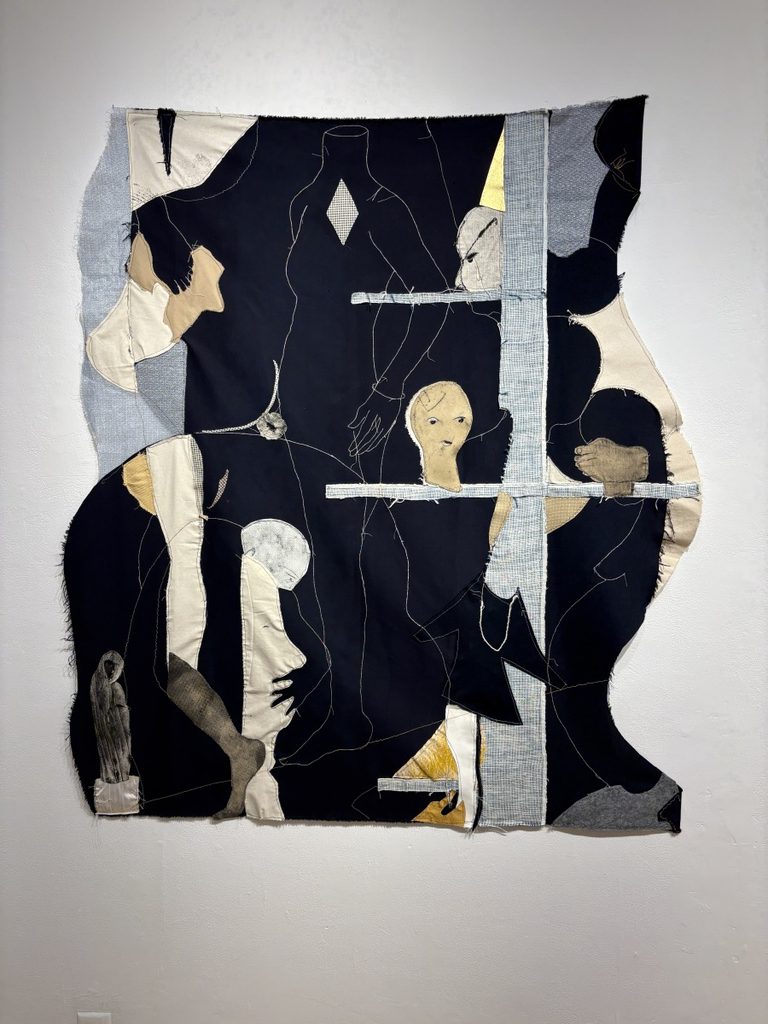
The human figures that inhabit her work constantly travel between these two interconnected spaces of both the inside and the outside. Suspended between the seen and unseen states that we often experience. Her porous and hybridized characters are a result of her relationship to the world, a personal statement, a focus on the internal, but they are also penetrated by the external world: her environment, city life, encounters, observed moments and gestures, and what the world goes through on a daily basis. Here, she records and takes pieces of the external world by means of the material that she brings into the work. Here, passing through the everyday intertwines with internal memories or feelings of what the outside world may bring, and the pieces she builds up and assembles become an illustration of all of those experiences. Connection becomes an important foundation for these vessels and bodies, because the meanings behind them or their material are just as potent with both potential and memory.
Throughout the exhibition, pieces connect to create a whole new piece, resulting in a strong sense of collaboration that emanates throughout each room. Whether it be through overlapping figures, forms, materials, or sculptures atop wooden tables creating conversations with several of the wall works. Another intriguing collaboration came from the artist duo of Nicolas Touron and Amy Lemire. Touron’s vessels use a 3D method of creation to build up elegant forms that are both mystical and energetic. By using fine details, filigree, and animal forms, Touron becomes an oral storyteller. Through enhancing and embellishing his partly open and partly closed porcelain sculptures each time they are created, he creates vessels that hold the symbolism of the creatures that make them – whether it be a praying mantis or a flowing sea creature. The visual fables that emerge from those openings he leaves is from Borosilicate glass which is then added, in collaboration with glass artist Amy Lemaire.
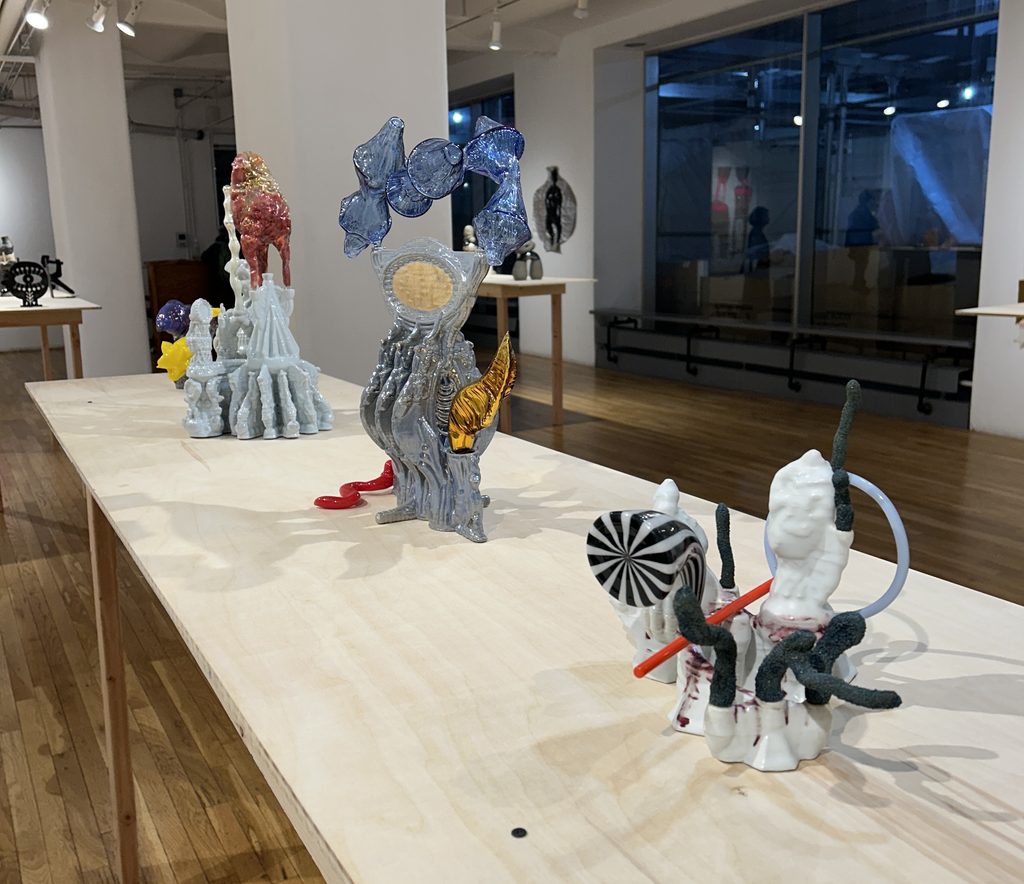
Amy Lemaire’s glasswork is ethereal and spellbinding. Offering spontaneous pops of color throughout the exhibition’s mostly earthy and muted color tones, Lemaire’s forms make the 3D-printed forms come even more to life. Foiling the humorous figures and creating narratives of the other works, this collaboration of clay and glass creates phantasmagoric universes in which surreal beings emerge. Using forms that are reminiscent of octopuses and other elegantly flowing sea creatures, the glass brings a sense of the uncanny and unknown. This being anchored within known forms or forms of recognizable creatures such as the octopus or praying mantis, which we can latch onto, lets us fill in our own stories as we experience these forms.
Stepping into this exhibition, I came in expecting mainly a focus on vessels in the sense that I am used to; however, I was surprised to discover the artists took the idea of vessels to a whole new level. Potential became a significant word that seemed to keep coming up while thinking through this exhibition. The vessels full of potential and memories spoke to me first, while seeing the body standing in as a significant vessel was exciting. The wallworks added a sense of motion to the gallery as the ceramics pulled in a sense of humor, weight, and narrative. Each work activates the space and the conversations about how the artists see vessels and bodies continue to expand.
Vessels: Bodies, Tales & Machines, exhibiting Jeanne Verdoux, Fanny Allié, Nicolas Touron and Amy Lemaire, at Westbeth Gallery, 57 Bethune Street, New York, NY 10014. On view from October 16th through October 31st, 2026. Hours: Wed.- Sun., 1- 6 p.m
Make your tax-deductible donation today and help Art Spiel continue to thrive. DONATE
About the Writer: Taylor Bielecki lives in Gowanus, where her studio is, and works at Pratt Institute, where she earned her MFA. She also studied at Penn State, where she earned a BA in English and a BFA in Fine Arts. She finished as a finalist in the Kennedy Center’s VSA National Emerging Young Artist program for 2017, where she earned an award of Excellence. She has shown prints internationally in a print exchange in Australia and exhibitions in Dubai, India, and the Glasgow School of Art. She has also shown paintings internationally in Gallery 24N, PhilaMOCA’s juried exhibitions in Philadelphia, Pa., Perry Lawson Fine Art in Nyack, NY, BWAC in Red Hook, and IW Gallery in Brooklyn. Taylor works for Two Coats of Paint, TUSSLE Magazine, and has joined Art Spiel as a contributing writer. @Taylor.Bielecki