An autumnal lineup of exhibitions at Wave Hill delve into the splendor of the landscape through intersections of nature, societal transmission, history, and political climate. These engagements are created through processes involving acts of listening, archival practices, explorations of bodily autonomy and mythologies. The following is an interview with Wave Hill curators Rachel Gugelberger and Gabriel de Guzman, unpacking key takeaways about its most recent projects.
Wave Hill has a vast selection of exhibitions on view currently. There are recurring multidisciplinary and thematic elements that each artist is exploring: artistic mythologies, complexities of existence, flora and landscape, environmental factors, care and sentience, bodily forms, and more. How do the exhibitions intertwine through the viewing experience?
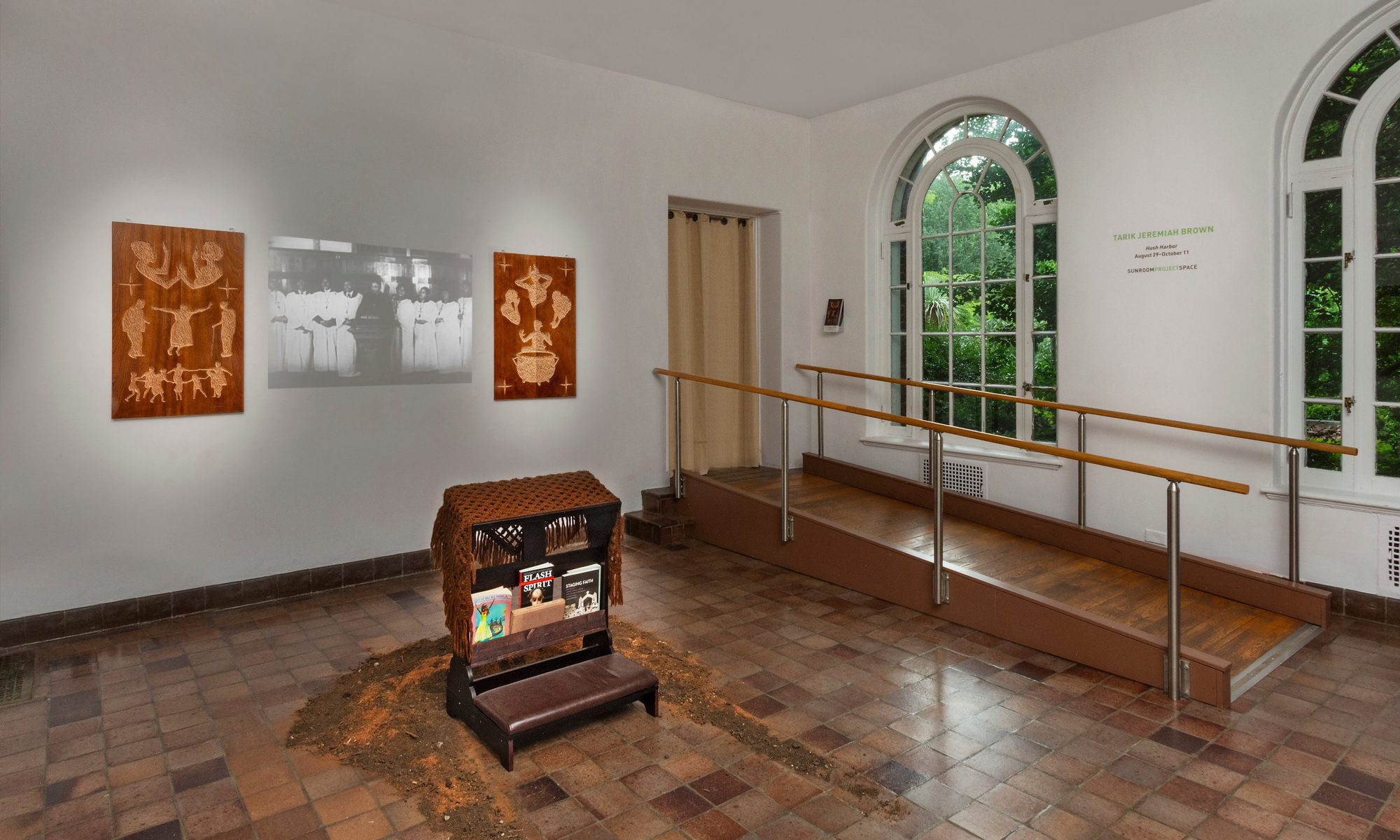
WH: All of our exhibitions are rooted in the intersection of art, culture, and place. Exhibiting artists respond to Wave Hill’s unique site in varied ways—some engaging with its plant collections, garden design, and landscape, while others explore its social history and architecture as a former private estate. Touch points of our current exhibitions include the impact of war on people and landscapes; clandestine outdoor spaces known as hush harbors as a site of spiritual and liberatory refuge; how society views trans people through the lens of entomology; the musical score as a visual and conceptual framework to explore the natural world; and the activation of sound within landscapes shaped by migration, environmental precarity, and political struggle. Tarik Jeremiah Brown’s Hush Harbor and Camille Cooper’s SHOWPIECE transform the Sunroom and Sun Porch respectively, into containers of layered histories, transforming the architecture and landscapes into frameworks for considering refuge, visibility, survival, and transformation. Drawing from Black church traditions, literature, archival research, his family’s musical legacy, and the woodlands of Wave Hill, Brown explores the histories of Black survival, memory, and imagination, particularly those that originated in the Antebellum period. Hush harbors were clandestine gathering places where enslaved Black communities worshiped and fostered resilience beyond their captors’ surveillance. Through sculpture, Super 8 film, and sound, Brown created a multisensory environment that invites viewers to engage with the work through the body and the senses, offering quieter forms of knowledge otherwise erased from historical archives.
Are there additional aesthetic or conceptual overlaps that converge that would be helpful for readers to know and unpack further, including what the selection process is like, and how they work within the unique spaces on the grounds?
WH: The selection process for our exhibitions varies depending on the space and program. In Glyndor Gallery, we present both solo and thematic group exhibitions. We conceive, develop, and present exhibitions and related programs around themes that offer new ways of thinking about the relationship between nature and culture, while continually expanding and challenging the meanings we assign to both. The perceived binary between nature and culture provides a productive framework for examining how we understand ourselves and the extent to which we look to the natural world to shape and reinforce belief systems, social norms, and personal and political ideologies. The more closely we consider the diversity and complexity of what we call the natural world, the more apparent it becomes that “nature” is not fixed or singular, but an open-ended spectrum that can encompass multiple realities, perspectives, and possibilities for interpretation. The Sunroom Project Space exhibitions are selected through an annual open call that offers artists in the New York City area and in the early stages of their careers—regardless of age and education—a chance to present a site-specific, solo project in the Sunroom or Sun Porch of Glyndor Gallery. Wave Hill invites proposals for artist projects that thoughtfully respond to and engage with the site of Wave Hill—its plant collections, history, design, and architecture—with a focus on the interconnected relationships between nature, culture, and place, including its location in the Bronx. Many of the ideas for exhibitions at Wave Hill House are informed by or supplemented by submissions to general opportunities at Wave Hill. As Wave Hill House is the busiest building on the grounds, housing our cafe and program and conference spaces, these exhibitions focus primarily on two-dimensional works. Artists for outdoor art projects are selected from a combination of factors, including open calls, curating artists who have experience presenting public art, or approaching artists who have participated in Wave Hill’s Winter Workspace residency and are familiar with the site. These outdoor installations involve working closely with the artists in conjunction with our Horticulture team and facilities staff to develop projects that respond to aspects of Wave Hill’s grounds, landscape, plant collection, history, and architecture, while addressing logistics, feasibility, and safety concerns. Often, the outdoor artworks presented are related to exhibitions shown in Glyndor Gallery or Wave Hill House, and periodically, these works are standalone, site-wide projects that offer an opportunity for visitors to experience the gardens and grounds in an engaging way.
Each artist embraces Wave Hill’s architecture uniquely and with poignancy. What is this installation process like in each instance?
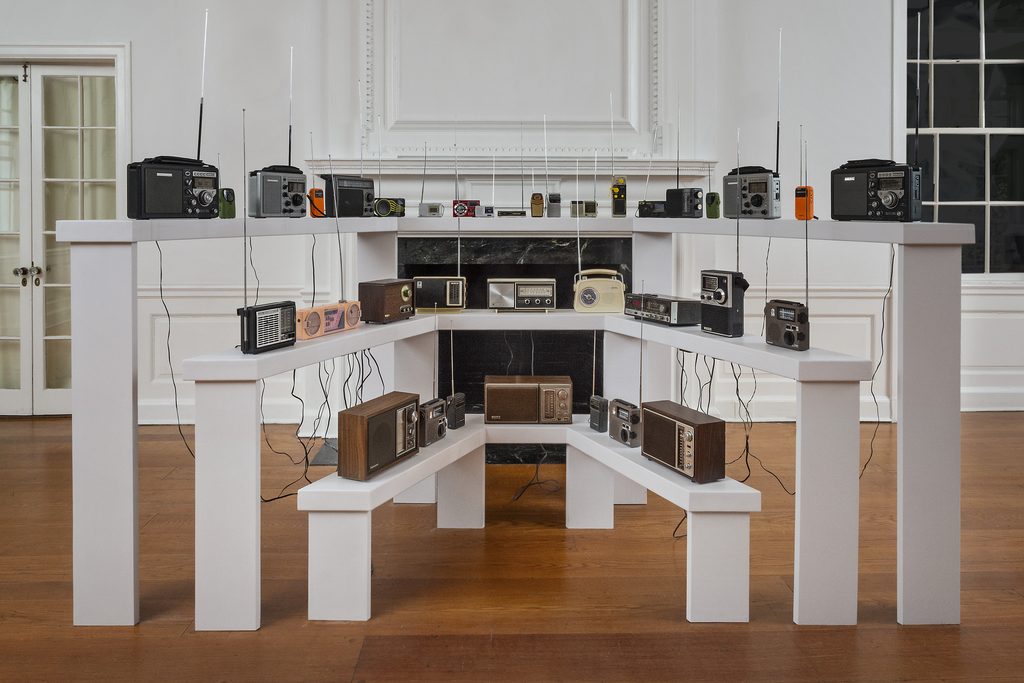
WH: Our current exhibitions are a great example of how varied artists’ practices and methodologies are represented, and what types of works can emerge in response to the garden and domestic architecture of Wave Hill. We are far from a “white cube.” At Glyndor House, art is presented in a former Georgian Revival red-brick building with fireplaces, chair rails, wainscotting, architectural molding, as well as abundant windows with garden and Hudson River views. It is impossible to ignore the history and garden context. Take for example the sound installation On Toscanini (2026) and Sonora (2017) included in Angel Nevarez & Valerie Tevere’s exhibition As far as the ear can hear. On Toscanini was conceived during the artists’ 2025 Winter Workspace residency at Wave Hill. The work centers on the musical legacy of Italian conductor Arturo Toscanini (1867–1957), who fled fascism in Italy and found refuge at Wave Hill from 1942 to 1945. It explores nonverbal forms of communication through archival images of Toscanini’s conducting hands wrapped around the walls and accompanied by an artist-designed operatic soundscape of Ferde Grofé’s Grand Canyon Suite (1929–1931) broadcast through an orchestra of FM radios. Eschewing a traditional portrait of Toscanini, the spirit of the conductor is channeled through radios and the television screen featured in an archival photo nearby, that shows a young girl sitting on a man’s lap watching Toscanini conducting from his studio at the NBC Symphony Orchestra. In the single-channel video Sonora, viewed on a monitor, the artists transform Harry Torrani’s 1937 “Mocking Bird Yodel,” an American folk song, into an audiovisual meditation on communication across the Sonoran Desert. Installed on a green-painted wall and accompanied by two potted aloe vera plants, Sonora (2017) extends its meditation on communication and contested landscapes into the architecture and grounds of the house. The green wall and living plants create a subtle dialogue between the interior and the surrounding landscape, while the views of the Hudson River Valley evoke the long tradition of Hudson River landscape painting and its construction of the American landscape as both sublime and possessable. Like the Sonoran Desert, the Hudson River Valley is not an untouched wilderness, but a landscape shaped by histories of Indigenous dispossession, migration, settlement, and contested belonging.
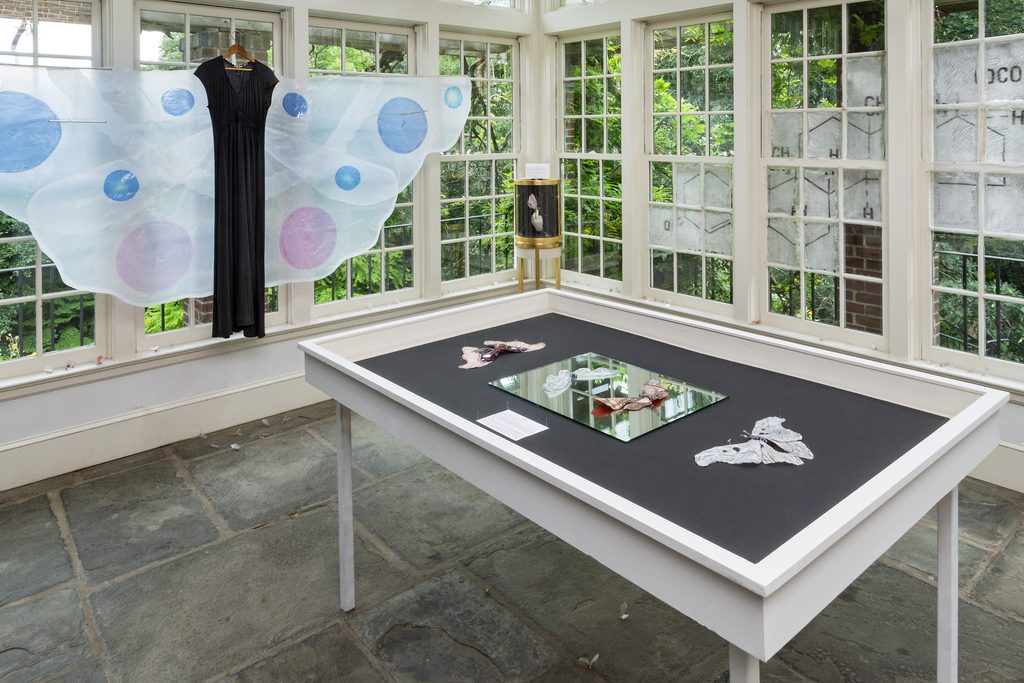
WH: Cooper reimagines the Sun Porch as a natural-history showroom, placing Wave Hill’s botanical and ecological context in dialogue with the museum conventions of entomological display. Using “transgender ephemera,” including hormone replacement therapy packaging and prescription papers collected from his community, Cooper meticulously crafts each insect—moths, a praying mantis, and cockroaches—as a celebration of gender variance. In drawing parallels between society’s treatment of trans people and our perceptions of insects, the work challenges assumptions about disgust, difference, and visibility.
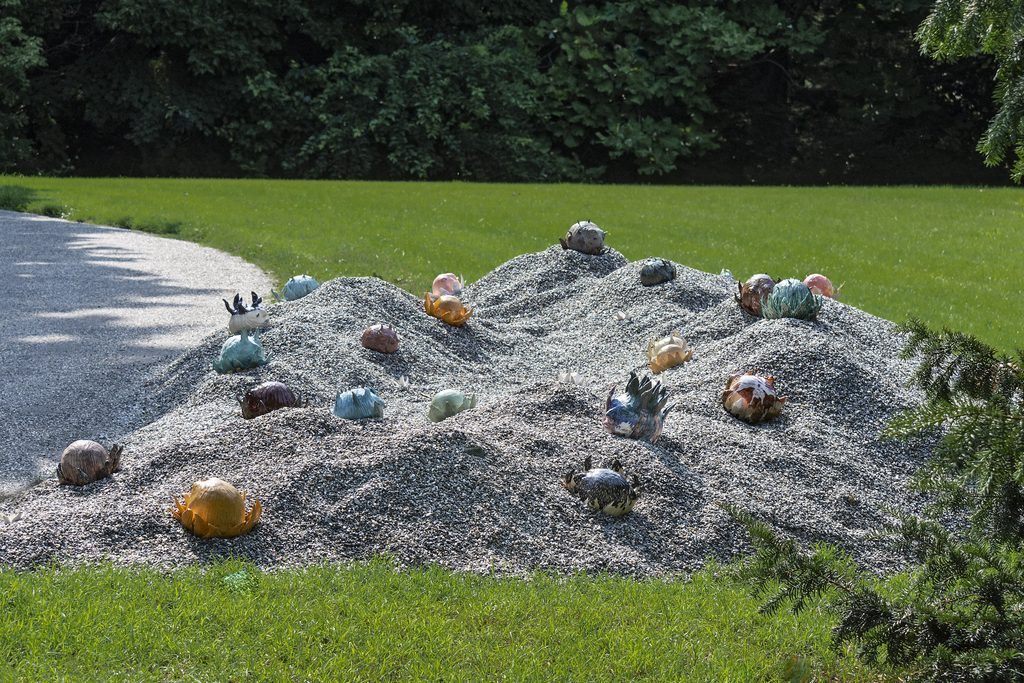
WH: Noormah Jamal’s installation Blooms is situated outdoors, so this involved collaboration with the horticulture staff. The artist was a Winter Workspace resident at Wave Hill, meaning she had a studio in Glyndor Gallery for 7 weeks during the winter. Being on site regularly and getting to know the grounds helped her rethink an installation that she had previously only shown inside for the outdoors and Wave Hill’s landscape in particular. Preparing for this installation involved a lot of communication, planning, and problem solving alongside the horticultural team, who were amazing to work with. When it came time for the actual installation process, it was all-hands-on-deck with gardeners, art staff, and the artist herself prepping the land, shoveling gravel and shaping the mounds.
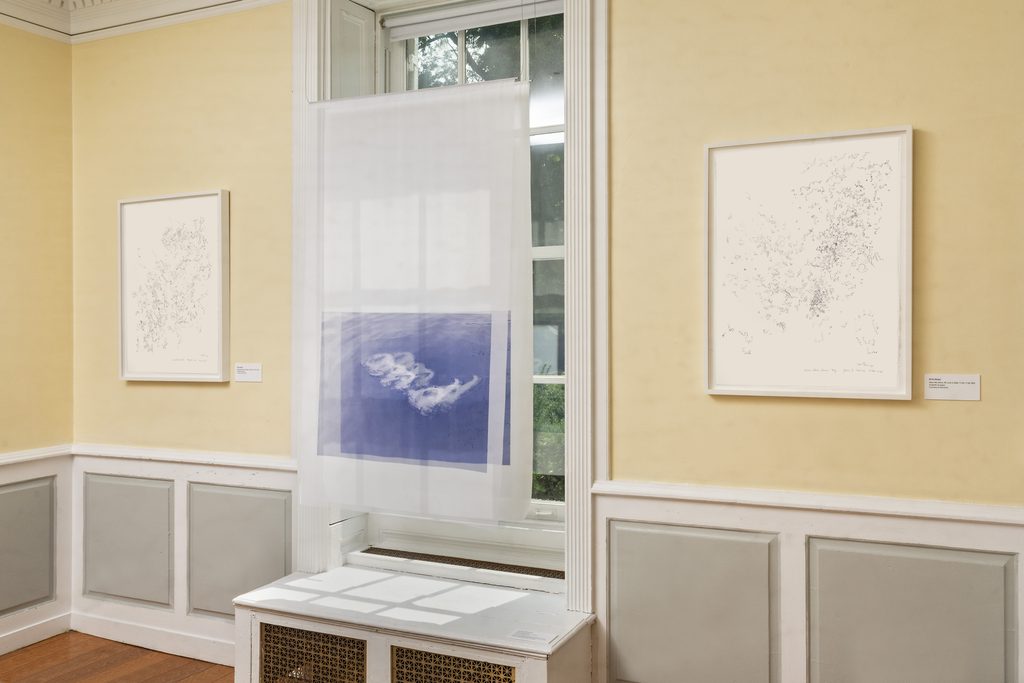
WH: Like Glyndor Gallery, Wave Hill House is also a converted home rather than a traditional gallery space. Because the cafe and dining areas are located there, several factors, such as placement of the artworks, need to be considered when curating there. All of the work in Dots & Loops is site-responsive in some way. Take for example, Rita Maas’s drawings which were all created onsite at Wave Hill through a deep listening practice the artist developed in which she draws the birdsongs she hears at different gardens. Other work in the exhibition engages Wave Hill’s architecture more directly. Jen Chen-su Huang’s work takes up and reconfigures archival images of Wave Hill’s greenhouse in states of disarray, placing them next to musical scores and weaving patterns to explore the way in which gridded forms can represent language and convey a multiplicity of meanings. Audra Wolowiec was thinking a lot about the unconventional exhibition space. She designed work specifically for certain underutilized nooks and crannies, including in front of a window and inside the fireplaces.
What were the defining factors of curating each exhibition, and what else would you like readers to know?
WH: Our ideas about what constitutes art, like our ideas about nature, could be more expansive. Art, like the natural world, can hold and reveal a broad range of stories shaped by diverse and complex lived experiences. In doing so, it can expand our understanding of human, nonhuman, and plant worlds—and the intersectional relationships between them. A driving force behind our curatorial choices at Wave Hill is to find works that expand our conceptions of nature and culture, blurring the distinctions between them. This includes understanding the intertwined relationship between ourselves—our very human experiences, desires, struggles, and feelings—and the natural world. In many cases, our artists convey their point of view through their experience of nature, whether that is exploring migration through birdsong (as in Nevarez and Tevere’s Sonora), finding resonance between their own gender transition and the metamorphic cycles of insects (as in Cooper’s SHOWPIECE), or connecting with one’s history through recreating ancestral embodied experiences in the woods (as in Brown’s Hush Harbor). In each of these examples, as well as in Jamal’s Blooms, an intuitive relationship between the artist’s interior and exterior landscapes meets an intellectual curiosity and care for the lives of those who have been pushed to the margins of society. Exploring colonialism, gender issues, trans rights, race relations, slavery, and immigration in our current exhibitions, nature becomes a lens, a metaphor, and a source of comfort for those who are excluded from traditional narratives, just as nature itself is often left out of our anthropocentric worldview.
Wave Hill, 4900 Independence Avenue, Bronx, NY 10471. Hours: Tue – Sunday, 10 AM – 5:30 PM, with last entry 30 minutes before closing.
Make your tax-deductible donation today and help Art Spiel continue to thrive. DONATE
About the curators:
Gabriel de Guzman is Director of Arts & Chief Curator at Wave Hill, where he oversees the visual and performing arts program, including contemporary art exhibitions in Wave Hill’s galleries and on the grounds, as well as outdoor music, dance performances, and indoor concerts. Previously, de Guzman held curatorial positions at Smack Mellon, Brooklyn, and The Jewish Museum, New York. As a guest curator, he has also presented shows at Site: Brooklyn, Dorsky Gallery Curatorial Programs, The Bronx Museum, BronxArtSpace, Dyckman Farmhouse Museum, Rush Arts Gallery, En Foco at Andrew Freedman Home, the Affordable Art Fair New York, and Northern Manhattan Arts Alliance. His essays have been published in Nueva Luz: Photographic Journal and in catalogues for the Museum of Arts and Design, Taller Puertorriqueño in Philadelphia, the Arsenal Gallery at Central Park, Kenise Barnes Fine Art, and the art institutions mentioned above. PoliticsNY and amNY included de Guzman on their 2025 Power Players in Arts & Culture list. He earned an M.A. in art history from Hunter College and a B.A. in art history from the University of Virginia. Gabriel de Guzman: @gabrield3 ; https://www.facebook.com/gabriel.deguzman3
Rachel Raphaela Gugelberger is a New York City–based curator whose work focuses on place-based practices and socio-cultural themes. She is currently the Curator of Visual Arts at Wave Hill, a public garden and cultural center in the Bronx, where she organizes the Sunroom Project Space program. Exhibitions include Angel Nevarez & Valerie Tevere: As far as the ear can hear at Wave Hill; An Incomplete Haunting at 601Artspace; in pieces at PS122 Gallery; Bound up Together at Smack Mellon; and Jameco Exchange, presented in a vacant storefront in Jamaica, Queens. Previously, Gugelberger served as a guest curator for Residency Unlimited’s New York City–based artist residency program, supporting artists and research-based projects underrepresented in the arts. She also worked as Associate Curator at No Longer Empty (NLE), a nonprofit organization known for site- and community-responsive exhibitions in unique, non-art locations such as vacant storefronts and landmark buildings, where she directed the NLE Curatorial Lab. She holds an MA in Curatorial Studies in Contemporary Art and Culture from Bard College, New York. @rachelgugelberger ; https://www.facebook.com/rachel.gugelberger/
Afriti Bankwalla is a Parsi-Zoroastrian researcher, writer, and curator based in Harlem. Her research interests include queer vernacular performance, feminist performance and conceptual art, and dolls and puppetry. Bankwalla has curated exhibitions independently and as a part of the curatorial team at Wave Hill. Recent projects include Noormah Jamal: Blooms (Wave Hill, Bronx), Dots and Loops (Wave Hill, Bronx), and Interior Motives (Sophia’s Apartment, Philadelphia). Bankwalla’s art writing and interviews have been published in District Fray, Brightest Young Things, Optic Nerve, Skirt Chasers Local, and No Dear among others. Bankwalla enjoys collecting dolls, reading biographies about eccentric women, and walking in Riverside Park. She earned an MA in performance studies at NYU Tisch.
@a_free _tea
About the writer: Yasmeen Abdallah is an interdisciplinary artist, curator, and writer. She has been an artist/educator/lecturer at institutions including the New Museum, Pratt Institute, Sarah Lawrence College, Residency Unlimited, BRIC, Kean University, Parsons, Civic Art Lab, Creative Time, Columbia University, Children’s Museum of NYC, El Barrio Artspace, Interference Archive, Fairleigh Dickinson University, and University of Massachusetts. She holds Bachelor’s degrees in Anthropology and in Studio Art, with honors from the University of Massachusetts. Abdallah also earned an MFA in Fine Arts, with distinction, from Pratt Institute. Exhibitions include ABC No Rio; Ankhlave Arts Alliance; Art in Odd Places; Bartow-Pell Museum; the Boiler; Bronx Art Space; Bullet Space; Chashama; Clemente Soto Velez Cultural Center; Cornell University; Darb 1718 Gallery; Ed Varie; Elizabeth Foundation; ELY Center of Contemporary Art; The Factory LIC; Fairleigh Dickinson University; Flux Factory; IW Gallery; Kean University; La Bodega; Museum of Reclaimed Urban Space; NARS Foundation; Nine; Open Source; Peep Space; Pratt Institute; PS122 Gallery; Red Hook Public Library; Satellite Art Fair; Space 776; Spring Break Art Show; Stephen St. Gallery; Swale; 601 Artspace; Tappeto Volante; Tempest; Trestle; University of Massachusetts; Westbeth Gallery; Whitebox; and Yonkers Public Library, among others. Publications include Anthropology of Consciousness; Ante Art; Art Observed; Bust Magazine; Emergency Index; Free City Radio; Hot Coffee Conversations; Hyperallergic; Impulse; Papergirl Brooklyn; Radio Alhara; Transborder Art; Tussle Magazine; and Urban Activist. Her work is in public, private, and traveling collections in the U.S. and abroad. @86cherrycherry
Artists’ social media:
Angel Nevarez & Valerie Tevere: @nevarez-tevere
Tarik Jeremiah Brown: @tarikjeremiah
Camille Cooper: @camelcooper
Noormah Jamal: @noormah.jamal
Sonya Posmentier: @posmentier
Audra Wolowiec: @audra.wolo
Rita Maas: @ritamass
Jen Chen-su Huang: @hepoosclouds
ᐧ