History has always depended on materials. Marble, oil paint, bronze, woodcuts, engravings, museum vitrines, and photographic reproductions preserve the past as well as determine how events, ideas, and narratives are represented. Over time, images become durable, gaining a certain kind of truth value because they acquire material permanence and spread through copies. Mythological heroines, biblical women, allegorical figures, and historical subjects return across centuries through the persistence of artistic media, carrying with them the assumptions, hierarchies, and ideologies embedded in their forms. Melora Kuhn‘s solo exhibition, The Legacy of Disembodiment, on view at Private Public Gallery, starts with the recognition that if representation has helped naturalize and proliferate the narratives these images and forms carry, then materials themselves can be a site of political intervention.
Continue reading “Melora Kuhn’s Power of Erasure and Material Revision”Jenny Holzer’s Hypocrisy
Opinion

“I want people to concentrate on the content of the writing and not ‘who done it.’ I want the work to be of utility to as many people as possible. And I think if it were attributed to me, it would be easier to toss.”
Quote by Jenny Holzer from Art21
Recently, I wrote an opinion piece on the suspect politics of Maurizio Cattelan’s show at Gagosian Gallery — it questioned why successful artists who make political claims for their work do not use their privilege to engage in direct political commentary and action rather than critique by analogy. I’m not suggesting they need to engage in social practices like Mel Chin or Tania Bruguera; I think artists like Cattelan can be more direct in their criticism or more like Theaster Gates, who acknowledges the contradictions and privilege that comes with his success to the degree that he openly differentiates between museums and institutional exhibits that permit him to experimentation and his gallery exhibits that afford him market engagement. Meanwhile, while those works have an implied politic, he is an activist who focuses on community development, which is realized through his Chicago-based Rebuild Foundation, which is a platform for cultural development and neighborhood transformation. This multifaceted approach enables Gates to navigate and influence both the art world and broader societal issues without collapsing one into the other.
Continue reading “Jenny Holzer’s Hypocrisy”Dee Shapiro – From Fibonacci to Bathers

The artist at the Islip Museum. “Cornered”, watercolor on graph paper, 40 x 40 inches, 1975-76
Dee Shapiro’s paintings have evolved over decades of a rigorous thematic and formal search—how colors and shapes can express the intricate relationship between pattern, geometry, and nature through a two- dimensional form? With what appears to be a strong impetus to constantly re-invent her painterly vocabulary, Dee Shapiro’s work keeps us on our toes with each of her series of work, which she sees overall as evoking an alternate reality with absurd connection. From her early Fibonacci progression color coded on graph paper, to her later representational Bathers series–Shapiro’s paintings assert themselves with a life of their own, without a need for any explanation.
Continue reading “Dee Shapiro – From Fibonacci to Bathers”Museum as Muse at the Flatiron Project Space

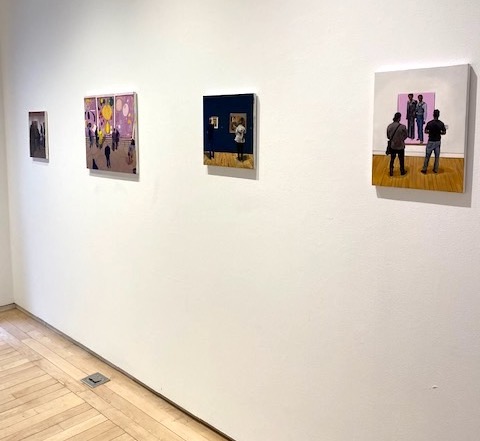
A favorite experience of mine is to visit the Metropolitan Museum without a show or work of art in mind to see. I enjoy wondering the galleries until I come across something I had not noticed before and then spend the time looking and analyzing the work. This experience is likened to one I have recently had at “Museum as Muse”, a show curated by Leigh Behnke, consisting of works by the artist herself, Joe Fig and Peter Hristoff. The show is not at a sprawling Chelsea gallery or at a small, but relevant Lower East Side venue. It is tucked away within the confines of an academic institution, School of Visual Art, located on 21st Street in the SVA Flatiron Gallery Project Space. As the title suggests, all three artists have used the museum in some capacity as a starting point for their work.
Continue reading “Museum as Muse at the Flatiron Project Space”Valerie Hegarty – Memory of a Place
In Valerie Hegarty’s work, autobiography, history, and art history merge seamlessly into engaging installations with a distinct sense of place – visceral and subtle, layered and focused. An inquisitive rigor runs through her work, stirring in the viewer an appetite for more. Valerie Hegarty shared with Art Spiel some thoughts on art making, her own art journey, and some of her upcoming projects.