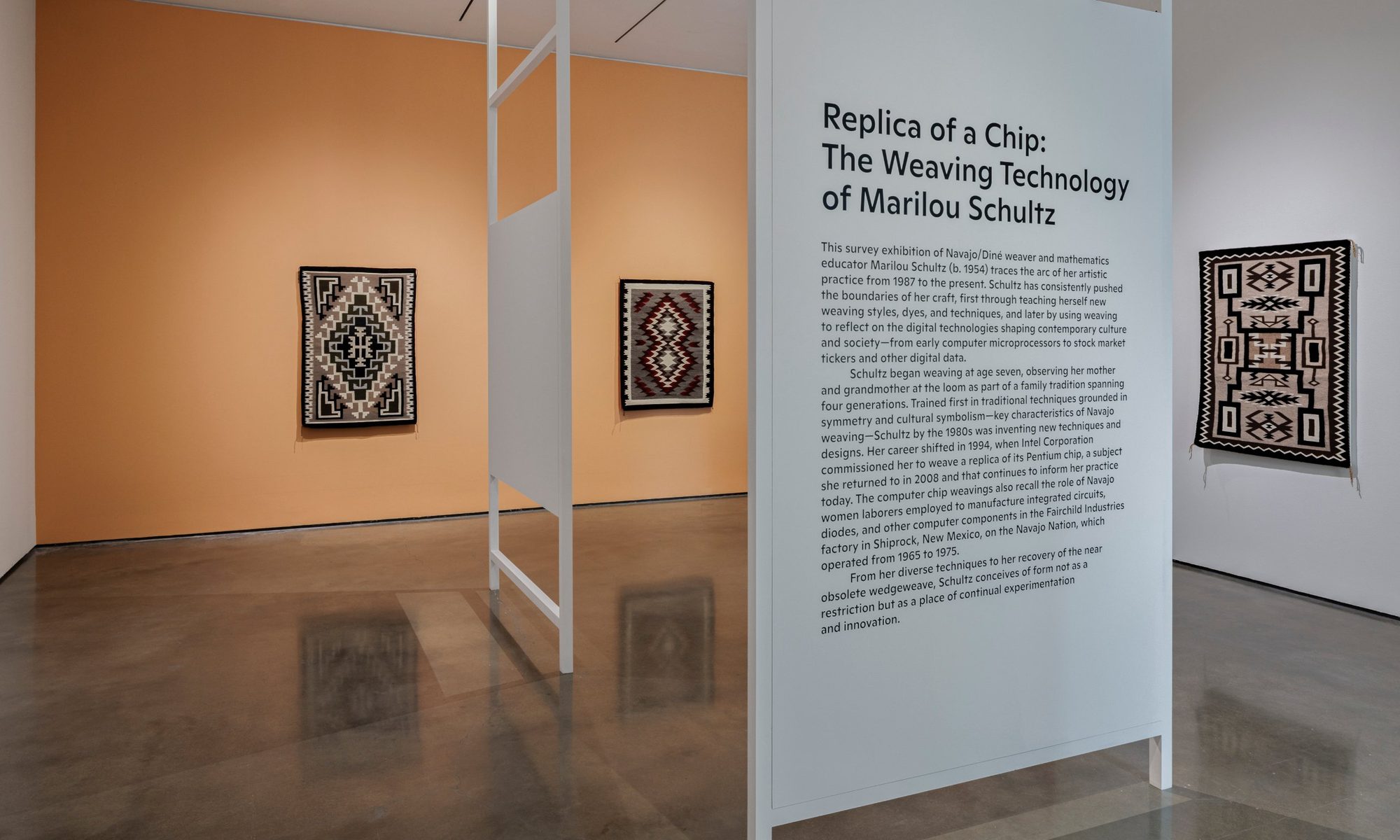
A microchip replicated in hand-spun Churro wool sounds like a conceptual provocation, but the actual object is even more compelling. The title of Marilou Schultz’s exhibition, Replica of a Chip: The Weaving Technology of Marilou Schultz, refers both to the artist’s feat and an unlikely pairing between computer architecture and Diné (Navajo) weaving. In 1994, Schultz was commissioned by Intel to reproduce the company’s Pentium microprocessor as a textile, translating its intricate geometry into interlaced threads. She followed through, replicating a device associated with the precision and abstraction of computing through the material intelligence of the loom. The success of this artistic translation inspired the replication of other chips in wool thread — Nizhóní AMD (2008), Integrated Circuit Chip & AI Diné Weaving (2024), Popular Chip (2025), and Golden Computer Chip Diné Weaving (2026) are included in the exhibition — and to a body of work translating complex systems and new ideas into color and pattern.
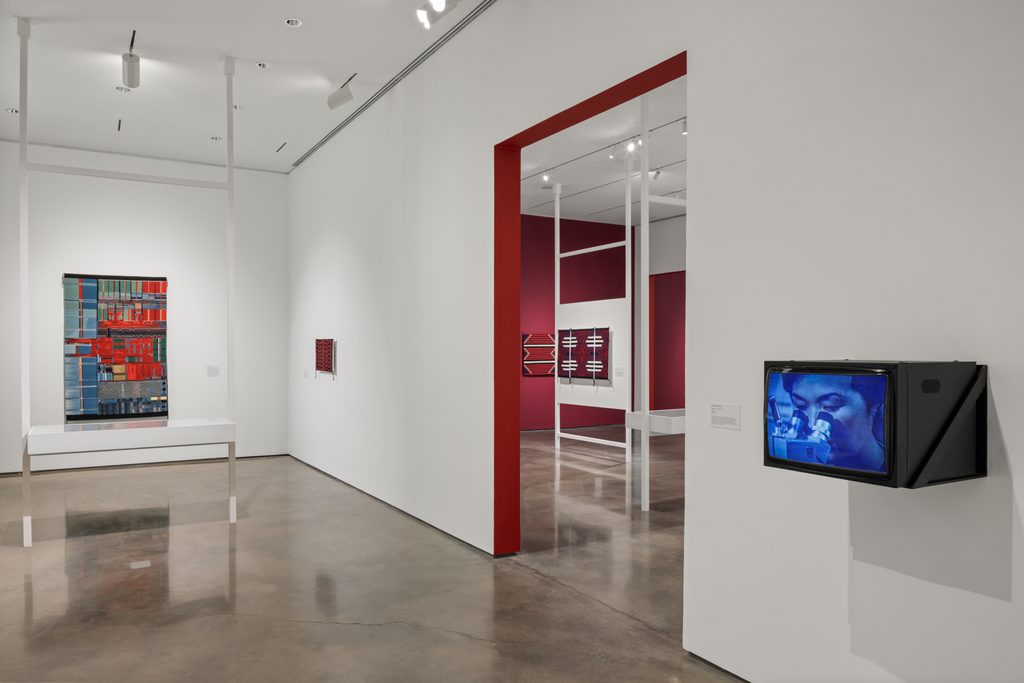
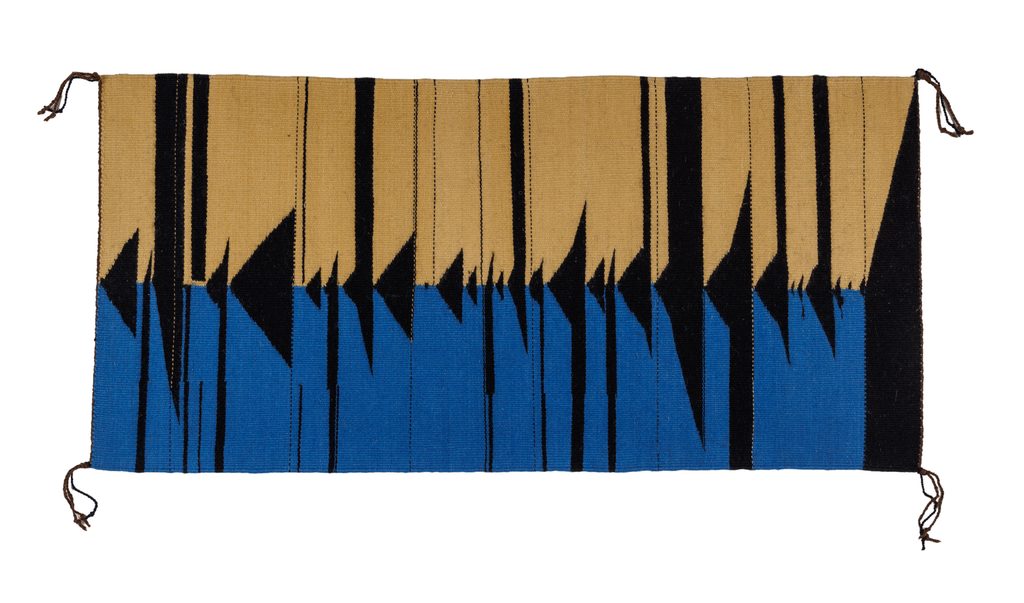
Weaving has a digital logic of its own. Warp and weft are the two fundamental components of woven threads, whose intersecting relationship determines the structure of the textile. The over-under dialectic engaged in weaving hints at a shared prototype with the binary relationship between zeros and ones of computing, but in Schultz’s work, the relationship between weaving and computation extends beyond visual resemblance. Recognizing patterns, negotiating constraints, and translating abstract relationships into structured forms give rise to adaptation and experimentation, pushing weaving to its edges. The Arizona-based artist began weaving at the age of seven, learning from her mother and grandmother within a family tradition spanning four generations. Her practice developed through engaging with inherited techniques and a willingness to test their possibilities. By the 1980s, she was experimenting with new designs, dyes, and methods while working as a mathematics educator. The Intel commission brought these interests into an unexpected alignment, but the assignment came without instructions. Schultz was given an image of the Pentium chip and left to determine how its components and intricate relationships might be reconstructed through warp and weft. She had to analyze the image, calculate its proportions, and work out how its geometry could be translated into the technical language of weaving. The resulting textile is therefore more than a representation of a computational object; it is the product of her experience, reasoning, and experimentation. Her textiles make this technical intelligence visible without suggesting that weaving and computing are interchangeable, notable in her subjects extending beyond computing to other forms of technology. Stock Market (2019) and Stock Market Weaving (2022) are striking horizontal textiles that pair blocks of color interrupted by a sequence of black lines of fluctuating sizes and thickness. As their titles suggest, they draw inspiration from variations in the stock market, but from a distance, they resemble a pulsating waveform, calling to mind the aesthetics of sound technology.
In weaving, counting, recognizing sequences, and anticipating consequences are integral to the process, but abstraction is exercised through this material experience. Her approach to asymmetry offers a particularly revealing example of this. In an interview with Justin Maiman and I on Ginger Radio Hour, she describes turning a pattern upside down so she could begin with its point, the one feature she knew she could reliably establish. The rest had to be worked out in response to what the weave would permit. She describes this as allowing the textile to “be what it wants to be.” Form emerges through the interaction of her intention, technique, and material conditions, with many aspects remaining out of her control, but her woven QR code is proof of her ability to move from representation to operation. Presented between the two stock market pieces is Navajo Weavings’ Lens Through Technology (2022), featuring a functional QR code set against six vertical lines of alternating colors and subtle white patterns. The QR code’s pattern of marks and spaces must retain the relationships required for machine recognition, even when translated into threads. Because the textile is scannable — leading to a Google search result for Navajo weaving — it not only resembles but also participates in a digital system. It is a clever reminder that information is not confined to a screen or printed surface, and moreover, it is proof of Schultz’s ingenuity and artistic range.
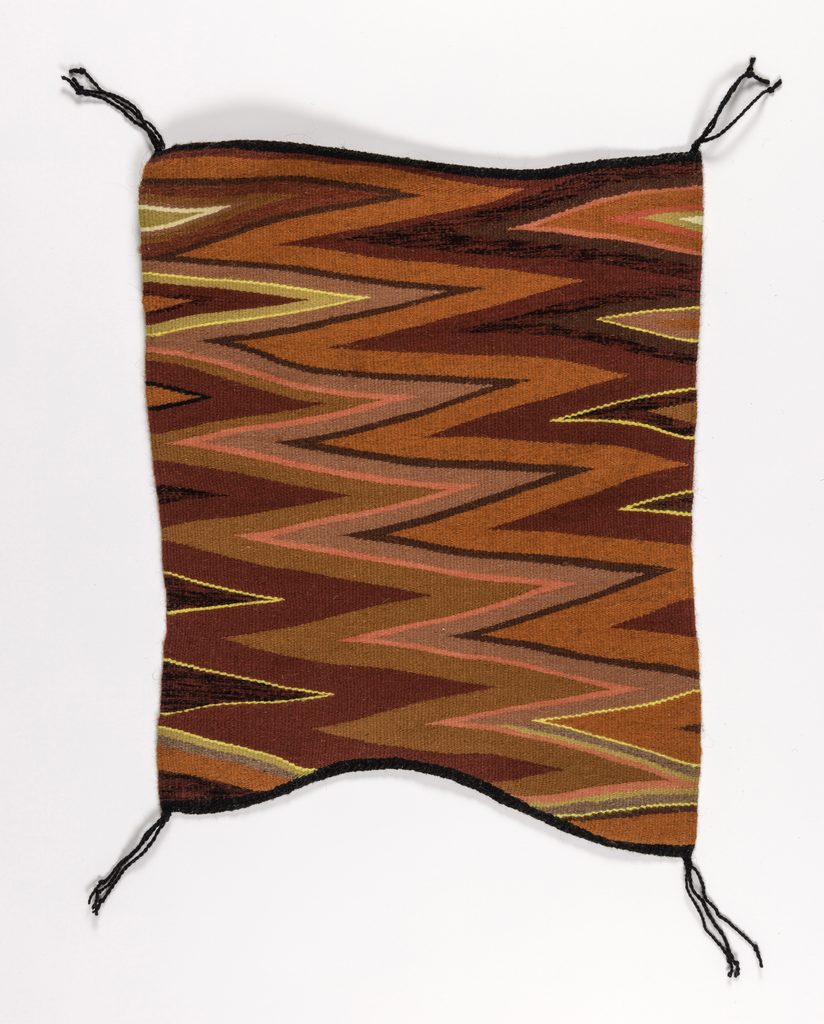
Across the dozens of textiles on view, geometric repetition gives way to asymmetrical forms and elaborate pictorial arrangements. Color and proportion establish distinct visual rhythms. Schultz’s elaborate dye techniques create subtle variations in color that convey shading, texture, and depth. In her woven replicas, metallic thread adds a degree of visual fidelity to the original technology. Some of her textile compositions depend on regular intervals, and others introduce interruptions or gather multiple scenes and details within a single surface. Still others push the possibilities of weaving beyond the flat textile, with surfaces shaped into three-dimensional forms that curve, bulge, and form into cylindrical textile objects. Her experimentation expands the medium’s spatial and sculptural possibilities, demonstrating how the structure of the weave can generate volume as well as pattern.
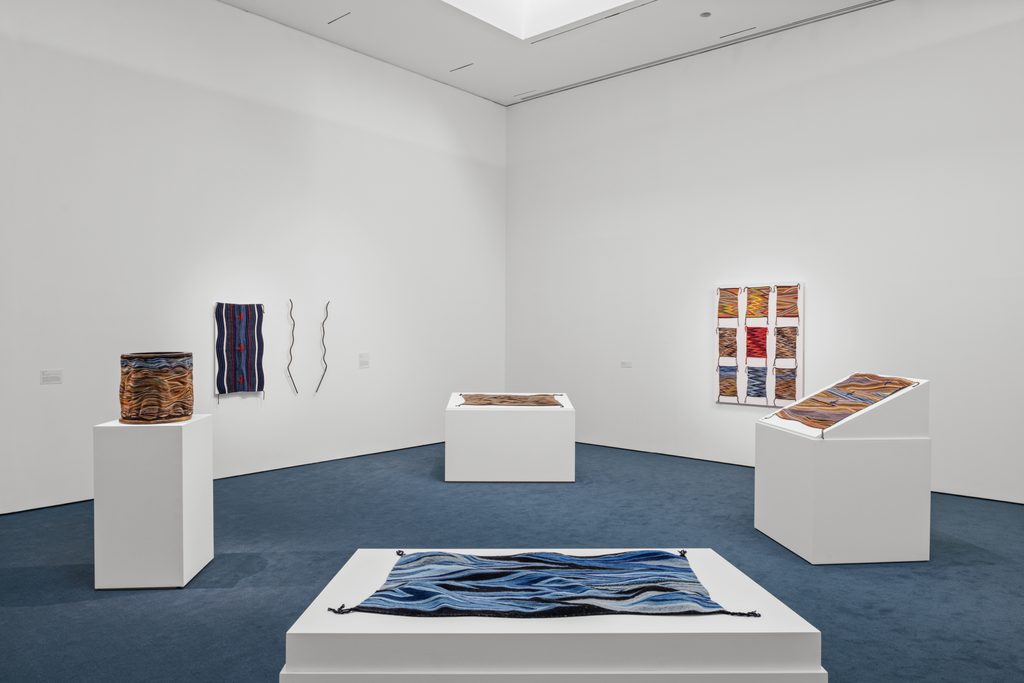
The exhibition’s historical framework, thoughtfully developed by curator Candice Hopkins, places this technical experimentation within the history of Indigenous labor in semiconductor manufacturing. Beginning in 1965, Fairchild Semiconductor operated a plant in Shiprock, New Mexico, on the outskirts of Navajo Nation, employing primarily Diné women to assemble microchips. The plant closed in 1975 following reports of poor working conditions and a peaceful standoff between Navajo workers and local law enforcement, resulting in widespread layoffs. The recruitment of Indigenous women was shaped in part by racialized assumptions that their manual dexterity was innate, linking their hands to the precision associated with weaving and jewelry-making. Such assumptions reduced culturally situated expertise to an essentialized bodily trait, obscuring the knowledge and skill involved in their work. The history complicates accounts of computing that locate technological achievement exclusively in engineering labs, corporations, and machines. Indigenous women contributed to the industry’s material production, even as their labor and technical knowledge were often marginalized.
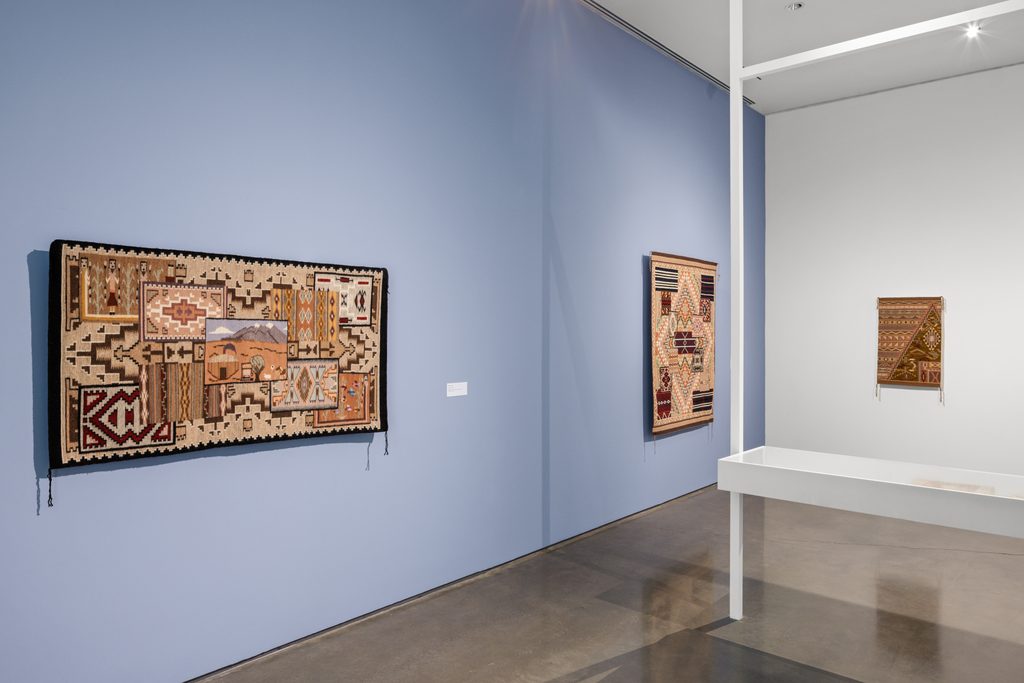
Schultz’s chip weavings bring these histories into relation without treating weaving as a precursor to computer technology. Instead, they challenge the division between traditional craft and advanced technical production, making visible forms of knowledge that conventional histories have kept apart. The exhibition’s inclusion of work by her mother Martha Gorman Schultz, grandmother Mary Jasbah Clay, and niece Melissa Cody, further readjusts the idea of innovation as an individual achievement or a clean break with the past. Weaving knowledge passes between generations with each practitioner inheriting techniques while finding new ways to extend and reinterpret them, as Cody’s visual and symbolic reference to retro video games illustrates.
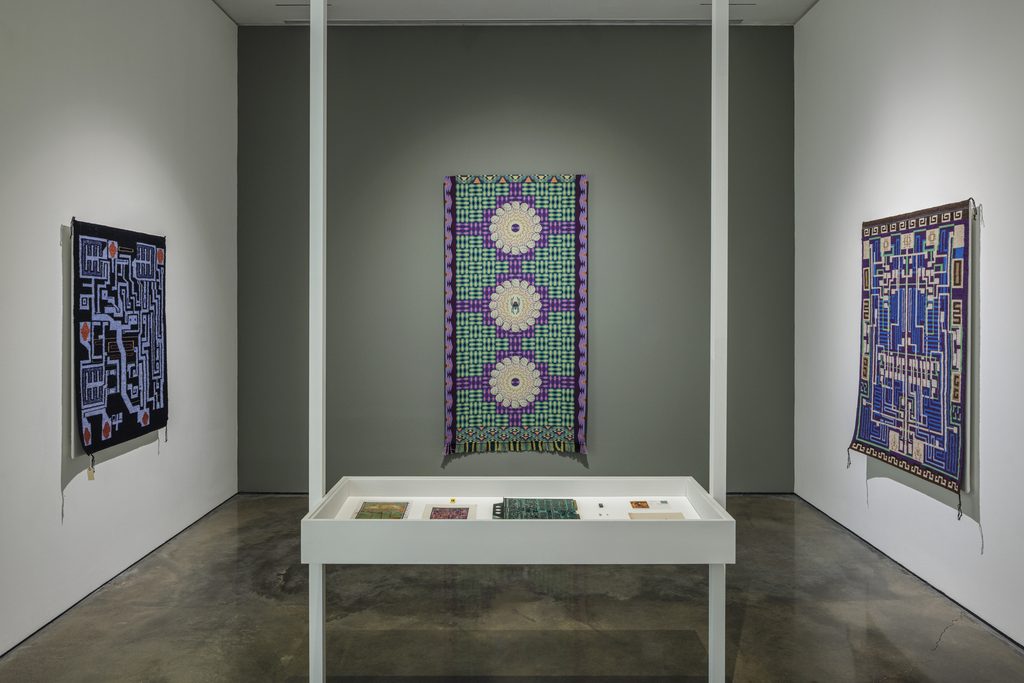
Replica of a Chip ultimately offers a broader account of Schultz’s technical and artistic intelligence, demonstrating how her work brings together distinct systems through shared patterns, reconsidered structures, and what the material conditions of this expressive medium introduce as possibilities of their own. Her textiles show how systems can illuminate one another, while affirming weaving as an ongoing embodied art practice of calculation and visual thought.
Replica of a Chip: The Weaving Technology of Marilou Schultz is on view at Hessel Museum of Art, Center for Curatorial Studies, Bard College, 33 Garden Road, Annandale-on-Hudson, NY. On view from June 27th through November 29th, 2026. @ccsbard
Make your tax-deductible donation today and help Art Spiel continue to thrive. DONATE
About the author: Natasha Chuk, PhD, is a media scholar, arts writer, educator, and independent curator whose work examines the intersection of art, philosophy, and creative technologies. She is the author of Vanishing Points: Articulations of Death, Fragmentation, and the Unexperienced Experience of Created Objects (Intellect, 2015) and Photo Obscura: The Photographic in Post-Photography (Intellect, 2025). @natychuk