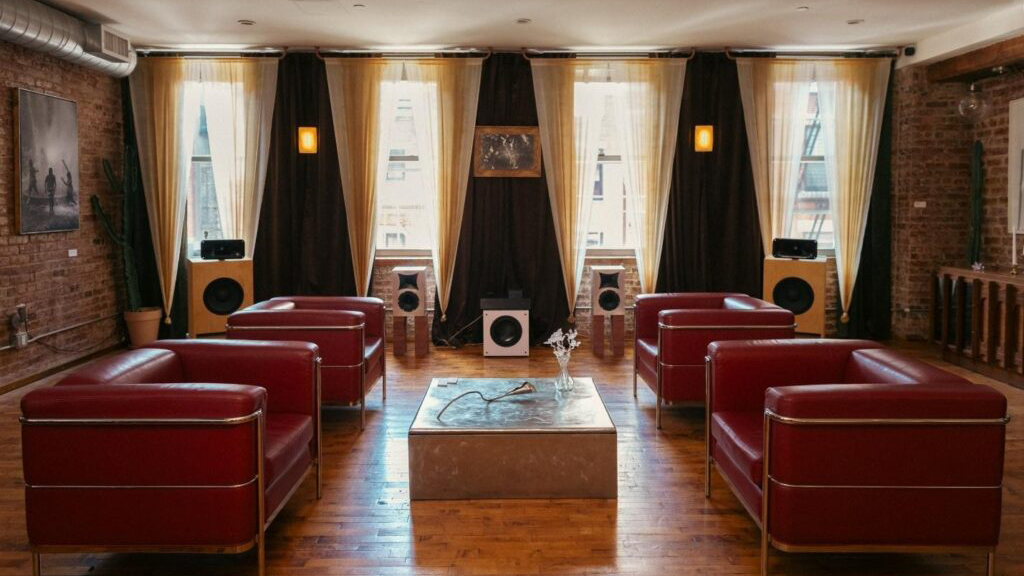
Located along the central artery of Little Italy, amid a glut of red sauce joints with checkered tablecloths, sits the new home of Fugue Gallery. Having recently relocated from Canal Street to Mulberry Street, the space, a 1,000-square-foot brick loft, eschews white box sterility for something more atypical.
On a walk-through with Fugue’s Eric J Chan, he explained one of the goals of relocating is to reframe the typical gallery-client relationship, to situate works of art and interior design in relation, offering appropriate context for the pieces and more transparency for connoisseurs and buyers. The overarching ambition, down the road, is to offer a new model for the gallery concept, perhaps. He is also considering the possibility of an art concierge service adjacent to the gallery itself, to connect buyers with the right pieces.
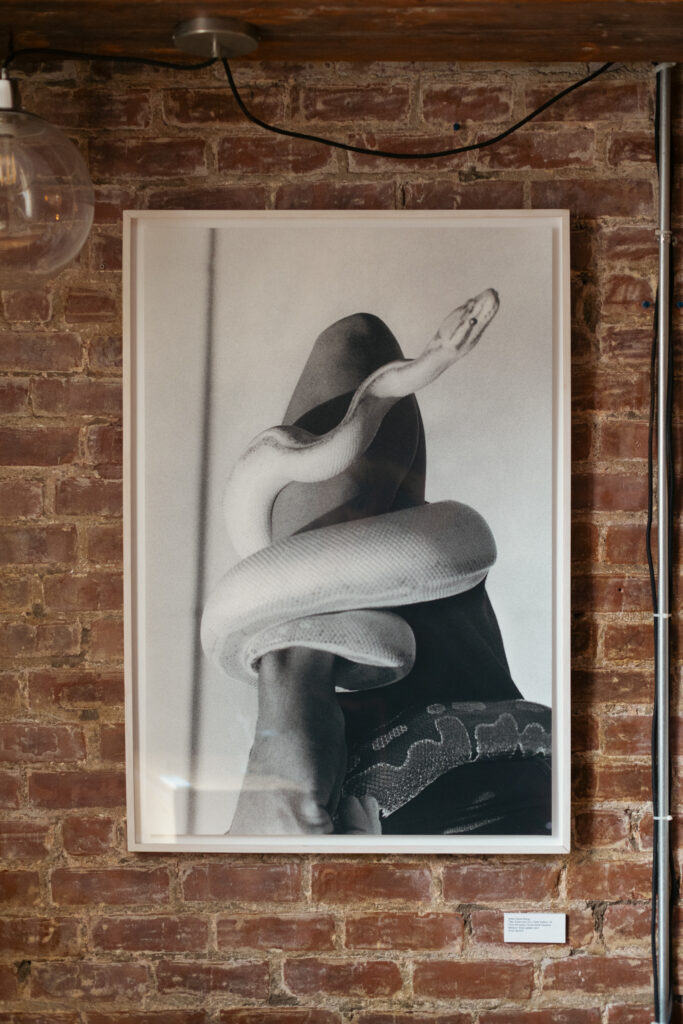
Design objects are installed throughout the loft, like Danielle Gadus’ textile piece, Daybreak, warm strips of silk which hug the windows overlooking the tourist throng on Mulberry St. Then there is the custom speaker system by Otis Gordon, all sharp planes and edges, to better integrate with the space itself. In the kitchen, a batch of kombucha was brewing. Chan is cultivating an intentional, if casual approach, soft-launching the gallery with invite-only showings and related programming in the coming months, including listening sessions, private dinners, film screenings, meditation, and sound bathing. It just so happened that in the afternoon I arrived, two artist models were in attendance as well, the ball pythons featured in David Zheng’s Snake and Arm, with the artist and other associates milling about, giving the whole enterprise the feel of a low-key hang out, an art clubhouse.
To herald the arrival of the new space and renewed mission, Fugue is presenting the exhibition Forbidden Fruit, featuring sixteen emerging and mid-career artists. Arranged clockwise around the gallery, the show’s circular path can be read as a Blakean journey of innocence and experience, and of transformation. From birth to death and rebirth, the styles go from abstraction to realism and back.
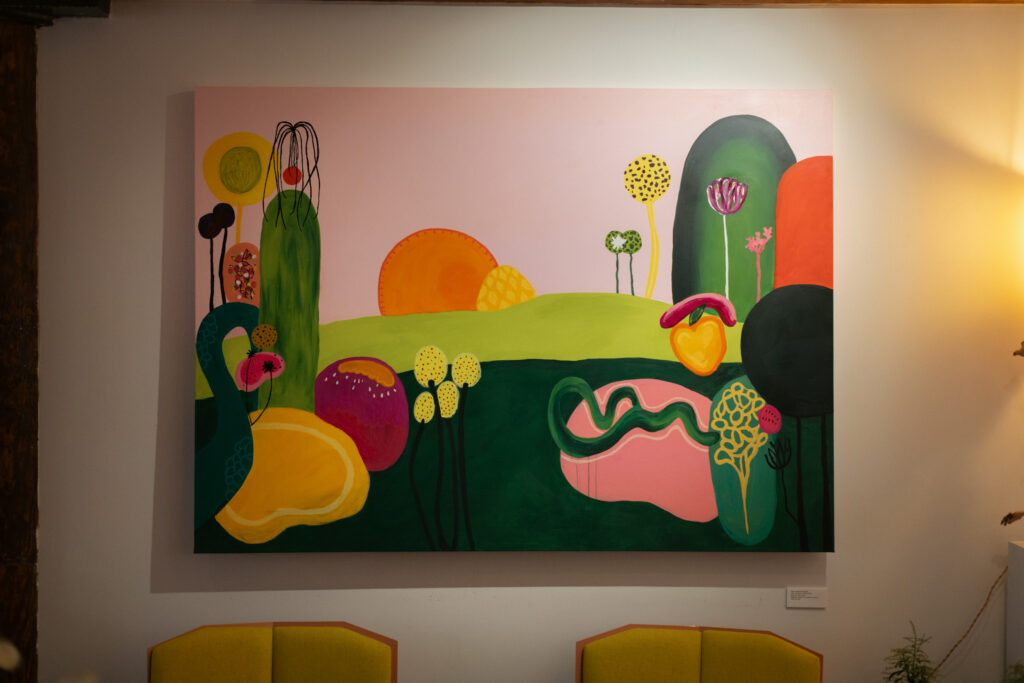
Viewers start with Valentina Benaglio’s In Search of Eden, a bright, gumdrop-colored landscape, verdant and juicy. The serpentine shapes exist as a reminder of temptation, the painting questioning the inherent tension in leaving and finding, of searching and exile. Then there are echoes of other artists, as in the long-legged spider-like shape which calls back to Louise Bourgeois, and the Kusama-like dotted trees.
Alexa Huang’s three abstract oil paintings in the show reinforce a sense of searching for paradise, too, or in the case of A Missed Catch, with its falling figure, caught in mid-air, the instantaneous longing for the garden after being expelled.
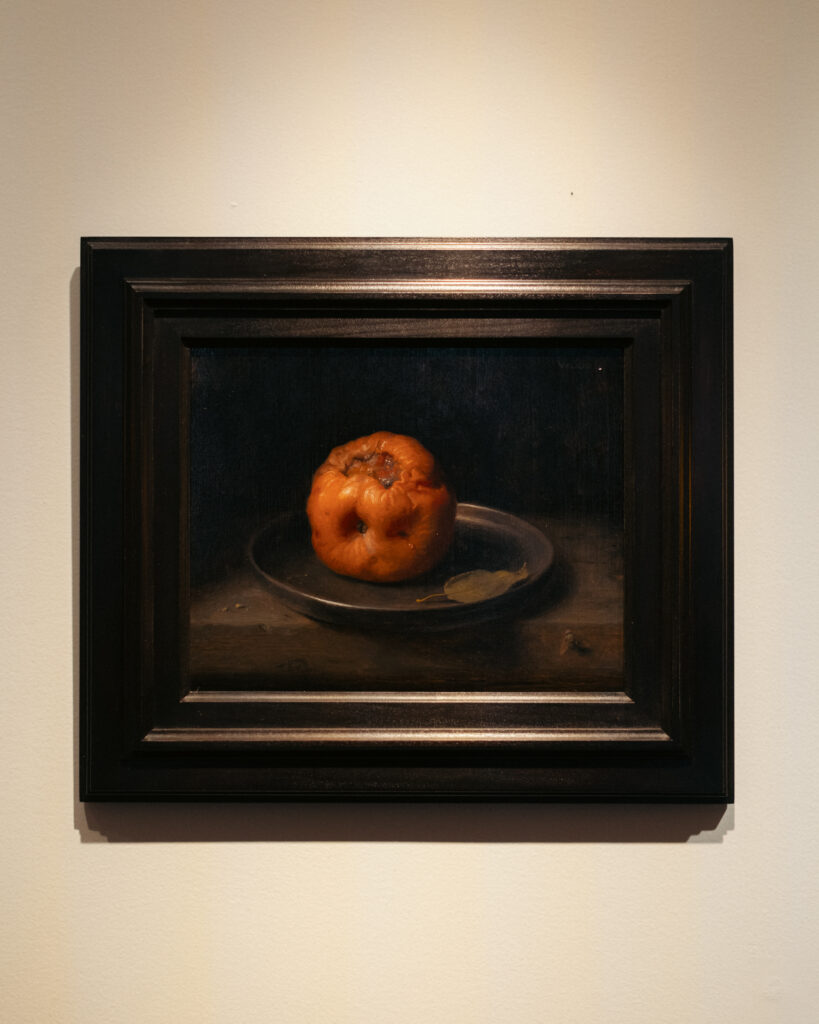
Justin Wood’s three memento mori oil paintings take the viewer from abundance through decay and death. Purple Grapes, featuring the titular fruit still waxy and plump on the stem, is followed by Rotting Apple, the moldering fruit sapped of vitality, puckered and collapsing in on itself, with the trio completed by Skull with Leaf, the cranium placed upside down, slightly tilted, a tooth dislodged from its jaw, lying nearby.
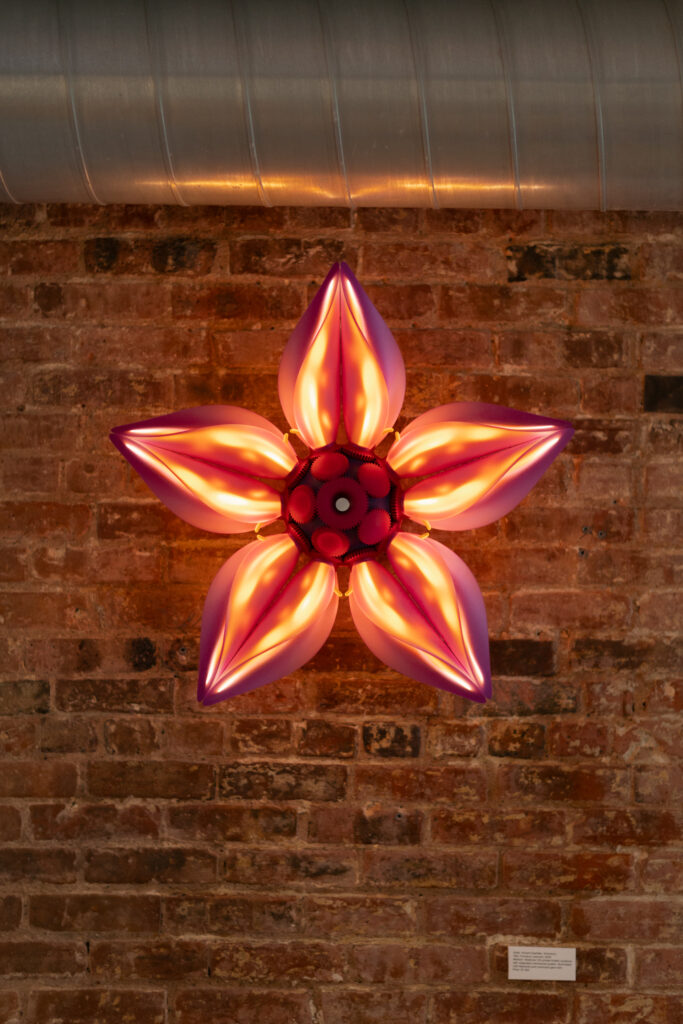
Having arrived directly from a show in Berlin, a highlight of Forbidden Fruit is Vincent Sachtler’s 3D-printed flower lamp, Comarum Palustre, a kinetic sculpture which has gained viral notoriety. Affixed to the brick wall of the gallery, the gears of the flower turn and the petals pulse and glow, a trippy, undulating melding of the mechanical and botanical.
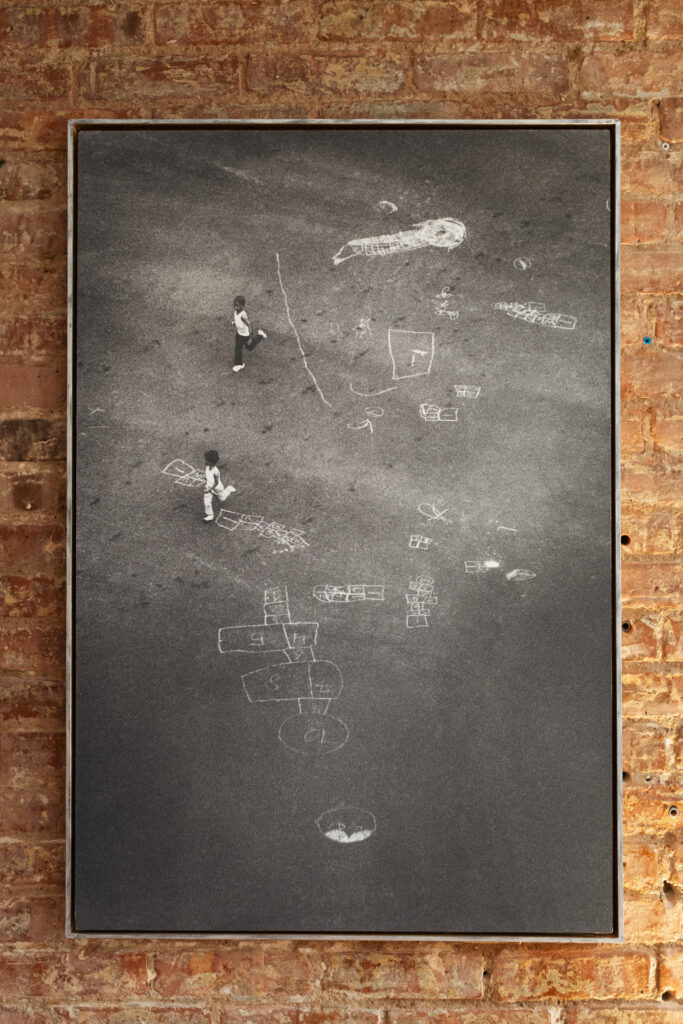
David Zheng’s black and white photos of children at play, from the series Some Sorta Paradise, capture the sense of youthful abandon, a vision of unsullied joy. There is a timelessness to the images, absent any screens or phones or hallmarks of our digital connectivity. Bliss, shot from above, which shows an overview of two children hopscotching on a chalked-up asphalt playground, and The Dance, seen straight on, with children soaked in a fountain, could be from an era of New York. Across the room, the aforementioned photo Snake and Arm, a python looped around the subject’s arm, alert, with one beady eye trained at the viewer, leads us back to the garden and to the beginning of the cycle; the circuit completes.
Transformation is an organizing principle of the show, and a fitting watchword for Fugue Gallery as well, as they move from innocence to a more measured understanding of their purpose after several shows in their previous space. As I finished my tour, the two snakes I met earlier were serenely draped over the edge of Marie Helene Boone’s sleek steel coffee table, seemingly at home.
Forbidden Fruit, on view at Fugue Gallery, through August 21, 2026, by appointment. @fugue_gallery @gallery_fugue
Make your tax-deductible donation today and help Art Spiel continue to thrive. DONATE
About the writer: Mike Dressel is a writer and mixed-media artist based in New York. His byline has appeared in Impulse Magazine, Slant, The Gay & Lesbian Review, and Culturebot, among others. @mkdrssl
Danielle Gadus: @daniellegadus
Otis Gordon: @otissstudio
Valentina Benaglio: @valebenaglio
Alexa Huang: @alexasassybean
Vincent Sachter: @vinnimicry
David Zheng: @davidzhengstudio
Marie Helene Boone: @helene.studios
@Pythons_of_nyc