No one ever thinks the plate is going to become a problem.
A plate survives three apartments and one bad Thanksgiving. A suitcase gets hauled across borders or shoved beneath beds; sometimes it is packed in hope, sometimes because someone has no choice. An iron presses school clothes and funeral clothes, then outlives its usefulness and sits in a closet somewhere, still holding the pressure of human hands.
That is the animating idea behind extraORDINARY things, the quietly arresting exhibition at the Flinn Gallery in Greenwich Library.
Curated by Flinn’s Ellen Hawley, the show gathers four artists: Qingjun Huang, Carole Kunstadt, Cheryl R. Riley, and Rob Strati. All share an unnerving conviction that objects absorb human behavior long before anyone calls them art, and if the title at first seems playful, almost too pleased with its own typography, the work soon begins talking back.
“Is it ‘extraordinary,’ or is it ‘extra ordinary’?” Hawley told me. “You come in thinking, ‘Oh, just things,’ and then, through the text, the QR codes, or simply by leaning in and looking, you realize they have these unusual stories.”
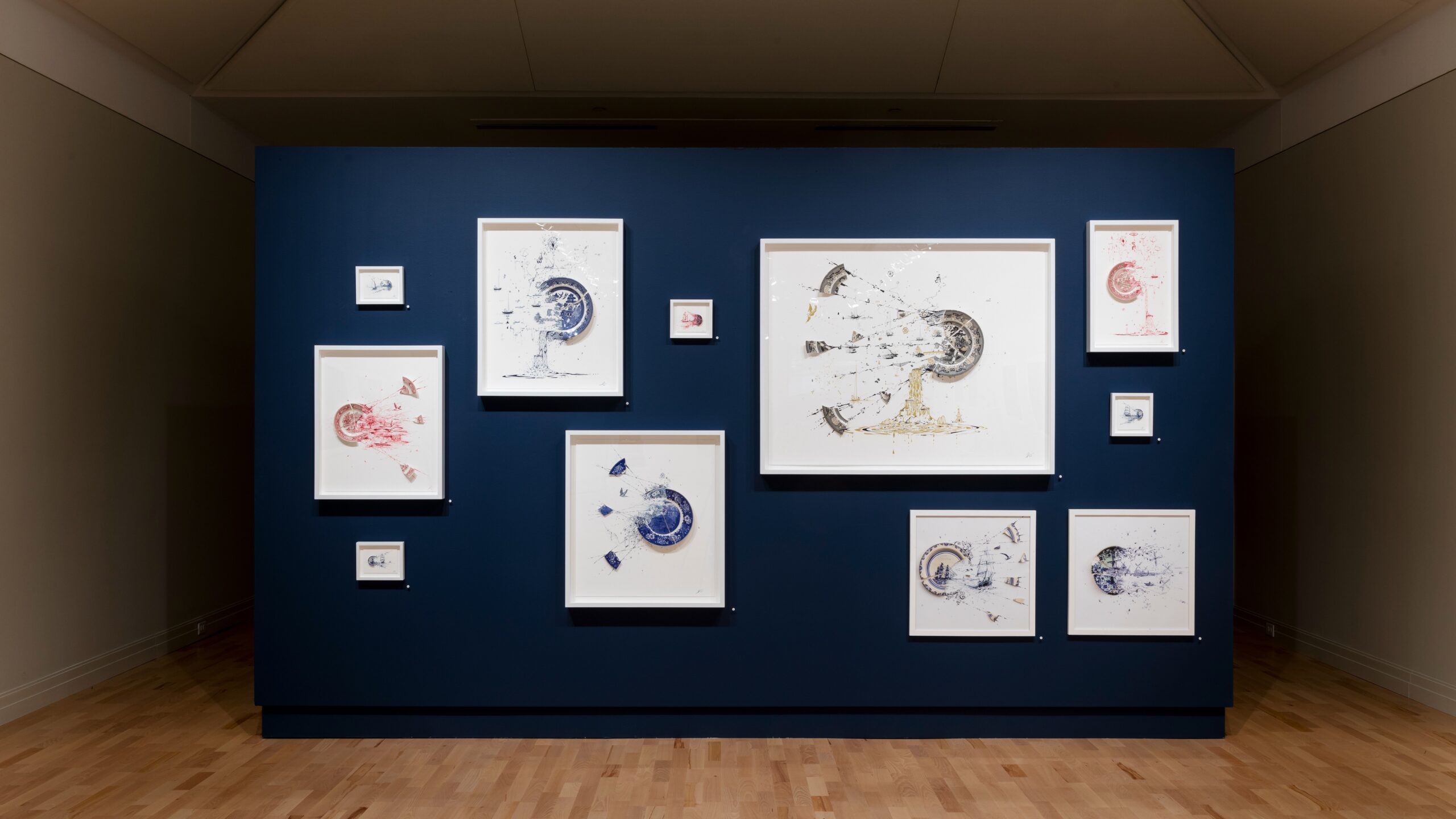
Rob Strati’s plates are probably the show’s easiest way in, which is exactly why they become so treacherous. Working from antique porcelain shards, Strati extends painted scenes beyond the broken edges in pen and ink; ships drift out of bounds, horses make a break for it, and waterfalls decline to stay politely inside the china. At first, the work offers the old-fashioned pleasure of craft. The eye follows the line, admires the hand, and only then realizes that the fracture has quietly taken charge.
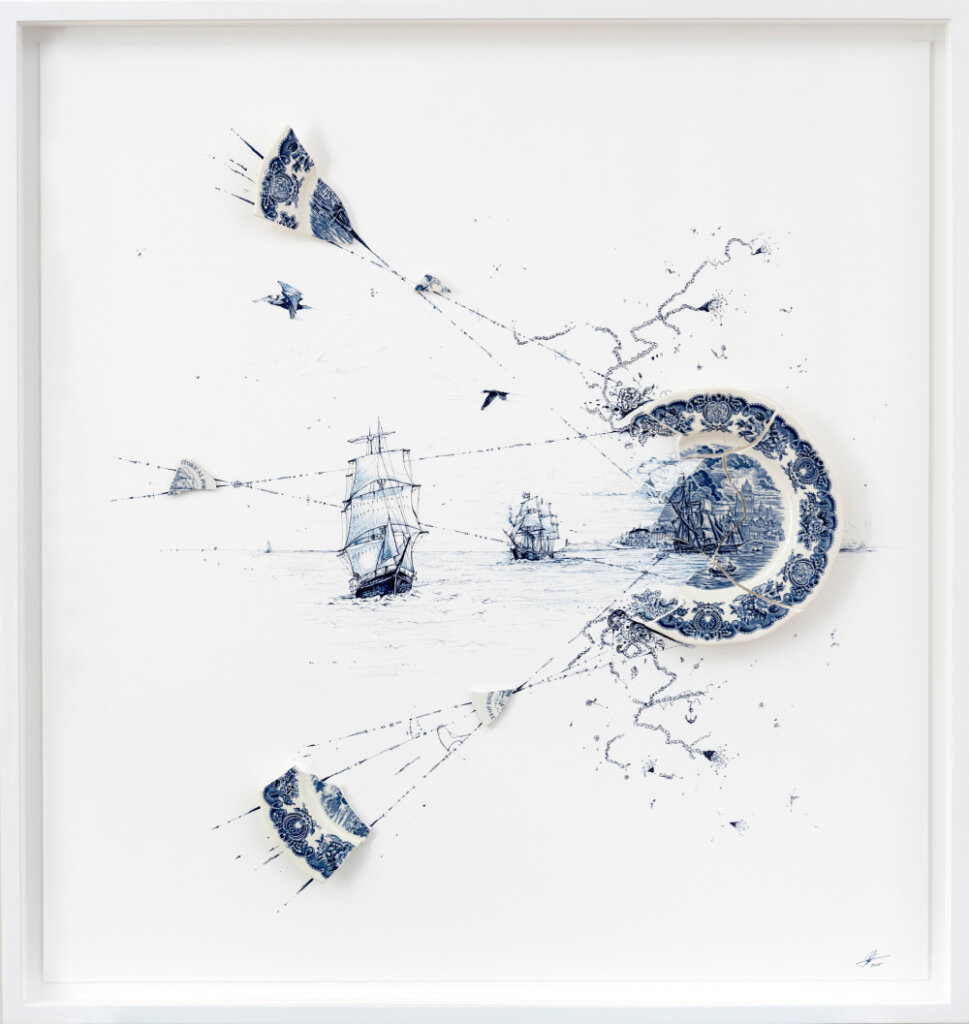
The origin story remains refreshingly plain. A plate inherited from Strati’s mother-in-law slipped from his wife’s hands and shattered. The fragments sat on a sideboard for months because nobody could quite throw them away. Eventually Strati brought them to his studio and started drawing outward from the edges. His wife posted one piece on Facebook; the response was immediate and exceeded anything his earlier work had received. The series quickly found a devoted audience, allowing Strati to leave his day job. A body of work with real staying power began, improbably enough, with an oops.
Strati has said the series also came out of a larger feeling that the country had cracked, especially after January 6. Yet the works resist becoming political cartoons. They stay plates, which is part of the discomfort. Blue Willow, that dish-cabinet classic of tidy little bridges and pagodas, no longer feels especially calm.
The obvious comparison to kintsugi, the Japanese practice of repairing broken pottery with lacquer and powdered gold, only clarifies what Strati refuses to do. Kintsugi treats the crack as part of the object’s history and restores the vessel to wholeness. Strati has no interest in repair. He follows the break instead.
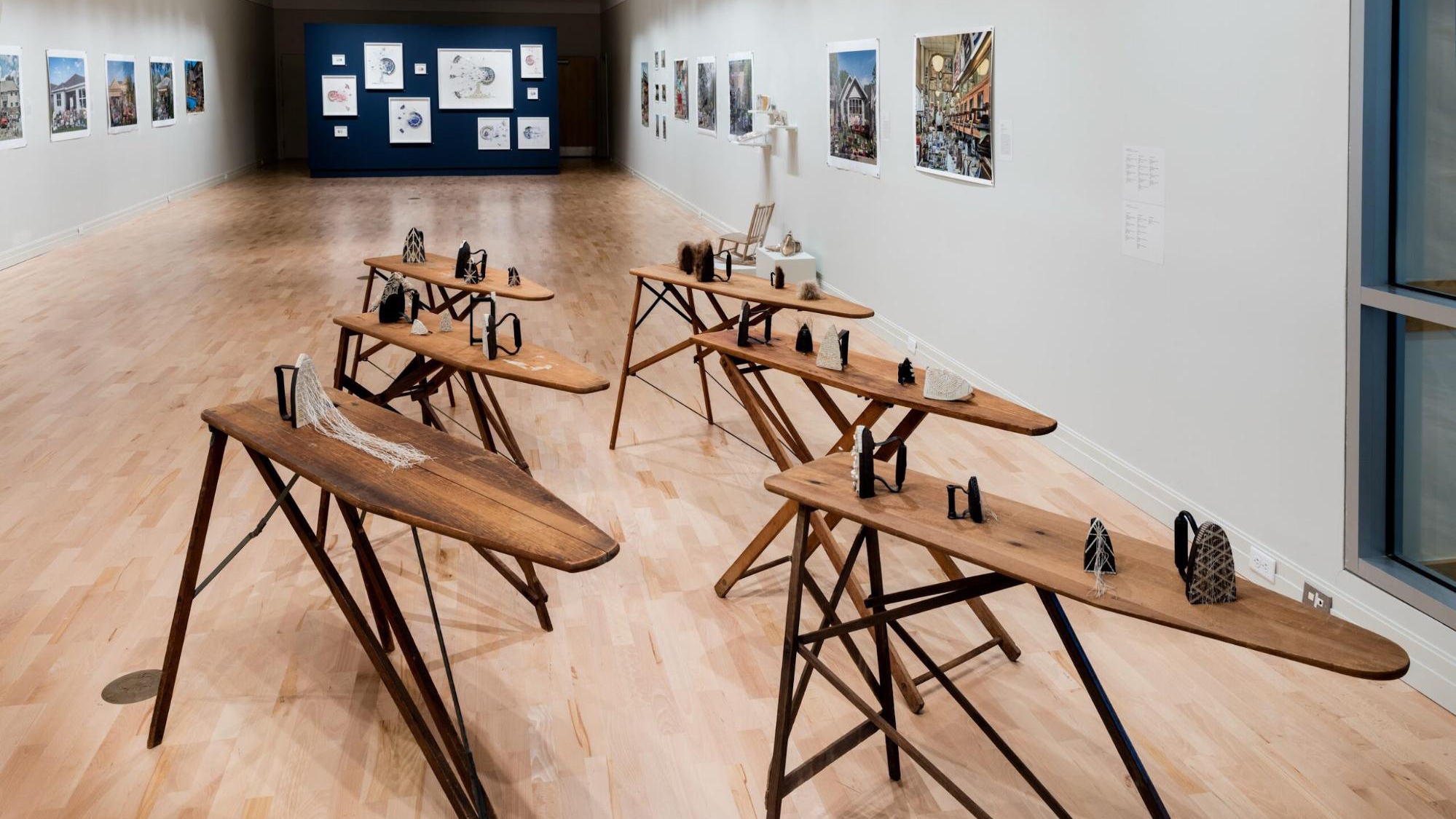
Across the gallery, Carole Kunstadt’s Pressing On works shift the exhibition into harsher territory. They incorporate scorched lace, linen thread, fur, and heavy sad irons, the old solid kind heated directly on a stove. Kunstadt also uses fragments from the writings of Hannah More, the eighteenth-century British reformer who wrote about women’s education and the moral burdens of domestic life while also speaking out against slavery. The paper appears singed into the objects themselves, as if the iron had pressed history too hard.
An iron is nobody’s idea of a thrilling wedding gift. Its job is to smooth away disorder before anyone thinks to notice it. Kunstadt reverses that logic. Her irons seem to absorb the burden of the work itself. Looking at them, you begin to sense not only heat but duration: the repetitive, half-invisible labor through which domestic life maintains its appearance of ease.
Hawley pointed me toward another lineage here: Meret Oppenheim’s fur-covered teacup, that surrealist masterpiece in which usefulness gives way to estrangement. Kunstadt’s irons operate in a related register. These objects no longer function; one sprouts coarse fibers that resemble singed hair, while another appears burned from within. Their practical identity has drained away, leaving something rawer behind.
Kunstadt displays the irons on antique ironing boards gathered over many years rather than on neutral pedestals. Hawley said the choice changed the energy of the work: “All of a sudden, it was echoing this human scale of women working.” Seen across the gallery, the irons resemble witnesses more than tools.

Cheryl R. Riley’s Transcendence Preserved introduces another kind of pressure: preservation itself. Riley encloses vintage suitcases and household objects in transparent vinyl, marking in gold the places where hands once touched them: a handle, a dial, the worn edge of a case. She links the luggage to the mass movement of Black Americans out of the South and into uncertain new lives elsewhere. The gold is not decorative, but forensic notation.
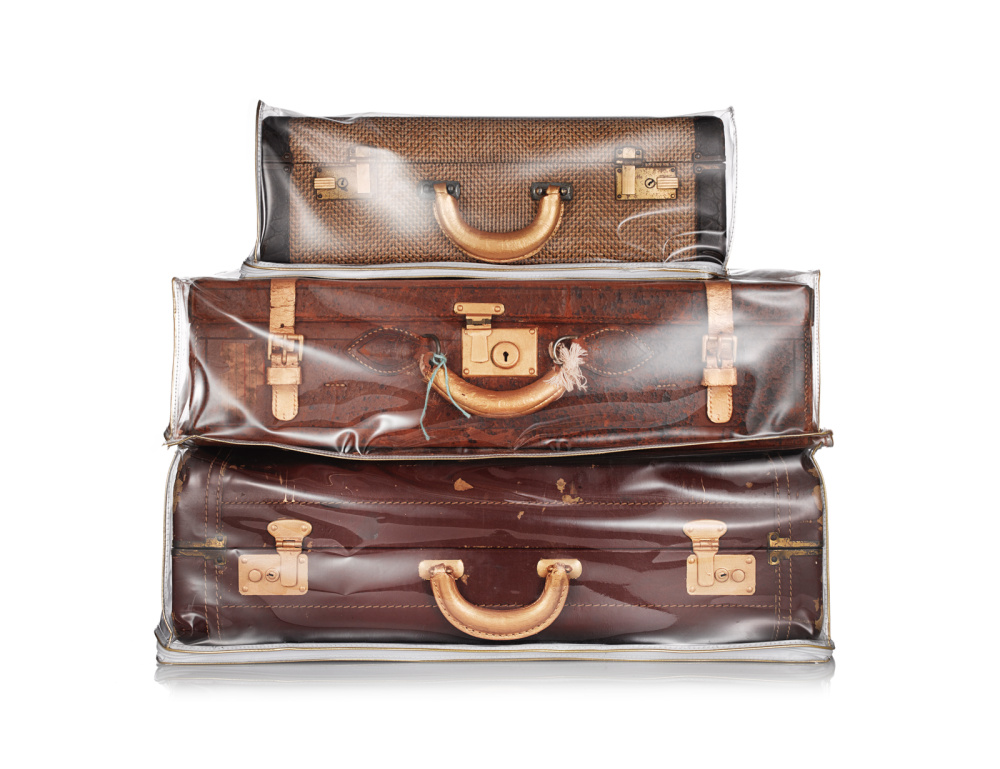
At first the objects gleam beneath the gallery lights. The vinyl protects them while taking them out of use, preserving old marks beneath a surface that feels both tender and sealed. The suitcases still promise movement, though Riley refuses to let travel look glamorous. In her hands, movement can mean escape, or it can mean danger. It can also mean standing in a room and deciding what is important enough to carry away.
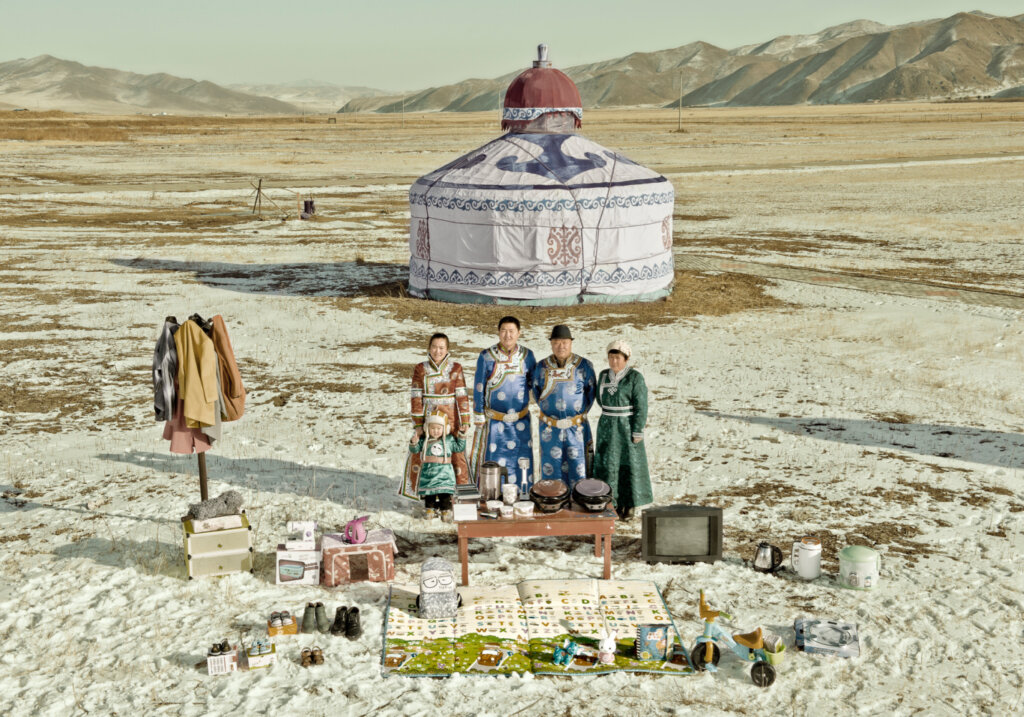
Qingjun Huang’s photographs widen the exhibition’s frame from household possession to the object-life of work itself. Huang is best known for Family Stuff, the long-running series he began in China in 2003. He would travel through villages and cities persuading families to bring the contents of their homes outdoors, then stand beside the full material evidence of daily life. The method sounds less like an art project than a very patient home invasion. Yet the photographs make immediate sense: a television sits beside a wedding portrait, a satellite dish leans against a washbasin, and a child’s toy turns up near something inherited and repaired too many times to discard.
The works at Flinn show Huang moving beyond the household inventory alone. Several photographs focus on work: a kite maker, a noodle vendor, a puppeteer, a beekeeper, a shoeshine worker. The tools matter because they reveal how a person moves through the world.
Huang began the series during a period of rapid modernization in China, and many of the lives he documented have already changed. More recently, after relocating to Peoria, Illinois, he turned his attention toward immigrant families in the United States. As Ellen Hawley observed, the work begins resembling a sideways portrait of the American dream. Assimilation never fully smooths the surface. The old country remains in the room.
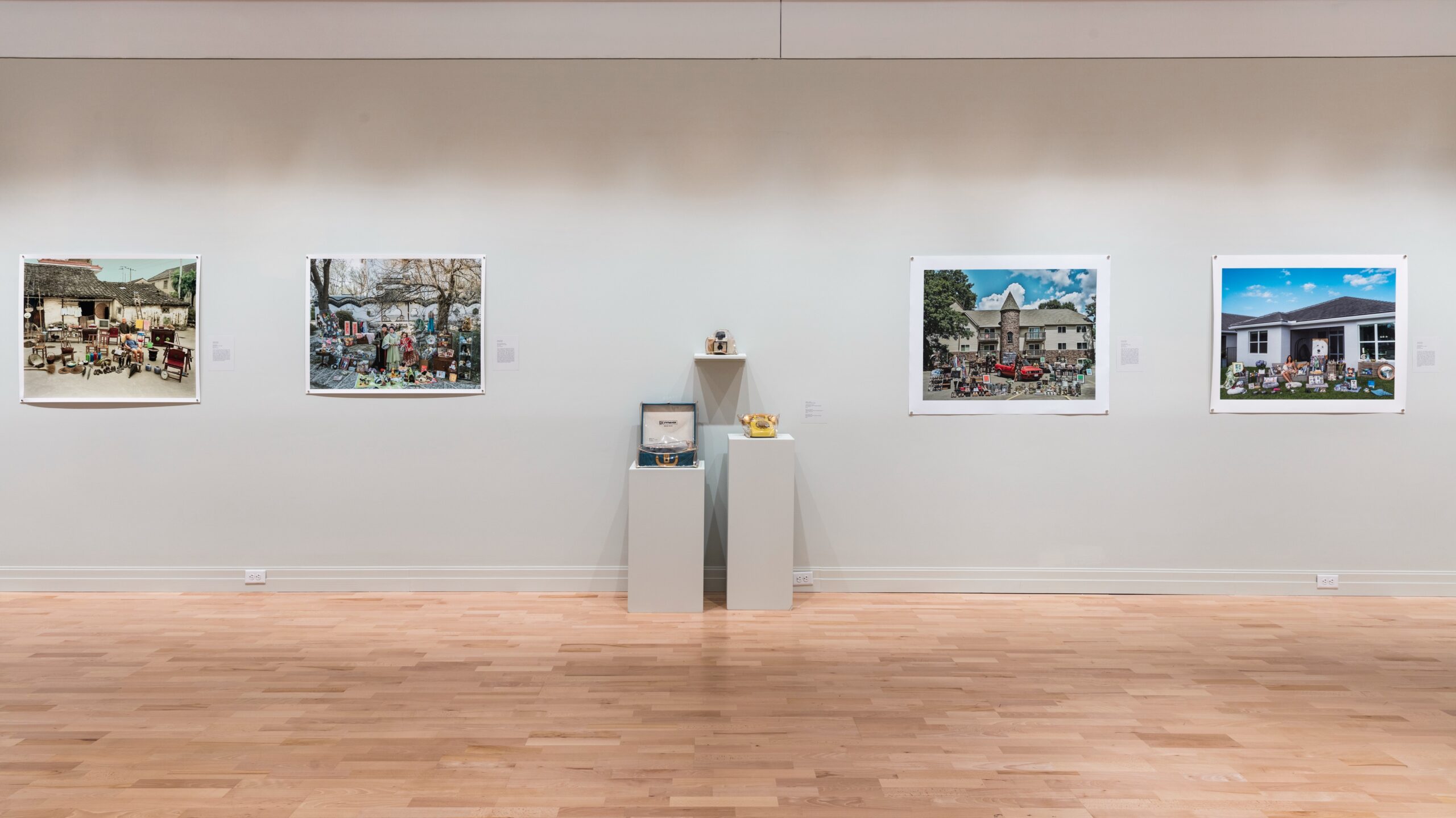
Installed inside Greenwich Library, the exhibition acquires another layer altogether. Libraries already know how much a forgotten thing can hold. Here the gallery starts feeling less like a white cube than a rogue archive where the objects have slipped their labels and started confessing on their own.
Duchamp’s urinal announced that an ordinary object could become art by context alone. Hawley’s artists make the riskier claim: the object was already carrying a human drama before anybody put it on a pedestal.
That distinction gives extraORDINARY things its force. The exhibition never sentimentalizes the everyday. A suitcase carries the private weather of leaving. A chipped plate carries years of dinners and arguments. The objects here do not become extraordinary because they have entered a gallery. They become extraordinary because the artists reveal how much pressure they were already storing.
You leave the Flinn Gallery looking differently at your own apartment. The old suitcase in the closet no longer reads as storage.
It reads as evidence.
extraORDINARY things is on view at Flinn Gallery, Greenwich Library, through June 17, 2026. An Artists Talk with guest moderator Larissa Bailiff, featuring Qingjun Huang, Carole Kunstadt, and Rob Strati, takes place Sunday, May 17, at 2 p.m. The gallery is at 101 West Putnam Avenue, second floor, Greenwich, CT. More at flinngallery.org and on Instagram at @flinngallery_greenwich.
About the writer: Laurie Gwen Shapiro is the author of The Aviator and the Showman (Viking), about Amelia Earhart, and is currently at work on a new Viking book about Albert Einstein’s extraordinary American years. More at LaurieGwenShapiro.com.