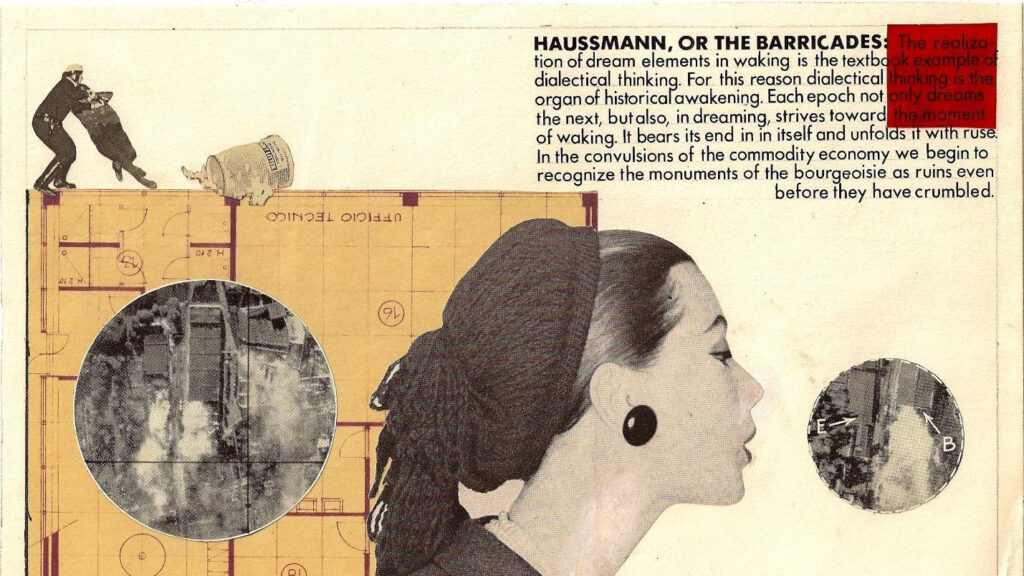
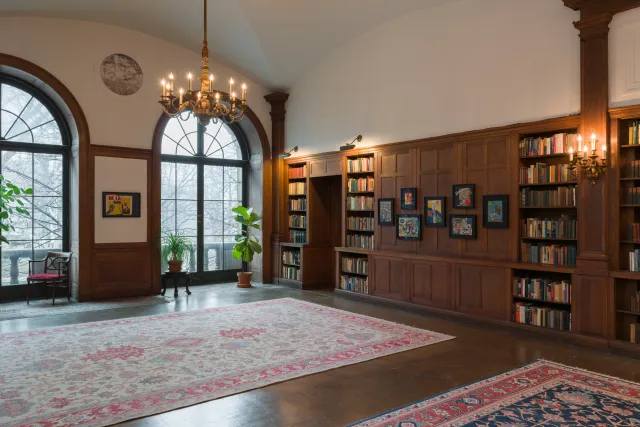
Interspersed throughout the stately library of the Academy of Arts and Letters in Washington Heights, in and around shelves holding works by Academy members like John Cheever, Pearl S. Buck, and Grace Paley, a new exhibition of collages by the cultural critic, essayist, and Dylanologist Lucy Sante is on display. Knots, organized by curator Kristin Poor, features mostly recent works from the last few years, save one, Haussmann, or the Barricades, which dates to 1979.
Sante has made collages since her teens, and in the late 70s/early 80s created collaged fliers for downtown acts like filmmaker Jim Jarmusch’s no wave band The Del-Byzanteens. With her practice, Sante sits comfortably in the company of other writer/collagists, like journalist Janet Malcolm and poet John Ashbery, whose image-making offers a parallel artistic pursuit. Still, with Sante being a writer, text is prominent in several of the works on display. But in these collages, the singular word or occasional phrase, dislodged from the larger context of a sentence or paragraph, takes on an unusual potency, words like “drive” or “tenderoni,” or the phrase “first class dope.” Even the mere punctuation mark of the piece titled ?, already a puzzlement, a readymade mystery, with the faces of two shadowy figures, gangsters, or alternately G-men, affixed to a souvenir postcard of the Delaware River, while the titular question mark hovers apparition-like opposite.
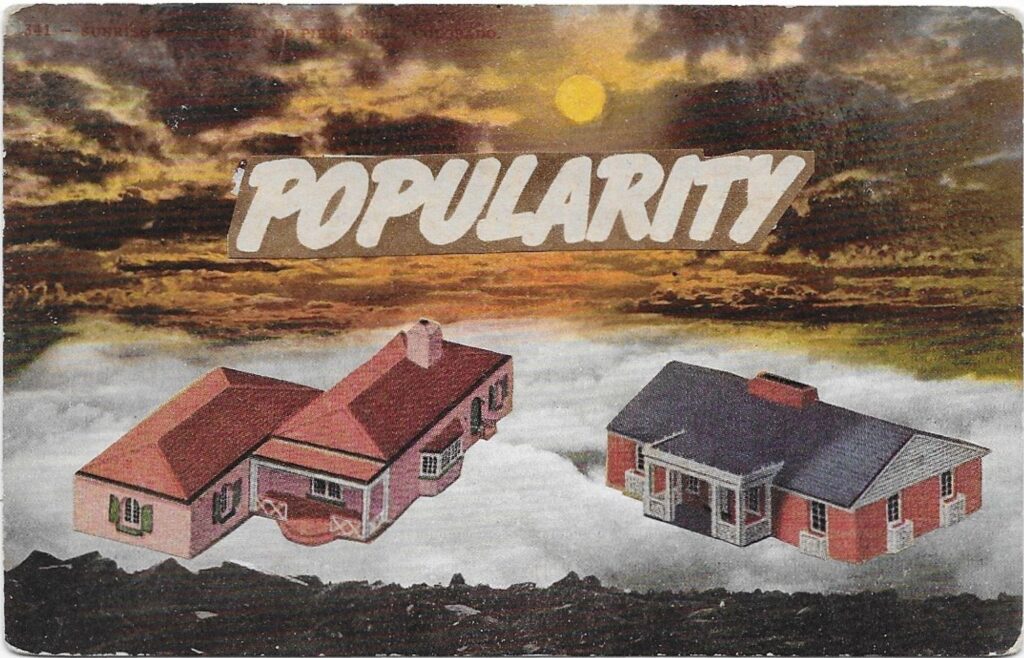
Sante speaks of her collages as “tightly held knots of ambiguity.” The show offers viewers thirty-six of just those ambiguous images, culled and assembled from a large trove of mid-century printed matter. They are suffused with mystery, many with a noirish slant, like wheatpasted advertisements slipped in from another dimension, some parallel universe cold war state. For example, Popular, featuring three domino-masked female heads, disembodied silent film sirens, which hover while opposite are three long black leather coats, suitably fetishistic. Growing up in postwar Europe, Sante’s vision of the world was first informed, in her recollection, by glossy magazines and movie posters, lending these collages the quality of being refracted through those formative images.
Sante maintained her collage practice for years before falling off, resuming in earnest during the pandemic, and was influenced by the ease of sharing on social media, the lure of the Instagram grid. In the essay accompanying the exhibition, she writes of her practice that “[s]implicity is always the best bet, so I like to work with as few elements as possible: word, background, figure; I’ve made collages with only two ingredients. Much like writing, making collages involves drastically using up options: 50 percent with the first item, 25 percent with the next, and so on.”
Indeed, none of the collages in the show are overly fussy. There is a definite sense of humor to several as well, as with Slipping Around: a woman go-go dances in place, in her bra and heels, while foregrounded two other women wrestle on the ground. There is a stag party feel to the image, displaying the camp violence of a Russ Meyer film outtake.
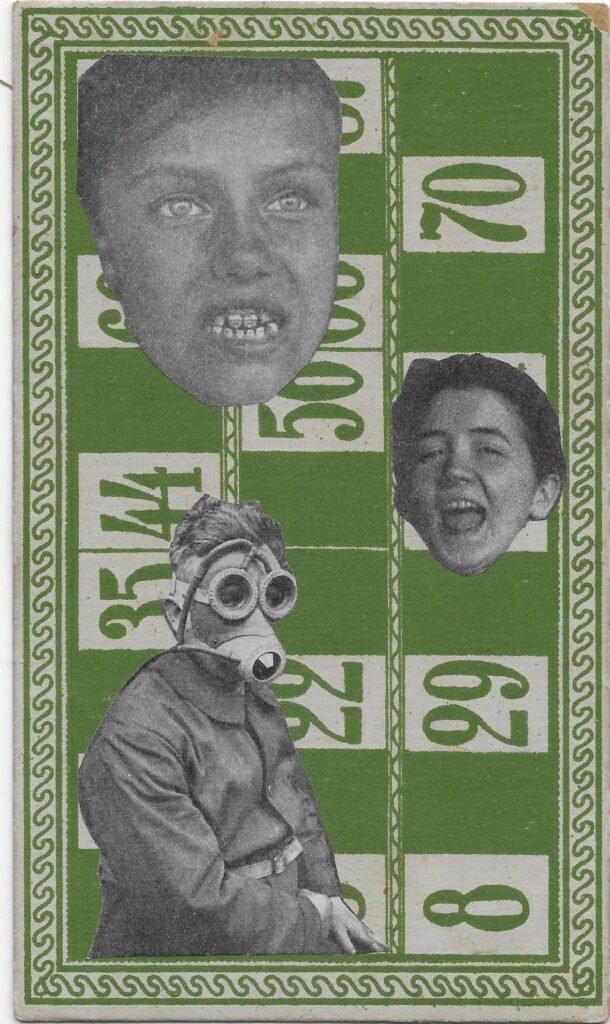
Some larger works in the show measure 16 x 24, but most are intimate in size and scale. Pocketable. Like the entire series of imagined covers for science fiction books, nine images in all here, that incorporate her grandparents’ lotto bingo cards.
On a bright blue Saturday in mid-April, the library was at capacity to celebrate the show and hear Sante read in advance of the publication of her third volume of essays, My Heart & I Agree. Works in that new collection are divided into segments based on affinity. Those kinships are clear off the page as well. Sante was joined on the bill for her reading by another trans woman, Leor Miller. There is clearly an affinity with Miller, whose friendship Sante cultivated after her “egg cracked,” a shorthand used when a person acknowledges to themselves they’re trans. Miller was a student of Sante’s longtime friend, the photographer Barbara Ess, and spoke at her memorial. Sante reached out, and Miller followed that ceremony, and Miller became a trans mother, of sorts, to Sante.
After Sante read from her new book, including a humorous poem, some juvenilia, and a section of memoir, Miller performed songs from her musical project Leor Miller’s Fear of Her Own Desire (https://whoisleormiller.bandcamp.com/), accompanying herself on a mint green electric guitar. That Miller is also a visual artist as well as a musician strengthens those affinities, the tendrils of connection in their intergenerational friendship. The musician always follows the poet, Sante joked after being introduced by curator Kristin Poor, nodding to the traditional performance line-up. For this afternoon, it was less of a hierarchy than another example of give and take, a shared sensibility. The event felt of a piece with Sante’s sustained artistic project, which has only gained more acclaim. A finalist for the 2025 Pulitzer Prize in Memoir/Autobiography for I Heard Her Call My Name: A Memoir of Transition, and a recently announced recipient of the 2026 Windham-Campbell Prize for Nonfiction, Lucy Sante is having a prominent second act and newfound appeal. Based on the response to her work, both written and visual, it is not likely the wave of recognition will crest soon.
Knots is on view through July 3, 2026, at the American Academy of Arts and Letters. Audubon Terrace, on Broadway between West 155th and 156th Streets. @artsandlettersnyc
Mike Dressel is a writer and mixed-media artist based in New York. His byline has appeared in Impulse Magazine, Slant, The Gay & Lesbian Review, and Culturebot, among others. @mkdrssl