
For a long time, when I was young, I felt distant from the idea of “history.” In textbooks, history always appeared through years, wars, reforms, and changes of political power, as if it were made of events already organized and settled. Yet the history that truly remains in the body often appears in more hidden forms. It may be a silence within family narratives, a memory that one generation chooses to avoid, a recurring pattern in festive images, or a color that seems joyful while quietly carrying a wound. Very often, history continues to exist in another form, lingering in images, bodies, and everyday experience.
Entering Bùi Thanh Tâm’s solo exhibition Here on and after at Eli Klein Gallery, this sense of living “after history” becomes clear. The word “after” in the exhibition title points to a temporal afterward, while also suggesting a state of continuation. After war, after colonialism, after trauma, culture continues to grow, carrying traces of rupture, distortion, and reassembly.
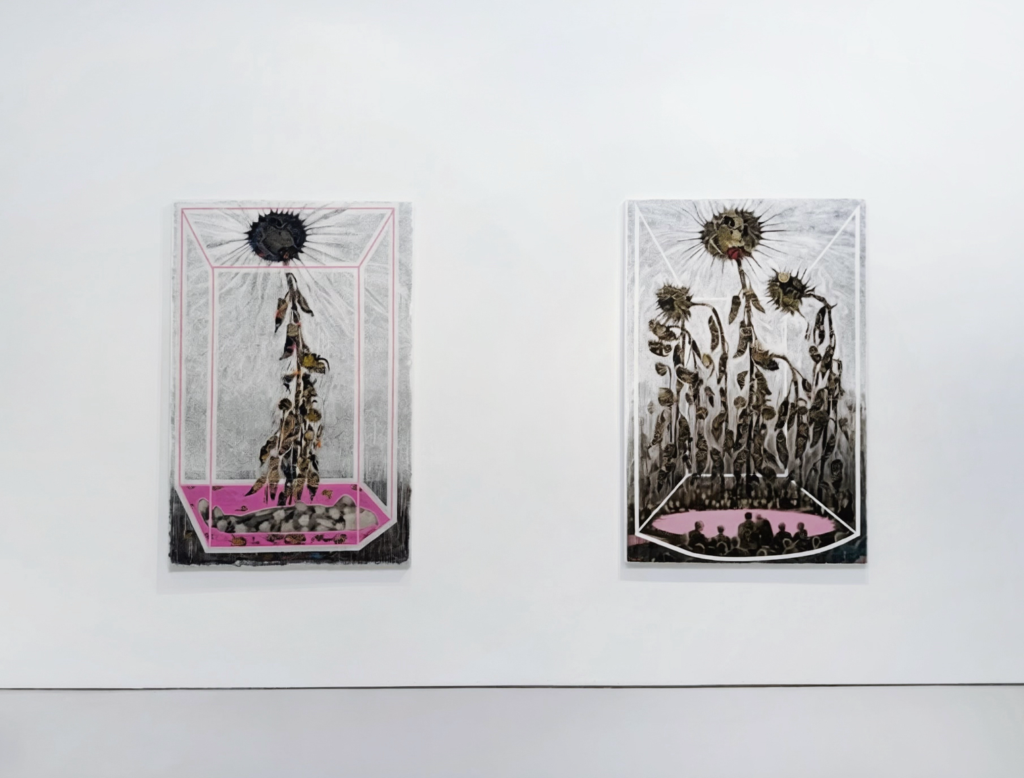
The sunflower is one of the most recurring images in the exhibition. Usually, sunflowers evoke sunlight, hope, and vitality; in Tâm’s paintings, however, this image takes on a sense of weight. It resembles an eye and also a wound. In the Searching for the Sunflower series, the petals open outward like eyelashes, while the dark center of the flower appears like a pupil. It gazes at the outside world while drawing the viewer into an injured interior space. It searches for light, and this search always takes place within shadow.
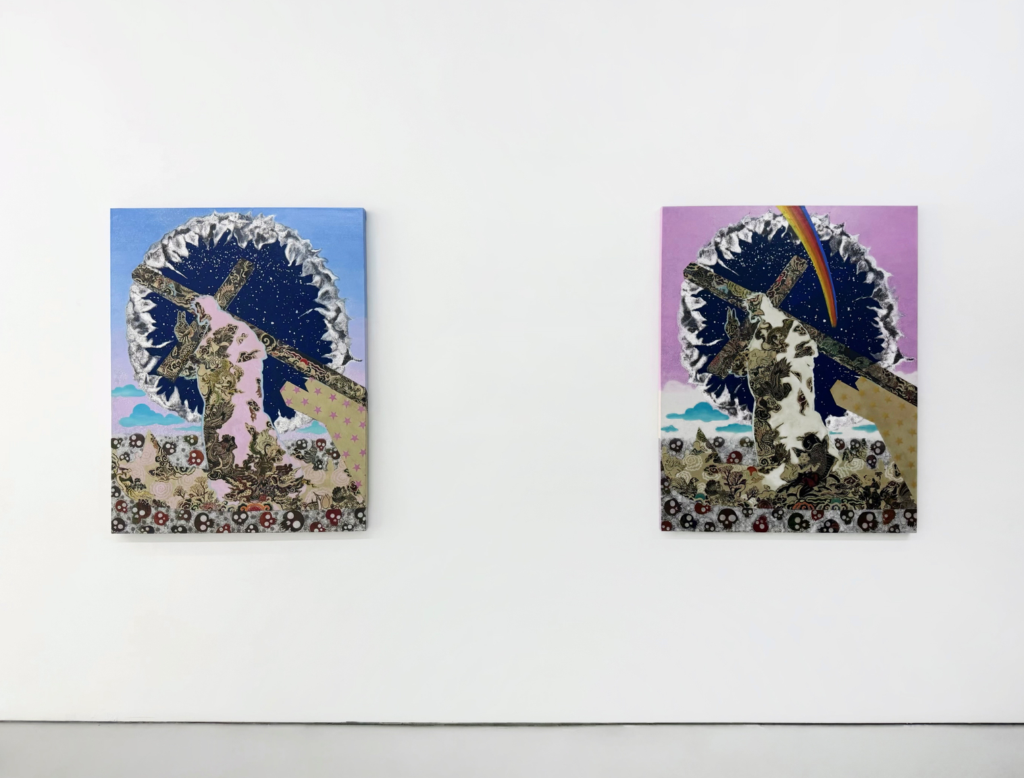
This tension also appears in Hello. God is here series. Religion here becomes a spiritual field marked by burden. The figures in the paintings drag tilted crosses, sometimes with a faintly playful gesture. The cross shifts from a sacred symbol into a form of weight. Salvation also loses its sense of lightness, coming closer to the force of enduring suffering and continuing to move forward.
In the Utopia series, the sunflower is placed within a more enclosed structure. Black flowers stand upright inside narrow cage-like spaces, surrounded by swirling brushstrokes, pierced forms, and hidden details. The “utopia” here appears dark, fractured, and pressured. It becomes an ideal surrounded by force, a state of life that must sustain itself within constraint. The flower continues to grow, and this growth is always accompanied by oppression.
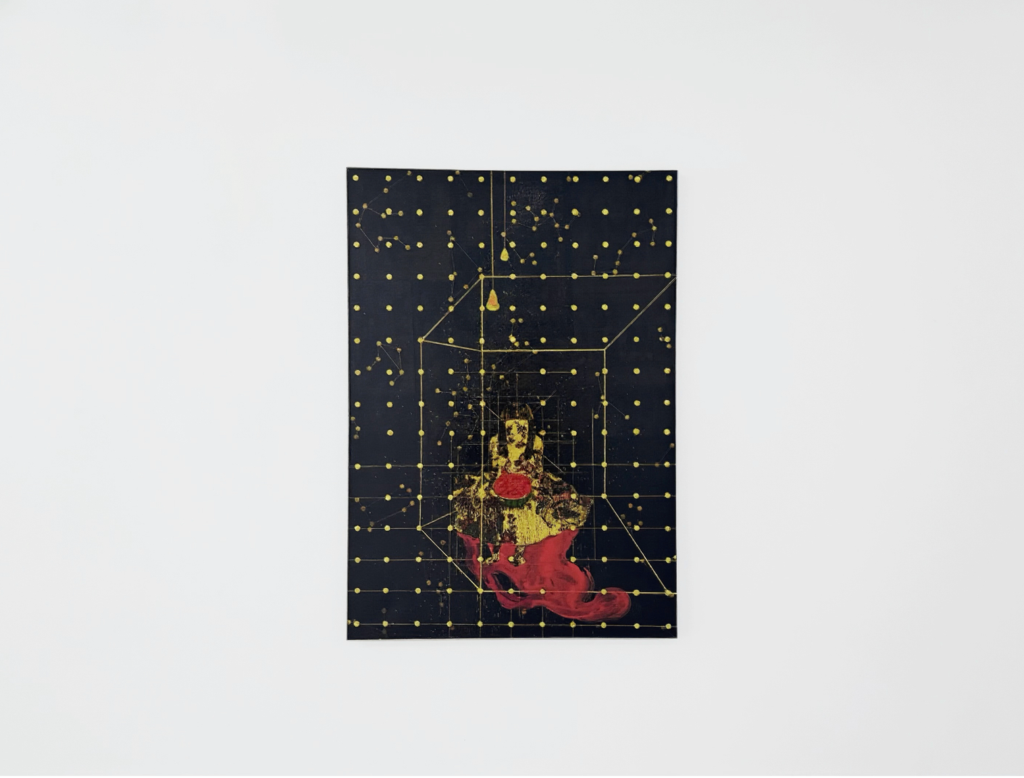
The Mutant series further disrupts stable structures of body and image. The figures become hybrid, collaged, and difficult to categorize. They carry the traces left by historical violence and intergenerational trauma, appearing like mutants forced into being through conflict and rupture. Here, mutation is not fantasy, but a cultural experience: when the past cannot be inherited as a complete whole, new subjects can only reassemble themselves through fragments.
From this perspective, Tâm’s work can be understood through the framework of postcolonial memory and cultural reproduction. Even after colonialism and war end as political events, they continue to exist within images, bodies, belief systems, and collective memory. Homi Bhabha’s notion of cultural hybridity appears here as a tense process of regeneration. Traditional woodblock imagery, Christian symbols, modernist painterly language, and the trauma of war overlap within the same pictorial space, making identity the result of constant transplantation, collision, and transformation.
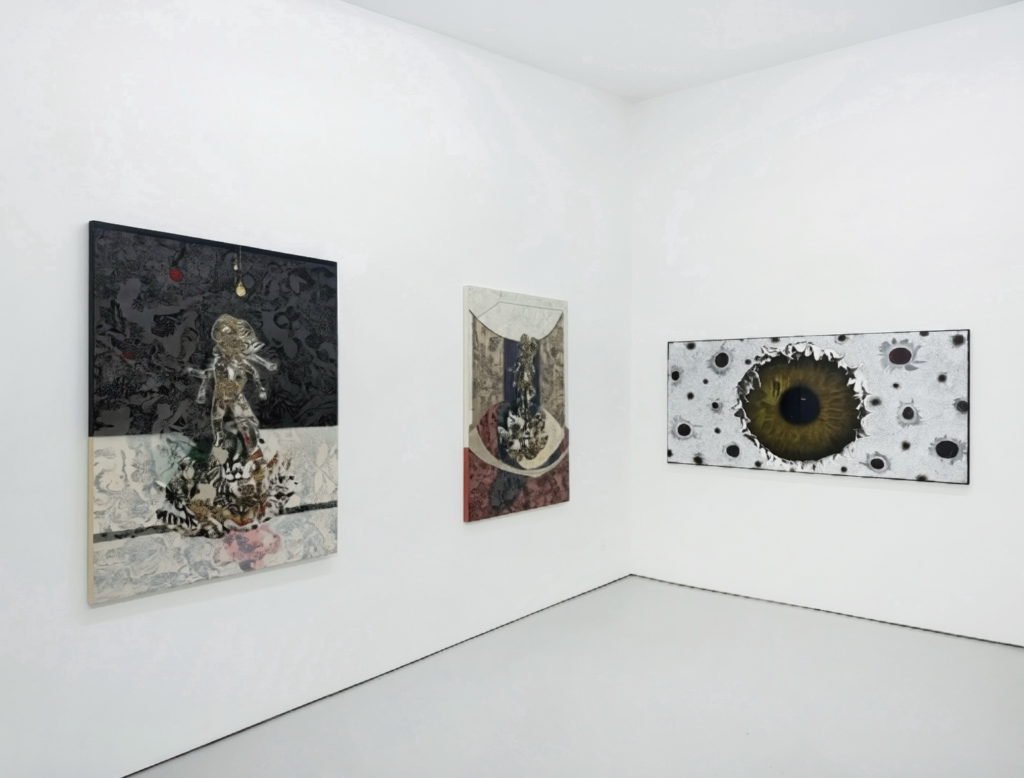
In this sense, Here on and after is an exhibition about how life continues to grow after trauma. Tâm allows these images to transform, migrate, wound, and reassemble within new contexts. Sunflowers, crosses, folk woodblock images, and mutant bodies together form a visual state of “after the embers”: they come from the past, while continually breaking away from fixed historical forms; they carry wounds, while continuing to generate new forms of life.
The power of the exhibition lies in its insistence that history continues to shape the present. Flowers that appear bright, patterns that seem festive, and symbols that seem sacred all become complex, heavy, and ambiguous in Tâm’s paintings. They are residues of cultural memory, as well as starting points for renewed growth. “Here on and after” may suggest that we are always living after history, and that this “after” is not an ending, but a terrain that continues to burn, transform, and sprout.
BÙI THANH TÂM: HERE ON AND AFTER, Eli Klein, 398 West Street, New York, NY 1001.
On view through July 18, 2026. Tue- Sat, 10 am – 6 pm.
Make your tax-deductible donation today and help Art Spiel continue to thrive. DONATE
About the writer: Shuhan Zhang (b. 2002, Jiangsu, China) is a curator, writer, and Ph.D. researcher. Her research examines digital art, cultural platforms, and the contemporary art market, with particular interests in artistic visibility and contemporary exhibition practices. She has curated exhibitions including Between the Breath of Objects, After the Face, Lithic Coordinates, Losing Ghosts, A Lure, A Lament, and Spreading Growth. Her writing has been published in Tussle Magazine, IMPULSE Magazine, Art Spiel, and Whitehot Magazine, focusing on exhibition criticism and contemporary art discourse. @hiirebecca_a