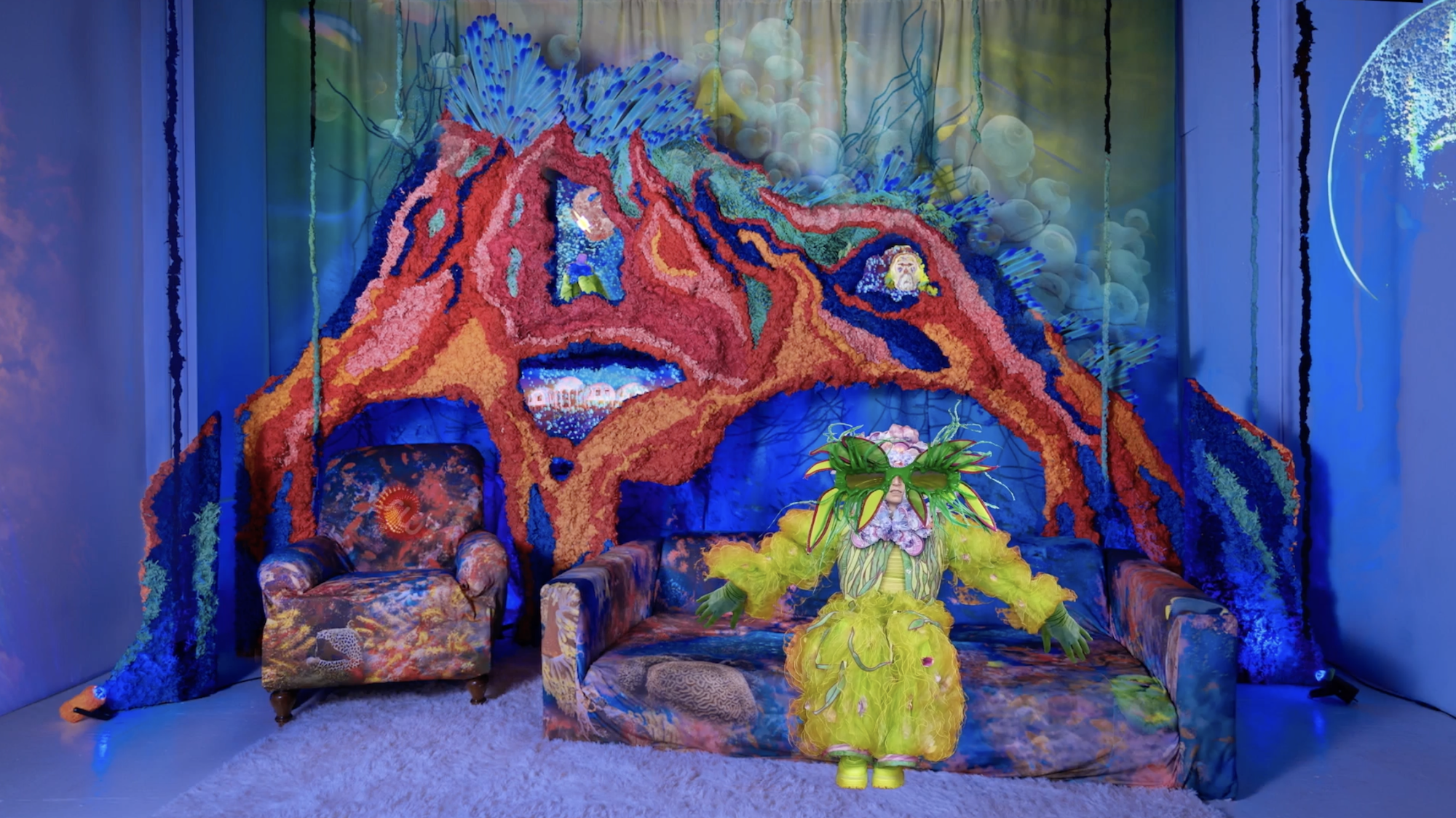
Dakota Gearhart grew up on a Florida coastline where algae blooms, sewage outflows, and bikini contests share the same shoreline, and her work has been carrying that mix of beauty, decay, and amusement into a much bigger frame ever since. Across animation, sculpture, performance, and sound, she builds video worlds where pixels sing, electricity becomes sentient, and the nonhuman shows up on equal footing with the rest of the cast. Her ongoing animated series Life Touching Life is hosted by Tiffany, a half-algae, half-woman figure who guides viewers through episodes shaped with collaborators — poets, scientists, activists, caretakers — whose lives already reflect the worldview the work is reaching toward. It’s funny, strange, and serious in roughly equal measure, which turns out to be the right register for the worlds it stages.
Your work moves across animated video, performance, sculpture, and net art. How would you describe what you do, and what’s the thread underneath all of it?
I’m an artist using video, collage, sculpture, sound, performance, and technology to create immersive worlds that question how we relate to the more-than-human, each other, and the cosmologies we inhabit.
Across these amalgamated forms, I work to dismantle hierarchies between species, matter, and knowledge by treating biological, technological, and planetary life as equally animate and capable of relationship. The thread underneath my practice is an ecofeminist and animist approach to world-building that uses humor, sensuality, and a maximalist visual language to make the familiar strange and invite viewers into new ways of imagining collectivity.
Tiffany — your half-algae, half-woman host of Life Touching Life — feels rooted in the Florida you grew up in, where manatees gather in sewage-warmed water and red tide blooms in every bay. How did she arrive, and what does playing her let you do?
Tiffany comes from my experience growing up in Florida, where algae blooms, sewage outflows, bikini contests, manatee orgies, and tourist spectacle all coexist on the same shoreline. She’s shaped by that environment, where excess, decay, beauty, ecology, and amusement are inseparable.
As a half-algae, half-woman host, Tiffany lets me speak from a position that is not fully human. Playing her allows me to step outside human exceptionalism and act instead as a mediator between species, materials, and forms of knowledge. Through her, I can hold play, grief, curiosity, and even magic, all at once, and guide viewers through a vivid cosmology where all matter is alive and in relationship.
Life Touching Life commissions scholars, poets, and activists — including the 2023 episode with poet Erika Dane Kielsgard, and the 2023 trip to Japan on your NEA fellowship. How do you choose collaborators, and how does their material become Tiffany’s world?
I deeply admire people whose lives already reflect the worldview my series is proposing. People who are in intimate and thoughtful relationships with nonhuman life through their research, care practices, or creative work. I’m less interested in illustrating expertise or elegant logic than in amplifying lived philosophies of coexistence and care that are already being practiced. I usually find them through my own research or an introduction.
Our conversations often begin as interviews, recordings, or exchanges of writing. From there, I translate their words into storyboards for animations and incorporate performance, sound, and collage. Their material doesn’t get adapted into a script so much as absorbed into the ecosystem of the episode, where their voice can sit alongside algae, electricity, insects, or coral as another form of living knowledge. In this way, Tiffany becomes a host not just of a show, but of a shared world shaped by many contributors. As Octavia Butler wrote, “All that you touch, you change.
All that you change, changes you.”
As a storyteller, I am most fascinated by multi-perspective philosophy as a way to understand the flexible nature of reality. Co-creation is really a labor of love, and I am grateful to all the collaborators and contributors who’ve added their energy to the Life Touching Life project.

You’ve said you focus on animation because it expresses the animated qualities of the world, “whether living or not.” Is there a moment in Life Touching Life or another piece, where animation did something live action couldn’t have?
Yes, many times, but especially in moments where the boundary between living and nonliving needs to dissolve in a way that feels matter-of-fact rather than symbolic.
In Life Touching Life, there’s a sequence where electricity slowly becomes sentient. In live action, that would read as a metaphor, a special effect, or a visual trick layered onto reality. In animation, it can simply *be true*. Light, pixels, wires, and atmosphere can share the same visual language as skin, algae, or coral, so the viewer doesn’t experience a shift from “real” to “imagined.” Everything exists in the same universe or ontological plane.
Animation lets me remove the hierarchy between documentation and speculation. A bioluminescent pixel can sing with the same legitimacy as a human voice, and a black hole can perform opera without needing to justify how. That flattening is essential to the work’s worldview, and it’s something live action would constantly pull back toward realism.
Pick one project that feels essential — Life Touching Life, The Sextant of the Rose, or another — and walk us through how it came together, from the first spark to the final form.
The idea for Life Touching Life came to me in 2019 after I taught Cinéma Vérité documentary filmmaking and experimental animation at the same time. In one afternoon of back-to-back teaching, the notions of nonfiction and fiction dissolved. I realized, in the end, that media really becomes a projection of what a director wants to share with the world. Which was the first spark, and the second spark came later during the pandemic: the world is so serious (rightfully so), but it’s also funny, surreal, cute, and mysterious (rightfully so), and Life Touching Life enables me to express the importance of those qualities as well as my more comprehensive research.
As for the final form, it came together through participating in the New Museum’s NEW INC program and Brooklyn’s BRIC residency. These experiences made clear to me how collective imagination has been instrumental to the blossoming of my life and art. I learned I could contribute to that collectivity intentionally, and I have done that with this freely shared project. During different release stages, my artist collective Blockbusters has been very helpful, as well as SoMad, a queer and femme space, who’ve generously supported the project’s growth.
As for production, it takes months to put all the multi-media together and export it into one form, which I do for every episode, because even with all the contributions, I am still the director making the final cut. (If you’d like to know more about the behind-the-scenes production, I write about it in detail here on my Substack.)
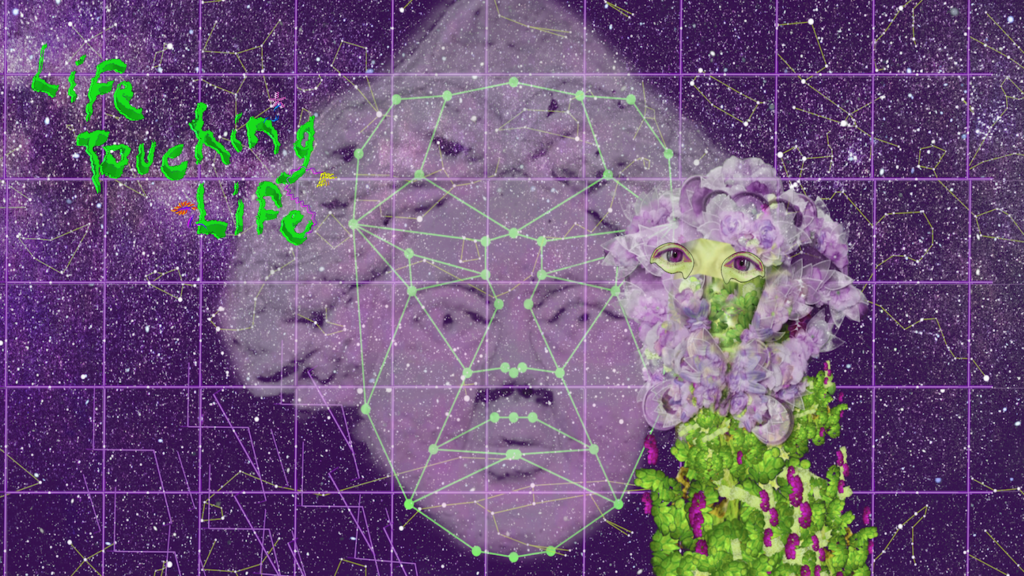
You call your practice “alchemy-inspired” and quote Anna Tsing on how destruction can be generative. How does that show up in the studio when something isn’t working?
In the studio, alchemy mostly shows up as a willingness to let multi-media and multi-perspectives linger together, ferment, and transform into something new, which is a surprise even to me. But yet, this tedious process also naturally invites failure to have its moment in the studio.
When something isn’t working, I don’t try to fix it immediately. I pull it apart and put it back together, layers of animation, sound, drawings, found materials, and I look at the fragments as raw material again. A sequence that feels flat might become a performance. A failed sculpture might get scanned and turned into a landscape. A sound recording that’s unusable as dialogue might become atmosphere. I treat breakdown as a return to ingredients. I’ve always been interested in trash, and especially in our relationship with recycling, even as concepts. Physically, I work with discarded materials as a way to push back against our material-driven culture, to heighten the psychic charge of the work, and to acknowledge that flowering plants continue to grow from cracks in the concrete.
In this way, quoting Anna Tsing isn’t just theory-baiting. For me, it’s also practical; the studio is full of leftovers, glitches, scraps, corrupted files, and discarded objects that often become the most generative parts of a piece. Instead of asking “how do I make this behave?” I ask, “What is this trying to become if I stop insisting it be what I planned?” That shift, from controlled logic to creative trance, is where new forms tend to emerge, and where the work starts to feel alive again and again and again.
You’re a year into the Sharpe-Walentas Studio Program. What has dedicated studio space, and that cohort opened up — and what’s currently living in the room?
Not paying studio rent and being in community with creative, kind, and smart artists has shown me how to not center capitalism and scarcity in my daily conversations and in my life. I’ve started prioritizing my health and my relationships, and my work is jumping off the screen into collages and sculptures, as well as some painting, which the cohort has inspired me to undertake. If someone is interested in a visit, please do get in touch. I’d love to show you what is currently living in the room.
The SW cohort is especially connected, and our exchanges are mostly about art, how we make it, and how to live in this chaotic world. We share studio visits, supplies, and a mutual interest in each other’s work and life, without the nagging problem of money dividing us, which often happens in artist circles. Every time I enter the studio, I thank the founders and the funders for the program; it is a gift, and may it continue for years to come.
You’ve described your earlier work as exploring “the fragile terrain between desire and excess.” With Life Touching Life, you now talk about offering “beauty and play” as the climate-change era presses on. How did the work move from one to the other?
In the earlier work, I was circling the problem. I was looking closely at how desire tips into excess, and how pleasure, consumption, beauty, and harm can blur together. The tone was more diagnostic, sitting inside that instability and trying to understand its texture.
With Life Touching Life, the question shifted from “how did we get here?” to “how else might we live here?” The work didn’t abandon those tensions; it reoriented them toward possibility. Instead of dwelling in the collapse, I became interested in what kinds of relationships, myths, and forms of attention could grow out of it.
Beauty and play emerged as necessary tools rather than aesthetic choices. As climate anxiety intensifies, I felt a responsibility to make work that not only critiques systems of excess but also offers viewers an embodied experience of connection, humor, sensuality, and care. The work still holds contradiction and decay, but now they exist within a larger imaginative ecosystem where coexistence feels thinkable, even pleasurable.
Make your tax-deductible donation today and help Art Spiel continue to thrive. DONATE
About the artist: Dakota Gearhart is an interdisciplinary artist based in New York. Her artwork examines the environment and how it is perceived. She creates a collaborative animated series called Life Touching Life that invites scientists, researchers, and caretakers to share observations on consciousness and its relationship to biodiversity. Her work has been exhibited, screened, and presented at the New Museum, NY; The Bronx Museum of Art, NY; Museum of Fine Arts, St. Petersburg, FL; Tacoma Art Museum, WA; Oregon Contemporary Art Center, OR; Horse Hospital, London; Horse and Pony Gallery, Berlin; Lab’Attoir, Thessaloniki; I-House, Tokyo, and many more. She has been awarded the Franklin Furnace Fellowship, and a National Endowments for the Arts US-Japan Creative Fellowship, and most recently, the Fulbright Scholar Award, which will bring her work to India in 2026. Currently, she is an artist in residence at Sharpe-Walentas studio program. www.dakotagearhart.com @_dakotagearhart
About the writer: Etty Yaniv is a Brooklyn-based artist, writer, curator, and founder of Art Spiel. She works in installation, painting, and mixed media, and has shown her art in exhibitions across the United States and abroad. Since 2018 she has published interviews and reviews through Art Spiel, often focusing on underrecognized voices and smaller venues. More about her art can be found at ettyyanivstudio.com and on Instagram @etty.yaniv