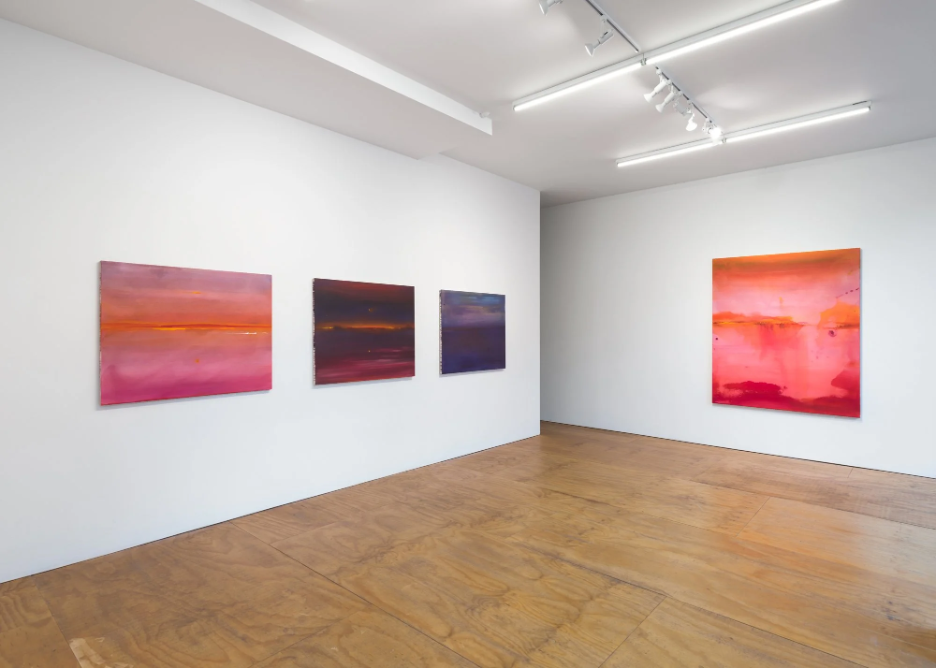
Life’s a beach, or maybe it should be if it could only resemble Tommy May’s resplendent scenes of light reflecting on Sammy’s bay beach on the east end of Long Island. Are beach scenes banal? Despite a robust art-historical lineage of beach paintings ranging from Milton Avery to Alex Katz, not to mention myriad others, including Picasso, Monet, and Degas, there’s a tendency to relegate the genre to kitschy decoration, best suited for motel rooms or dentists’ offices. Despite a softness to May’s surfaces that could cross into that territory, the paintings deftly skirt it through their atmospheric intensity and sophisticated touch.
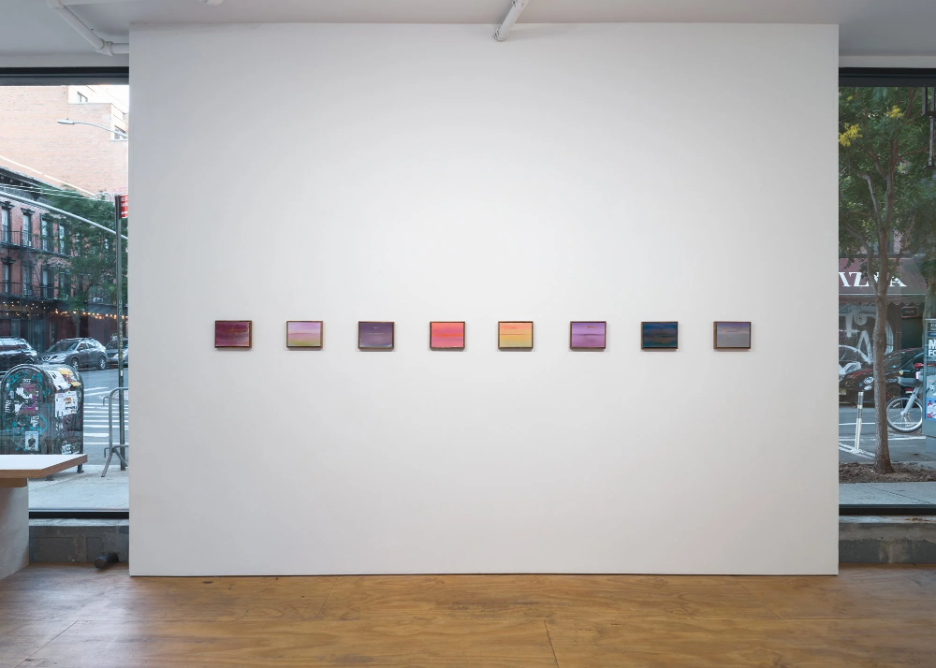
Sammy’s consists of 16 acrylic/acrylic wash paintings, all 2026, in various sizes ranging from relatively large (70 x 62”) to a suite of nine small ones, all 6 x 8”. The specificity of the depicted locale reinforces the choice of a repetitive format, as do concepts of memory and the ritual of walks on the beach. Each painting is punctuated by a tiny dot, moon or sun, hovering over the horizon, at times barely visible, evoking Turner’s The Fighting Temeraire (1838) and Whistler’s Nocturne, Blue and Gold—Southampton Water (1872), as well as the serial suns in Matthew Weinstein’s recent show at Tibor de Nagy. This pinpoint of paint somehow seems to hold each painting together — the 19th-century poet Shelley personified the moon as “wandering companionless” but here it seems an essential and integrated beacon, more akin to Jim Morrison’s exhortation to “swim to the moon” and “climb through the tide.”
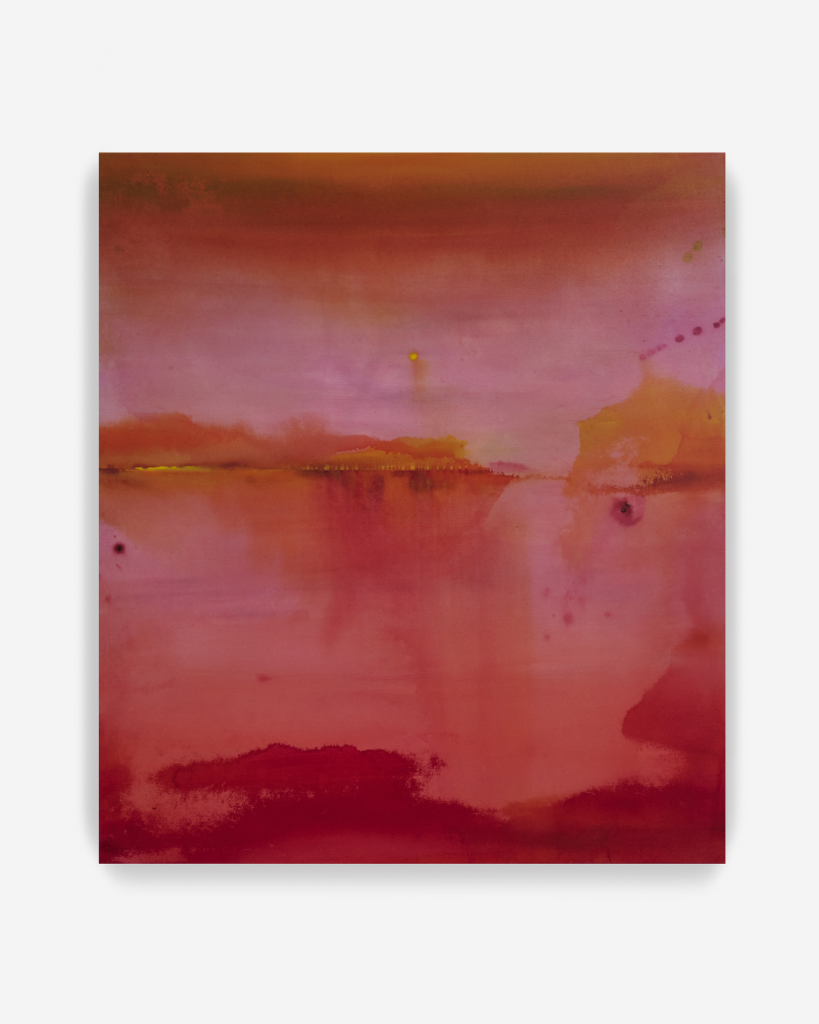
Often verging on monochromatic abstractions in vibrant hues of pinks, violets, and oranges, May’s paintings are consistent evocations of landscape, specifically sky and sea, with an ever-present horizon line. With their subtle shifts in color, they suggest the glow of light on the water and in the sky; however, their highly saturated planes of color can at times obscure their source. Take Fish Traps at Sammy’s, its deep purple and brown swaths dissolving in swirls of color that almost completely mask the fish trap reference. Skipping Stones, the spatially deepest and the loosest in paint handling of the group, is also the most compelling and open-ended. Here, May appears to cede control to what the paint itself can do, leaving drips and splatters of pinkish-red that enliven rather than distract from the essence of what is being depicted.
Repetition can be mind-numbing or borderline conceptual. In different series — Haystacks, the Thames, the Rouen Cathedral — Monet painted the same scene over and over to demonstrate the ways that imagery and perception can be altered by various factors, light and atmosphere among them. May’s beach views seem similarly conceived, exploring the profundity of what is right in front of us.
All photos courtesy of the gallery.
Make your tax-deductible donation today and help Art Spiel continue to thrive. DONATE
About the writer: Amanda Church is a painter and occasional writer living and working in New York City, where she is represented by High Noon Gallery. @mspants21
Tommy May, Sammy’s Half Gallery
235 E 4th St, New York, NY 10009
June 17-July 10, 2026