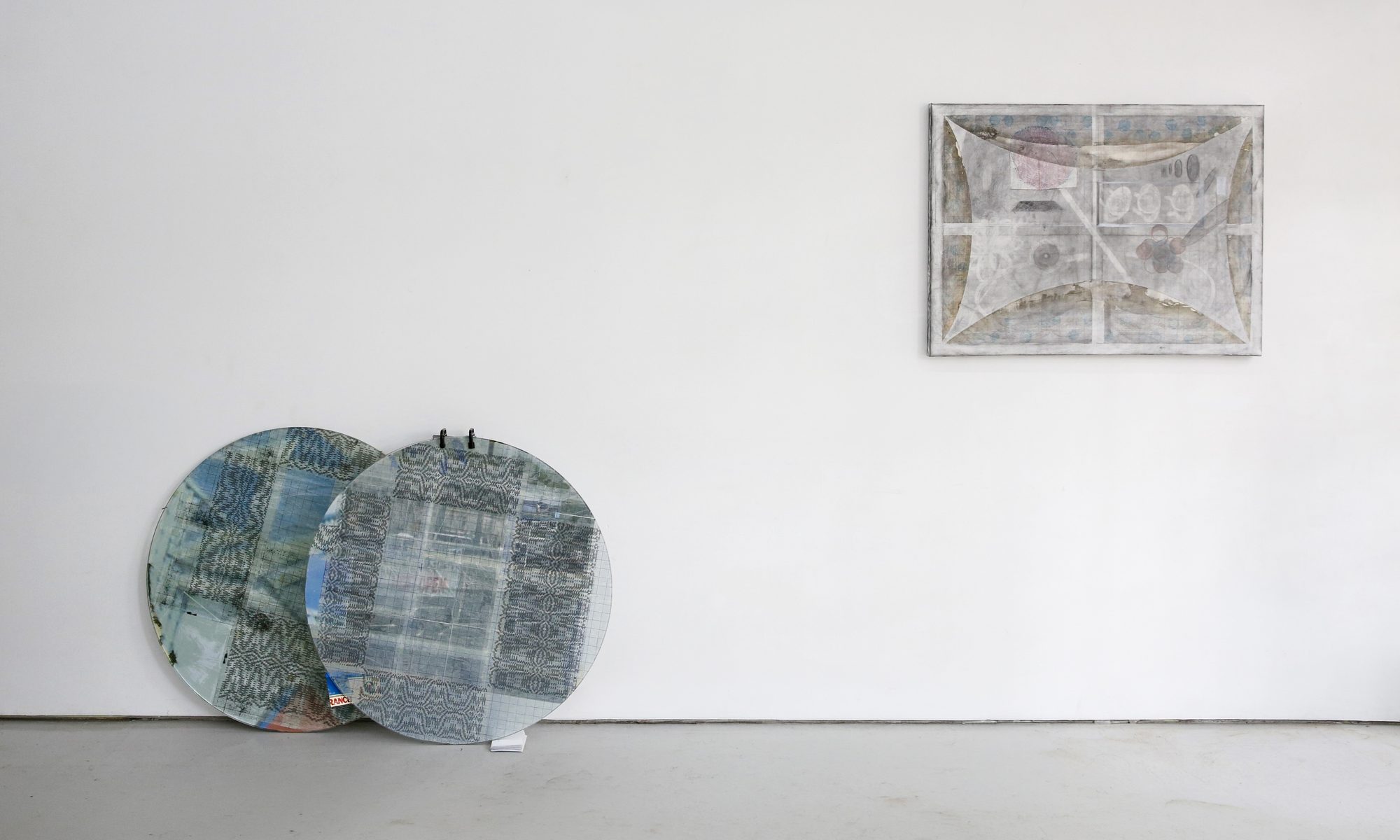
For artists Clare Hu, Tianyi Sun, and Shaan Ken Rao, their residency-then-exhibition is already well past its expiration date. Entering the group show Best by 07/21/2026 may feel more like intruding on a gallery’s installation or deinstallation than attending its finished presentation. Moving blankets are spread across the walking path, with splashes of white paint visible on the quilted fabric. Glass tables lean on white walls. Enter the back room, and you may trip over one of many sandbags, or duck your head under the arm of a swinging C-stand.
Continue reading ““Best by 07/21/2026” at Eli Klein Gallery”Growing After the Embers: A Review of Bùi Thanh Tâm’s Solo Exhibition Here on and after
For a long time, when I was young, I felt distant from the idea of “history.” In textbooks, history always appeared through years, wars, reforms, and changes of political power, as if it were made of events already organized and settled. Yet the history that truly remains in the body often appears in more hidden forms. It may be a silence within family narratives, a memory that one generation chooses to avoid, a recurring pattern in festive images, or a color that seems joyful while quietly carrying a wound. Very often, history continues to exist in another form, lingering in images, bodies, and everyday experience.
Continue reading “Growing After the Embers: A Review of Bùi Thanh Tâm’s Solo Exhibition Here on and after”Andrius Alvarez-Backus: I Want to Know, I Need to Know
In Andrius Alvarez-Backus’s solo exhibition, I Want to Know, I Need to Know, at Eli Klein Gallery, the work Are You Still Strong Enough? (2025) emerges as the visual center of the show’s underlying tension. A My Little Pony toy hangs vertically, the surface covered in bronze patina, while the incision along its abdomen is carefully stitched closed. What was once a lighthearted and slightly absurd object becomes, through this treatment, both fragile and solemn. Its form evokes a body after surgery, yet also resembles a preserved specimen. However, the meticulous stitching does not suggest that the wound has truly healed. Instead, the seam runs along the body, leaving the incision exposed and gradually becoming part of the sculpture’s structure. The suturing does not erase the rupture; it keeps the rupture visible. The wound is no longer simply a trace of intervention, but the structural element through which the work sustains its tension.
Continue reading “Andrius Alvarez-Backus: I Want to Know, I Need to Know”