
Lee Sherry (1947–2012) showed paintings in New York and Boston through the 1970s and 1980s, moved in the circles of the Language poets, and left behind a body of work that almost no one knew existed. Seeing and Recognition, on view at Field of Play Gallery in Brooklyn through June 28th, is the first survey of her paintings — assembled by curator and artist David McDonough, artist Susan Bee, who was a close friend of Sherry’s in the 1970s, and artist and archivist Zak Vreeland, who acquired works directly from her studio after her death. The show brings together paintings that span decades, from early experiments made in dialogue with minimalism to luminous, layered late work that unfolds the longer you look. We spoke with David McDonough, Susan Bee, and Zak Vreeland about how the show came together, what the paintings do, and why Sherry’s work went unseen for so long.
How did you first encounter Lee Sherry’s work, and what was that initial experience like?
David: My first encounter with Lee’s work was at the home and studio of the painter Susan Bee. I was there visiting with my MFA class as part of a studio visit organized by artist Nancy Bowen. I was one of the last to leave because I was talking to Susan about another mutual friend and poetry connection (Susan is married to Charles Bernstein), and when I stepped out into the hallway, a painting she had hanging immediately caught my attention. It was the yellowish painting in the show, and what appeared to be an image of a white dove over layers of black animal forms and red writing. This is the painting we eventually decided to use as the flyer image. It totally stopped me in my tracks; it felt like a painting that I had been searching for in my own practice at one point, and it called straight out to me and asked me in. So I needed to know more about where this painting came from. I asked Susan who made the painting, and when she told me the artist’s name, Lee Sherry, I was shocked. I had never heard of her. Then I was even more shocked when I could not find a record of her work online, except for a page Susan and Charles had put together, which included a remembrance by the painter David Reed. I am a big fan of David Reed’s paintings, and reading what he said about the later work (which appears quite different from the painting I saw) spoke to things I find important in painting. A commitment to deep exploration of a theme that involves finding the painting through the process of making it, and a touch that is specific and necessary for the painting that is being made.
For years, I found myself asking anyone I thought might know about Lee Sherry if they knew her or had heard of her (no one had), and referencing her work in studio visits when it felt appropriate (this tended to puzzle folks). Then one day, I was visiting a show several friends were in, when I happened upon a painting of several orange circles in a field of blue, which looked and felt a lot like what David Reed photographed and described. When I asked the curator who made it, because it looked a lot like a Lee Sherry painting, he looked at me with a surprised, curious expression and said, “This is a Lee Sherry painting.” Then we both had what felt like a simultaneous “how do you know who Lee Sherry is??” moment, and this is probably the beginning of the show. The curator was the artist Zak Vreeland; he had several paintings and many works on paper from Lee that he acquired when he helped to clean out her studio. We started talking about how to show the work and shortly thereafter got in touch with Susan Bee, David Reed, and Lee’s ex-husband, James Sherry. Each of these folks lent work for the show and shared invaluable stories and insight into Lee and her process. So that was my first encounter, but it is also the genesis of the show. The first encounter with her work was so powerful, I spent four years hunting for more and assembling a show!
Zak: I first saw her work in her apartment shortly after she died in 2012. Her own work was mostly stored away on racks, and there were a few small pieces of her own on the wall. I remember the apartment being decorated with a variety of religious images and little sculptures, Buddhist and Hindu. Her paintings seemed to have spiritual or mystic qualities in that environment.
Susan: Lee was a close friend of mine from about 1977 to 1986. I always admired her paintings and graphic designs, and her dedication to her art. She was part of the group of my poetry and art friends around Roof Books (her ex-husband James Sherry is the publisher) and L=A=N=G=U=A=G=E. She wrote a piece about painting in that publication and also for my magazine with Mira Schor, M/E/A/N/I/N/G. She was an important part of a circle of friends who met at Reed College: Leslie Scalapino, Mei-mei Berssenbrugge, David Reed, Nina Weiner, and James. Those folks became my companions in the 1970s. My husband, Charles Bernstein, and I put her in a group show of word-based artworks in Milan in 1979. Later on in 1982, we exchanged paintings. Unfortunately, we had a falling out in 1986, and thereafter we lost touch. When she died, David Reed offered us some of the paintings that he and James had saved in storage. That’s when I took the two paintings that David McDonough saw in my hallway. We held an informal memorial for Lee in David Reed’s studio, and I remember that Cora Cohen spoke warmly about Lee. At the memorial, I read the unpublished review that I had written for her show at Susan Caldwell Gallery in 1983. Lee had never read it.
Lee left a note describing the act of seeing and recognition as the subject of her painting. How does that manifest in the work itself?
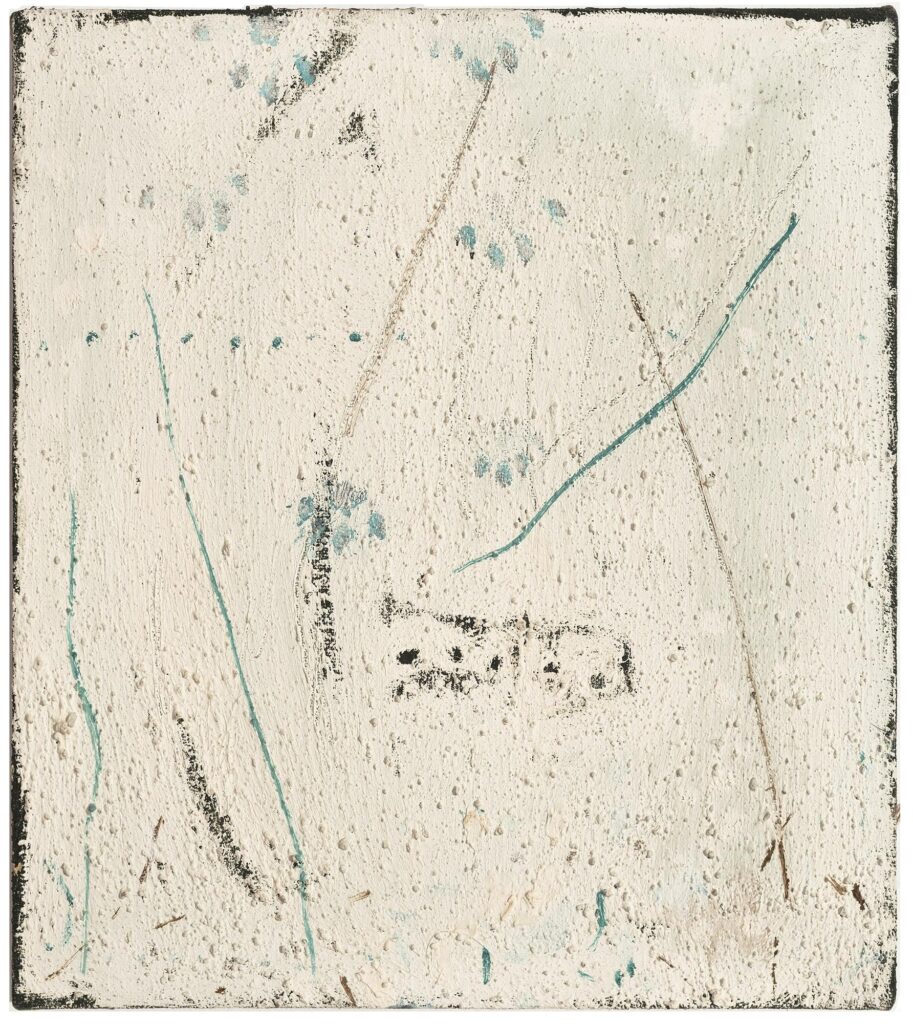
David: All of the work has an instant read, which allows the viewer to take in the basic premise of what they are looking at (figures in trees, animal silhouettes on colored ground, orange circles on a blue ground), and then each piece unfolds slowly and reveals more and more about the complicated nature of its making, and how we are supposed to read it. In each and every work in this show, the more you look, the more you see, and I would add, the more you question some of the original assumptions you had about the work when you first saw it. Effectively, viewing the work in the show is this experience of seeing something, it coming into focus in your mind, and the recognition of form or intention as you see it more clearly.
Can you describe a specific work in the show that exemplifies that quality — what do you see, and how does it unfold?
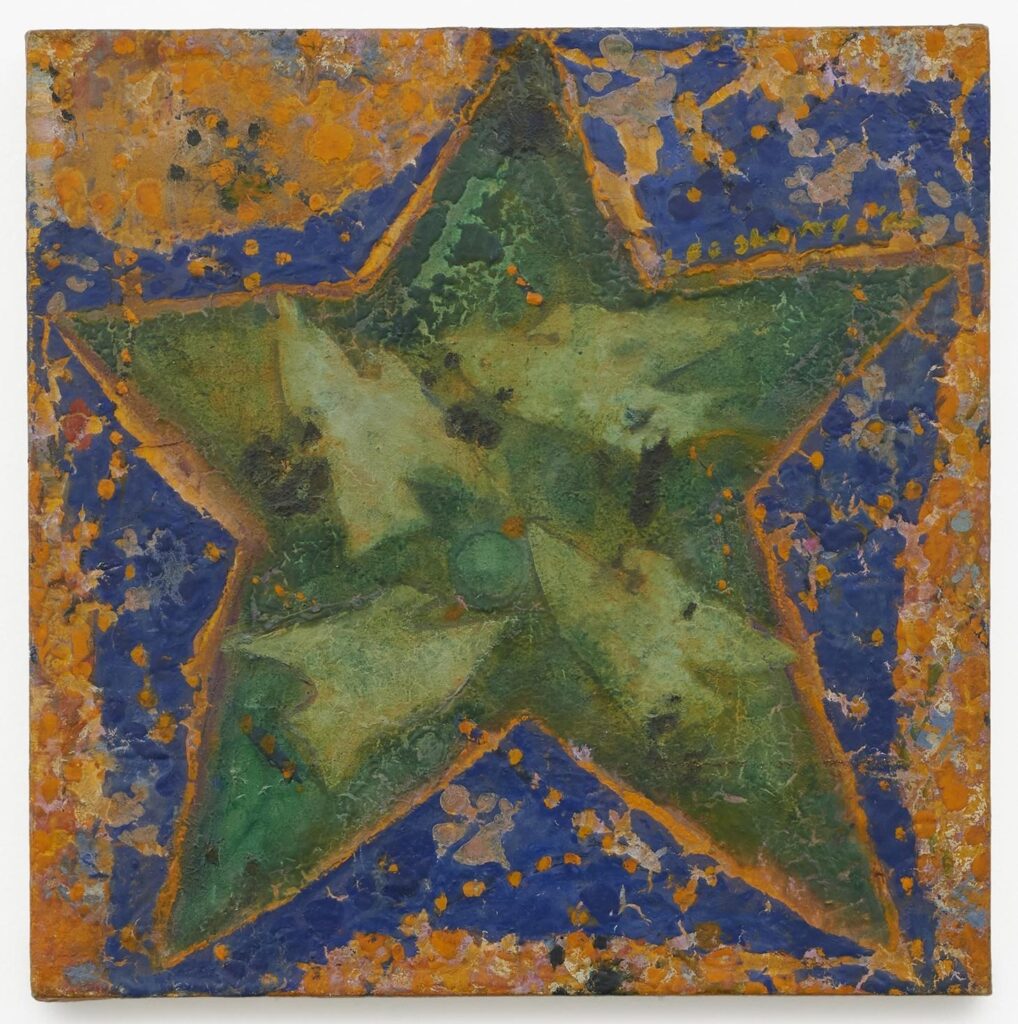
David: It is not easy to select a single work as an example here, because I think all the work does a version of this, and is the basic thread that ties the work from so many different eras and modes of working together. Below, I am including a beautiful small painting from the show, which has so much surface activity and so much imagery that appears to be moving and unfolding as you look at it. I have seen repeat visitors to the show look at this for minutes at a time and fail to notice the images of four faint birds in the center of the star until they are pointed out. This painting allows the viewer to move back and forth between surface texture and image, and let the two break apart and meld back together in an endless loop. The more one looks, the more one discovers about the internal workings of the painting.
She worked with Renaissance techniques for binding pigment, among other methods. How did her technical practice shape what appears on the surface?
David: Lee read a statement on Porfirio DiDonna at his memorial service held at the New York Studio School in 1986. In it she said, “When I first met Pro he showed me how to make black oil, which was not only a Renaissance technique for binding pigment invented by Giorgione, but a revelation to me about all old painting and how it was made, and why it looked the way it looked.” She goes on to describe the interest Porfirio DiDonna had in these alchemical processes, and how it was his intention to use these processes to “transform matter into spirit” in his painting. I think the same is true of Lee’s work, and the material explorations, and the techniques she used were similarly aimed at taking the tangible, material substance she was using and transforming it into an ineffable, otherworldly experience.
Lee showed actively in the 1970s and 1980s but never gained wide recognition. How do you account for that, and does it shape how you approach this show?
David: Recognizing there is a lot to the story I still don’t know or fully understand, I would guess the lack of wider recognition is partially due to Lee’s personality, partly due to some unfortunate circumstances within her friend groups, and it must be said she was a woman painting and making art in the 70s and 80s, fewer women (by a large factor) found fame and broad recognition than men.
Lee came from parents who had a successful, well-known, some would say famous, theater company. I have seen the offspring of famous folks recede from the spotlight. Lee also went through a divorce and a break with a friend group, followed by the sudden loss of a dear friend and fellow painter. After this, it sounds like she basically stopped showing and stopped socializing with art world folks, perhaps not socializing very much at all. She didn’t seem to have the drive or impetus to show her work or sell her work in a commercial forum. If you are not connected socially to a group or have anyone there to champion your work in the industry that would appreciate it, your work goes unrecognized.
In terms of our approach to the show, I think because of the fact that she stopped showing after the 80s, we had a lot more of the recent work available to us. This influenced our ability to devote the larger of the two gallery spaces to the latter work. This might have been what would have happened regardless, since viewing the later work can really be enhanced by seeing several other iterations of it at the same time.
Zak: She had the closest relationship to the Nielsen Gallery in Boston, but she did not live there, so I do not think that helped in getting her established in the New York art scene. Also, it seems, she moved from one style of work to a very different-looking style of work several times in the 1970s and 80s. They are all related, but they do not have a recognizable ‘signature style’. Her friend, David Reed, who had shows in many of the same galleries and was in group shows with her, had a recognizable signature style by the mid-1970s that a viewer could pick up, even while painting one series after the other that had a lot of variety. I have heard that galleries prefer an artist like that.
Susan: This is a complicated question to answer. Lee unfortunately abandoned her public art career after 1986. She was very disappointed, I think, with the response to her two shows at the Susan Caldwell Gallery. I, for instance, could not get her work reviewed, though I tried. I did write a review of her PS1 show for Women Artists News in 1981. And she had other supporters, including the art critic William Zimmer and the gallerist Nina Nielson. After Porfirio Di Donna died suddenly from a brain tumor, she retreated to her studio. After that tragedy, Lee had a stormy relationship with the very talented but troubled poet, Peter Seaton. But she never stopped painting, and we are now able to see the extent of the artworks she made during this period when she was publicly absent.
She had close ties to the Language poets and significant relationships with artists like Porfirio DiDonna. How present is that avant-garde community in the work itself?
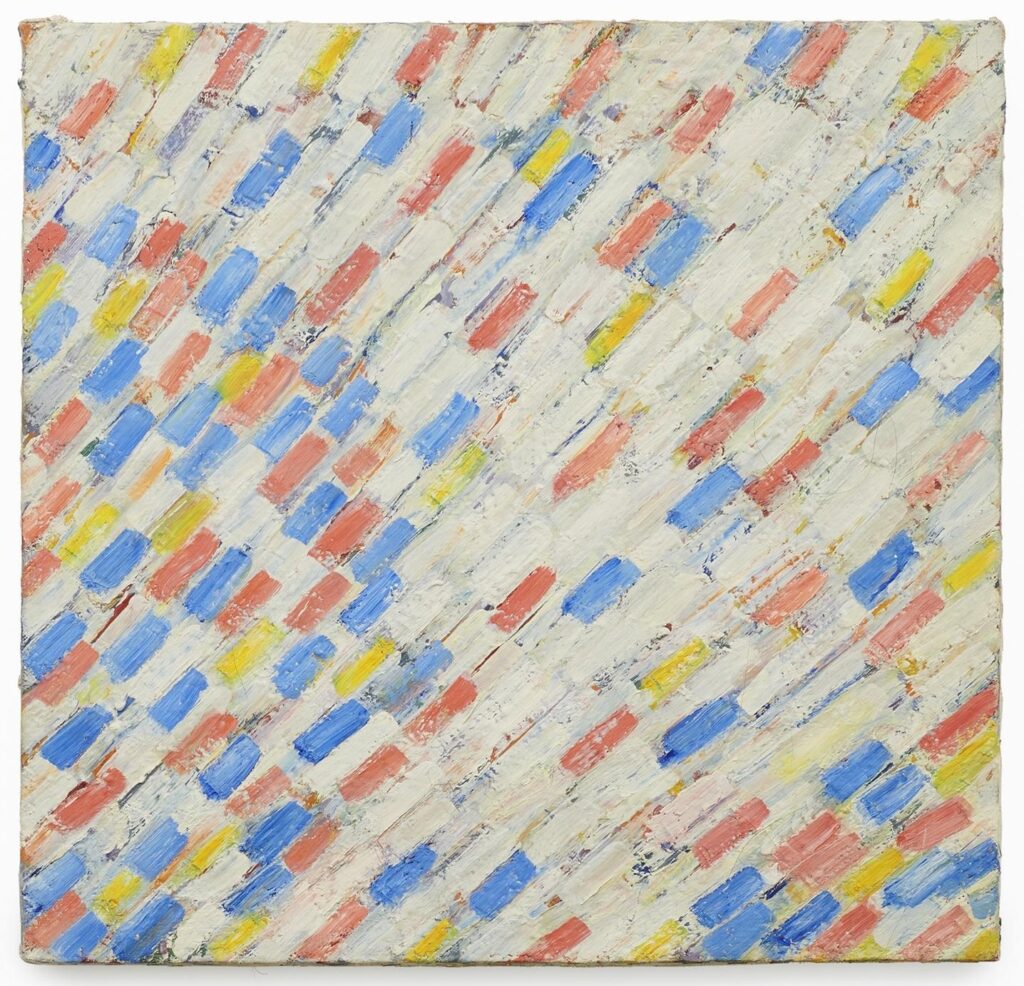
David: The show is organized almost chronologically, and what I think you can see is the way Lee was interacting with and sometimes wrestling with current trends in art and painting as she was finding her own voice. In each case, it feels like Lee is responding to what others are doing and finding her own way to engage with the process. There are a few pieces that show her experimenting with materials at a time when minimalism was quite dominant. She went through an impasto paint phase when this was part of the zeitgeist, and then found a group of painters experimenting with historical techniques, Porfirio DiDonna among them. After this, the work changed fairly drastically, but there is always a thread of humor, playfulness, and idiosyncratic impulses. Perhaps this comes partially from her Chicago upbringing, where her mother showed with the Chicago Imagists, and both parents founded and ran the theater and improv comedy group, Second City.
This is the first survey show of her paintings. What did the process of assembling it reveal?
David: Similar to what was stated above, collecting all the work and organizing it into a single show helped reveal what was common to Lee Sherry throughout. Each work has its own mystery to it, and each was clearly made by someone with very specific ideas about what they wanted to do, even if that is not entirely decipherable to the viewer. Through the process of looking at all the work together in the same space, and flipping through many of the drawings and studies we have, it seems clear that the later work was a place where Lee was able to distill her interests in specific painterly touch and subtle interaction of forms, while letting go of a lot of the content of the previous work.
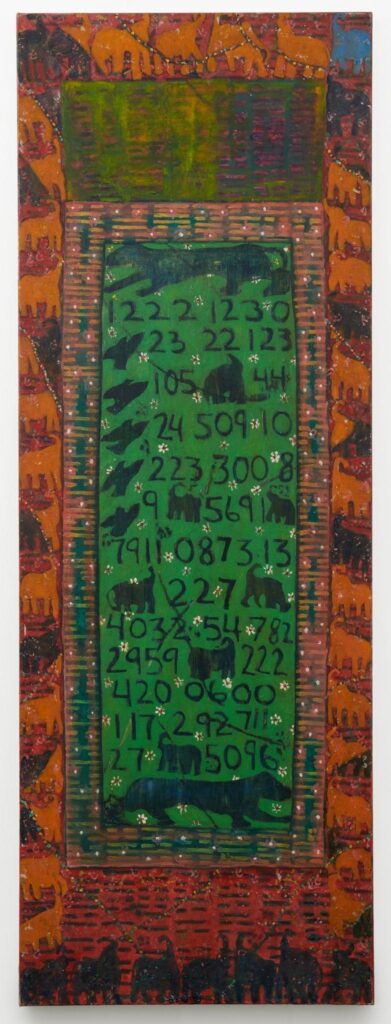
Zak: It revealed to me the issues that seemed to occupy Sherry in all of the periods of her work. A visibly painted surface- not using paint to create an illusion, but making something that looked like it was made by hand, of brushstrokes. In the same vein, nothing is square and sharp or mechanical. Every circle is asymmetrical to a degree, which she achieves by painting around the outside of the circle, then from within the circle, leaving a wobbly white line border, which is the white undercoat. The numbers on The Figures are painted the same way; they are not black numbers painted on a green background, the green was painted over the black, and she left number-shaped holes.
What do you hope this show does for Lee Sherry’s place in the history of this period?
David: Lee Sherry’s work deserves to be known to a wider audience. The work has been described as feeling timeless, and this is not surprising if we consider the influences we know of that date back to the 1500s through our nearly contemporary (2000s) time. There are lessons in this work for most any artist, and these are an excellent example of the type of work that can be made by someone who is willing to let in such myriad influences while thoroughly following through on her own interests and ideas.
Zak: It would be great to see her included in shows with her better-known peers that seek to evoke the sense of the period, especially the abstract minimalist works, the artists trying variations of minimalism, and then the 80s reaction against it. There is a lot to look at in the larger community of artists of the time.
Susan: I have been very personally gratified to see Lee Sherry’s artwork get the recognition that I always felt she merited. I wish that she had been able to share her artwork when she was alive. I have been happy to collaborate with David McDonough and Zak Vreeland, who brought such understanding and critical appreciation to the curation of the work of my long-lost friend. It has also been a wonderful experience to work with the staff and artists of Field of Play Gallery on this project. I hope that this show fills out a bit of forgotten and lost history of the period and that a new audience will discover Lee’s unique artwork. Many special thanks to David Reed and James Sherry for loaning us so many of Lee’s paintings!
Make your tax-deductible donation today and help Art Spiel continue to thrive. DONATE
Seeing and Recognition, The Paintings of Lee Sherry (1947-2012)
Curated by David McDonough, Susan Bee, Zak Vreeland
May 28 – June 28, 2026, at Field of Play Gallery, 126 13th Street, Brooklyn 11215 @fieldofplaygallery
David McDonough is an artist and educator based in Queens, NY. David has shown in solo and group shows in the NYC area, including recent shows with Good Naked Gallery, Field of Play Gallery, Paradice Palace, Studio Archive Project, Tappeto Volante Projects, Equity gallery, and One River School. He has received multiple awards and is a Dedalus Foundation Fellowship nominee. He teaches painting at CUNY College of Staten Island and is represented by Good Naked Gallery. This is his first curatorial project. @dedume
Susan Bee is an artist, book artist, and editor. She has had eleven solo shows at A.I.R. Gallery in NYC. In 2024, Bee’s “Susan Bee: Eye of the Storm, Selected Works, 1981-2023” was at the Provincetown Art Museum, MA. Bee’s artwork is in many public and private collections and has been widely reviewed. She has published many artists’ books, including collaborations with poets. Bee was the co-editor ofM/E/A/N/I/N/G: A Journal of Contemporary Art Issues with Mira Schor from 1986-2016. She has a BA from Barnard College and an MA in Art from Hunter College. She received a Guggenheim Fellowship in Fine Arts in 2014. susan_bee_1
Zak Vreeland is an artist and art archivist, bookseller, and appraiser based in Brooklyn. He studied writing at Bard College and wrote and performed music and theater projects at Bowery Poetry Club, Joe’s Pub, and other venues. He was a librarian at Salander-O’Reilly Galleries and an archivist at the Renee and Chaim Gross Foundation. He is currently a board member of the Ora Lerman Charitable Trust and frequently exhibits his artwork in Brooklyn and Manhattan. @zak_vreeland_art
About the writer: Etty Yaniv is a Brooklyn-based artist, writer, curator, and founder of Art Spiel. She works in installation, painting, and mixed media, and has shown her art in exhibitions across the United States and abroad. Since 2018 she has published interviews and reviews through Art Spiel, often focusing on underrecognized voices and smaller venues. More about her art can be found at ettyyanivstudio.com @etty.yaniv