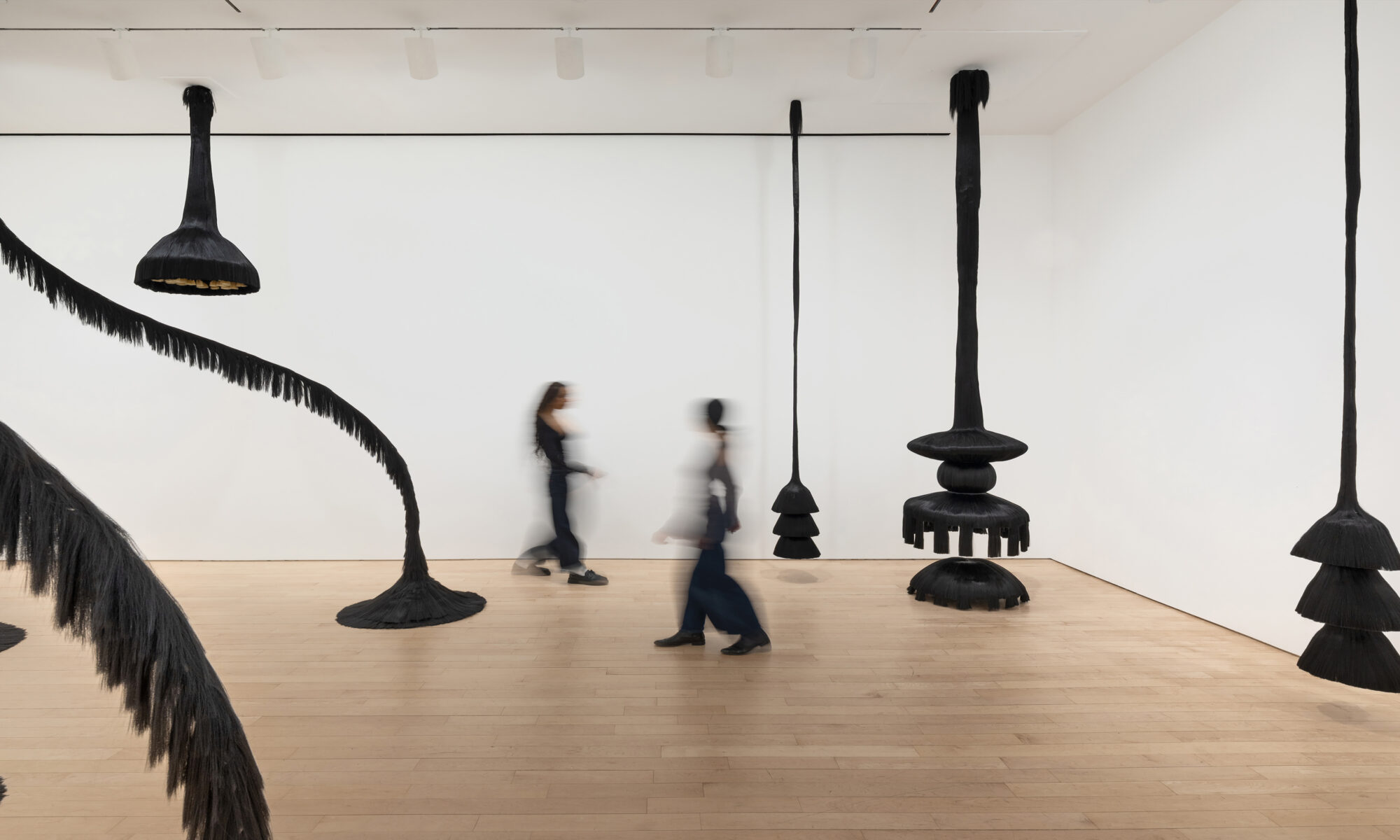
Kanekalon hair, the synthetic fiber of braiding salons and everyday hair care, is the raw material of Your Birth is My Birth, a speculative universe currently taking over Jane Lombard Gallery through June 13th. Artists Merryn Omotayo Alaka and Sam Frésquez have spent nearly a decade building Hairland, a collaborative fictional ecosystem that began with large-scale tassel sculptures in a Phoenix nonprofit space and has grown into a fully realized botanical mythology.
The exhibition transforms the gallery into a conservatory of invented species featured in five bodies of work: Listening Roots, Hearing Bells, Mother & Child, Stacking Pearls, and Umbra Pods, each with its own life cycle and place within a web of mutual dependence. The starting point is the epiphyte, a plant that grows on other plants without harming them, a model for thinking about care, growth, and connection that runs through the work at every scale. The title is borrowed from a phrase two friends exchange in the television series I May Destroy You, in good times and hard ones alike. We spoke with Alaka and Frésquez about how Hairland began, how they build together, and what draws them to worlds that don’t exist yet.
Your current exhibition, Your Birth is My Birth at Jane Lombard Gallery, imagines an entire speculative ecosystem born from Kanekalon hair. Can you walk us through how this world first emerged between the two of you, from the earliest conversations and references to the moment it began taking physical form in the studio?
Hairland has evolved over the past ten years, starting in 2016 at a month-long exhibition at a local nonprofit arts space in Phoenix. Our first time using hair was in a piece titled It’s Mine, I Bought It (a reference to Princess Nokia’s song Mine), a series of large-scale, tassel-shaped sculptures. At this point in our collaboration, we were thinking more about material culture, adornment, and histories as they related to hair and the tassel form.
In 2020, during the pandemic, we began working on patternmaking together over FaceTime, which eventually turned into experimenting with new shapes using hair. The first of which were bubble forms that we made in reference to both the popular hairstyle emerging at the time and Ruth Asawa’s practice. This led to our first larger body of work for the exhibition Things We Carry at Lisa Sette Gallery.
The tassel form evolved into larger, organic, otherworldly shapes. At this point, the installations were becoming more atmospheric as we leaned into establishing the forms that have become a foundation for our practice. In 2022, we received the Lehman Emerging Artist Award from the Phoenix Art Museum and began writing science fiction as a way to understand our work. The Kaneklaon Forest more formally presented Hairland as speculative fiction. We constructed this mythology that Kanekalon Trees evolved from a detached yaki ponytail. Writing collaboratively has always been part of our practice, but this was the first time we started writing fiction together. In 2023, we both began graduate school programs and focused on our individual practices, but we were still thinking about Hairland. After finishing our MFAs in 2025, Sam relocated to Chicago, where we set up a studio, and Hairland has continued to evolve.
Can you tell us about your studio? Do you share a physical studio when working together?
Yes, outside of grad school, we have always shared a studio. Our current studio is our third shared space. Sharing a studio has allowed us to stay in conversation with Hairland even when we don’t have a project we’re working towards.
Your works feel simultaneously botanical, bodily, and architectural. How do you move from discussion and sketching into construction? What does the process of physically building these forms look like, especially at such immersive scales?
Each project tends to take on different references and points of departure. For our current exhibition, discussions started during visits to the Lincoln Conservatory in Chicago. We talk through shapes and forms that we want to use, which leads into sketching. After we’ve decided on shapes and sizes, we talk through construction. This usually takes trial and error to get the forms we want. When working in larger spaces, we will use SketchUp to visualize how the installation will take up space. Construction usually requires both of our physical involvement; we often talk through our movements before and during the building process. A large portion of our refinement takes place during installation.
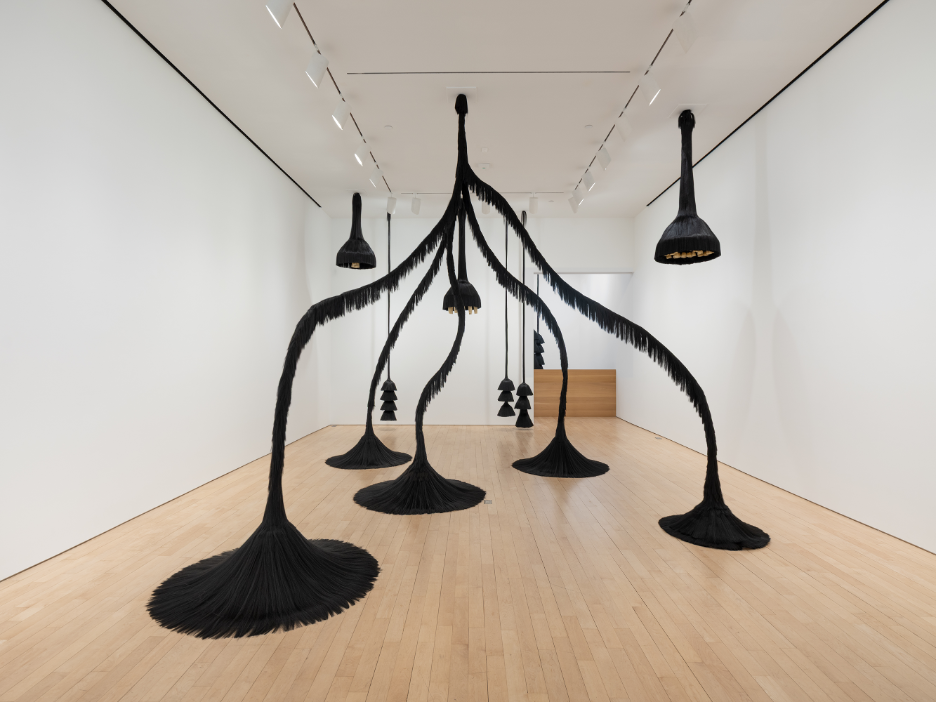
Hair operates here as both material and metaphor, something tied to identity, care, lineage, maintenance, and transformation. What drew you specifically to Kanekalon hair as the foundation for this evolving universe, and how has your relationship to the material changed through making the work?
When we started using Kanekalon hair, it felt familiar; it was already a part of our daily lives and our friendship. In the process of working with the hair at such large scales and quantities, we’ve learned a lot about it, how it behaves, and its limitations. We’ve learned to let the material lead and function in ways that it’s used in the world. The reasons that we use Kaneklaon hair and the ways that we approach it have changed, at the beginning the work had a more serious tone to itconceptually and has evolved to have more of a humorous approach, but there has always been a sense of familiarity and intimacy to physically making the work.
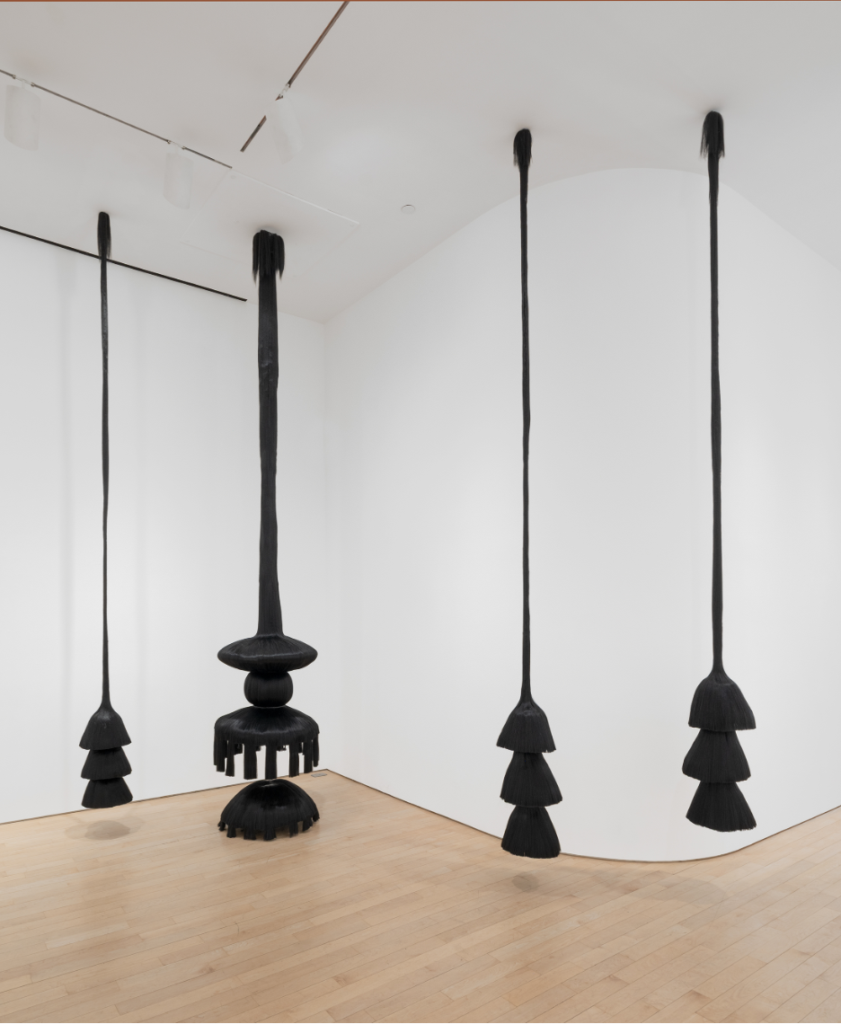
The exhibition introduces distinct “species” of sculptures. How do you think about naming and categorizing these works? Do you approach them more like sculptures, organisms, characters, or something else entirely?
Our approach to naming is a combination of the three. For this exhibition we were thinking a lot about the ways people relate to plants and the approaches we have to naming them. Their common names are in reference to the world that we’re building. We were imagining what humans’ first interaction with the plants would be like, what associations they would make with the shapes, and what their relationships to the plants would look like long term. We were also thinking about how each character relates to one another. Because this work was informed by epiphytes, we were thinking a lot about the ways that they could live together reciprocally. After imagining what the spans of their lifetimes look like, they start to really develop personalities of their own.
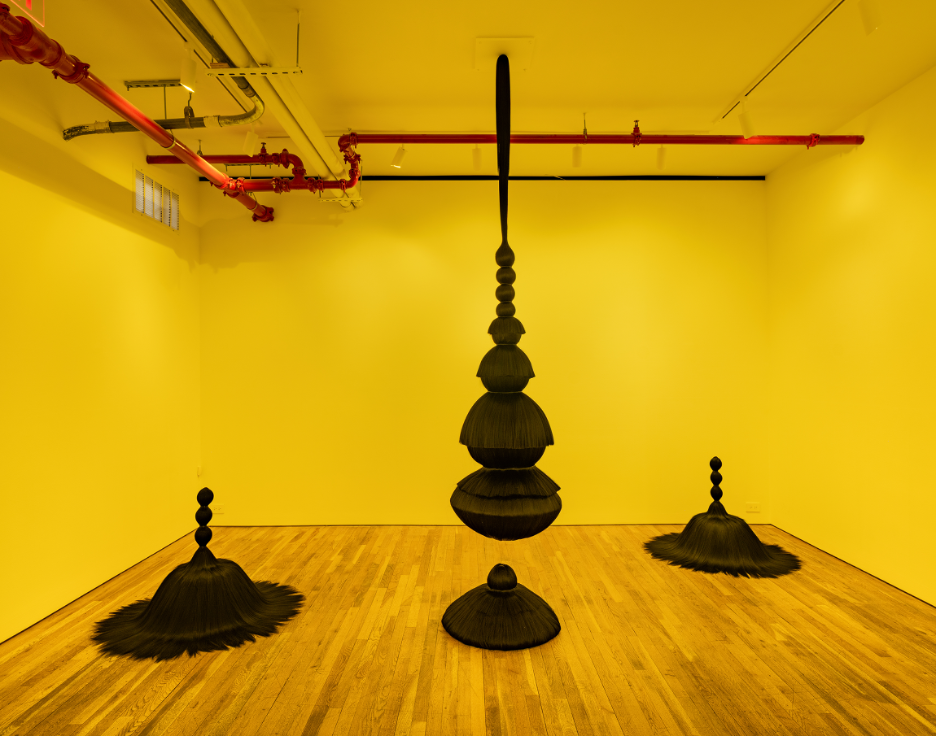
Collaboration is central to the exhibition. How do your individual practices differ from one another, and where do they naturally overlap? Are there specific roles, instincts, or sensibilities each of you brings into the partnership?
Our individual practices overlap in many ways: we’re both interested in questioning how we know what we know, in looking for and at alternative value systems. We both often work with lived experiences as a reference point, and both draw from our background in craft and fiber techniques. Because we’re working from lived experiences we inherently show up with different backgrounds, skill sets, and interests. At the beginning stages of the work we will verbalize ideas for sculptures together and Sam will translate our conversations into sketches. Another important asset to the realization of the works are Fresquez’s grandparents John Hertz and Mary Ellen Fresquez, both of whom are mechanical engineers and craftspeople. They have consistently played a role in the design and fabrication of large-scale work.
The exhibition references science fiction, botanical research, and conversations with botanists, yet the works also feel emotionally and physically grounded. What kinds of references (whether literary, cinematic, scientific, or personal) have most deeply informed the development of Hairland and Your Birth is My Birth?
The title Your Birth is My Birth is a line from the show I May Destroy You. A theme throughout that show that we were drawn to was the friendship between the two main characters. “Your birth is my birth, your death is my death” was a phrase that they often said to each other in different situations, at times in moments of difficulty, and at other times in celebration. The phrase speaks to a kind of care and reciprocity that resonates with both our collaborative work and friendship. The research that we did around plants also brought us to ways of thinking about symbiosis and interconnected lives. Pop culture has always played a role in the work,sometimes more directly than others. Some major reference points for us are the works of people like Jordan Peele, Octavia Butler, and Julio Torres and their use of speculative fiction, world building, and humor.
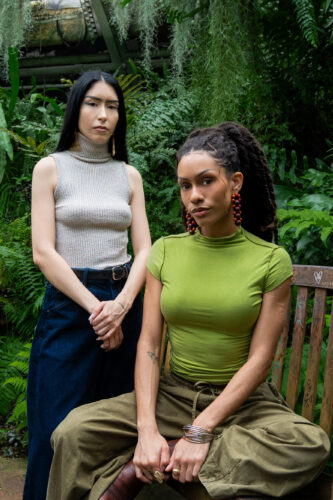
photo courtesy of Jane Lombard Gallery
Courtesy of Jane Lombard Gallery
Your Birth is My Birth at Jane Lombard Gallery @janelombardgallery
Featuring Merryn Omotayo Alaka @merrynalaka and Sam Frésquez @samfresquez
Runs through June 13th,2026