Seeing and Recognition: The Paintings of Lee Sherry

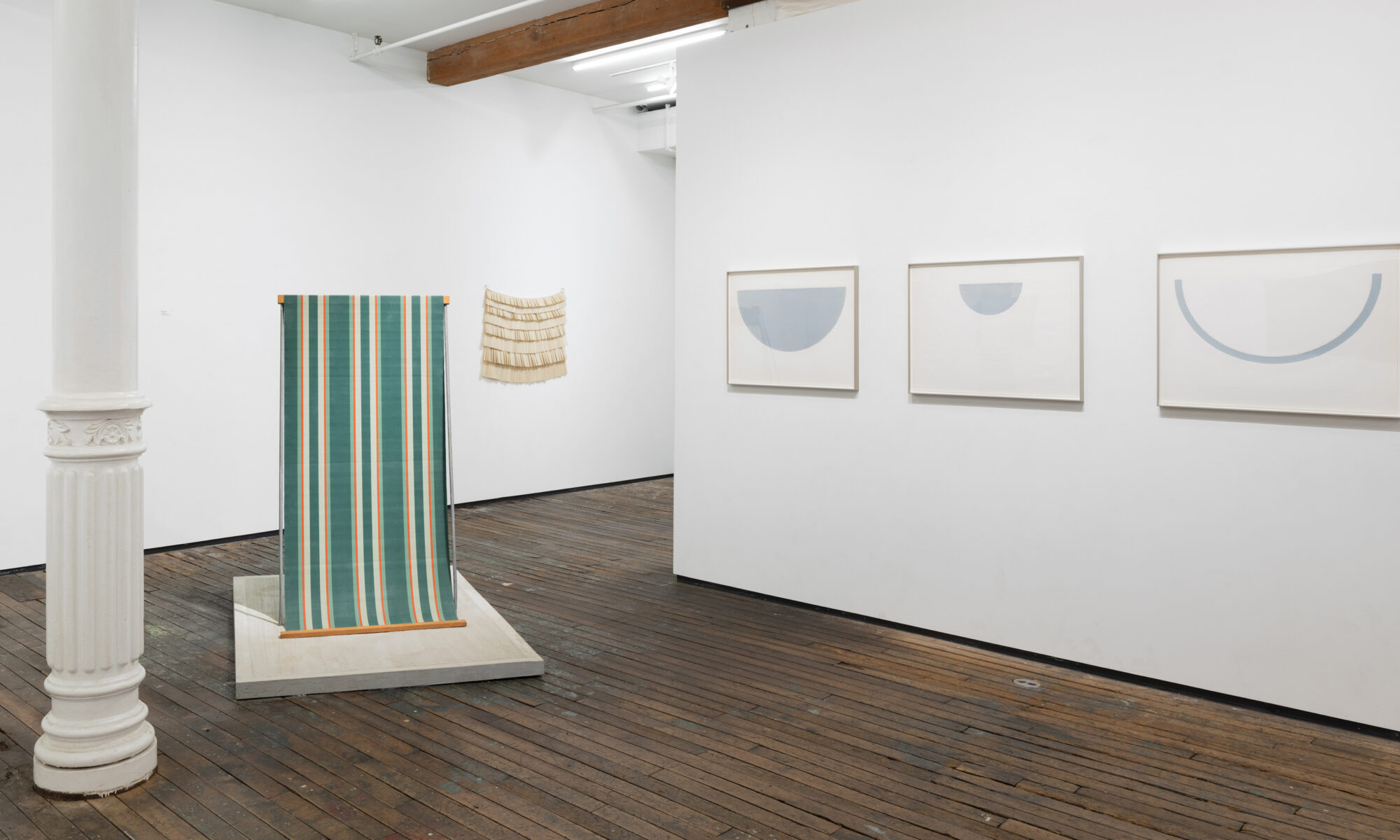
Lee Sherry, Installation view, Seeing and Recognition

Lee Sherry (1947–2012) showed paintings in New York and Boston through the 1970s and 1980s, moved in the circles of the Language poets, and left behind a body of work that almost no one knew existed. Seeing and Recognition, on view at Field of Play Gallery in Brooklyn through June 28th, is the first survey of her paintings — assembled by curator and artist David McDonough, artist Susan Bee, who was a close friend of Sherry’s in the 1970s, and artist and archivist Zak Vreeland, who acquired works directly from her studio after her death. The show brings together paintings that span decades, from early experiments made in dialogue with minimalism to luminous, layered late work that unfolds the longer you look. We spoke with David McDonough, Susan Bee, and Zak Vreeland about how the show came together, what the paintings do, and why Sherry’s work went unseen for so long.

Continue reading “Seeing and Recognition: The Paintings of Lee Sherry”

The $650 Show Art History Forgot, Thirteen Women, One Wet Floor, Zero Permission

At 33 Bleecker Street, history does not politely vacate.

In the 19th century, Herman Melville grew up at this address, long before the current building rose here in 1900. A century later, Joel Shapiro kept an early studio in the building before moving on to larger quarters. This winter, the ground-floor gallery Zürcher has been restaging a 1972 exhibition titled 13 Women Artists. Museum curators made the trip to NoHo. Emails arrived from outside the city asking for more time.

Continue reading “The $650 Show Art History Forgot, Thirteen Women, One Wet Floor, Zero Permission”

Art Spiel Picks: Philly Exhibitions in October 2024

HIGHLIGHTS
Hanne Friis, ​​The Mountain, hand-stitched faux leather and steel, 37 13/16 x 54 5/16 x 37 13/16 inches, at Locks Gallery, photograph courtesy of the gallery

Sometimes, we are confronted with artwork that hums with possibilities so profound you can feel them taking root in your chest and making a new home. You stand in the gallery, soaking it in, and you want to share it with as many people as possible. That said, I hope you take a good chunk of time to sink into the transcendent earthy abstractions of Warren Rohrer at Locks Gallery. Afterward, head upstairs and marvel, open-mouthed, at the unexpected forms created by sculptors Hanne Friis and Lynda Benglis. Then, journey over to Fleisher/Ollman Gallery and get lost in Sarah Gamble’s glittering forest interiors and interdimensional abstractions, filled with mystery and magic.

Continue reading “Art Spiel Picks: Philly Exhibitions in October 2024”

Yi Hsuan Lai: Objects, Bodies, Things at Gallery 456

Yi Hsuan Lai. Something Happened, 2022. Archival pigment print mounted on dibond. 16.25 x 21.625 inches. Courtesy of Gallery 456 and the artist

I was scrolling through Instagram recently when I saw a post that read: “What’s your artspeak ick?” The word “anthropomorphism” immediately came to mind. It’s nothing personal. It’s just that a friend of mine had an art history professor who once (in)famously tweeted: “I will scream into a pillow if I see another student write the word ‘anthropomorphic’ in their paper.” Therefore, I paused before ascribing “anthropomorphic” qualities to the work of Taiwanese artist Yi Hsuan Lai.

Continue reading “Yi Hsuan Lai: Objects, Bodies, Things at Gallery 456”

Harriet Korman’s Brutal Realism

Opinion
a hallway with paintings on the wall
Photo credit: Fernando Sandoval/MW

In Harriet Korman’s exhibition titled Portraits of Squares, the squares in question are either nested within the framework of a grid or stand alone as discreet entities surrounded by blocks of color. Her palette, in the main, is made of secondary and tertiary colors, which for the most part, are applied in an opaque and unmodulated manner — her surfaces tend to be flat and dry. Korman uses color both as a formal element to reinforce her composition’s structure as well as spatially. As one moves around the gallery, there seems to be no logical progression or sense to the paintings’ variations. The canvases, all of the same dimensions, are rectangular and are hung on the horizontal at eye level; their sequencing refuses to surrender an associative, conceptual, or anecdotal narrative. What one is left with is the fact they all, in part, reference squares and that they are all relatively different in approach. Subsequently, it is hard to determine if the “portraits” represent systemic deviations on a singular theme or if each painting was individually intuited. Behind the reception desk hangs a painting from 1979 whose forms are organic, their edges blurred, and whose surface is mottled. This painting stands as a reminder that Korman works thematically, and the present paintings are an aspect of her broader investigation of abstract painting’s various idioms.

Continue reading “Harriet Korman’s Brutal Realism”

At the Limits: Elena Dahn at Revolver

Dahn Performance

Thin, translucent layers of shaped and stretched natural latex are mounted onto walls or wooden boards to extend the limits of painting—these are Elena Dahn’s New Bodies, on view at the Buenos Aires-based artist’s first New York exhibition. Hosted by Revolver, a contemporary art venue launched in 2008 by Giancarlo Scaglia in Lima and subsequently in Buenos Aires and on the Lower East Side, the exhibition is an invitation to rethink the relationship between body and painting, performance and mark-making, space and surface.

Continue reading “At the Limits: Elena Dahn at Revolver”

Impossible Failures at Zwirner

Opinion
A photo of Pope.L in his studio, dated 2022
Pope.L, studio, 2022, photo courtesy of David Zwirner Gallery 52 Walker

When I heard about Impossible Failures it promised to be an exciting exhibition, in that it was to bring together Gordon Matta-Clark (1943–1978), a White post-Minimalist artist best known for his site-specific works of cutting through buildings and homes, and Pope.L (b.1955), a Black artist who used to describe himself as the friendliest Black man in America, and is known for his public performances and installations, which address Black racial stereotyping and other such hypocrisies. In a not un-interesting way, the resulting exhibition is a curatorial mash-up in which the works in it are overwhelmed. As such, this is not an exhibition where the works of each artist supply a context for the other, nor does it explore Matta-Clark’s legacy by focusing on Pope.L’s overlapping strategies. Instead it might be thought of as a collaborative installation authored by the curator Ebony L. Haynes.

Continue reading “Impossible Failures at Zwirner”

Mary Ann Unger: To Shape a Moon from Bone at WCMA

A picture containing indoor, wall, floor, room

Description automatically generated
Installation view of Mary Ann Unger, WCMA

Power. Power, not bravado, not ego, but the power of intelligence, skill, fortitude, and vision is what Mary Ann Unger possessed and that is what is on exhibition at Williams College Museum of Art (referred to as WCMA). Throughout her life she defied limitations frequently imposed overtly and subconsciously on women. Attending Mt Holyoke College in the mid-60s, she studied biochemistry when few women were found in science departments, then transferred to studio art taking up welding, casting and carving. This was not the typical route for women during the mid-to late 60s. She traveled on her own to North Africa and this journey greatly influenced her work. Returning to New York she completed an MFA at Columbia and launched her career as a post minimalist sculptor, finding herself in the minority amongst a sea of men.

Continue reading “Mary Ann Unger: To Shape a Moon from Bone at WCMA”

The Agreement: Chromatic Presences – Funky and Formal at Zurcher

A picture containing indoor, wall, ceiling, floor

Description automatically generated

 Installation view of The Agreement: Chromatic Presences, curated by William Corwin at Zürcher Gallery. Photo: Adam Reich. Courtesy of Zürcher Gallery NY/Paris.

I’ll start with a question: does a critic have an obligation to propose a solution to an enigmatic puzzle an exhibition might pose? What has led to this, is reading William Corwin’s catalog essay for The Agreement: Chromatic Presences, in which he ignores recounting the history of sculpture and color—deemed for a very long time to be irreconcilable like fish and cheese. It is now common knowledge, sculpture till the time of the renaissance was largely polychromed, but a neo-classical notion of purity and essentialism came to be imposed upon it to differentiate it qualitatively from painting. As a result, sculpture came to be limited to the colors of its materials—marble, bronze and wood. In the West, this formalism was institutionalized by the Enlightenment’s and was the excepted norm until the mid-20th century, when art’s traditional forms began to morph. Consequently, we must ask if there is a more contemporary issue concerning color and form at the heart of Corwin’s The Agreement: Chromatic Presences, and if so, what might it be?

Continue reading “The Agreement: Chromatic Presences – Funky and Formal at Zurcher”