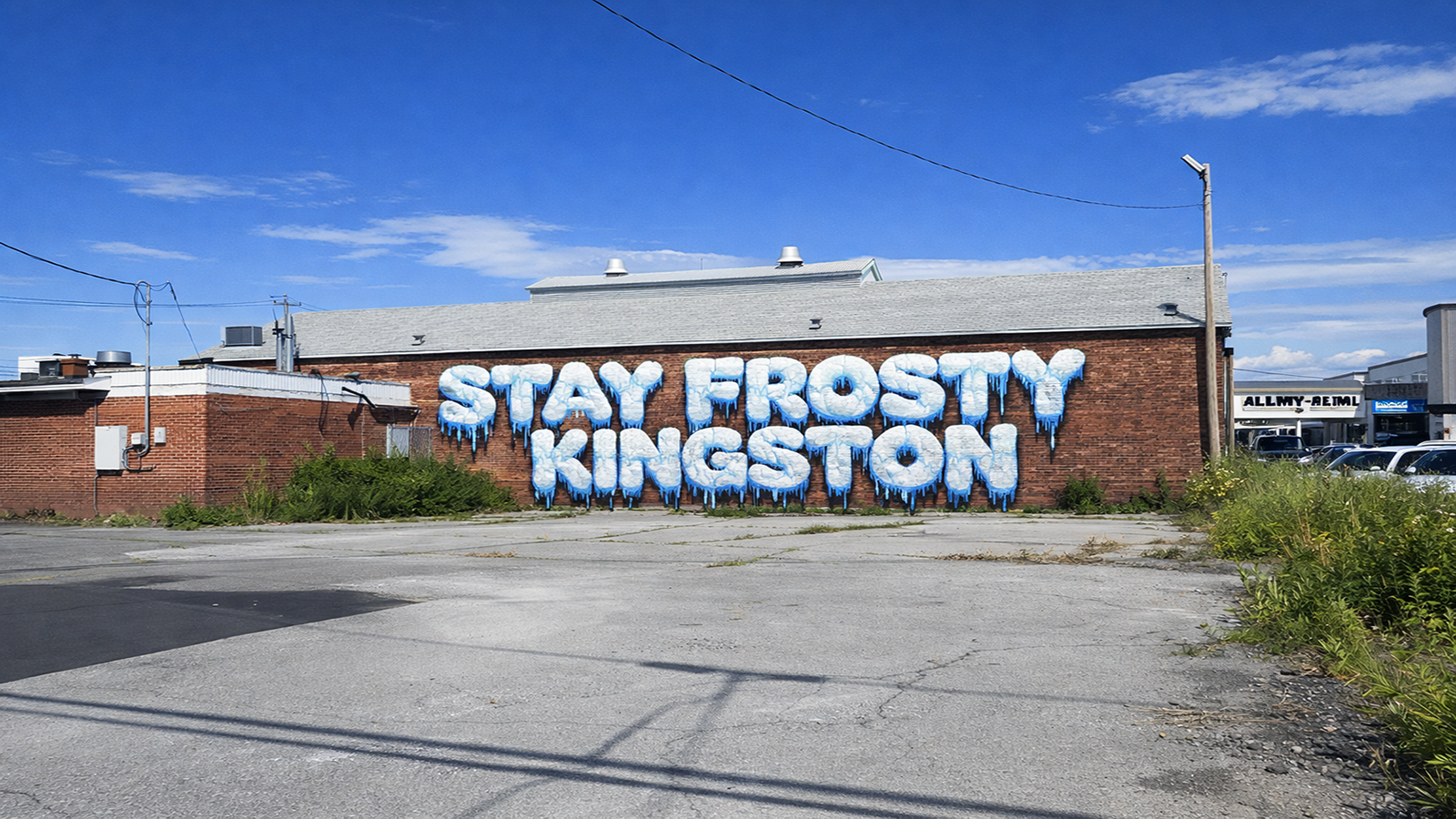
The gallery is a parking lot. The walls are car hoods, trunks, dashboards, and glove compartments. That is the premise of Stay Frosty, the itinerant art project launched by New York’s BravinLee programs that arrives in Kingston this June as part of Upstate Art Weekend, in collaboration with ArtPort Kingston. After a debut edition in Harlem that transformed a parking lot into a temporary neighborhood, Stay Frosty is now on home ground — a community where the car is less symbol than necessity, and where ArtPort Kingston has spent years weaving contemporary art into everyday public life. We spoke with BravinLee’s Karin Bravin and John Lee, and ArtPort Kingston’s Laurie De Chiara, about what brought them together, what they’re building, and why some of the most exciting art right now might be happening in a parking lot.
Stay Frosty puts dealers, artists, and the public on equal footing in a parking lot — work shown out of car trunks and hoods. After running BravinLee for more than two decades, what is your takeaway from this kind of open-air, hierarchy-flat presentation?
John Lee: After 15 years as a conventional put-em-up / take-em-down white box, BravinLee programs was created in 2006 with the emphasis on removing the word “gallery” and replacing it with “programs” — to emphasize that we were not just a conventional gallery, but an evolving set of initiatives shaped by changing conditions. Besides allowing us to change and adapt to the rapid evolution of the art world, BravinLee Programs was trying to avoid boredom.
Stay Frosty emerges from the growing limitations of the traditional gallery system, where fairs and market pressures often reward scale and repetition over experimentation. The system may be working perfectly well for a small handful of successful galleries, but for many smaller programs, participation began to feel more dependent on costly systems built around visibility. Stay Frosty offers a more direct and flexible alternative. Artists and organizers retain greater control over how work is presented and experienced, creating opportunities to engage audiences on their own terms rather than through hierarchical gatekeeping.
The Stay Frosty goal is not to reject commerce or capitalism, but to rethink where value is created and who benefits from it. It treats art less as managed content and more as a live, shared encounter — participatory, provisional, and accessible. Participation costs just $1; visitors are not charged — reinforcing the idea that engagement should remain open and collective rather than financially exclusive. Stay Frosty seems like an exciting way for us to surround ourselves with a community of our own making and to decide when and how we speed up or slow down.
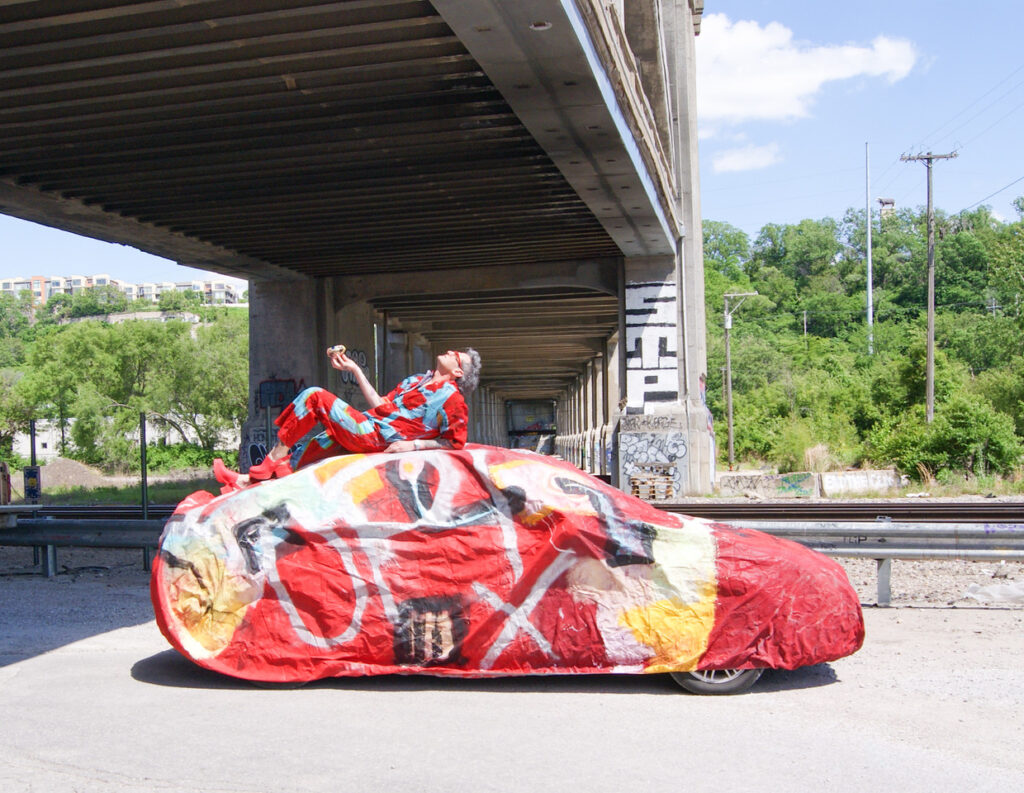
Vehicles are one of the most overdetermined objects in American culture — freedom, class, escape, status, Americana. Harlem and Kingston bring very different car cultures into the room. What were you and the artists discovering about that loaded object in Harlem, and what feels different about deploying it in a place where the car is simply the default mode of getting anywhere?
Karin Bravin: When I originally envisioned this project, I was picturing the Hudson Valley and something closer to an old-fashioned tailgate, where the car exists within a landscape of rural communities. Harlem transformed that idea completely. It became less pastoral and more urban, a compressed rooftop party, a temporary neighborhood. And because everyone left their cars in the lot overnight, the installation had a kind of durational quality.
The Hudson Valley changes that relationship entirely. There, the car is less symbolic because it is genuinely necessary. It’s how you get groceries, get to work, see exhibitions. Every evening, the art will have to be adjusted or partially dismantled, so people can drive away. The show is more intertwined with daily life.
I think the project also comes from a collision of our own biographies. I’m a native New Yorker, and I don’t drive, so cars have always carried a cinematic quality for me. John grew up inside car culture; his father was a Pontiac dealer. For him, vehicles were embedded in family business and American identity. Stay Frosty works somewhere between those two perspectives: the car as fantasy and the car as necessity.
After running the inaugural edition, what about the format surprised you, and how is that surprise shaping decisions for June?
Karin Bravin: What surprised us most after the first edition was the level of inventiveness artists, dealers, and curators brought to the format. Both the ideas and the execution completely surpassed our expectations. That experience made us more relaxed going into June because we now have a deeper trust in the format’s openness. The less prescriptive we are, the more unexpected the results. It also made us realize how much the project depends on collaboration and community. That spirit of shared experimentation is what makes collaborating with ArtPort so meaningful and why it feels exciting to now share curatorial responsibilities with one of the participants from the first iteration.
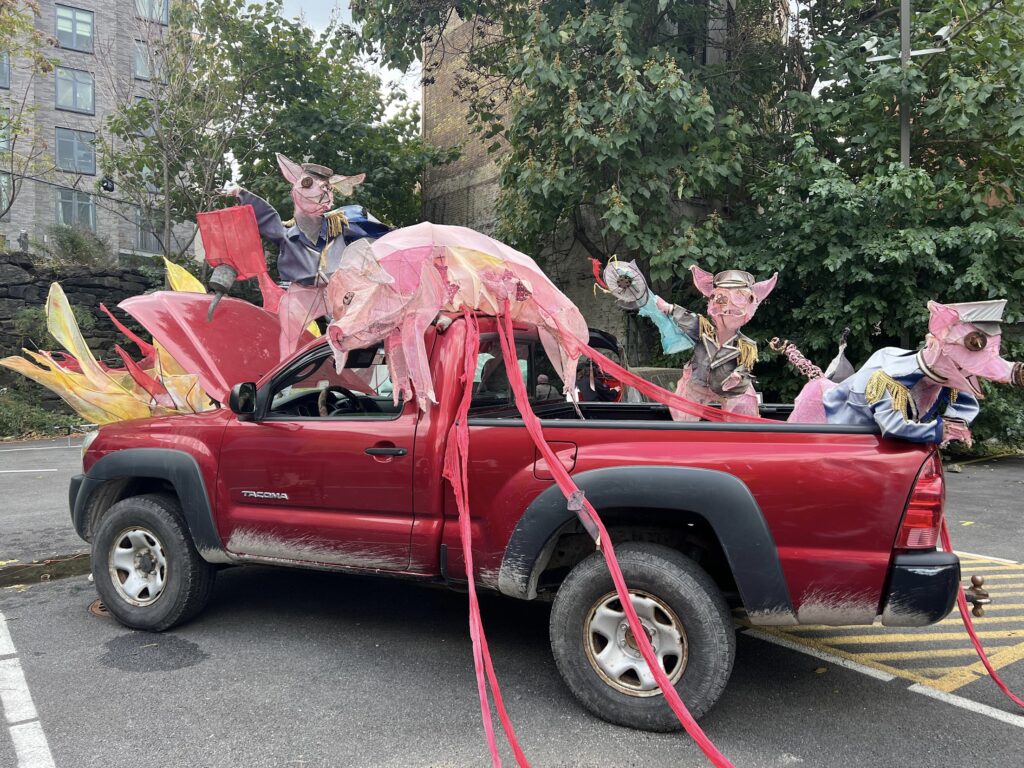
Curating for a trunk, a glove compartment, or a hood is a fundamentally different proposition than curating for a wall. What kind of artist or work tends to thrive inside that constraint, and how is that informing the Kingston lineup?
Karin Bravin: Whether participants focus on the roof, trunk, glove compartment, or dashboard, each choice shifts the scale of attention in a different way. First, you see it as a transformed car, or as something that may not even look like a car. Then you lean into it, peer through windows, and look under the hood. It’s much closer to installation, theater, and site-specific work than to hanging work on a wall.
What interests us most is not any single type of creative response, but the overall composition of the exhibition. We don’t want it to feel like a parking lot full of similar vehicles. Some artists completely consume the interior space, turning the car into a total environment. Other artists use the vehicle’s exterior as the primary gesture.
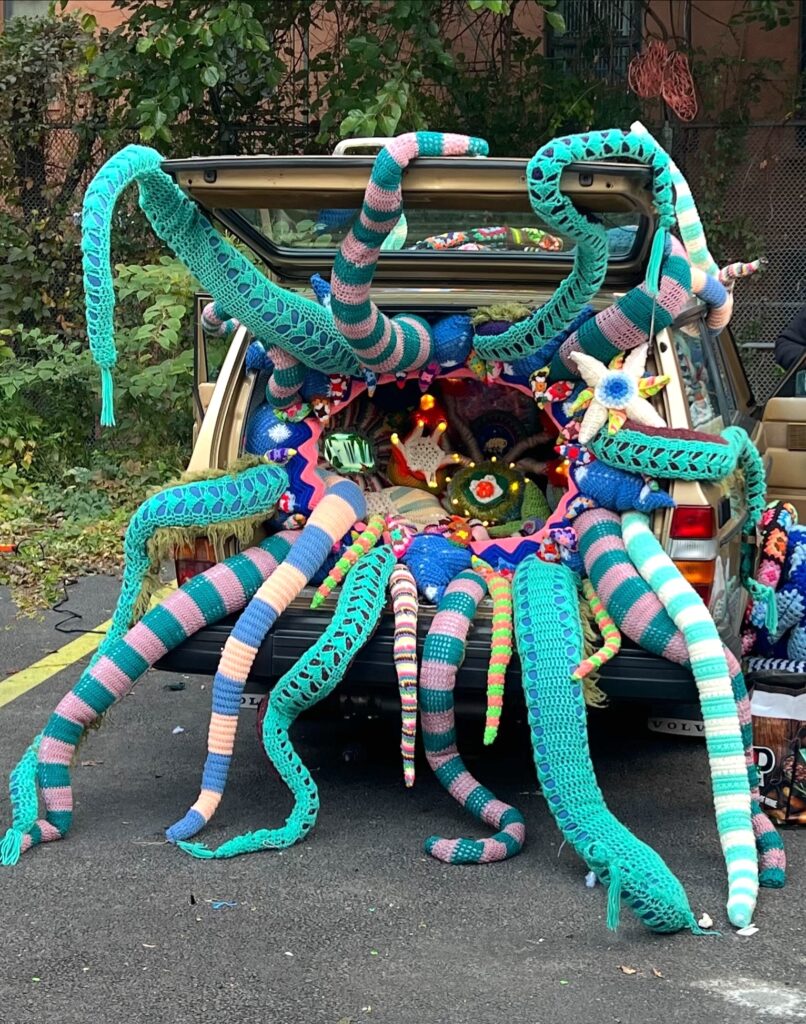
The challenge is creating contrast and variation. In Harlem, for example, having Willie Cole’s car made of hundreds of water bottles parked beside JAG Projects’ meticulously constructed miniature white-cube gallery was symbiotic. Traci Johnson and Amy Ritter’s vehicles, which created interior immersive experiences, were beautifully juxtaposed with Kate Corroon Skakel’s monumental crocheted basketball hoop atop her car. Moving between them kept resetting the viewer’s expectations about what a car-based exhibition could be. That kind of friction is shaping the Kingston lineup as well. We are interested in how works coexist side by side — immersive projects next to more intimate gestures.
Without giving everything away, walk us through what visitors can expect to encounter in the Kingston parking lot in June: the artists, the works, the moments that don’t show up in a press release.
BravinLee and ArtPort: We are expecting over fifty participants. Many are from the Hudson Valley and tri-state area, but we are excited to say we also have participants from Miami, Boston, Kansas City, Michigan, Texas, and Toronto. We have a wide variety of vehicles, from vans and trucks to an Airstream, a camper, a kayak trailer, and even a boat. Participants include artists, critics, independent curators, non-profits, and galleries.
Several installations invite community participation, including Michele Brody, who will present her long-term community engagement project, Reflections in Tea, transforming her 2005 RAV4 into the Toyota Teahouse, made up of flowing walls of tea-stained tea filters. Rachel Urkowitz’s Alternate Side of the Street painting installation invites participants to have a seat and draw, while Woolpunk’s Gimme Shelter Stitch Out encourages visitors to stitch blankets, hats, and socks for the local homeless shelter. MATERIAL GIRLS brings visitors together to celebrate their tenth anniversary with cake, a card, and an installation. Ghost of a Dream is creating an experiential infinity room inside a vintage camper. Phaan Howng will present “bush charms” made of laser-cut powdered aluminum shading her vehicle, while the installation Mercedes Benz transforms a 2007 Honda Civic into a playful, subversive installation featuring works by Dasha Bazanova, Dessarae Bassil, and Amelia Biewald. There will also be immersive sound installations by both Cal Fish and Heather Nicol.
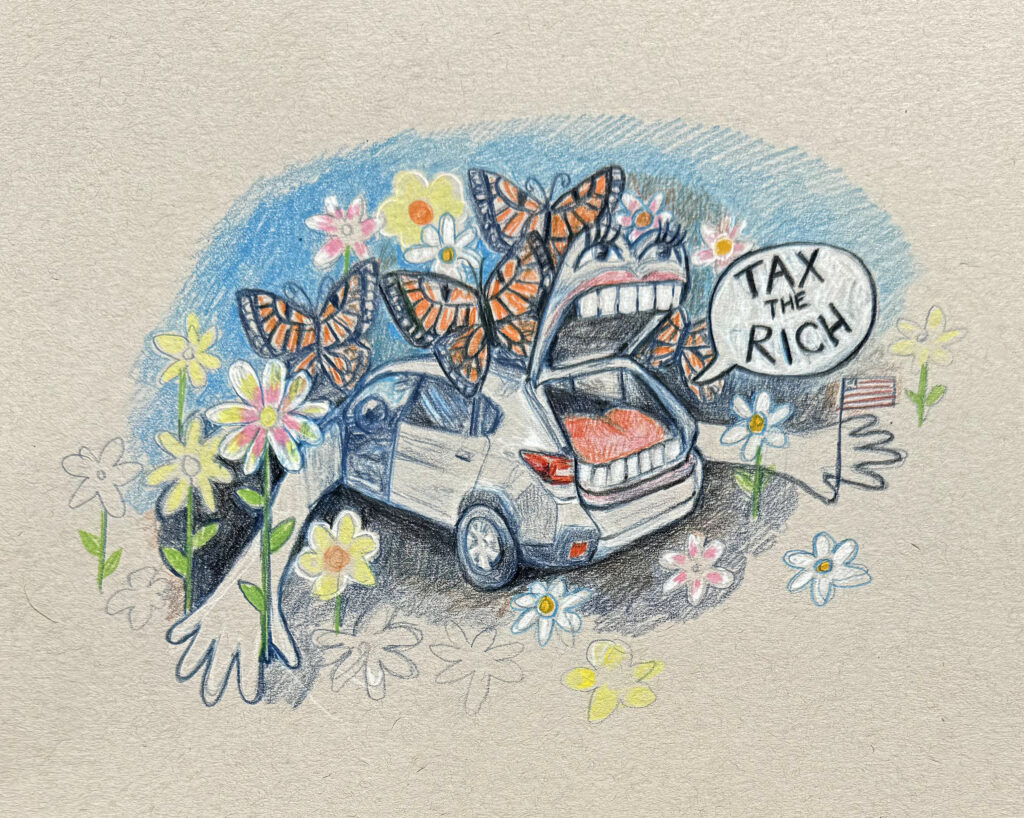
And any show would not be complete without activist installations, this time in the form of Julie Peppito’s hatchback-sized mouth fastened to the back of her Subaru shouting “Tax the Rich!” complete with cardboard flowers and monarch butterflies — artifacts from the No Kings 3 protest made with the help of over 100 volunteers — And also an exciting project from reALISE, an anonymous art and advocacy collective nonprofit dedicated to addressing the needs of human beings through collaboration with specialists across disciplines ensuring that stories are not flattened, but branch expansively and bloom with integrity, context, and care.
Stay Frosty is starting to feel less like a one-off event and more like a touring proposition. Is that the trajectory you want, and what does scaling — or refusing to scale — look like for a project built on this much site-responsiveness?
John Lee: Stay Frosty tour! Run away, join the traveling circus, make a few bucks, 2028 regime change, scale, don’t get bored, but in the Met Gala-Basel sense? No way Jose.
ArtPort Kingston has its own unconventional model. How did Laurie De Chiara and that collaboration shape your decisions?
Karin Bravin: Each time we visited Upstate Art Weekend, we made a point of stopping at ArtPort Kingston. Last year, when we met Laurie De Chiara and Stefan Saffer for the first time (IRT), it was immediately clear that there was a mutual respect and shared sensibility between our programs. We began talking about collaboration almost instantly, and a month later, I invited Laurie to participate in Stay Frosty Harlem. Working together curatorially has been incredibly natural and rewarding. Laurie and I both gravitate toward unconventional approaches and share a strong appreciation for the same artists who push boundaries and experiment with form, space, and experience.
Laurie De Chiara: I agree. Our curatorial visions overlap in a way that feels special, aesthetically, conceptually, and intuitively. What has made this collaboration especially exciting is the openness and trust in the process. We each bring different artists (though we share many), perspectives, and ideas into the conversation, yet we almost always find ourselves aligned in our artistic vision and decisions. Rather than forcing a collaboration, it evolved organically, creating a dynamic exchange that expands the project in unexpected ways. I was genuinely curious to see what would emerge from our working together, and the result has been a collaborative vision that feels both adventurous and deeply cohesive.
Tell us about ArtPort Kingston — how it started, the conversation you’ve been building there, and how Stay Frosty fits into it.
Laurie De Chiara: ArtPort Kingston began as an effort to rethink what an art space could be: less formal, less intimidating, and more woven into everyday life. Co-founded by artist Stefan Saffer and me, the project grew out of decades spent running galleries and independent curating, creating unconventional, participatory art experiences in New York, Berlin, and beyond before settling in Kingston. What drew us to Kingston was being outside of a major metropolitan city, the creative energy, and the feeling that there was room to build something alternative and experimental at the same time.
From the beginning, the conversation at ArtPort has been about accessibility — not simplifying contemporary art but rather opening up the dialogue. The organization has consistently focused on creating environments where people who may not typically enter a gallery feel welcome to engage, linger, ask questions, and participate. That has taken shape through exhibitions, performances, workshops, public art, artist residencies, and site-specific projects that blur the line between exhibition space and social space.
A big part of ArtPort’s identity has also been its use of unconventional spaces. Early projects activated the historic Cornell Steamboat Building on the Rondout waterfront, while later initiatives expanded into trails, storefronts, outdoor installations, and Midtown Kingston itself. Projects like ArtStream and Habitat for Artists emphasized art as something embedded in public life rather than contained within white walls.
That makes Stay Frosty feel like a very natural extension of the larger conversation ArtPort has been building with ArtYard, a space for outdoor art dialogues. The project transforms parking lots and vehicles into artist-driven installations and gathering spaces, collapsing distinctions between exhibition, performance, street culture, and community event. It brings contemporary art directly into an open, accessible environment where audiences can encounter work casually and collectively rather than through the traditional gallery model.
At the same time, Stay Frosty reflects Kingston itself, a place where creative experimentation, grassroots organizing, music, design, and public gathering often overlap. By partnering with BravinLee programs during Upstate Art Weekend, ArtPort is continuing its mission of creating experiences that are ambitious and artistically rigorous while still feeling welcoming, playful, and connected to the wider community.
Now that Stay Frosty is coming to your home ground, how is your thinking about ArtPort Kingston’s contribution shifting from what you did in Harlem?
Laurie De Chiara: For us, presenting Stay Frosty in Kingston during Upstate Art Weekend has shifted the project in a meaningful way because here it’s not a temporary intervention; it becomes an ongoing dialogue with the community and neighborhood. As one of the co-curators, I’m thinking about the overall exhibition concept and how the participating artists collectively create a larger artistic statement within the context of Midtown Kingston, the Hudson Valley, and Upstate Art Weekend itself. Themes that feel especially important to explore are collaboration, political awareness, social responsibility, playfulness, exploration, and the importance of being present and enjoying the moment.
In Harlem, Stay Frosty had an incredible energy as a pop-up public event. In Kingston, through our collaboration with BravinLee programs and ArtPort Kingston, we’ve been able to expand both the scale and ambition of the project by bringing more artists into the fold and encouraging even more adventurous installations and performances.
There’s also a very different atmosphere here. Kingston has a more relaxed and open energy that allows the project to evolve organically. The environment itself changes the experience as everything feels more expansive, immersive, and community-driven.
What excites me most is how naturally Stay Frosty aligns with ArtPort’s mission. We created ArtYard with a similar spirit in mind: a flexible public space for projections, installations, performances, and spontaneous creative interaction. ArtPort has always focused on breaking down barriers around contemporary art and creating experiences that feel accessible, participatory, and connected to everyday life.
At its core, Stay Frosty Kingston is about creating an artistic atmosphere, a temporary creative ecosystem where art, performance, music, gathering, and unexpected encounters all happen simultaneously. Because ArtPort is rooted here, we can approach it not simply as an event, but as part of a larger conversation about how art can activate public space and bring people together.
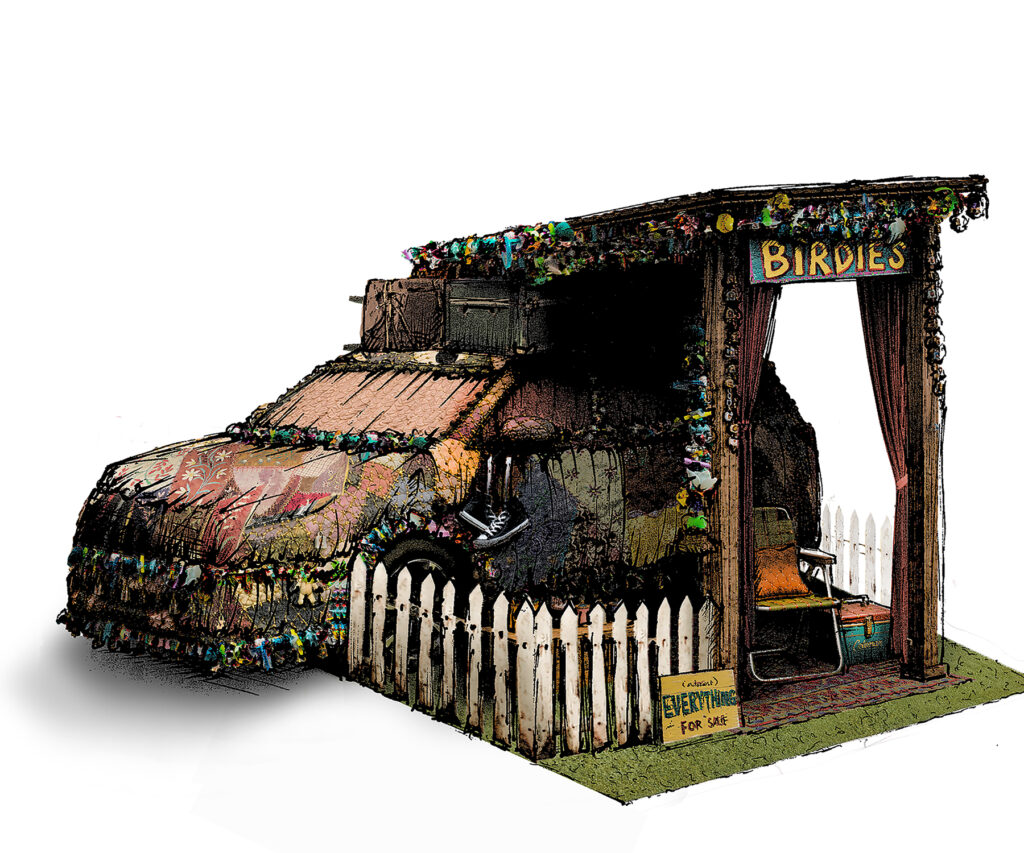
Stay Frosty will be located at ArtPort Kingston, 80 Smith Avenue, Kingston, NY. Upstate Art Weekend. Opening preview: Thursday, June 25th, 3- 6; Friday, June 26th: 11-6, Saturday, June 27th: 11-5, Sunday, June 28th: 11-4. To learn more, www.bravinlee.com www.artportkingston.org
ArtPort Kingston: Laurie De Chiara is a curator, gallerist, and cultural producer whose career spans more than two decades across New York, Berlin, and the international contemporary art world. In 1997, she founded De Chiara/Stewart Gallery in Chelsea, where she developed a program focused on installation-based and conceptually driven exhibitions. In the early 2000s, she expanded her practice internationally by establishing Galerie müllerdechiara in Berlin, fostering experimental exhibitions and transatlantic collaborations between the New York and Berlin art scenes. Alongside her independent curatorial projects, she founded the Berlin-based nonprofit ArtPod gUG in 2010, dedicated to accessible, participatory, and audience-centered art experiences. After more than a decade in Berlin, De Chiara returned to the United States in 2015 and founded ArtPort Kingston in 2019, which has since evolved into a nonprofit organization supporting artist-led initiatives, site-specific projects, and public engagement with contemporary art. @artsportkingston
BravinLee programs: Since 1991, Karin Bravin and John Lee have run BravinLee programs, operating a traditional gallery space in SoHo and Chelsea until 2024 while curating several off-site projects. They specialize in public art, having curated large-scale projects in Riverside Park and several East Coast municipalities. They have organized two fiber art exhibitions, The Golden Thread, in an 18th-century warehouse at the South Street Seaport, that drew thousands of visitors and strong press coverage. They also run a limited-edition artist’s rug program, creating hand-knotted rugs with artists in Kathmandu, supporting ongoing artistic experimentation. Together they lead Stay Frosty, their newest initiative. @bravinlee
About the writer: Etty Yaniv is a Brooklyn-based artist, writer, curator, and founder of Art Spiel. She works in installation, painting, and mixed media, and has shown her art in exhibitions across the United States and abroad. Since 2018 she has published interviews and reviews through Art Spiel, often focusing on underrecognized voices and smaller venues. More about her art can be found at ettyyanivstudio.com and on Instagram @etty.yaniv
Make your tax-deductible donation today and help Art Spiel continue to thrive. DONATE