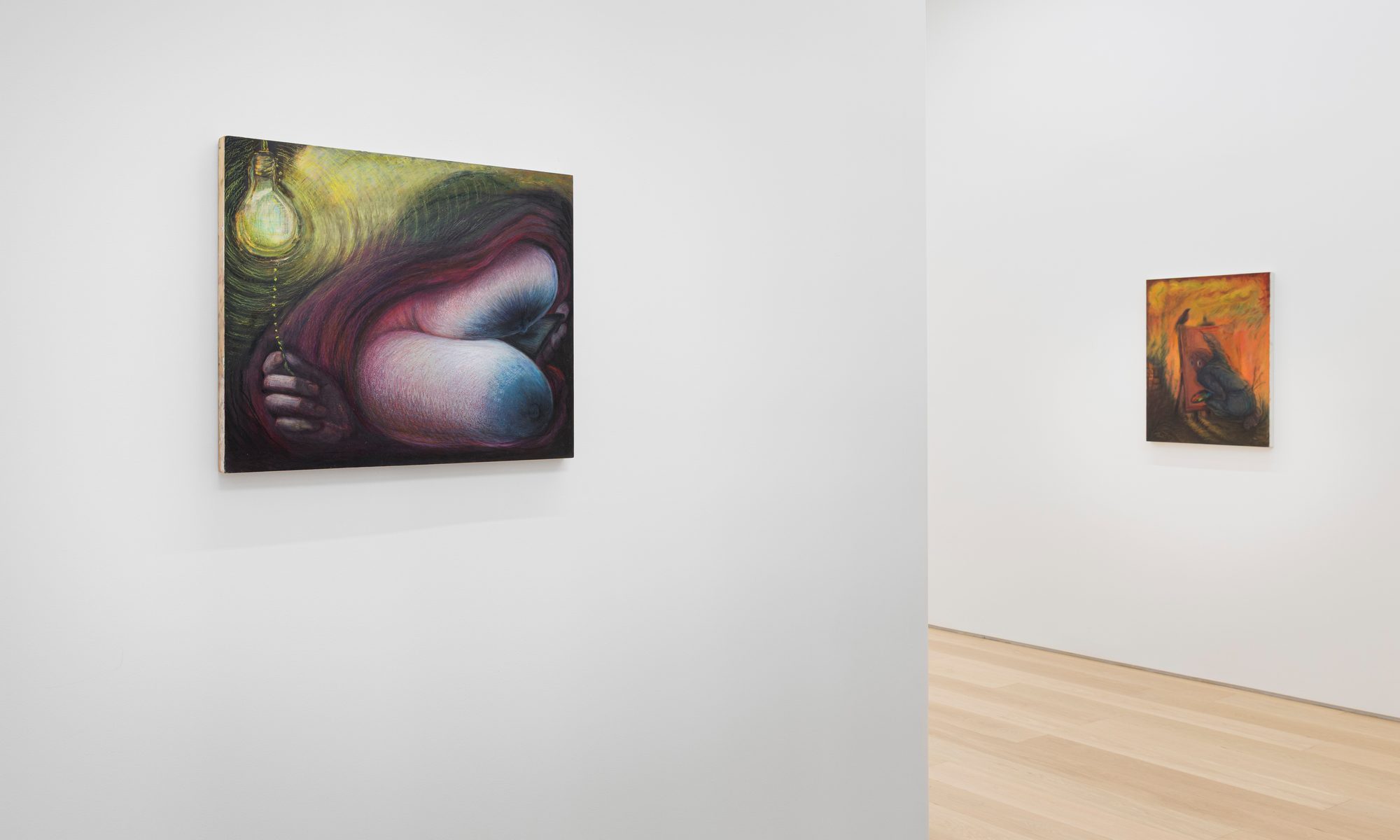
Rebecca Morgan’s exhibition Painting in the Age of Apocalypse is a bit of a roadmap for viewers. Morgan tackles the question of how to present images in the face of a raging political landscape, how to keep moving forward, and how to maintain oneself and some humor about it all. And most importantly to me, how to open up one’s painting style and allow both the work and the process to support you through this tumultuous and often unbelievable terrain we may find ourselves within. In this exhibition, Morgan engages potent themes from all her eras: sympathy for her rural background, feminist reappraisal of art history, and an unbridled excitement at infusing humor and technical prowess into her critique. Here, Morgan fuses all of these themes well, all the while showing us a fresh, looser style of painting that captures the frenetic energy of the moment.
With these paintings, like the one titled Druski as Erica Kirk, she sharpens the political content by making it more specific and savage. Especially this piece, Two White Demons Screaming at Each Other, where the titles of the works, such as Buy this Painting Priced at $175,000 to Pay Off My Graduate Student Loans (After the 50/50 Split with AGG), are potent, sharp, witty, and provide an opportunity for viewers to think and question. Haunting images from social media, the news, or other platforms (that we assume were circling obsessively in Morgan’s mind just as much as our own) find their way to fruition in a variety of painterly languages of finessed strokes, fine lines, vibrant colors bouncing off of more earthy tones, with a bit of a glow within each work. The paint makes the pieces come alive; Morgan’s use of color and blends build up the surfaces and pull us into the fray, joining the figures within.
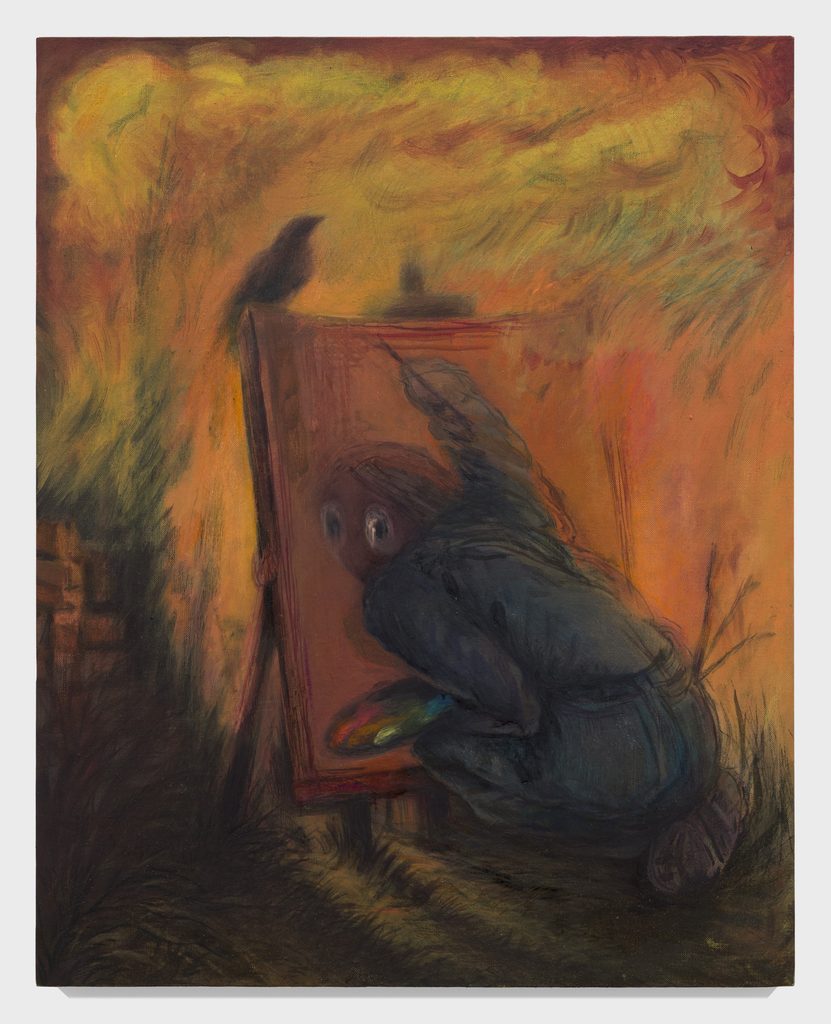
The titular artwork, Painting in the Apocalypse, inspired by Norman Rockwell’s Triple Self-Portrait, adds to Morgan’s previous themes of paintings within a painting, one of which I always immensely enjoyed. Here, instead of looking into a mirror like in Rockwell’s portrait, the artist stares back at us, in horror, from a vapor of fiery orange brushwork, as if to say – are you seeing this? Morgan presents us with an important question: How can I make art at a time like this? This becomes key to many artists as world disasters occur daily, and unbelievable political landscape shifts gears hourly, and social media keeps us nervously apprised of it all. Because of this, like Morgan notes, there’s a lot of material to paint from, and she uses that phenomenally well, but it’s certainly a treacherous landscape to paint as an artist, as the future seems shaky, uncertainty hovering over everything about what the future may hold.
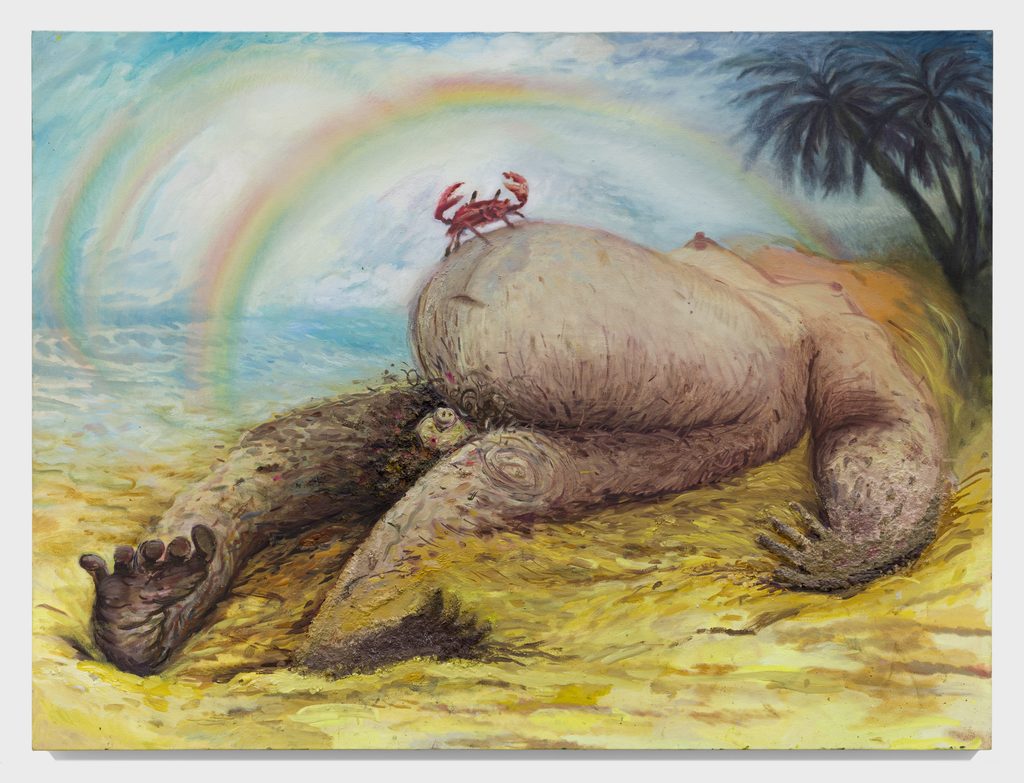
The figures in these works share the same exaggerated, whimsical energy as her previous works, but now carry with them darker undertones that reflect the times. In the piece titled When It Happens, a double rainbow forms and a very happy crab climbs atop a grotesque, bloated body. A question I heard at the opening was, “Why was the crab so happy?” All the while, I was wondering how that body got there, how long it had been there, slowly being overtaken by sand. I always assumed double rainbows to be lucky. Maybe the luck is for the crab, because by the looks of the person, their luck has definitely run out.
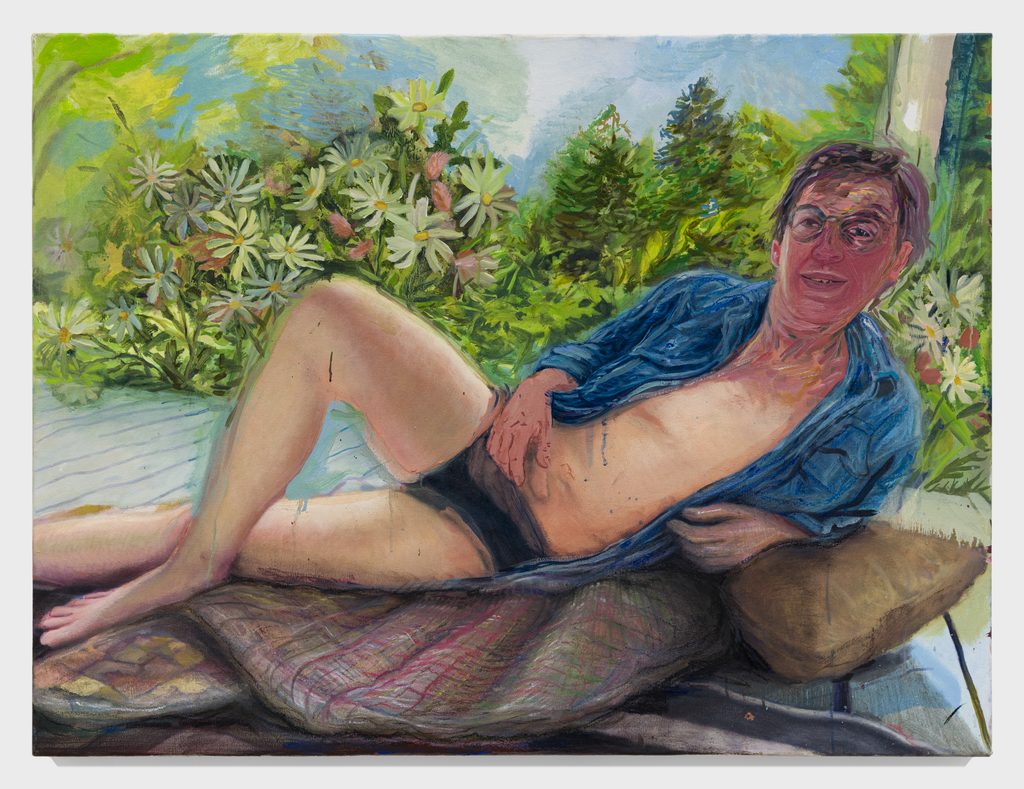
Morgan continues to use her figures to explore art history and, in a way, retreat into the past. Morgan brings a new twist to classical forms, figures, and works of art. She places her stamp on the contemporary counterpart to classical works, constantly shifting our perspectives, as she includes contemporary elements from the world we know, such as cell phones or modern clothing, which Morgan includes amongst her figures in their own world. Her energetic painting style, combined with fine details, lets Morgan’s hand show in all of the works, such as her edits and additions, like that of “Andy’s” hand, which was either repositioned or is meant to be in motion. Inspired by social media and current events, Morgan brings the past into the here and now- and positions satire at the forefront. This is especially evident in the work titled Andy After Sylvia Sleigh, where a figure, who is the artist’s partner, is rendered naturalistically in an updated homage to Sleigh’s male nudes: settled in a pastoral, more relaxed setting. The character of “Andy” suggests a desire to retreat into domestic bliss, as Morgan places them into the composition this way, reclined, relaxed, and watching viewers as they pass by; seemingly unaffected by the turmoil around them in that moment.
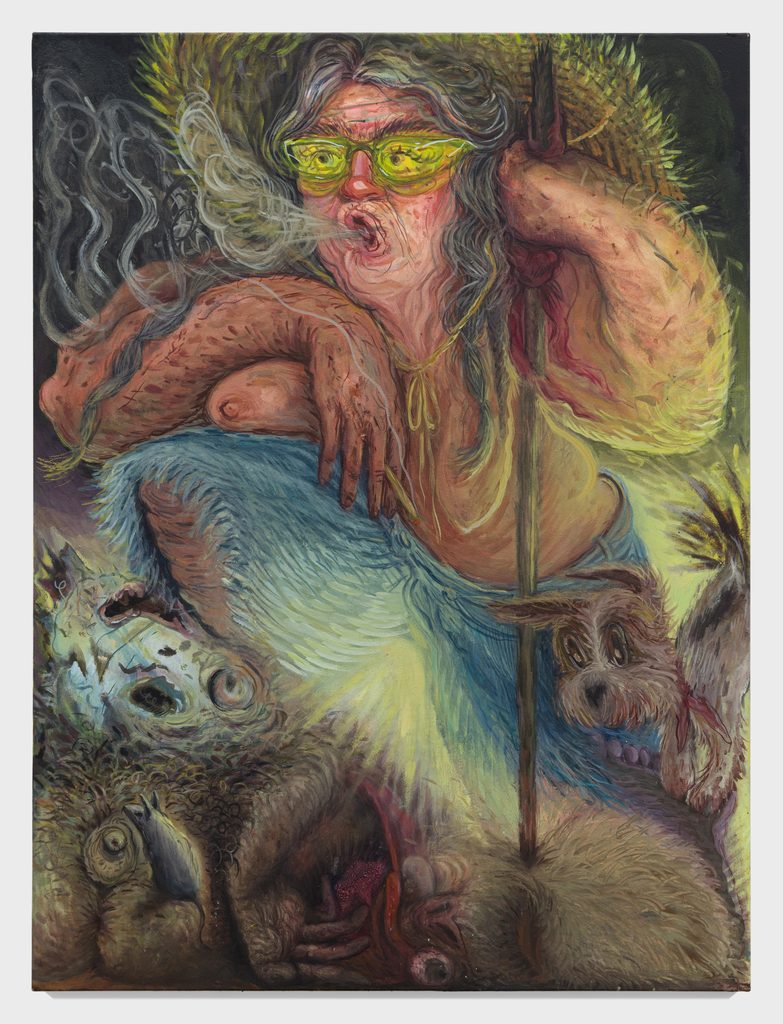
Another one of Morgan’s figures in Hunter Gatherer in the Apocalypse introduces a new persona for us to meet, as a grey-haired, topless woman greets us from the back wall of the gallery. She casually puffs out smoke while holding a pike that pierces through a man with the whisper of a red ball cap. These whispered details, within many of Morgan’s works, are like little treasures; they help us to construct the story Morgan has given to these figures. Whether it be how the figure is positioned, how the beached body is slowly being intertwined with the sand, or the hint of this red hat or another recognizable symbol, Morgan is expertly constructing a story. While the witty titles of all the works help, they still do not offer us the full context; Morgan welcomes us to piece that together on our own. While we do not know exactly who this woman is, we can see they carry an air about them- a survivalist or a matriarchal revolutionary; this enigmatic character could even be the artist’s future self.
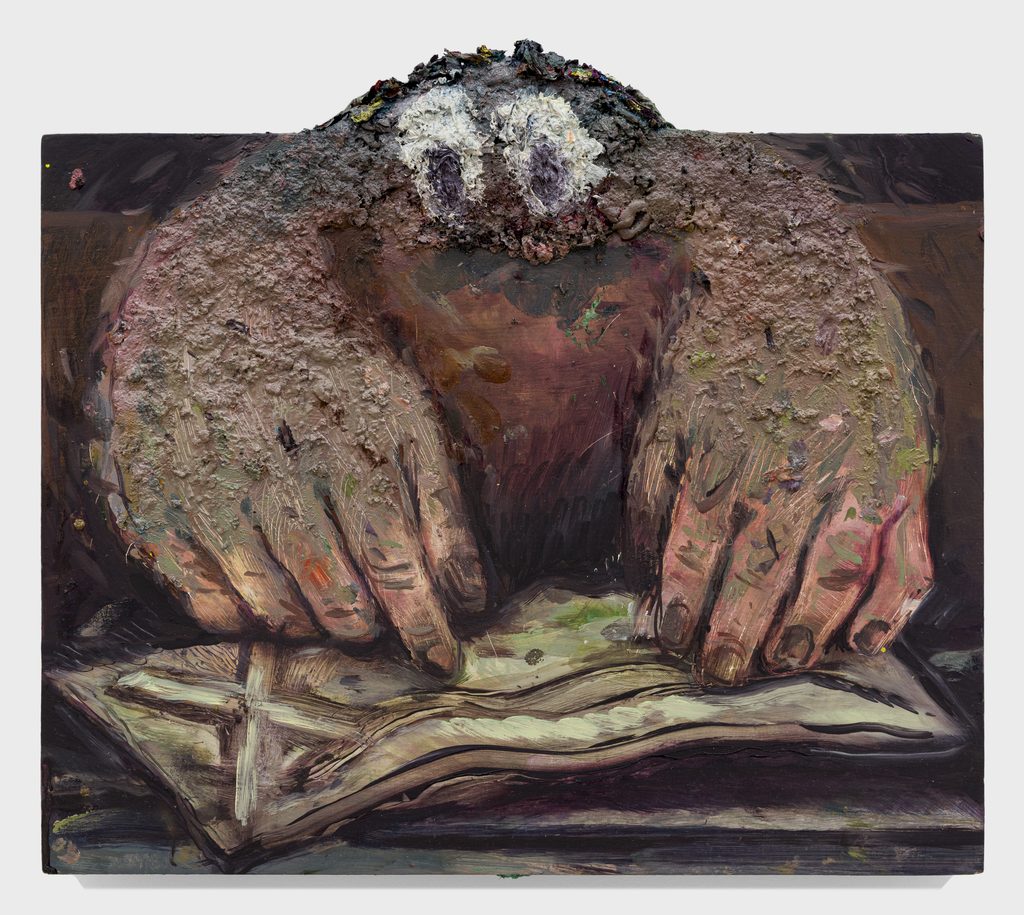
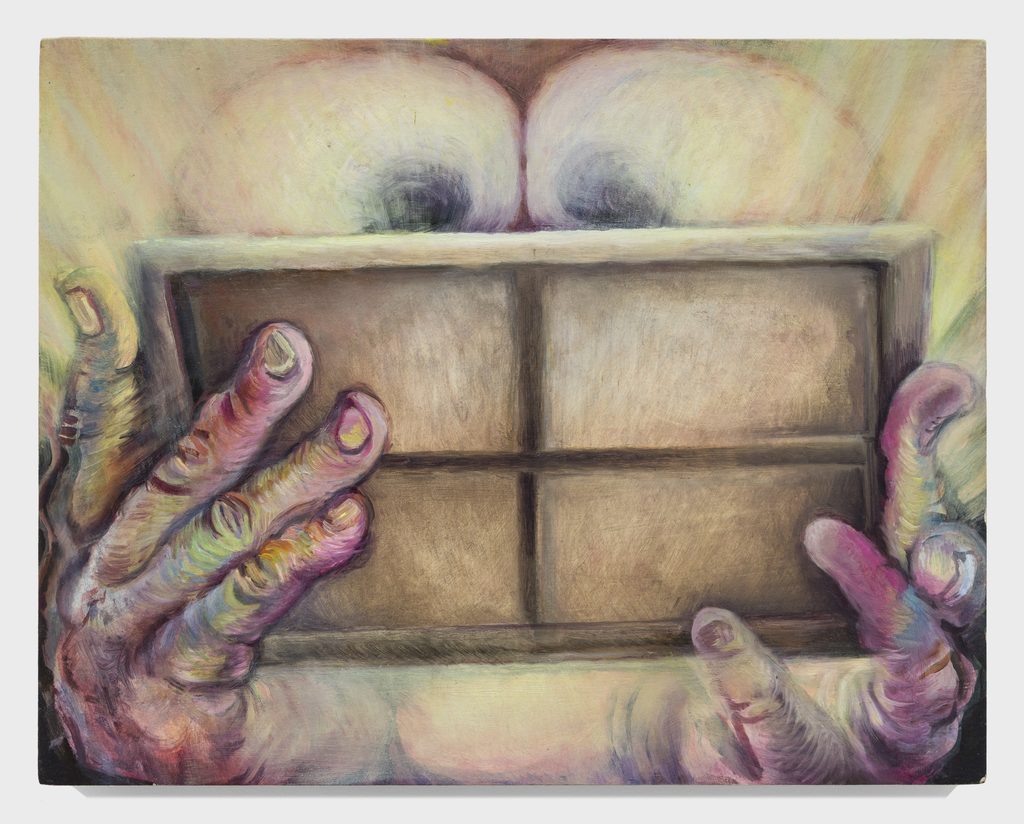
A closing quote from the press release stuck with me as I went through the exhibition. It echoed in my mind as I dove into the work, and it seems quite prevalent: “We can’t go on, we must go on, to paraphrase Samuel Beckett’s refrain.” Morgan’s continued exploration of painting leads us through the wasteland; the details within the paintings are the saving graces to a weary traveller. They make us stop and look, and dive into the painting. Morgan pulls us into the environment with details like the gnarly yet luscious feet melting into the sand of When it Happens, the loving legs of her partner, the sfumato flames of the apocalypse, or cross-hatched tubular eyes reflecting the enticing glow of the phone screen. Especially in the piece titled Treasure, we notice a wide-eyed figure enthralled by a painting. Instead of a phone screen, Morgan has made the canvas a glowing beacon with the figure’s hands, something we rarely see- art being treasured, and in person no less. Morgan presents no one answer to the premise of the exhibition, only displaying their own continued push forward within art. Allowing their ideas, voice, and humor to accompany us along our own journeys.
Painting in the Age of Apocalypse, Asya Geisberg Gallery, 45 White Street, New York, NY 10013. On view from September 9 through October 24, 2026. @asyageisberggallery @rebeccamorgan10
Make your tax-deductible donation today and help Art Spiel continue to thrive. DONATE
About the Writer: Taylor Bielecki lives in Gowanus, where her studio is, and works at Pratt Institute, where she earned her MFA. She also studied at Penn State, where she earned a BA in English and a BFA in Fine Arts. She finished as a finalist in the Kennedy Center’s VSA National Emerging Young Artist program for 2017, where she earned an award of Excellence. She has shown prints internationally in a print exchange in Australia and exhibitions in Dubai, India, and the Glasgow School of Art. She has also shown paintings internationally in Gallery 24N, PhilaMOCA’s juried exhibitions in Philadelphia, Pa., Perry Lawson Fine Art in Nyack, NY, BWAC in Red Hook, and IW Gallery in Brooklyn. Taylor works for Two Coats of Paint, TUSSLE Magazine, and has joined Art Spiel as a contributing writer. @Taylor.Bielecki