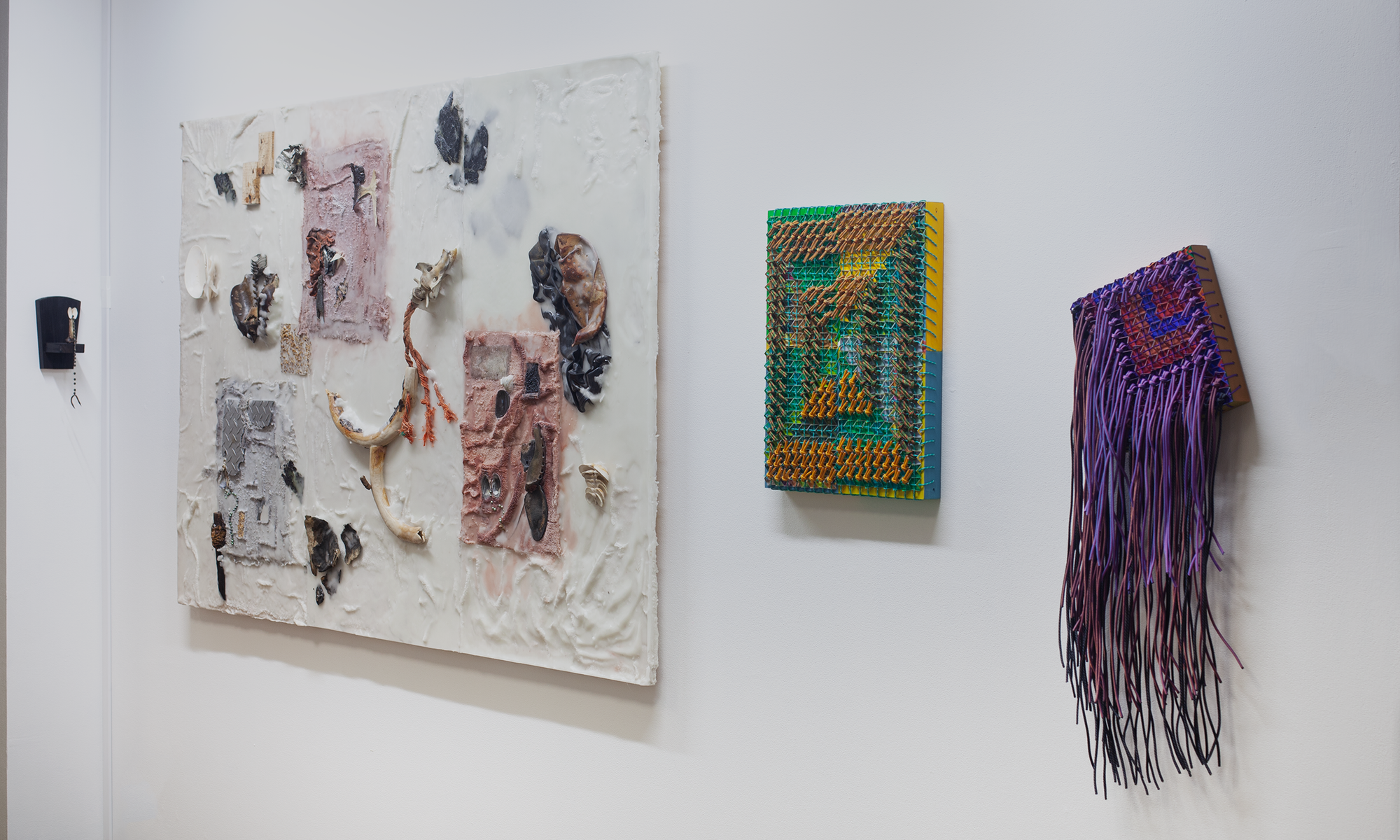
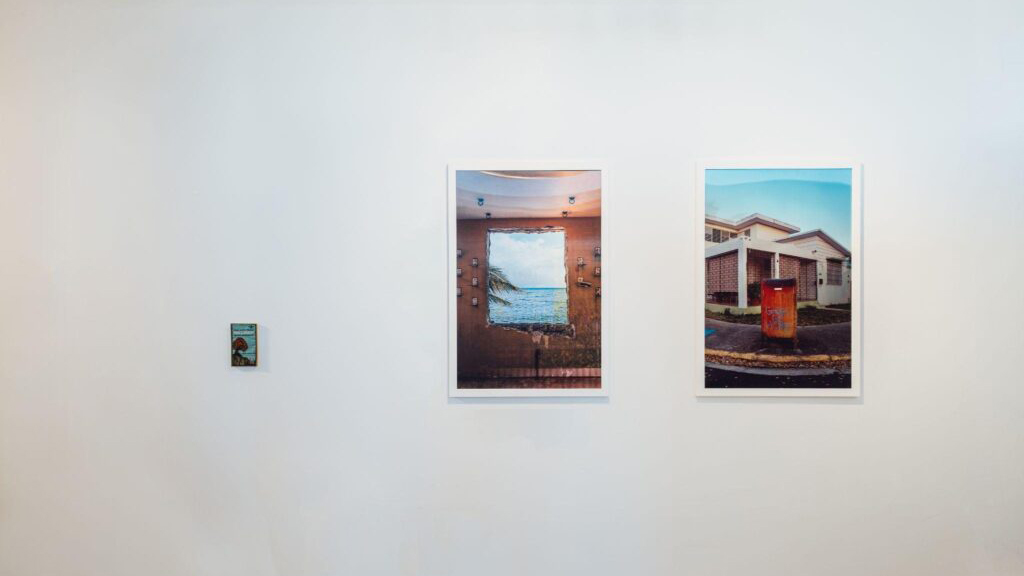
This year’s theme for SPRING/BREAK Art Show was Hide and Seek. The fair was within this new and exciting office space that felt like a labyrinth at first, but then it evolved into a wonderful journey- meeting new artists and old friends. Full of amazing works and installations, the booths caught my attention through either a detail, a connection, or a wonderful conversation. The themes varied, from Peter Gynd’s focus on the joys of the everyday to Juan-Manuel Pinzon and Matthew Logsdon’s connections through material, action, and discovery. David Howe and Jesus Benavente’s team brings urgency and humor, showing how decisions from up high affect our everyday lives. My experience of the fair concluded with the works of Noa Charuvi and Shmuel Charuvi, exploring connections to a sense of place and ways of viewing the world, often influenced by the works of family, while Braden Bandel’s paintings and drawings bring us into another world entirely- allowing us a place to rest and contemplate.
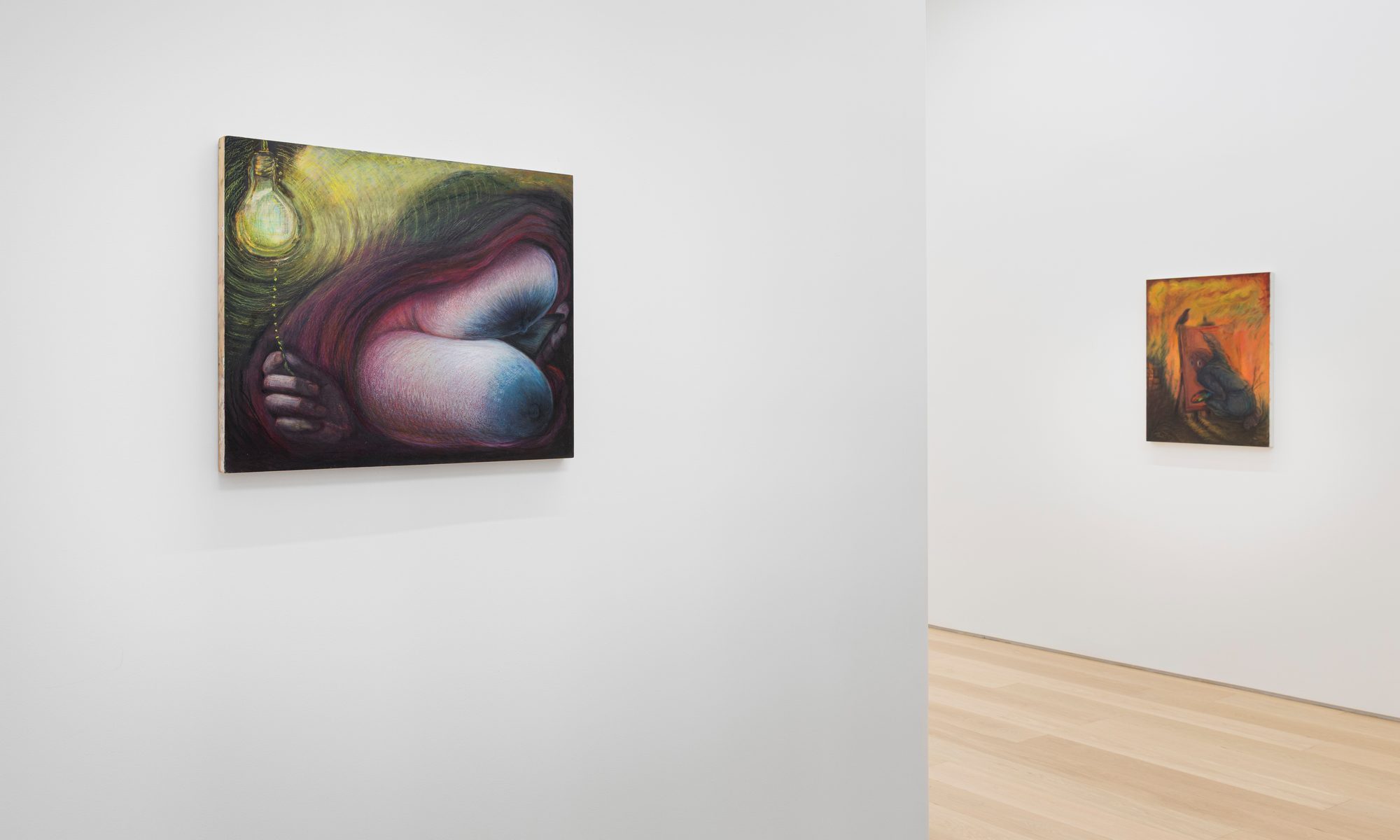
Rebecca Morgan’s exhibition Painting in the Age of Apocalypse is a bit of a roadmap for viewers. Morgan tackles the question of how to present images in the face of a raging political landscape, how to keep moving forward, and how to maintain oneself and some humor about it all. And most importantly to me, how to open up one’s painting style and allow both the work and the process to support you through this tumultuous and often unbelievable terrain we may find ourselves within. In this exhibition, Morgan engages potent themes from all her eras: sympathy for her rural background, feminist reappraisal of art history, and an unbridled excitement at infusing humor and technical prowess into her critique. Here, Morgan fuses all of these themes well, all the while showing us a fresh, looser style of painting that captures the frenetic energy of the moment.
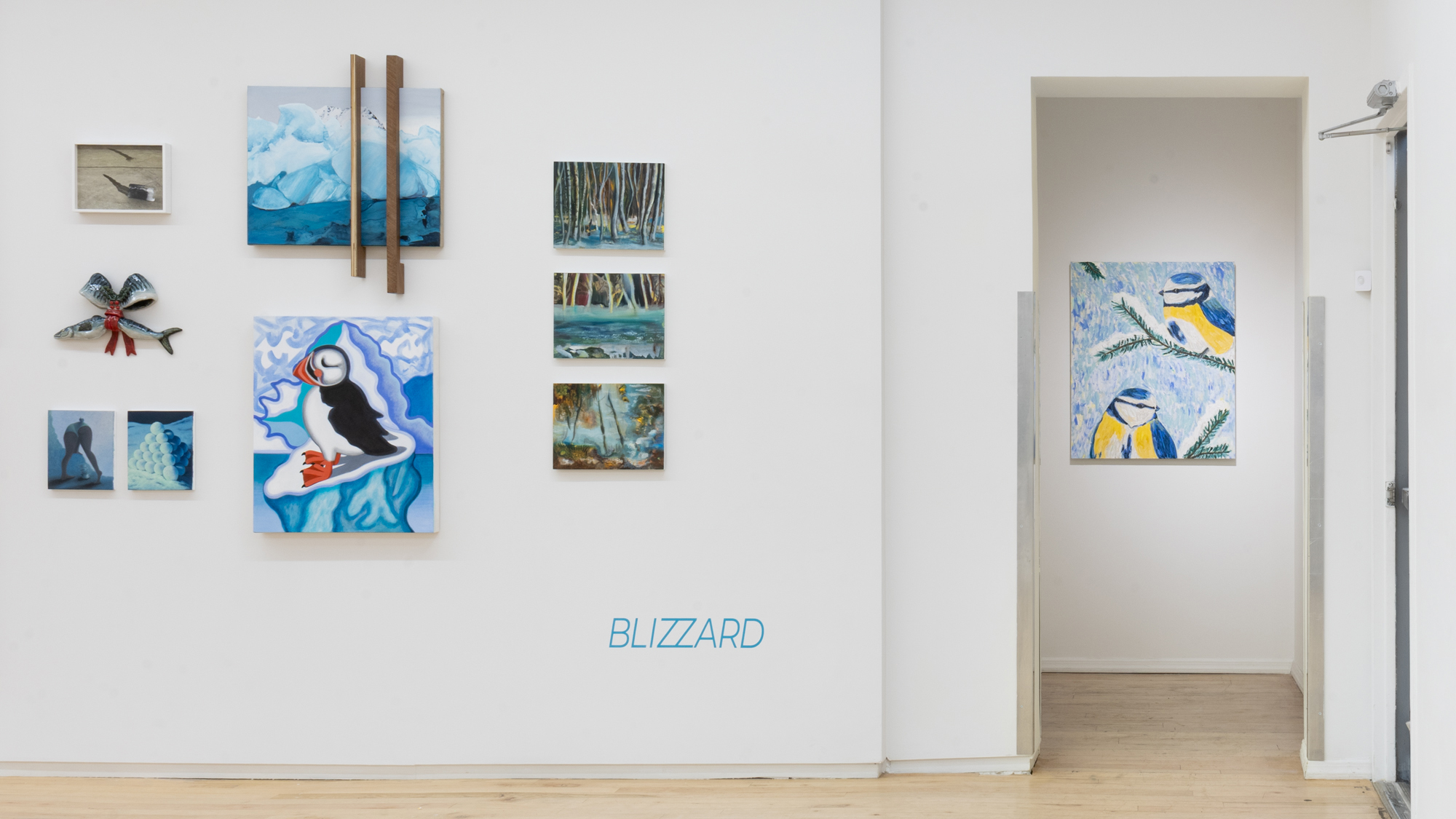
Walking into Dimin gallery on a humid summer day, Blizzard, the exhibition currently on view, envelops you with a welcoming dynamic, though like a winter storm, often all-encompassing, bitter, and fierce. Despite these negative associations coinciding with the theme of blizzard , there is a sense of peace and serenity while observing a storm safely. As long as you are observing from a safe distance, both the winter season and its storms can offer great solace and opportunities for contemplation. Similar to the work in this show, we are welcomed to dive into the environments of the works and take note of what themes are driving the artists. Given our growing concerns over climate change, global warming, and changes in the environment, this exhibition is very timely; especially ecologically, this show calls for attention. These artists certainly show how a snow day can slow time and force us to have more respect for the unyielding natural world.
Walking through MoMA PS1 for the first time in several years, I realized how much it has changed and how much I still remembered from my first visit, before officially becoming a New Yorker. The meandering, bustling energy of the building remained, each turn and new corridor offering discoveries. It was special to witness how eclectic and unique each artist’s vision and process was and how many identities and stories are gathered under one roof. Organized for the first time by MoMA PS1’s full curatorial team, the exhibition emphasizes the forces that shape daily life in the city today. This includes strategies of resistance and adaptation in the face of increased surveillance, shifting identities, economic uncertainties, how we view ourselves and others, and the ever-changing technologies around us. This exhibition notes both optimism and anxiety throughout all of the artists’ attention to the layered, eclectic lived textures of New York City and the people intertwined within it.
Stepping into Gallery 198, you become fully immersed in the exhibition Overflow, which connects the inside of the gallery with the outside. I quite enjoyed the nautical theme that seemed to stem from the waters and the vantage point that the metal spiral staircase provided, which allowed me to view works on the upper level and many of the works down below as well. Curator Andrew LaFarge Hamill utilized the space perfectly, and the surrounding site-specific works, including his own, make the exhibition an ever-growing and extended conversation beyond the gallery. It is like research that never fully stops. All of the artists in this exhibition are Skowhegan Alumni, and many of the works’ materials, especially those by Nancy Cohen and Elizabeth Demaray, are sourced or influenced by the Gowanus and Greenwood areas. The themes of the works are prevalent and immediate, and the research and care behind both the works and the curation are intricate. The exhibition brings a wide array of mediums, materials, ideas, and locations that allow viewers to fully immerse themselves within the Gowanus area.
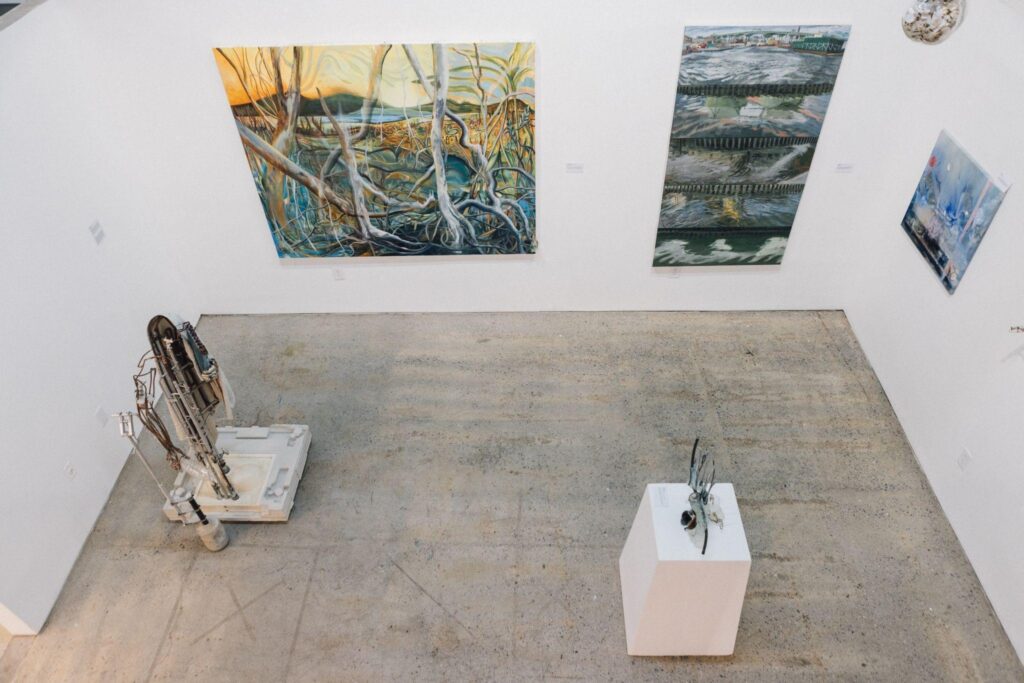
Aerial View of the installation below. Photo Courtesy of Dahlia Dandashi
Overflow, true to the title, extends beyond the gallery into the surrounding urban landscape. The exhibition responds directly to the Harbor Hill Terminal Moraine, a glacial ridge where intensified rain events and aging sewer infrastructure have led to the overflow of sewage and pollutants into Gowanus Bay. In close dialogue with these conditions, the exhibition adopts a granular approach by including site-responsive, site-specific, and research-driven installations, as well as sculpture, painting practices, and video works that engage with the role that water resources play in the neighborhood and in the climate crisis as a whole. Each artist tackles themes of various bodies of water and the ecosystems that lie beneath; others tackle the theme of place and ecosystems that are impacted as the waters are affected. Other artists source materials nearby or within the NYC area to include a materiality that builds new forms from recycled materials emerging from the ecosystems that many of the other artists are painting, drawing, or recording. The conversations amongst the works are tightly knit and multi-layered.
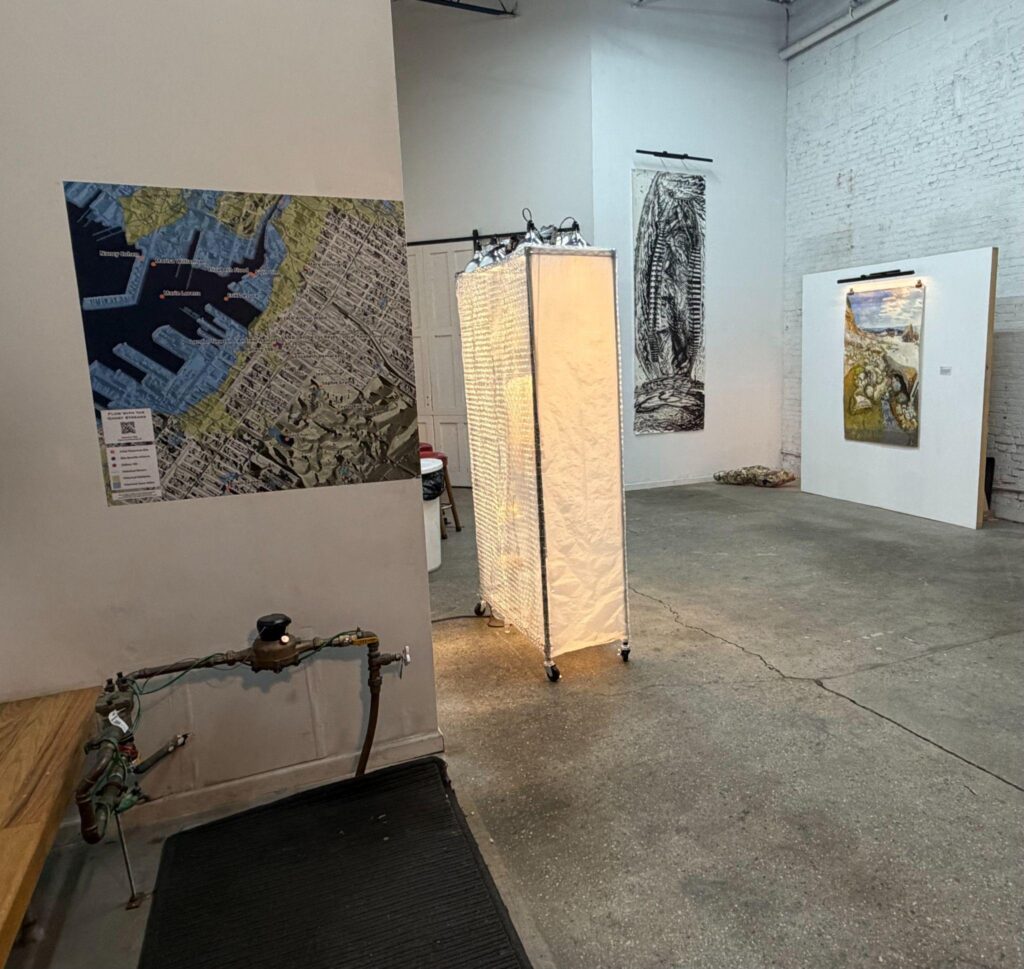
View of Interactive Map and installation view. Photo Courtesy of Andrew LaFarge Hamill
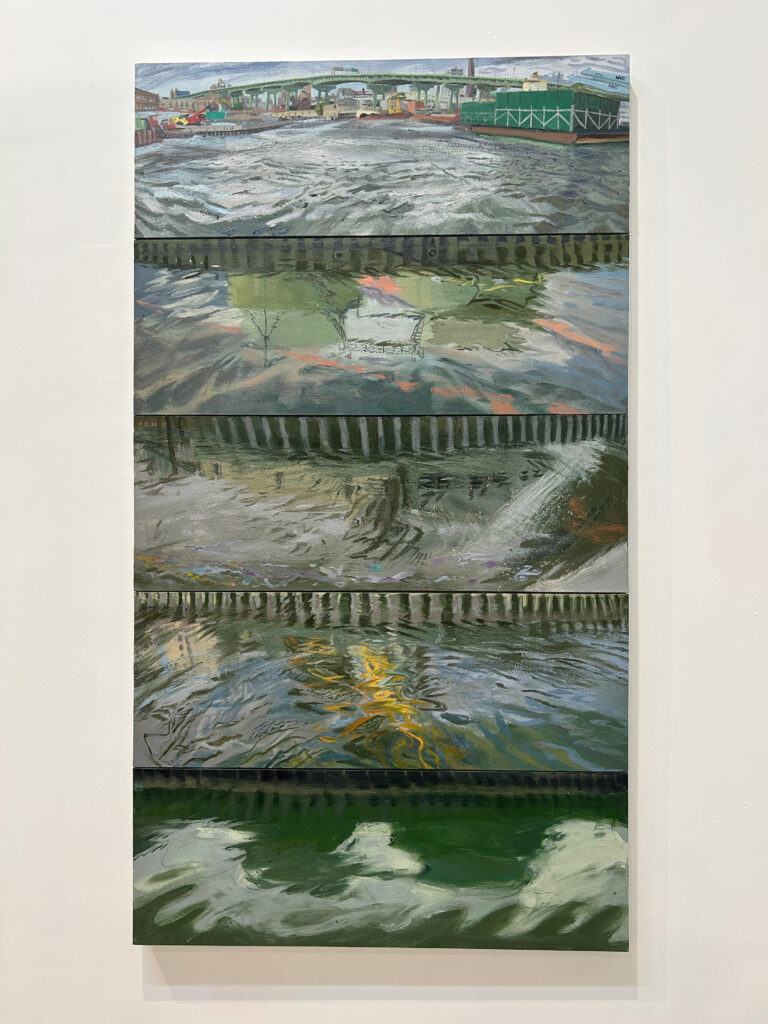
After moving to New York, I chose Gowanus as my home, and having been a resident for only a few years now, the sense of place that emanates from the works in this exhibition is welcoming. At the beginning of the exhibition, you are greeted with a map that can also be viewed digitally. Here, the artists’ works are noted on the map, indicating where materials were sourced, where the painting might have been painted, or where videos were taken. This cohesively pulls the neighborhood into the gallery and allows viewers to experience this eclectic place and its ever-evolving ecosystem and situation. Lili Chin’s video of Greenwood Cemetery, complemented by Sophia Grant’s birds, which were seen while exploring the cemetery itself, reminds me of my own walks there. Grant’s expressive and abstract backgrounds, especially in the work titled American Kestrel, allow the form of the bird to emerge and settle on the surface, as if glowing underneath bright sunlight. After stepping through Greenwood to the Gowanus canals and near the BQE, Elizabeth Flood’s works capture more wonderful moments. Especially the works titled Gowanus and Lookout (Hudson River, Storm King), by compiling several images with canvases stuck close together, Flood provides us with several scenic spots within each expansive work. Painting with a rougher, drier paint consistency, Flood allows the colors to glow and the rocks, mountains, debris, and ripples to show through; scraping, carving into, building up, or wiping away rough textures. Flood may only show what rises to the surface of the waters, deepening their reflections, but other works in the show depict details of the depth below.
Elizabeth Flood, Gowanus, 2026, oil on canvas, 75 x 42 in. Photo courtesy of Taylor Bielecki
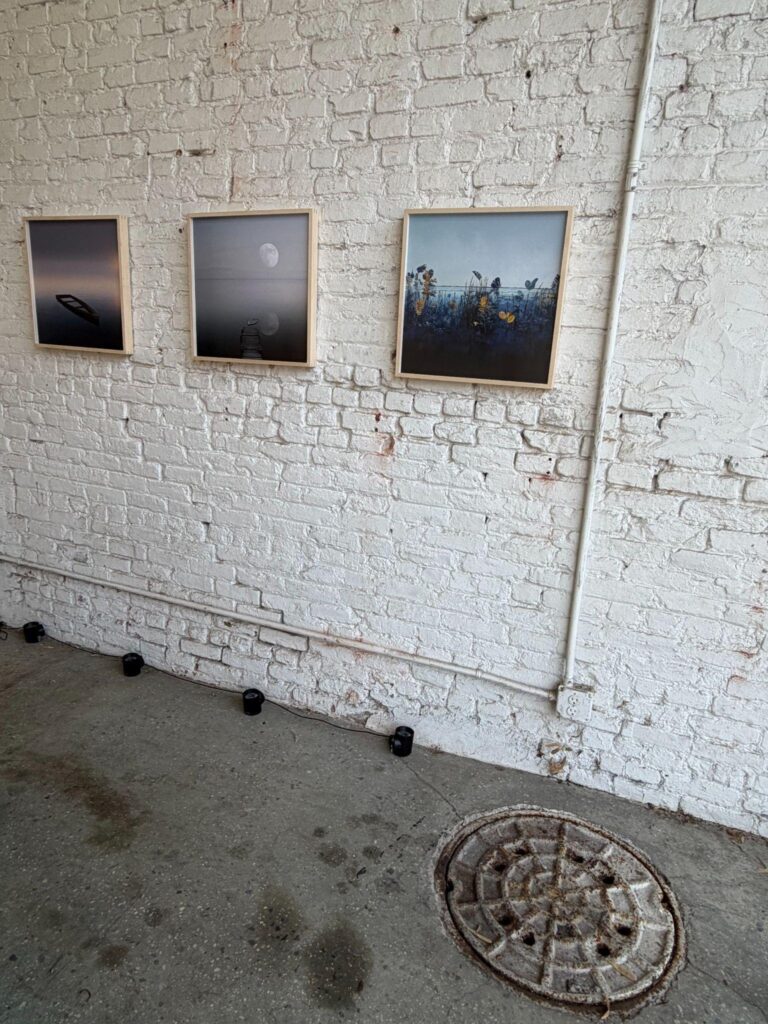
Revolving around the theme of water, several artists decided to depict the mystical side of water, the unseen depths below. Pulling us into a phantasmagorical, mist-filled environment, Mary Mattingly’s four metal prints depict murky waters. We do not know the depth, nor what is below, but Mattingly entrances us all the same. Using unknown light sources that permeate the mist, Mattingly lets the objects in the foreground, such as the sinking boat, the wooden pier, or the vegetation, become the focus as the water engulfs them. Mattingly shows us there are layers below that have yet to be explored as the objects seem to dissolve within the stillness of the surrounding waters.
Mary Mattingly installation shot. Photo Courtesy of Andrew LaFarge Hamill
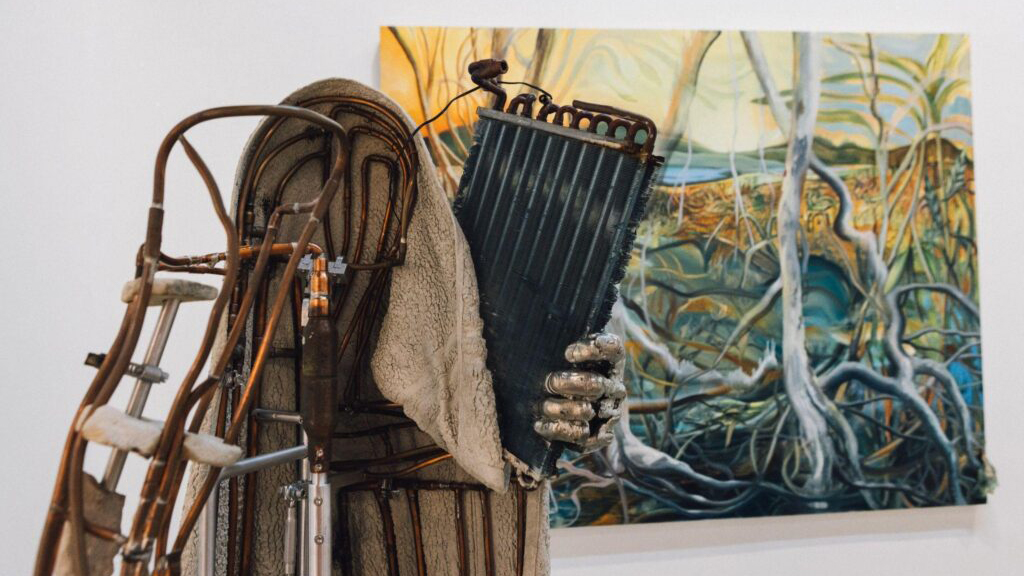
Deborah Wasserman’s paintings draw us into the intricacies of streams, rivers, and bays, and the flowing vegetation that grows alongside them. Especially through the painting titled The Tangled Land, The Strangest Sea, Wasserman pulls us into the depths to show the tangled root systems below. The anchors of the trees, the life force of their own ecosystem, the waters swirl around them and play a pivotal part in these environments, where both land and sea exist and benefit from each other. As in the painting Creatures of the Light, Wasserman draws us in with a stunning blue combined with layers of colorful reflections and several eyes that permeate from the currents. Just as we look through the swirling waters into the dissolving grasses above, the eyes watch us, placing us in the immediate role of being observed by nature. While humans are usually the ones affecting nature by polluting or changing water systems, these ecosystems still endure and instead watch us, to see if we change alongside them.
Nancy Cohen and Deborah Wasserman, installation view. Photo Courtesy of Andrew LaFarge Hamill
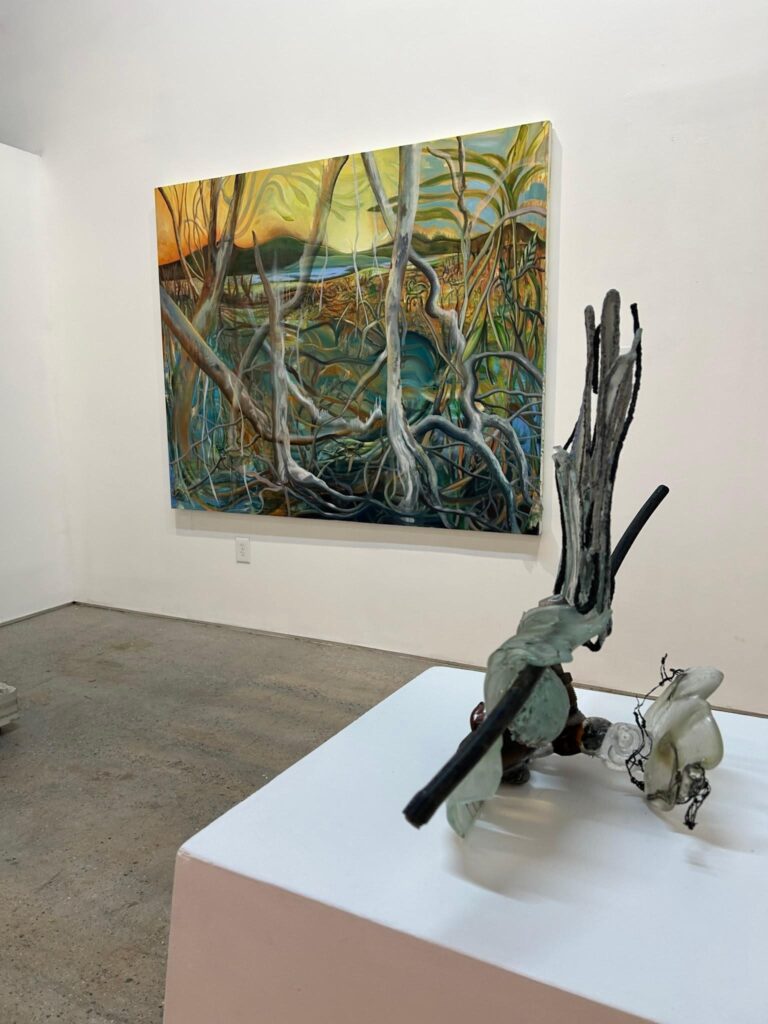
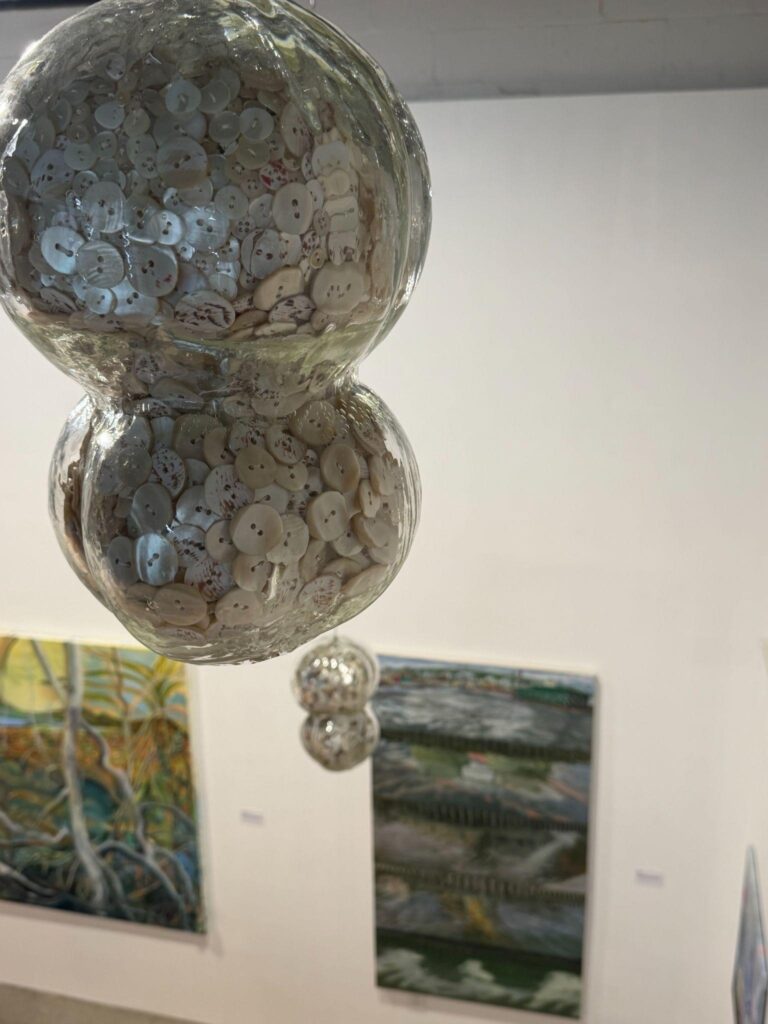
Another aspect of the exhibition that left me thinking long after I had left is the focus on materiality and the way many of the artists, such as Nancy Cohen, Jean Shin, Chris Pappa, or Taylor Baldwin, give items a new life. Nancy Cohen’s works all take found material and worked glass to create new conglomerates. Pieces like Side of the Road and Rubber River take discarded pieces from the surrounding areas, and instead of letting them flow away in the rain or litter the ground, Cohen gives them a new form, a new energy, and a new life. Using many handmade techniques to create paper and allowing glass to envelop metal or sand, Cohen expertly melds materials that are often at odds, since they are components that were either made or discarded and then reclaimed by Cohen. Jean Shin’s Tidal Orbs that hover over the gallery, or Chris Pappa’s mixed media forms that sit steadily on the ground, also pull from a combination of discarded and natural materials. They each show how materials can be reworked, rebuilt, reused, and given new life, one form suspended as if to complement the element of Air, and another of the earth. Here, these artists creatively repurpose objects, working with what the natural world has given them to rebuild entirely new creations.
Interestingly, Taylor Baldwin’s sculpture is seemingly the only humanesque figure within the exhibition. This left me thinking that the audience is instead meant to be the other “figures”. We are viewing the work and being viewed. Baldwin’s sculpture titled Unnamed Priest With Libation is placed in the middle of the back gallery, seemingly looking at one of Wasserman’s paintings, wielding a form resembling a tablet. Here, I take this figure, emerging from an overturned sink, to be judging or recording the works, the visitors, and the ideas that flow through the space. Carrying an empty water bottle, Baldwin’s veiled figure is built from an amalgamation of items, but he leaves one side open, so we get to see its inner workings as we circle around the piece. Each of the artists in this exhibition allows us to see the inner workings of their pieces, ideas, or explorations, just as much as they delve into the inner workings of nature around our neighborhood.
Just as nature is ever connected and the waters are ever-extending around us, this exhibition extends beyond the gallery walls. It extends to the nearby Green-Wood Cemetery, which has completed a major climate adaptation initiative, transforming its historic grounds into an “urban sponge” that absorbs stormwater runoff. Drawing attention to the NYC law that allows any citizen to plant and care for street tree beds, Landon Newton, in collaboration with curator Andrew LaFarge Hamill, will create a series of site-specific plant-based sculptural interventions outside the gallery, acting as hybrid bioswales to help mitigate pollutant runoff in sidewalk tree pits. These interventions will take place in the 2.5 blocks between Jean Shin’s outdoor work, Offering (2026), at the cemetery and the works in Overflow at the gallery. By including these works outside the gallery and the interactive map inside, Hamill ties all the works together through location. They emerge from the sites around Gowanus and the New York state area, bringing prevalent looks into urgent and pressing ecological issues that many of us may simply walk by in our day-to-day lives. The artists in this exhibition instead bring these concerns to light, pulling us into the environments we coexist in and presenting us with solutions and ways nature is trying to be healed and protected (both by human means and naturally). Overflow takes us into the natural worlds that the artists have surrounded themselves with in their work, and it turns the gallery into an intricately researched conversation that welcomes us to explore all of the information given to us and helps us dive in ourselves.
Jean Shin, Tidal Orbs, installation view. Photo Courtesy of Andrew LaFarge Hamill
Gallery 198, Overflow, 198 24th Street, Brooklyn, NY 11232, Exhibition up until Jul 25th, 2026. Open Hours: 3 pm – 8 pm Wed- Sun, and by appointment.
Make your tax-deductible donation today and help Art Spiel continue to thrive. DONATE
About the Writer: Taylor Bielecki lives in Gowanus, where her studio is, and works at Pratt Institute, where she earned her MFA. She also studied at Penn State, where she earned a BA in English and a BFA in Fine Arts. She finished as a finalist in the Kennedy Center’s VSA National Emerging Young Artist program for 2017, where she earned an award of Excellence. She has shown prints internationally in a print exchange in Australia and exhibitions in Dubai, India, and the Glasgow School of Art. She has also shown paintings internationally in Gallery 24N, PhilaMOCA’s juried exhibitions in Philadelphia, Pa., Perry Lawson Fine Art in Nyack, NY, BWAC in Red Hook, and IW Gallery in Brooklyn. Taylor works for Two Coats of Paint, TUSSLE Magazine, and has joined Art Spiel as a contributing writer. @Taylor.Bielecki
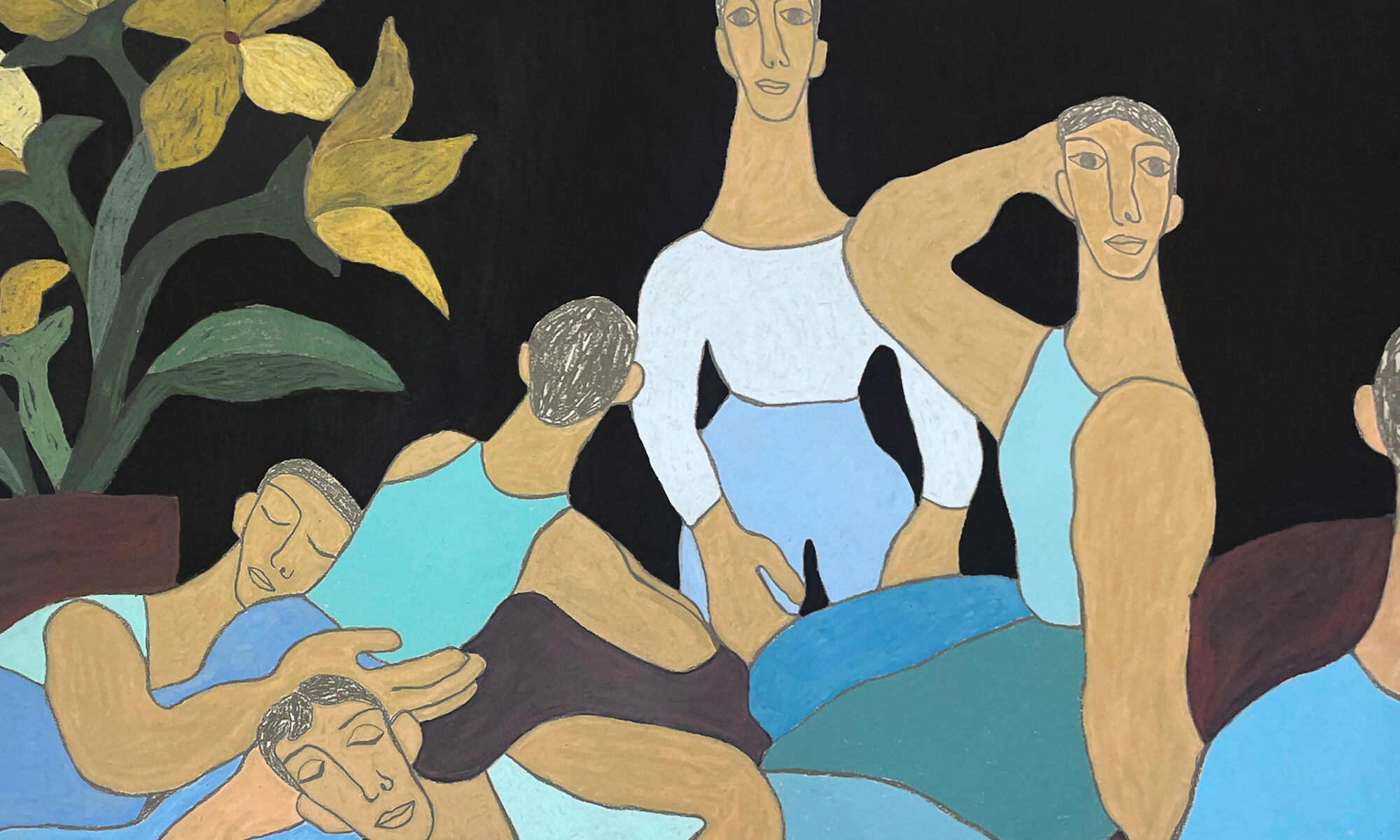
Angelo Vasta’s exhibition, Luci Spente, meaning Lights Off, at Tappeto Volante’s newest gallery in Tribeca, greets you with energetic works on paper in which bodies overlap, lean into one another, and drift across the surface. The figures carry a deeply personal connection as Vasta stresses the importance of closeness, exchange, and intimacy within domestic spaces. While not as brightly colored as his previous works, the colors here are deeper and softer, carrying a more somber tone. Vasta welcomes us into the spaces. He welcomes us as if we are a part of the group.
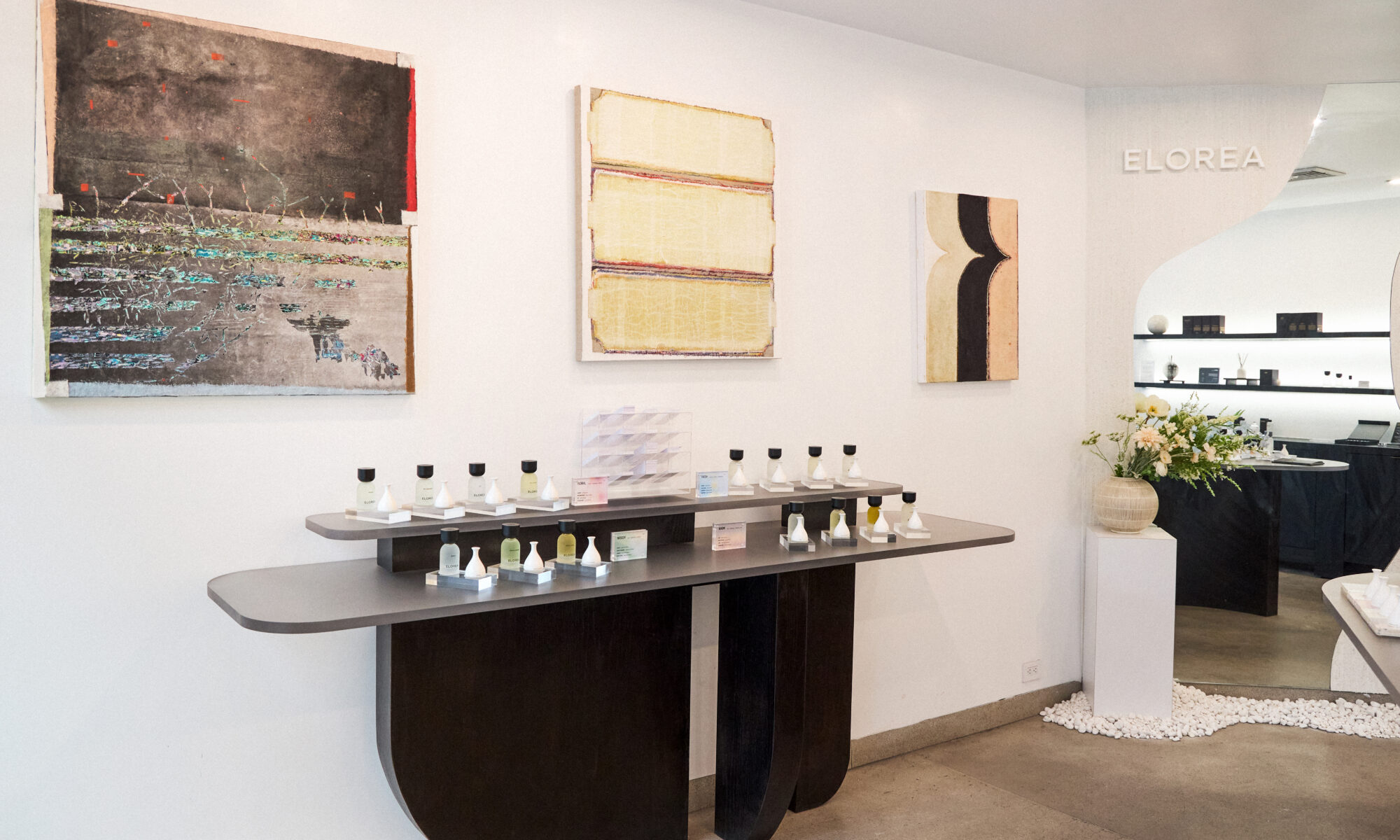
Stepping into the exhibition Strata of Time at Elorea, the focus is not only on the works hanging on the walls but also the fragrances around them as well. With works placed throughout a perfume shop, Herok was given the opportunity to respond to the fragrances surrounding his works. He uses his process of layering to overlay different colors, materials, and experiences of both to mimic the processes the perfume makers used to create their products, as they mix and meld various scents. The works are nicely displayed throughout the space; some works, like Out of Field 5, Out of Field 4, and See You Again, are displayed alongside products, while other walls allow works to stand on their own. This is an interesting exhibition collaboration that grew from studying the products and interviewing store personnel, a process that generated a new body of work carrying as many small details within the surfaces as the fragrances carry within the perfumes.
In the exhibition Funny Weather, curated by Imogen Aukland, four artists present distinct takes on reconstructions and uncertainty. A timely, unsettled feeling meanders through the space — sculptures that depict typically threatening objects unexpectedly softened, or photos that capture moments that physically change as you walk around them. Both the unexpected and a sense of upheaval are prominent themes throughout, whilst also giving us a “weather forecast” that changes by area, mood, and experience. This grants viewers the opportunity to question what art does: what an art object stirs within us, and how much our assumptions about something can shift when viewed from different perspectives.
Stepping into the exhibition Without Innocence at RAINRAIN gallery, you are greeted with a plethora of various mediums, ideas, influences, and experimentations. The paintings carry with them several levels of looking, small details to explore, and multiple dimensions within the edges. The photographs set the scene, allowing you to enter another space just as the paintings do, left to explore the worlds that Kawahara creates and builds within it all. The press release introduces a quote from Donna Haraway’s A Cyborg Manifesto, “…we are living through a movement from an organic, industrial society to a polymorphous, information system—from all work to all play, a deadly game (p 28).” This statement lingers alongside my thoughts throughout the exhibition, as I begin to notice more details, connections, and mechanisms that make this exhibition immensely similar to a cyborg in the making. Kawahara takes pieces of the body and fractions of different spaces within the canvas to build something entirely new out of all of these information systems.
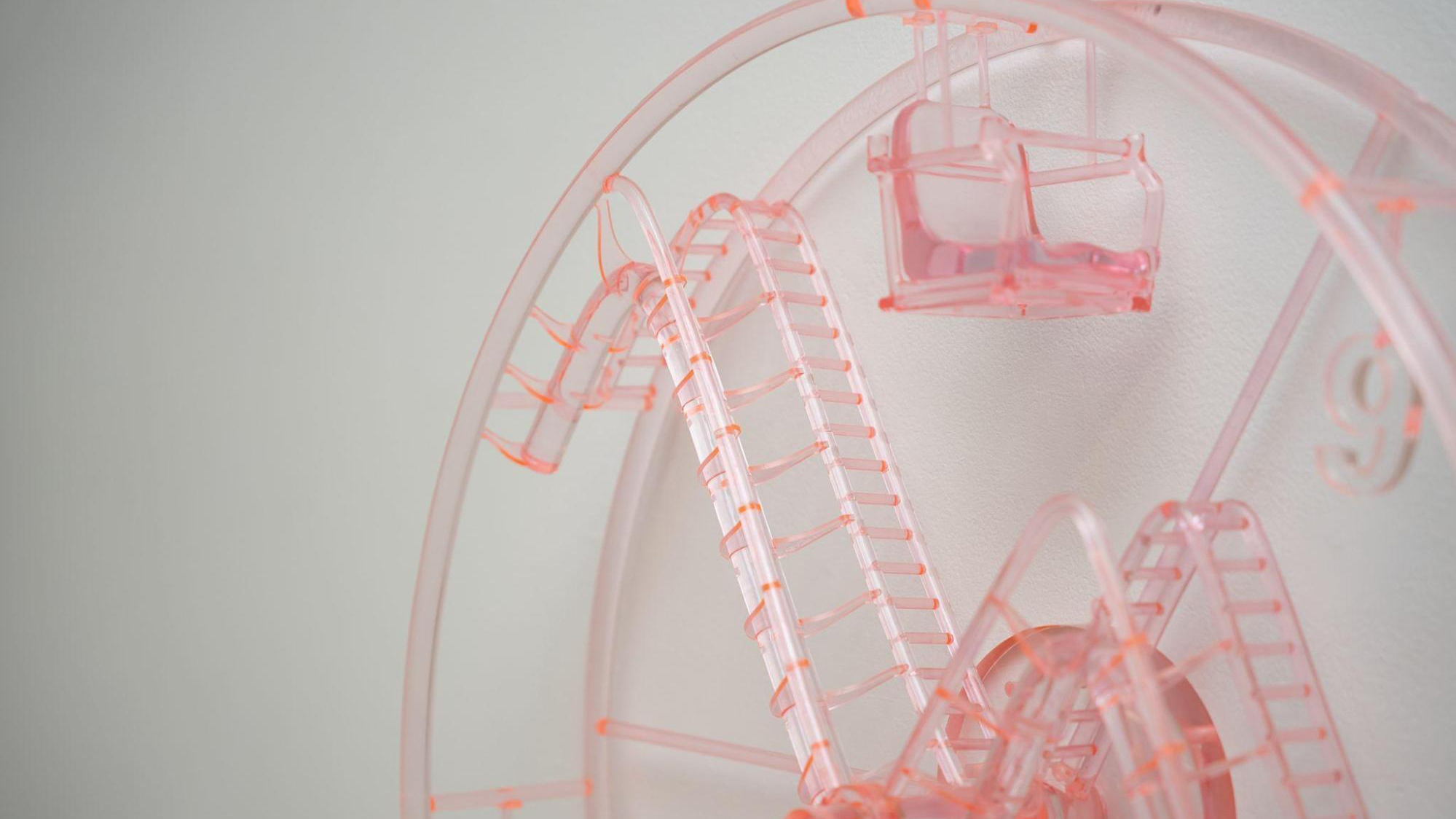
Upon entering the exhibition, you are greeted by pieces of various sizes and mediums, full of intricacies and exploration. With the pieces being smaller in size, besides the Ferris wheel, you have to get close to see the small details or the depth of space that opens into a world of its own within each piece. Within the works, Liu offers locations such as cities, darkened spaces, carnivals, and other places of transition. Places that one may find themselves when they are beginning to traverse or transition into someplace new. I appreciated that each work was either on the wall or a shelf, giving each a sense of its own place. The space around the pieces gives them an opportunity to breathe and allows viewers to look closely at one and flow seamlessly into the next.