
As the founding Executive and Artistic Director of the MassArt Art Museum (MAAM), Lisa Tung has continually focused on bringing immersive exhibitions to the public and establishing an institution that champions art education, contemporary art practices, and the accessibility of art. Having seen and admired the work of Masako Miki, Tung brought Miki’s imaginative creations to MAAM, where they come alive in Midnight March, curated by Alison Gass and Meghan Smith.
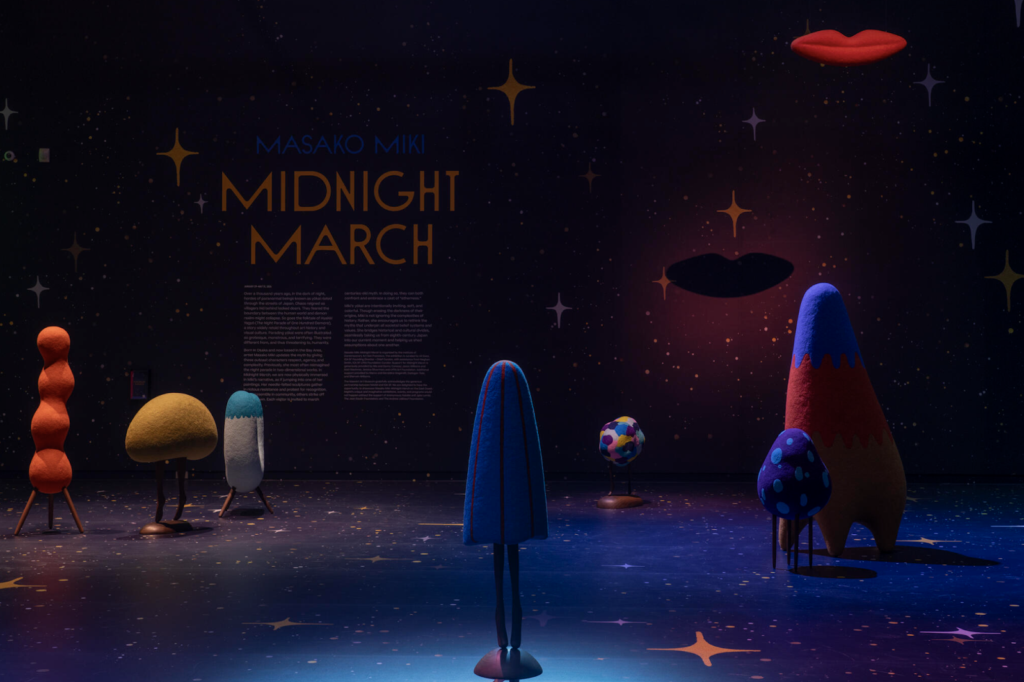
Midnight March transforms the Paine Gallery into a galaxy, filled with Miki’s large-scale, felted interpretations of Japanese folklore spirits, yōkai. Through their materiality, scale, color, and design, the typically alienated spirits are presented through a contrasting portrayal from their traditionally frightening depiction, shown as playful, respected, and not so different from ourselves. Through an animistic approach, Midnight March reimagines myth, highlighting our similarities, spirituality, and the power of sculptural storytelling.
When did Masako Miki’s work first come onto your radar, and what made Midnight March the right project to develop with her now?
I have long been a dedicated fan of Masako’s work. However, after seeing her unconventional felt structures in San Francisco and her later solo exhibition at the ICA San Jose, I knew Midnight March had to come to Boston. The needle-felted sculptures’ incredible scale and tactility were particularly drawing. This project perfectly embodies MassArt Art Museum’s (MAAM) mission to provide a dynamic space where professional contemporary art sparks public conversation.
The exhibition unfolds as a constructed world rather than a sequence of discrete objects. What were the key decisions in shaping how that world comes together spatially?
The exhibition has been adapted into a fully site-responsive installation for MAAM. We utilized the unique architecture of our Paine Gallery, which features a “bird’s eye” viewing balcony. This allowed us to build a “galaxy” that surrounds the work. Following Miki’s suggestion to cover the floor, we created an environment where the visitor not only observes but also physically steps into and becomes part of the transformative Midnight March. The sculptures are purposefully arranged so the audience can walk amongst them, encouraging collective action and a communal experience rather than a single point of view.

While Miki draws from nature, Japanese yōkai, and Shintoism, the work avoids literal explanation. How did you think about giving viewers entry points without over-directing how the work should be read? Can you give us an example of one work in this context?
To honor traditional folklore where yōkai come alive at night, we presented the exhibition in a dimly lit, dreamy environment. While traditional yōkai are often seen as frightening spirits, Miki reinterprets them as whimsical, soft forms. This shifts the focus to gentleness and accessibility, allowing us to maintain a safe space for dialogue. By presenting these “shapeshifters” as playful entities, we invite viewers to discover that “the other” is perhaps not so different from themselves, without the need for a literal explanation. A striking example is the Enchanting Lips Shapeshifter (2025). Masako reimagines the ghostly Kuchisake-onna—an urban legend of a woman with slashed lips—by isolating the lips and transforming her from a threatening figure into a powerful, autonomous being floating over the exhibition
The idea of “new mythologies” runs through the exhibition. From your perspective, what distinguishes Miki’s approach from more familiar uses of myth or folklore in contemporary art?
Miki updates myth by giving these traditionally outcast characters respect, agency, and complexity. Unlike traditional retellings that illustrate yōkai as threatening to humanity, Miki’s renditions are intentionally inviting and colorful. She uses the concept of animism—the belief that everything possesses a spirit—to remind us that we are part of a larger, living story. This transformation of historical myth into a contemporary celebration of inclusion aligns with a commitment to expressing diverse points of view.
Is there a particular sculpture or grouping that clarified the direction of the exhibition for you while working on it? What role does it play within the larger installation?
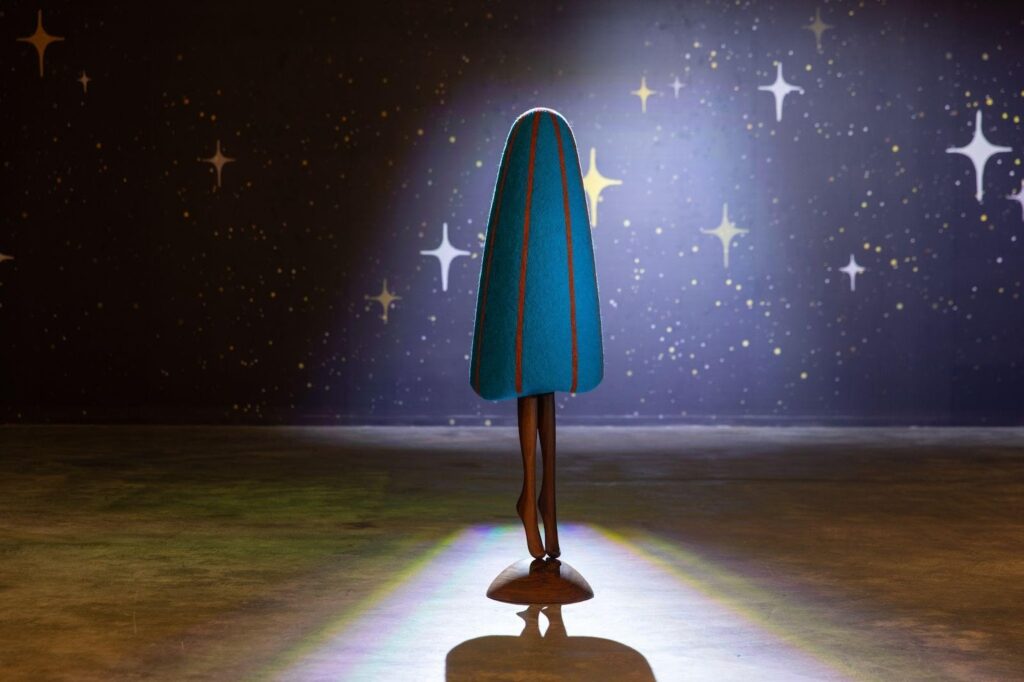
The needle-felted sculptures, such as the Ancient Tree Witness (2003) and the Sound Shapeshifter (2022), were central to clarifying our direction. Their intentional scale serves to remove traditional museum barriers. By leveling the spirits physically with the viewers, the power dynamic shifts from passive observation to active participation. These forms act as approachable entry points into the “galaxy” we created, grounding the supernatural in a tactile, human reality.

Felted wool is central to the work, carrying associations of labor, care, and touch. How did materiality factor into your thinking about how meaning builds across the exhibition?
The materiality of needle-felted wool is essential as it carries deep associations of labor, care, and touch. These abstracted felted forms provide a sense of approachability and tactility that contrasts with the often-frightening origins of the myths they represent. This softness ensures that the museum remains a safe space for dialogue and transformation. The physical warmth of the wool helps bridge the gap between the viewer and the “other,” making the concept of transformation feel gentle rather than jarring.
Miki speaks about countering harmful lore and building more inclusive narratives. What conversations do you hope Midnight March opens, rather than resolves, for viewers?
We hope the exhibition opens conversations about how we can reconnect to the world and to one another. In an age of digital isolation, it creates a vibrant physical destination where nature, myth, and community intersect. We want visitors to leave feeling that the world is a bit more magical and that we are more similar to “the other” than previously thought. It is an invitation to shed assumptions and discover a personal capacity for wonder.
Tell us about the curatorial vision for MAAM, and how Midnight March fits within, or stretches, that vision.A
s the Executive and Artistic Director of MAAM, I see my role as cultivating an experiential space where professional contemporary art serves as a spark for art making and public exchange. As Boston’s only free contemporary art museum, we are rooted in the belief that everyone should have access to world-class art. Midnight March perfectly embodies this mission by exploring “the other” as a celebratory catalyst for joy. It stretches our vision by utilizing our unique architecture to create a fully immersive, site-responsive “galaxy” that physically involves the visitor in the narrative.
Masako Miki: Midnight March, curated by Alison Gass and Meghan Smith. Exhibiting at MassArt Art Museum (MAAM), Paine Gallery, 621 Huntington Avenue, Boston, MA.
On view through May 31, 2026, Thurs 12–8 PM; Fri–Sun 12–5 PM. @maamboston
About the Director: Lisa Tung is the Executive and Artistic Director of the MassArt Art Museum (MAAM). She is dedicated to making contemporary art accessible to all and has curated numerous exhibitions that bridge the gap between professional art practices and public engagement. Under her leadership, MAAM has solidified its reputation as a vital cultural hub in Boston, championing visionary artists and providing unique educational opportunities for students and the community alike.
About the writer: Ella Jackson is a New York–based painter and creative, serving as Editorial Coordinator at Art Spiel and as gallery assistant at Plato Gallery. She earned her Bachelor of Fine Arts in Painting from Pratt Institute, where she developed a rigorous studio practice grounded in compositional exploration and critical dialogue. Her curatorial work includes an exhibition at The Blanc Gallery, and her artwork has been presented in shows such as her solo exhibition at Steuben Gallery and a group exhibition at IW Gallery. @ellagracejackson_