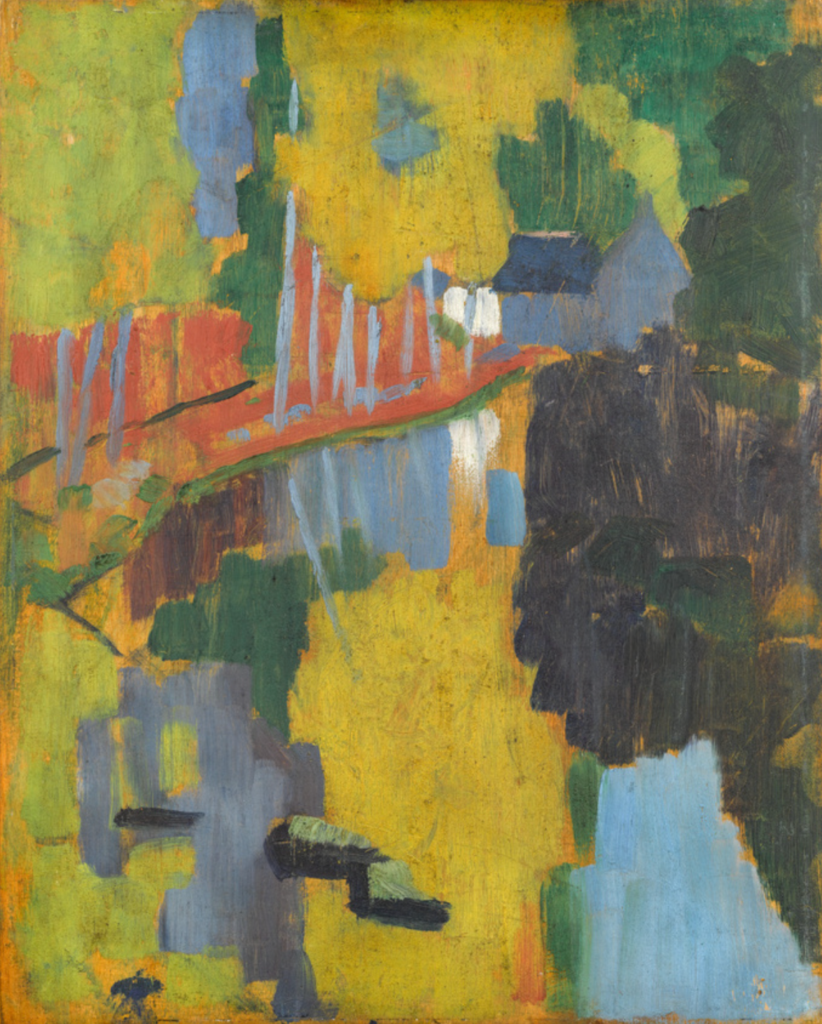
After the Impressionists blew open painting and reset Paris, rearranging everyone’s eyes, one might assume the dust would take a minute to settle. But almost immediately, a cluster of kids at the Académie Julian decided to reroute the whole thing again. Among them, Édouard Vuillard. To get to Vuillard, one must start with Paul Sérusier and Paul Gauguin standing by a lake in Brittany.
Gauguin gives young Sérusier the assignment that becomes lore: paint exactly what you see, but exaggerate everything. Make the red redder, the yellow louder, the green more emerald than nature allows. Then mirror the whole thing in the water with the same colors and the same value. Out comes a palm-sized panel titled Landscape in the Bois d’Amour (The Talisman), a quiet visual earthquake that shifts Impressionism toward the symbolic, the interior, the abstract-before-abstraction. The painting gets passed hand to hand among the artists who will call themselves Les Nabis, “the Prophets,” a name that’s both tongue-in-cheek and sincerely devotional. Forms flatten. Color becomes architecture. Figures dissolve into the atmosphere. Feelings overtake description.
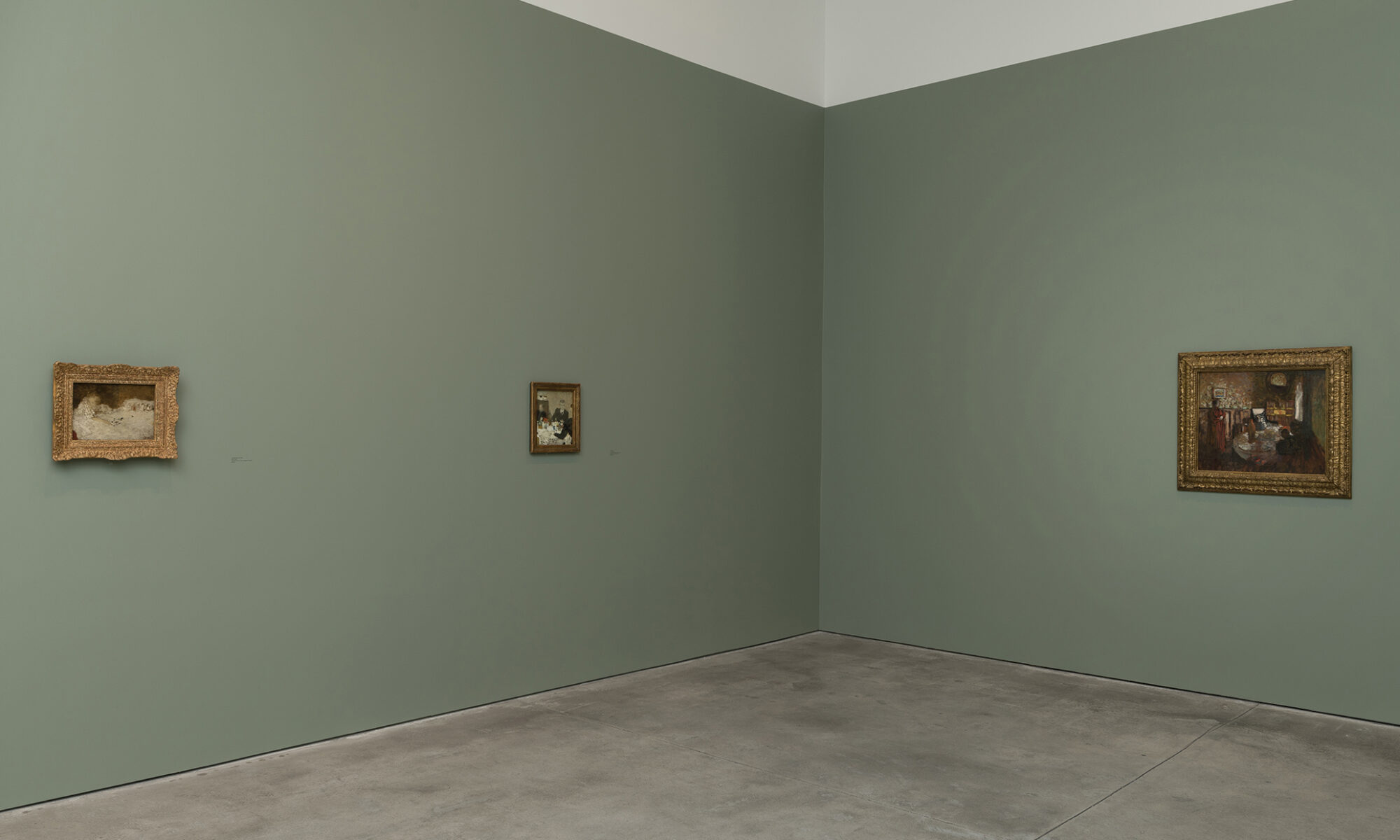
By the 1890s, the world around them was already shaking. Vincent van Gogh would die in Arles, Gauguin is sailing toward Tahiti, and Claude Monet is settling into Giverny. Meanwhile, this new school is scaling down and retreating indoors, into shadow, textile, ritual, and mood. That shift distills itself with startling clarity in Édouard Vuillard: Early Interiors at Skarstedt Gallery (March 3–April 25), where nineteen small paintings quietly rewire the story of Impressionism and point straight toward the century to come.
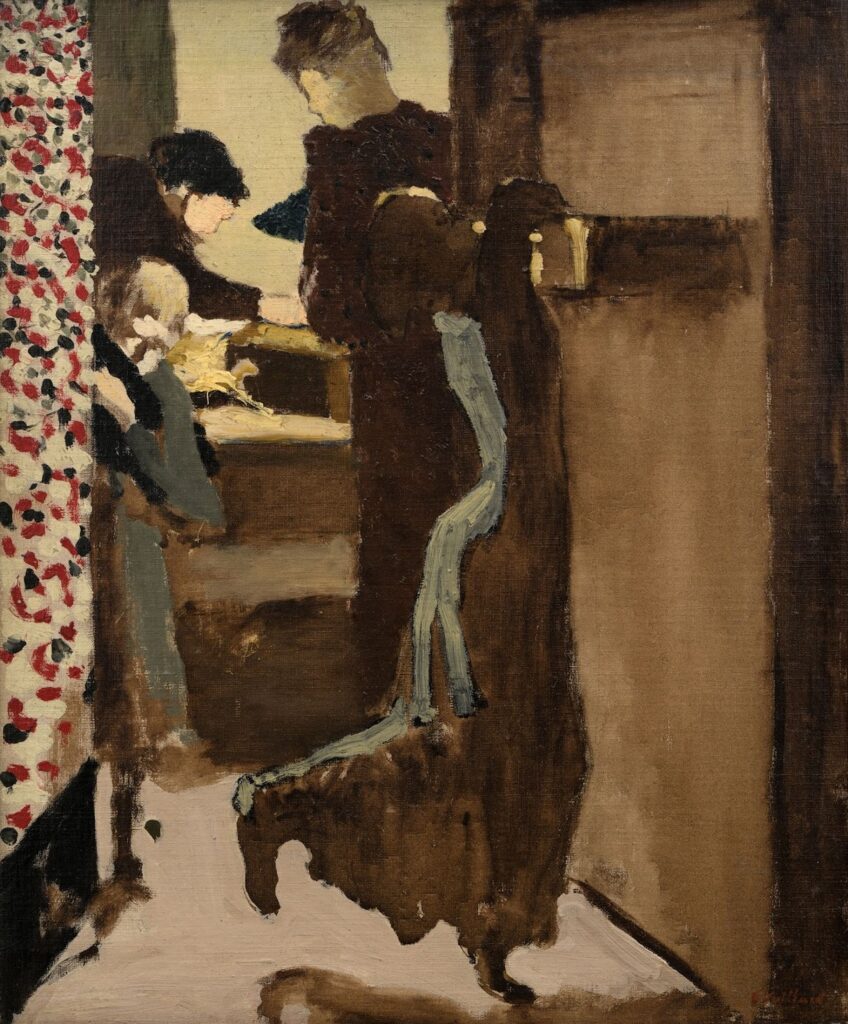
The show opens with The Drawer, a family scene that reads more like a psychic diagram. Vuillard’s father died when he was fifteen; his mother took over, raised the kids, ran a seamstress business out of their petite-bourgeois apartment, and kept everything moving because someone had to. That becomes the gravitational center of Vuillard’s world: women working, women deciding, women generating the visual field. It’s no surprise that his eye is attuned to painters like Berthe Morisot and Eva Gonzalès—women painting women indoors, where life actually happens.
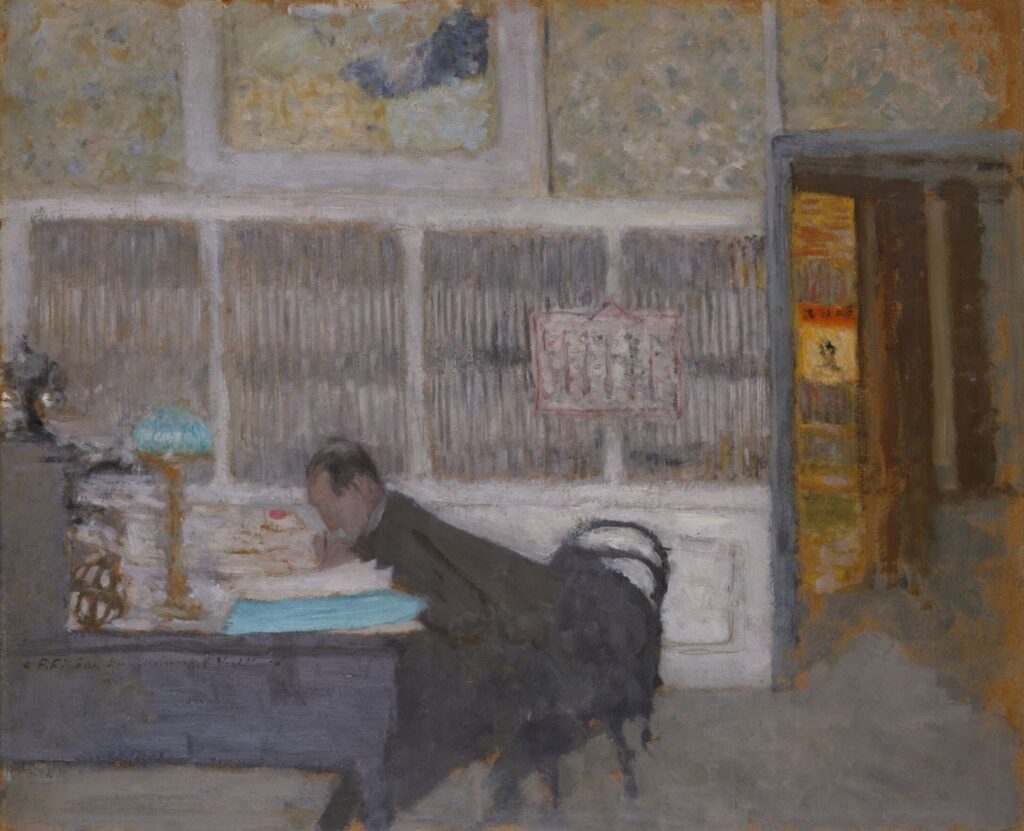
In At the Revue Blanche (Portrait of Félix Fénéon), the critic Félix Fénéon is folded into his surroundings until he is almost furniture. Cerulean blocks become a book and a lampshade. The rectangles lead you through a corridor of pearlescent greys and ochres before slipping you into warm light on the right. Everything is geometry softened by atmosphere. Centuries later, Richard Diebenkorn would borrow and expand on this template.
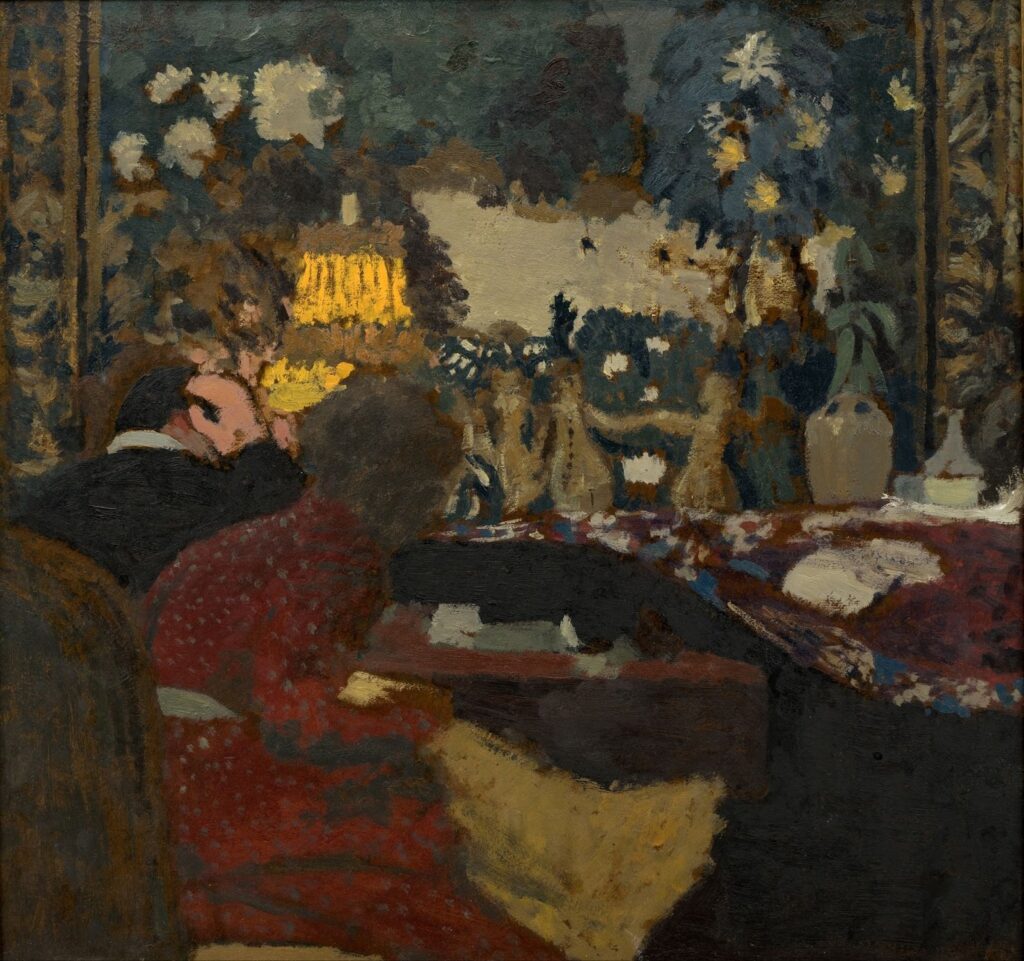
Then, In Front of the Tapestry, Misia and Thadée Natanson hit like a wall, dense enough to be almost rebuffed by your eye. Give it space, and it starts mutating toward a Clyfford Still: black, scarlet, and yellow stacked in tense verticals creeping across the surface. It’s wild to see this in 1899 and realize the mid-century is already germinating.
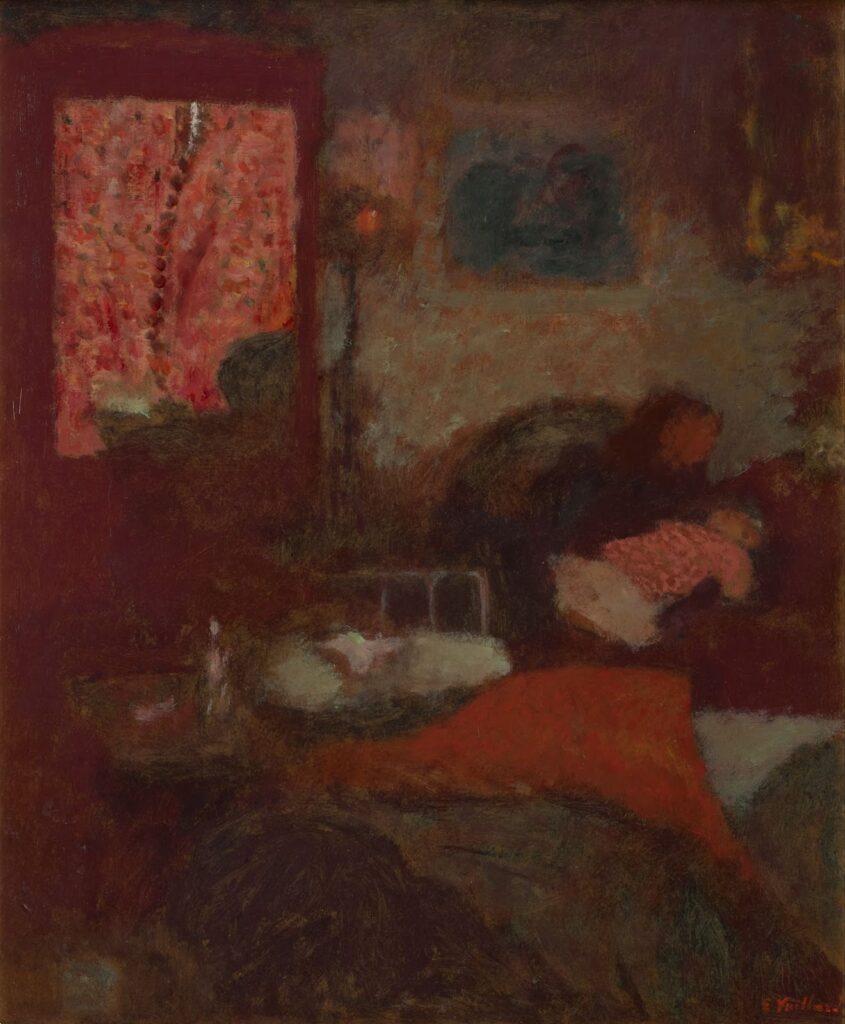
Interior with Mother and Child becomes an atmospheric color-field painting before the term exists. Rusty reds and oxidized greens hover against lamplight and refuse to clarify themselves. The painting keeps negotiating the line between what is “there” and what is felt.
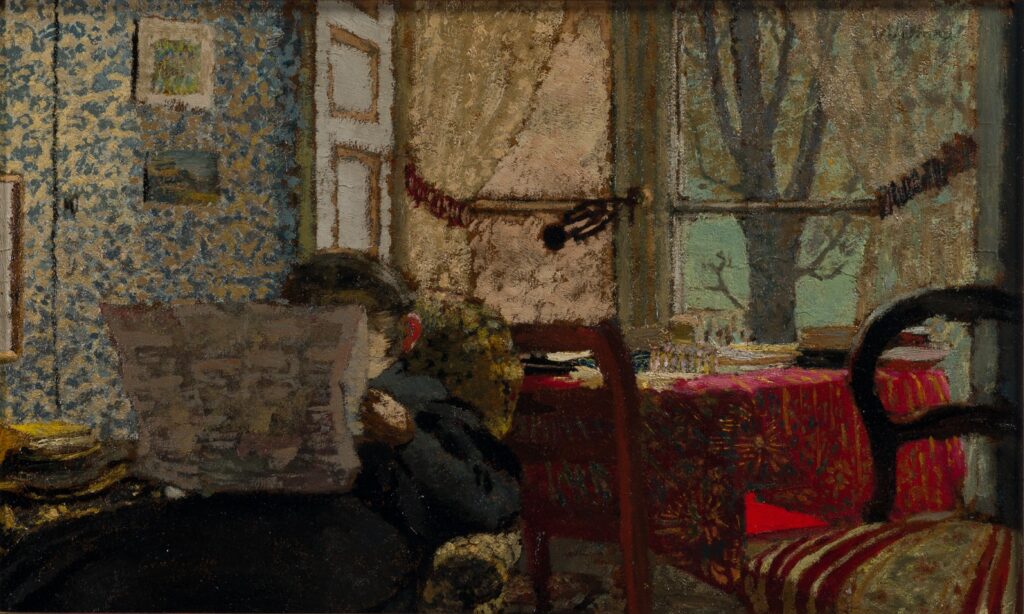
In The Newspaper, a dry-brush texture shifts from value to value as it moves in and out of shadow cast by a shutter. Toward the foreground, things darken, where a figure sits facing us with their face obscured by the paper they’re reading. A face hidden behind the front page, their features absent. Almost every face in the show is wiped clean, and somehow we read emotion more vividly because of it. Distance becomes intimacy.
What makes the show feel uncannily contemporary is how casual it is about scale. Everything is small—pandemic-era small—inviting you to come in closer. Women are not muses but operators of space. Rooms are not domestic backdrops but psychic engines. And as we seem to be entering an era that turns toward quality and effort in art, focusing on the hand and on the issues that are distinctively human, it feels prescient to see Vuillard refusing to harden into a style. He moves restlessly from one language to another, trying not to bore himself. That curiosity is the through-line.
A century later, the paintings still feel like they’re thinking their way forward.
Édouard Vuillard: Early Interiors at Skarstedt Gallery, 547 West 25th Street, New York, NY 10001. On view through April 25, Tues – Sat, 10 AM – 6 PM.
About the writer: Lucas Moran is an artist, writer at large, and the founder of End Scene – A roving endeavor and experiment in instability. He lives and works in Brooklyn, NY. @lucas_moran_