When I first learned how to swim as a child, my instructor told me to hold onto the edge of the pool and practice kicking. He counted the rhythm aloud, occasionally adjusting the angle of my body. Water kept splashing into my face, yet I could not make myself move forward. The actions had been broken down into steps: kicking, stroking, breathing, and I seemed to complete each one, but they never came together as a whole. Then, at some point, I stopped sinking. I still cannot say what exactly happened in that moment.
Looking back, I am unable to identify a clear instant when I “learned” how to swim. This experience is hardly unique. For a beginner, each movement can be performed in isolation, yet still fails to produce actual motion. Only when the body is forced into the water, losing balance, swallowing water, and struggling repeatedly, does a sense of rhythm begin to emerge. Even then, there is no precise boundary at which one can say that mastery has occurred. To “learn” appears less like a defined event and more like a gradual drift within repetition, lacking any moment that can be definitively confirmed.
When I entered Swim Lessons at RAINRAIN Gallery, this question resurfaced. Curated by Dasha Aksenova, the exhibition does not present “learning” as a process to be followed. Instead, it loosens the very premise of learning: before entering the “water,” knowledge seems applicable; once the body is fully immersed, that knowledge quickly loses its function.
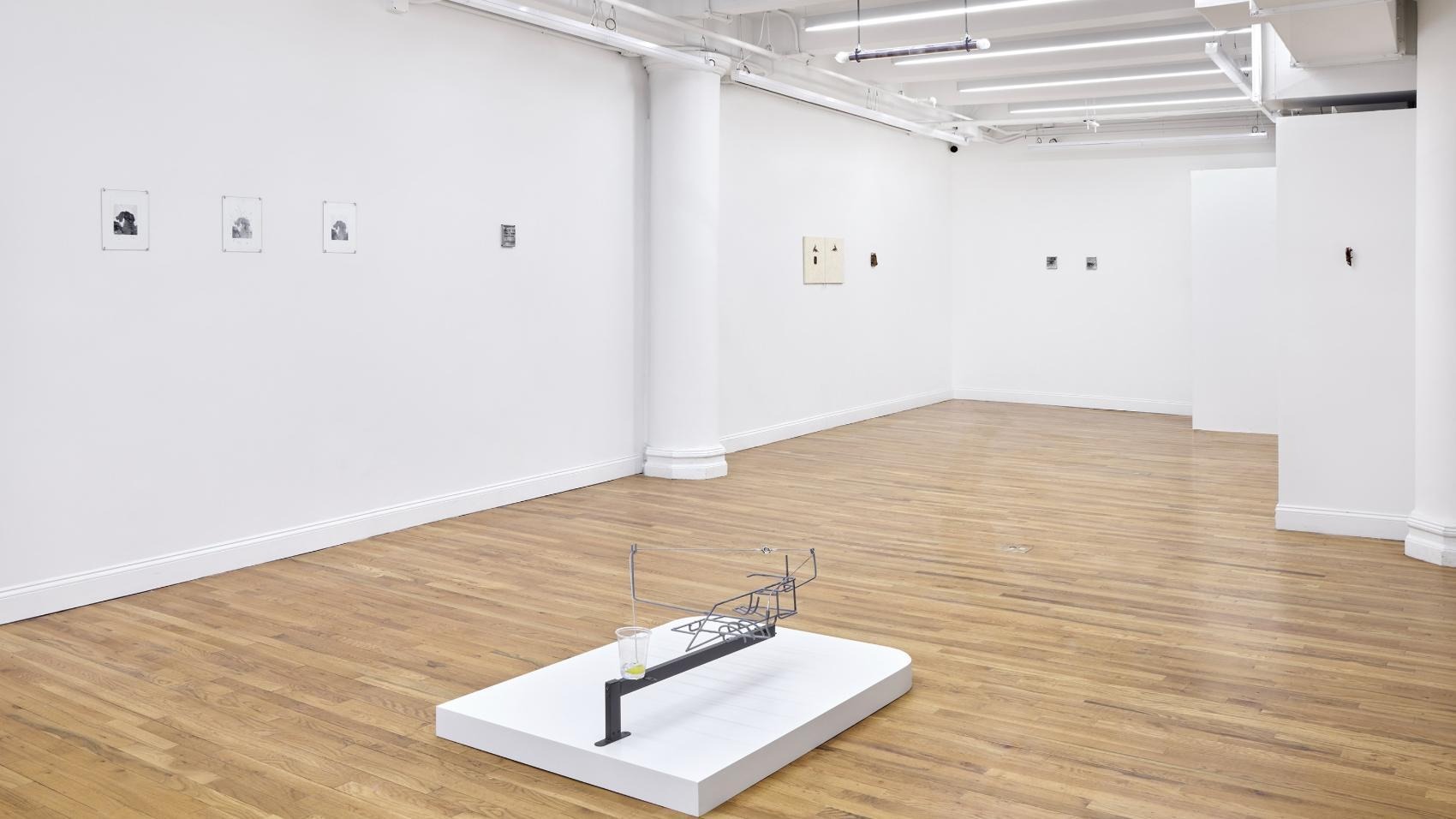
The exhibition does not offer a clear viewing path. The space is kept in a near-empty state: white walls extend inward, while exposed ceiling structures and linear fluorescent lights draw the eye into depth. Works are sparsely positioned along the walls and at various points in the space, maintaining visible distance from one another. Upon entering, it is difficult to locate a visual center; the body moves tentatively, constantly adjusting between approach and misalignment.
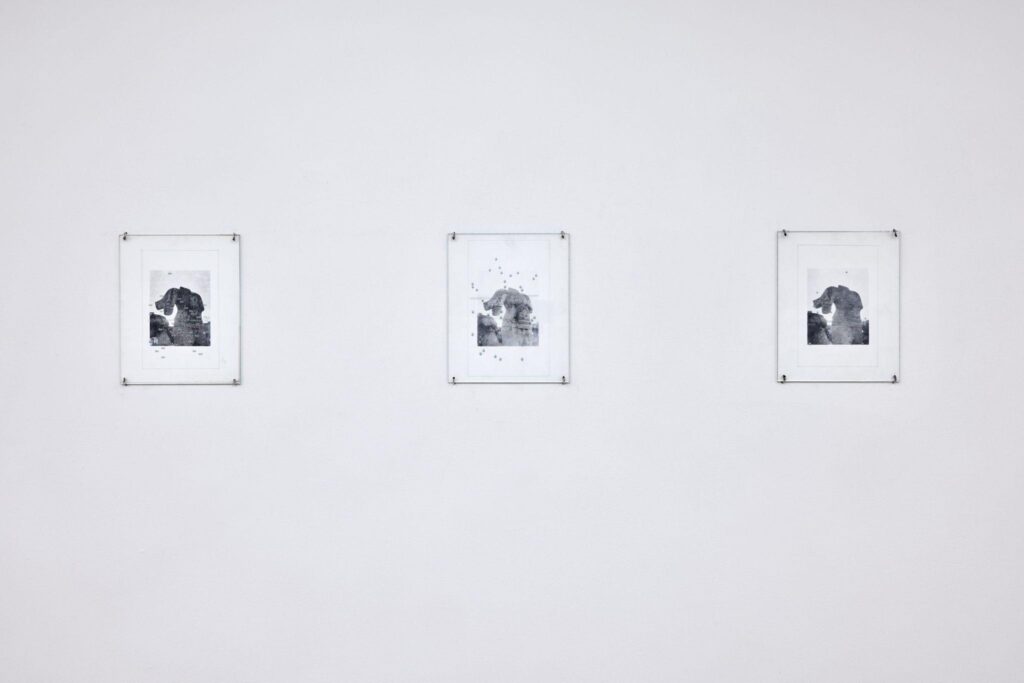
Along the walls, works appear at intervals rather than forming a continuous narrative. A group of small-scale works by Zhi Wei Hiu, such as Looking is the necessary instrument that, once used, I shall discard (2024) and the Untitled (Score) (2026) series, are installed slightly below eye level, requiring deliberate proximity to be seen. Silver gelatin images are pressed between glass and metal structures, their surfaces marked by subtle scratches and reflections, leaving the image in a state of partial visibility. As the body leans in, the image gradually emerges; with even a slight step back, it recedes again into an indistinct plane.
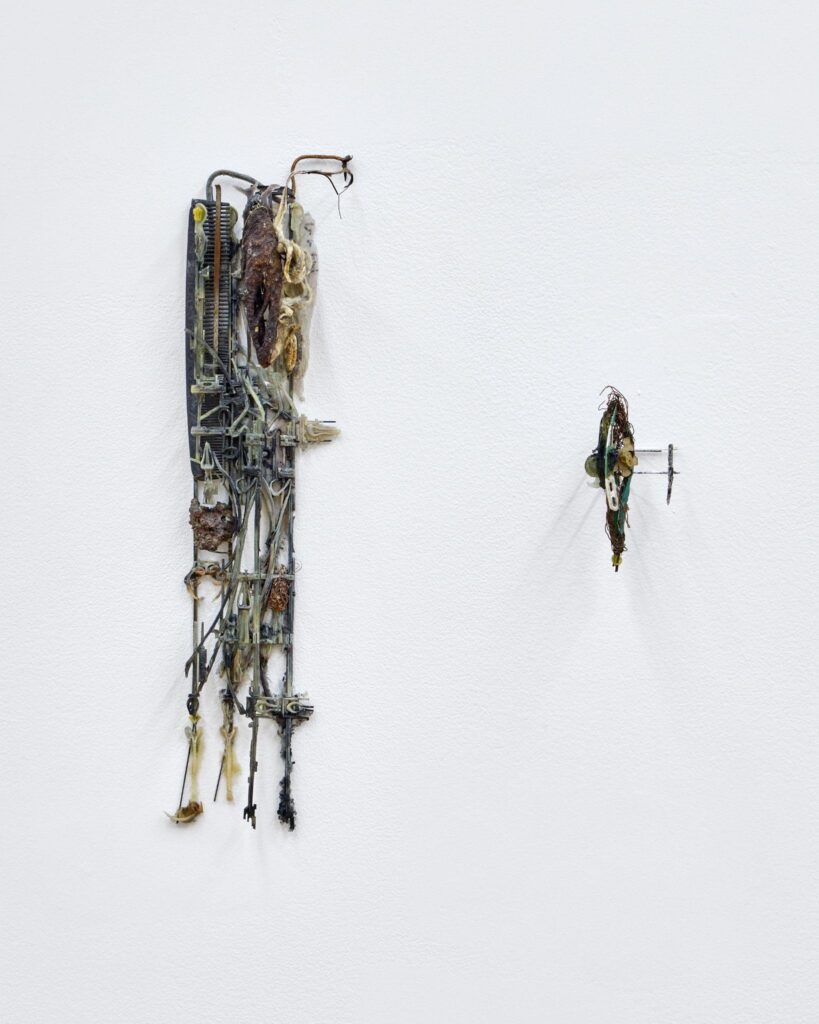
In contrast, Hanna Umin’s Haemon (2025) is fixed to the wall at a slightly elevated height, just above hand level. Composed of resin, metal, and various organic materials, including preserved fur, fingernail fragments, and the artist’s own bodily residue, the work produces a stark tension between its smooth exterior and the contained remnants within. As one approaches, the piece elicits an immediate physical response, holding the viewer in a brief oscillation between attraction and repulsion.
Echoing these dispersed installations is a condition of ongoing incompletion. The works do not cohere into a stable whole; instead, they remain open within the space. Connections appear loosened, structures misaligned, and material functions gradually displaced. As viewers move, they continuously recalibrate their distance: approaching to discern, stepping back to lose focus; fixing their gaze only to have it drawn elsewhere. Viewing no longer unfolds in a singular direction but develops through constant adjustment, sustaining the space as a site of continuous formation.
This structure resonates, in a subtle way, with Maurice Merleau-Ponty’s notion of “habit” in Phenomenology of Perception. For Merleau-Ponty, learning does not arise from abstract understanding but from the body’s repeated engagement with the world. Here, however, such habituation does not lead toward stable mastery; instead, it exposes the fragility of the body’s relation to its environment. Through repetition, the body does not settle into fluency but repeatedly re-enters uncertainty.
Yet this condition continues to shift. As learning drifts away from mastery and lingers between adjustment and imbalance, it also slips beyond any organized process. The structure of a “lesson” loses its efficacy; steps cannot be reliably repeated, and experience resists full transmission. Progress no longer points toward stability but unfolds through sustained delay.
From this perspective, delay itself does not signal a lack but becomes a more pronounced state. Through repeated failure and correction, the body gradually relinquishes its reliance on control. When water is no longer encountered as resistance to be overcome but as an environment to adapt to, the sense of “having learned” begins to surface, yet it remains uncertain.
If a lesson transmits knowledge through structure, then the works here form a kind of counter-lesson. Within ongoing repetition and drift, it becomes impossible to identify the moment when “not knowing” turns into “knowing.” As in water, we do not know when we begin to float; we only realize, at some point, that we are no longer sinking.
Swim Lessons explores learning as a process of repetition and encounter, rather than instruction. Through sculpture and installation, the artists engage materials in iterative ways, allowing form and meaning to emerge through ongoing negotiation and return.
Swim Lessons at RAINRAIN, 110 Lafayette St #201, New York, NY 10013. Curated by Dasha Aksenova, on view through May 2nd, 2026. Wed – Sat, 11 AM – 6 PM.
About the writer: Shuhan Zhang (b. 2002, Jiangsu, China) is a curator and writer. She is currently an M.A. candidate in Visual Arts Administration at New York University and holds a B.A. from the Central Academy of Fine Arts. Her research focuses on digital art, cultural platforms, and the contemporary art market, examining how technological infrastructures reshape modes of viewing, value production, and art circulation. She has curated exhibitions including After the Face, Lithic Coordinates, Losing Ghosts, A Lure, A Lament, and Spreading Growth. Her writing has been published in Tussle Magazine, IMPULSE Magazine, Art Spiel, and Whitehot Magazine, with a focus on exhibition criticism and contemporary art discourse.