Anne Katrine Senstad – Being (Un)schooled
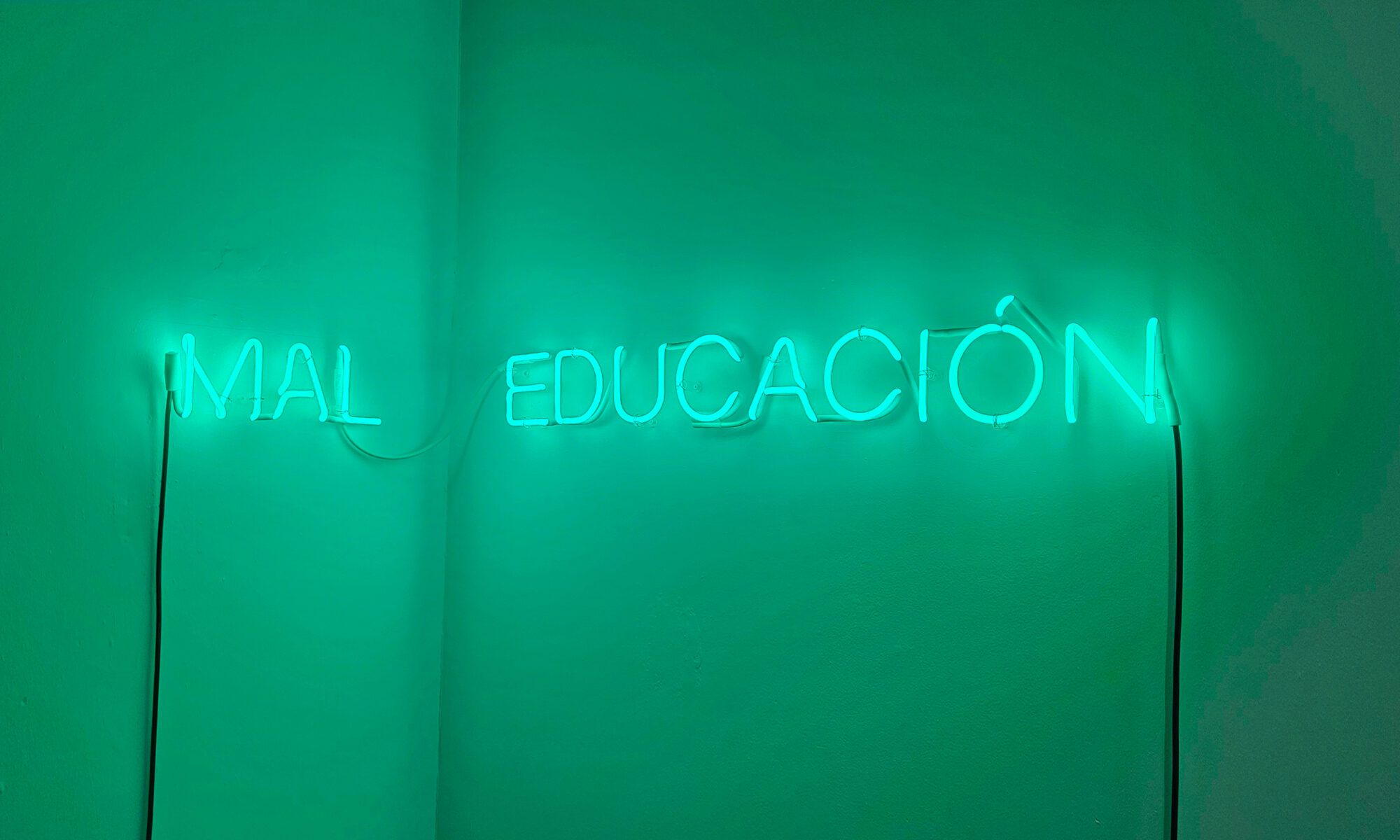
Anne Katrine Senstad, MAL EDUCACIÓN

Crossing the threshold of the “Veieja Escuelera” exhibition at Synesthesia Gallery, Brooklyn, visitors find themselves enveloped in an eerie haze of green light that is both sensuous and disquieting. This is not the only defamiliarizing element since the floor is carpeted with artificial grass and the light works encompass phrases in multiple languages. On Anne Katrine Senstad’s turf, nothing is what it seems at first sight. A Norwegian artist living between New York and Oslo, she uses light both environmentally and sculpturally to expose the interdependence between perceptual experience, cognition, and ideological beliefs. Her practice engages both with the phenomenological inquiries of minimalist artists such as Dan Flavin and Robert Irwin and with the tongue-in-cheek propositions of Conceptual artists such as Joseph Kosuth and Bruce Nauman who have paired neon light with text to invite reflection on the function of art as sign.

Continue reading “Anne Katrine Senstad – Being (Un)schooled”

Learning Where There Is No Bottom: On the Thresholds of Swim Lessons

When I first learned how to swim as a child, my instructor told me to hold onto the edge of the pool and practice kicking. He counted the rhythm aloud, occasionally adjusting the angle of my body. Water kept splashing into my face, yet I could not make myself move forward. The actions had been broken down into steps: kicking, stroking, breathing, and I seemed to complete each one, but they never came together as a whole. Then, at some point, I stopped sinking. I still cannot say what exactly happened in that moment.

Continue reading “Learning Where There Is No Bottom: On the Thresholds of Swim Lessons”

Floating in Three Acts- Keren Anavy at SUNY

Floating names a state of suspension, between sinking and surviving, between grief and the body’s refusal to stop. In Keren Anavy’s landmark solo exhibition, Floating in Three Acts, this condition is both subject and structure. The exhibition is built the way floating feels: without firm ground, without clear direction, with the question of outcome left open.

Continue reading “Floating in Three Acts- Keren Anavy at SUNY”

Re-evaluating Ellsworth Kelly at 100

opinion
Ellsworth Kelly, Spectrum IX, 2014, acrylic on canvas, twelve joined panels, © Ellsworth Kelly Foundation, Photo: Ron Amstutz, Courtesy: Matthew Marks Gallery

Ellsworth Kelly (1923-2015) is one of those artists whose status I’ve never understood. While he is held in high esteem by many, I’ve always questioned his significance. Don’t get me wrong, I like his work, but liking it doesn’t necessarily make it significant. His work is elegant, refined, and smart, and yet even in the 1950s-70s, it seemed conservative against the backdrop of Abstract Expressionism, Pop, and Minimalism. What made Kelly different from his peers was that when he was living and studying in Paris after World War2 on the GI Bill, while many of his fellow artists from the States were exploring lyric abstraction and L’informale, Kelly was looking at Art Concrete and had begun to make multi-canvas paintings.

Continue reading “Re-evaluating Ellsworth Kelly at 100”

David Dempewolf: Between Optics and Daydreams

David Dempewolf, imago 02 (bird’s eye self portrait), 2013 aqueous media and wax pencil on paper, 10” X 14”, courtesy of artist

Most artists’ studios give us a glimpse into their thought and work process but wandering through David Dempewolf’s studio gives more than a glimpse. It is an experience of entering a wonderous world— a hidden niche reveals a station for experimental animation, a corner serves as a station for wood printmaking, a quaint staircase to a small attic leads to imaginative series of drawings, and a “peephole” in a wall further guides our gaze below, to Marginal Utility, the non-for-profit gallery space he runs with his partner and spouse Yuka Yokoyam. It feels like entering a Borgeisan world where the artist’s thoughts and the endless possibilities of “cataloging” entangle and materialize into a new entity in a tangible space.

Continue reading “David Dempewolf: Between Optics and Daydreams”

In Case of Sam Spillman at Ulterior Gallery

https://images.squarespace-cdn.com/content/v1/56e4a5e1b09f956469fc080e/1650138651847-9U8SOF3SVVFR0HR2C2XP/Phase1_15_2000px.jpg?format=1500w

Installation view, courtesy of Ulterior Gallery

Far from the palatial white cubes of Chelsea or the intimate townhouse spaces of the Upper East Side is a different type of gallery space – one that serves as a reminder of an earlier moment in the art world, and yet persists into the present – the SoHo loft. In his debut solo exhibition, Sam Spillman has created work that probes at this history in In Case Of Sam Spillman at Ulterior Gallery. 

Continue reading “In Case of Sam Spillman at Ulterior Gallery”

Clive Knights: Fragmentary Intimations of Shared Meaning


Clive Knights in his studio, Portland, Oregon, 2021, photo courtesy of the artist

Clive Knights practices architecture and art, in particular mixed media and monotype printmaking. He holds professional architectural design undergraduate and graduate degrees from Portsmouth Polytechnic, UK, and a Master of Philosophy in Architectural History and Theory from Cambridge University. Clive has taught architecture since 1984 and was a full-time lecturer at Sheffield University for six years before moving to Portland State University in 1995 where he currently resides as a professor and director of the PSU School of Architecture. His primary areas of interest include the cultural meanings of architectural representation understood through the phenomenology of the human body, with particular reference to the writings of Maurice Merleau-Ponty; the revelatory capacity of metaphor in poetic work; and speculations in architectural design studio pedagogy. Publications include many journal articles and book chapters on the theory, history and pedagogy of architecture. 

Continue reading “Clive Knights: Fragmentary Intimations of Shared Meaning”