One is never prepared for the Maltese archipelago and its vertiginous dichotomy of antiquity and modernity; an exhilarating compound of ethnicities, languages, and cultures. Though one might consider it diminutive, during the three-day press preview, I traversed the main island, Malta, and its quieter, more pastoral and bucolic sister island, Gozo, in a flurry of taxis, ferries, and buses. (Comino, a nature lover’s sanctuary, remains largely uninhabited.) Malta occupies a distinctly liminal position within the Mediterranean world: a central island shaped across centuries by exchanges among Europe, North Africa, and the Near East. Situated a mere 60 miles south of Sicily and roughly an hour’s flight from Tunis, it has long functioned as a site of passage, encounter, and cultural layering—a geographic palimpsest upon which successive civilizations have inscribed themselves again and again.
This liminal quality permeates the second edition of the Malta Biennale, unfolding from March 11 to May 29, 2026. Under the artistic direction of acclaimed international curator Rosa Martinez, this year’s edition presents an ambitious expansion: 27 pavilions in total, comprising eight national pavilions—Malta, Poland, Spain, Finland, Armenia, China, Serbia, and France—alongside 19 thematic pavilions, including significant collaborations with the Gwangju Biennale in South Korea and the Çanakkale Biennial Initiative (CABANIN). This year’s edition has already welcomed thousands of visitors: international media professionals, collectors, curators, students, and members of the general public.
What distinguishes this Biennale—beyond its curatorial ambition and international scope—is its organizational intelligence and the inspired selection of venues. The curatorial team has achieved a seamless integration of contemporary art within historically charged sites that neither diminishes the work nor reduces the architecture to mere backdrop. Through careful site-specificity, the Malta Biennale creates a reciprocal activation between ancient fortified walls, baroque palaces, and contemporary artistic intervention—a dialogue in which past and present transform one another, allowing history to speak through contemporary art toward futures yet unimagined. The megalithic temple ruins, military fortifications, and grand master’s chambers don’t simply house these works; they amplify and complicate them, creating a temporal resonance that elevates both the historical architecture and the contemporary gesture.
Among the many works presented across these islands, several installations demand sustained attention for their formal strength and conceptual depth.
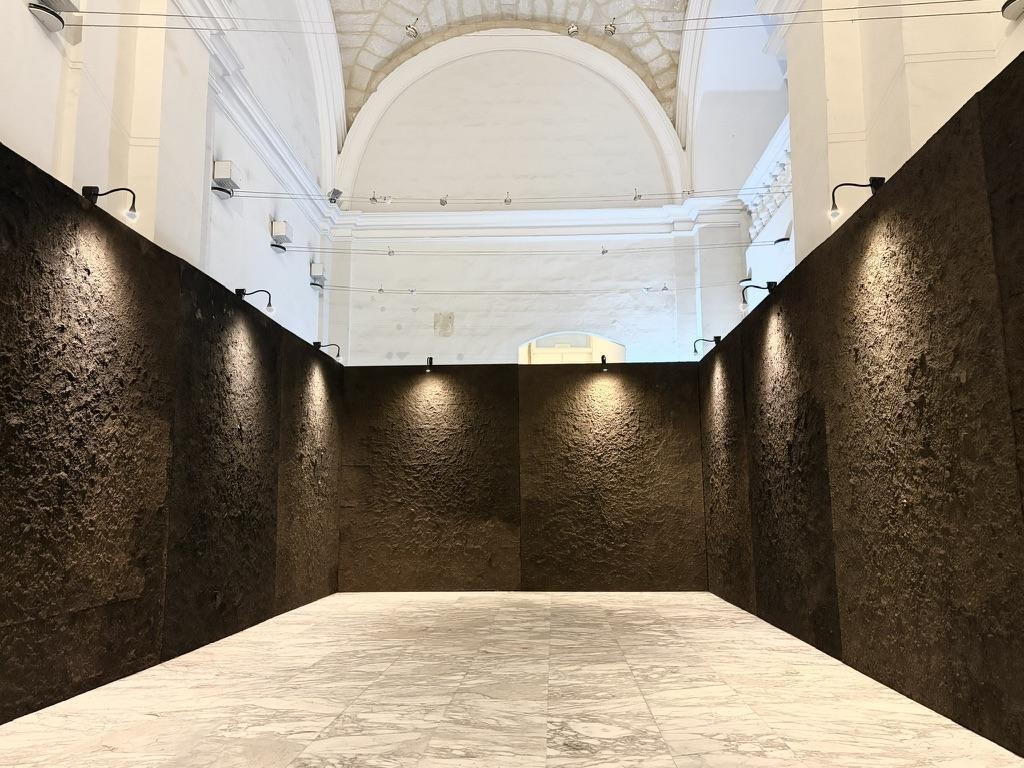
At the National Museum of Archaeology in Valletta, Portuguese artist João Marques presents large-scale burnt earth paintings and panels that function as contemporary memento mori. Marques’ process—literally subjecting earth to fire, transforming raw geological material through combustion—enacts a ritual that speaks simultaneously to destruction and renewal. Entering the installation, one confronts walls of charred earth rising to cathedral height, creating the solemn atmosphere of a sepulchral chamber. The environmental implications are inescapable: these scorched surfaces bear witness to landscapes consumed by climate catastrophe, yet the work’s formal austerity and material honesty propose fire as both destroying force and purifying agent. The burnt earth becomes both elegy and warning, a meditation on planetary mortality rendered in the most elemental terms.
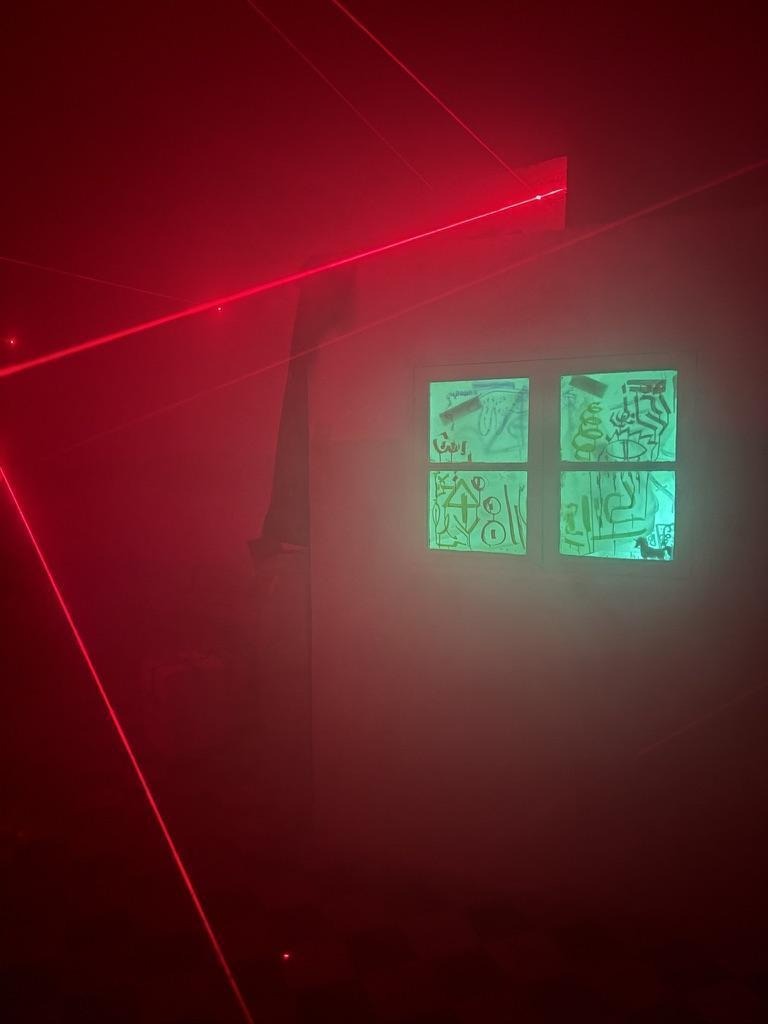
On Gozo, at the historic Ta’ Kola Windmill in Xagħra, Berlin and Malta-based artist Bettina Hutschek‘s monumental installation Encryption #3 transforms the windmill’s interior into a site of urgent decipherment. The large-scale drawing transmutes a speech on violence against women in digital spaces by women’s rights advocate Sima Bahous into an encrypted, hieroglyphic-like visual composition. Hutschek’s intervention insists that the violence enacted in digital realms—often invisible, systematically obscured—demands translation into material form to be truly understood. The work’s layered visual language requires sustained attention and interpretive work, proposing that understanding such violence cannot be passive but must be actively and painstakingly achieved.

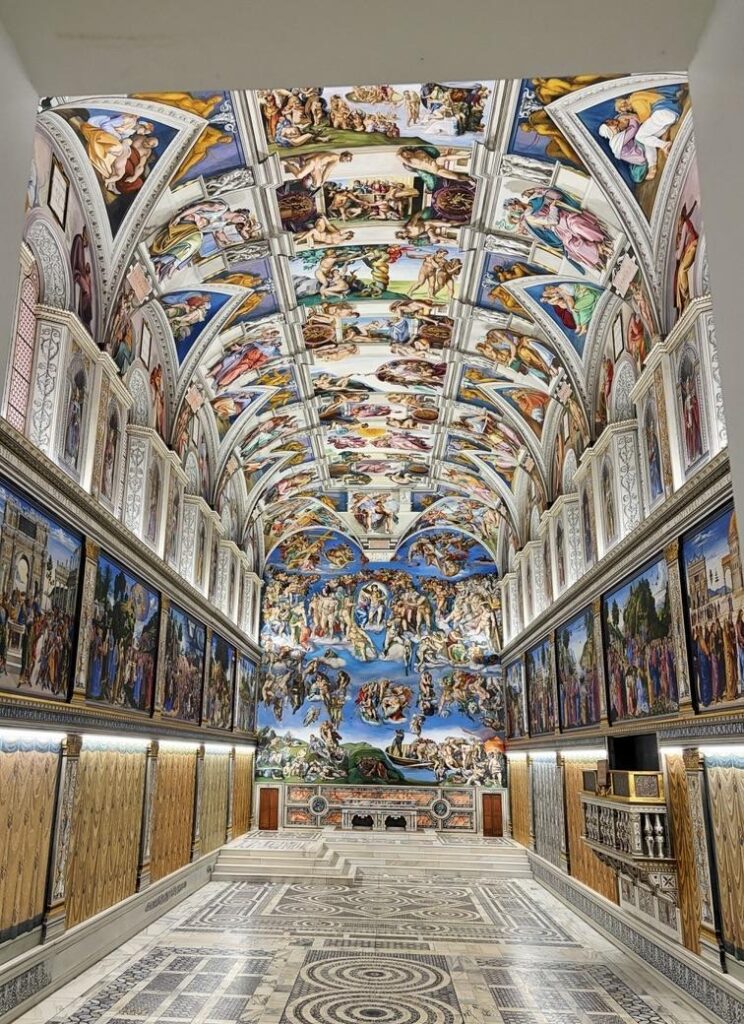
Maurizio Cattelan‘s scaled-down replication of the Sistine Chapel at the Grand Master’s Palace in Valletta reminds us that reality remains fundamentally a matter of perspective. The Italian provocateur’s miniaturization of Michelangelo’s canonical masterwork severs the conventional relationship between monumentality and meaning, compelling viewers to reconsider how scale shapes authority and aesthetic value. By reducing the sublime to the intimate, Cattelan underscores how profoundly human perception can deceive—how our sense of importance, grandeur, and cultural weight depends entirely on the frame through which we view it. The work functions simultaneously as homage and philosophical inquiry, suggesting that what we hold sacred might be radically reimagined through shifts in scale and viewing position.
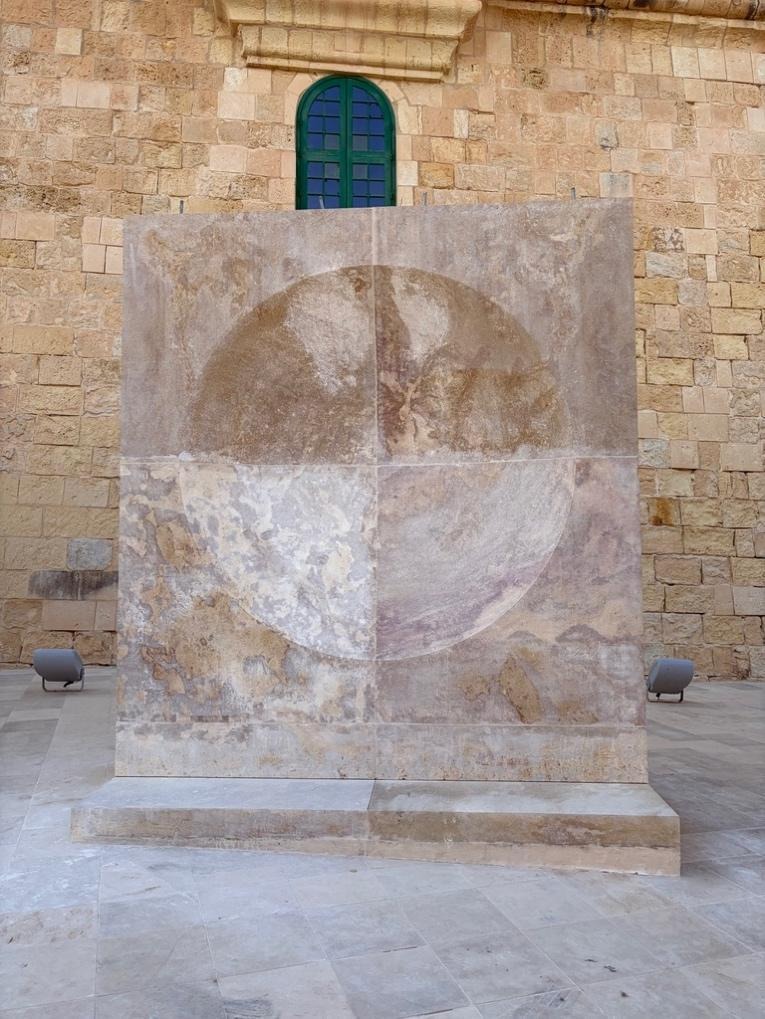
At Fort St. Elmo in Valletta, Finnish artist Anna Pesonen stages a site-specific, large-scale sculptural and sonic installation that reclaims obsolete military surveillance technology for cultural transmission. The work repurposes parabolic sound mirrors—once deployed for aerial threat detection—as instruments broadcasting kelkettely, a joik-based vocal practice from Karelia, the contested border region between Finland and Russia. This vocal tradition’s continuity was severed by border regimes, language suppression policies, and the displacement of Karelian communities during and after World War II—a history intimately interwoven with Pesonen’s own family narrative. Within the former military fortification, these sound mirrors become vessels of cultural memory, redirecting technologies of surveillance and violence toward preservation and transmission of nearly extinguished cultural practices.
The Cool Couple’s (Simone Santilli, Niccolò Benetton) multimedia installation within the Old Armoury of the Knights in Birgu examines how digital cultures transform violence into playful spectacle and the progressive blurring of boundaries between reality and simulation. The Italian duo’s work is “narrated” by the deeply controversial AI agent “The Priestess,” whose voice emerges from a month-long dialogue between the artists and their programmed creation. This AI-mediated narration itself performs the work’s central concern: how algorithmic mediation reshapes our relationship to violence, rendering the catastrophic as entertainment and the real as increasingly indistinguishable from its simulated double.
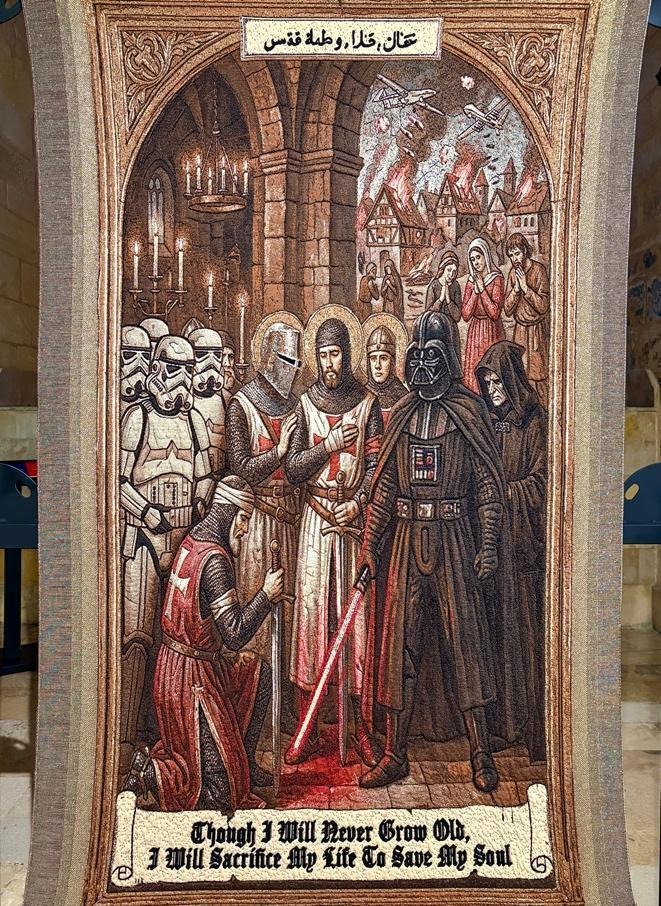
Turkish artist Halil Altındere‘s tapestries at the Grand Master’s Palace demonstrate his characteristic fusion of Pop Art aesthetics and political critique. His practice interrogates political, social, and cultural codes, addressing resistance against oppressive systems through visual juxtaposition. At the Malta Biennale, Altındere’s works stage unexpected encounters between ceremonial Ottoman court processions and Star Wars’ notorious villains—a collision that collapses historical empires and science fiction dystopias, suggesting uncomfortable continuities between past imperial structures and contemporary fantasies of authoritarian power.
The Malta Pavilion at MUŻA—The National Community Art Museum—presents works by Ġulja Holland, Pierre Portelli, Roderick Camilleri, Victor Agius, and Vince Briffa within a conceptual framework inspired by Lewis Carroll’s Alice’s Adventures in Wonderland. The pavilion invites visitors down the proverbial rabbit hole to interrogate the illusion of perfection manufactured by advanced technology, globalization, and industrialization—forces that, rather than delivering promised order, conjure instead a peculiar species of chaos. Among the works on view, Vince Briffa’s large-scale paintings in FARO: Landscape Twice Retracted perform a double withdrawal—first from the landscape itself, then from its representation. The work explores the co-existence of dualities, blending opposing forces and questioning its own reality, proposing that contemporary landscape exists only as phantom, as afterimage, as something twice removed from immediate experience. Victor Agius’s KHAOS: Thresholds of the Anthropocene positions viewers at the precipice of profound uncertainty, where the Anthropocene reveals itself as a moment of radical indeterminacy rather than a mere geological epoch. Through these diverse practices, the pavilion reflects Malta’s position at the crossroads of cultures while encouraging visitors to reimagine the precarious balance among innovation, humanity, and the natural world.
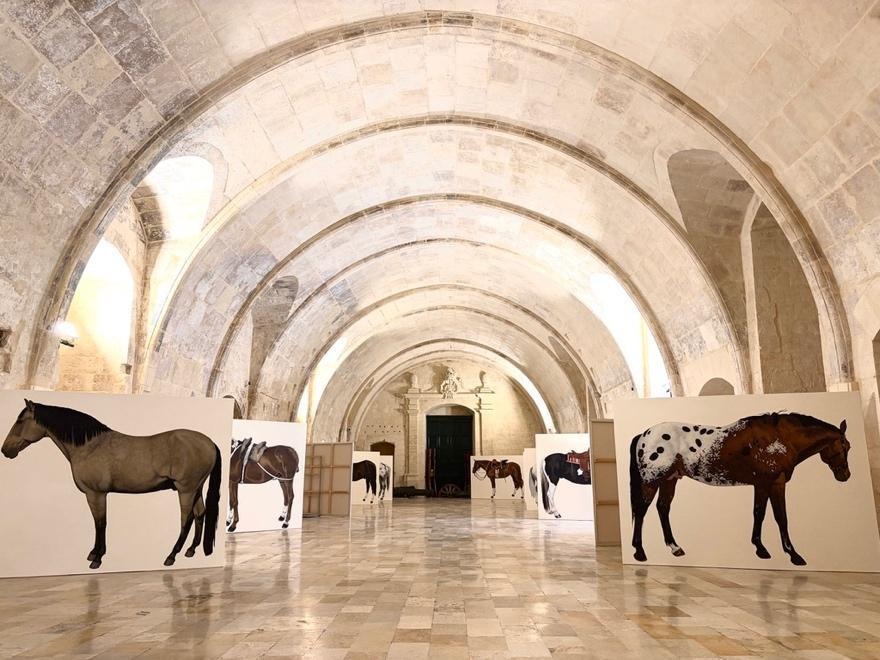
At the Grand Master’s Palace, American-French artist Lara Nickel‘s 12 Horses—Homage to Jannis Kounellis interrogates the conceptual boundaries of painting and its interaction with space and time. The life-size canvases, positioned in a deliberately non-traditional manner—independent from yet anchored to the walls, echoing Kounellis’s legendary installation—contradict the established iconography of the horse as transmitted through classical sculpture and painting. These representational works demand viewing from multiple angles, functioning simultaneously as illusionistic representations and sculptural presences. The installation activates the gallery through productive unease: because the canvases designate and define the space so assertively, the entire physical expanse belongs awkwardly to the paintings rather than to the viewer, inverting conventional hierarchies of spectatorship.
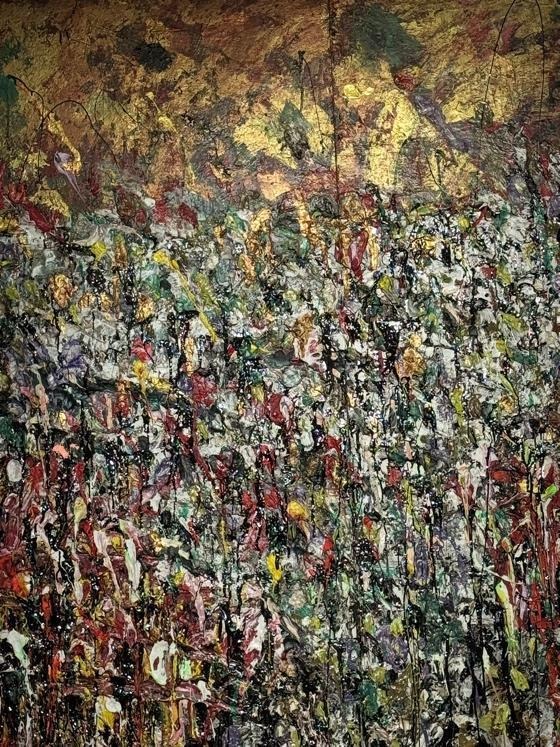
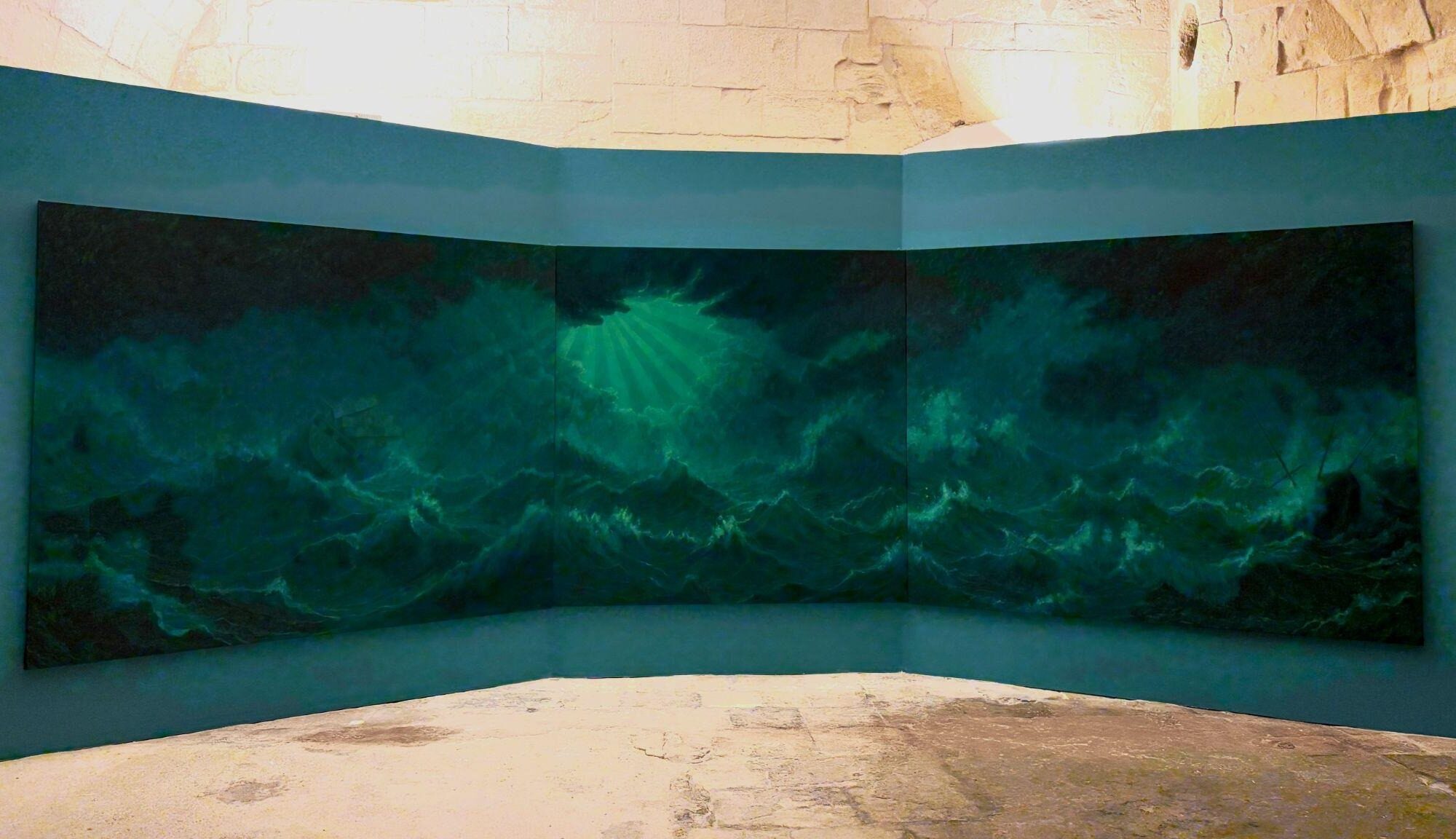
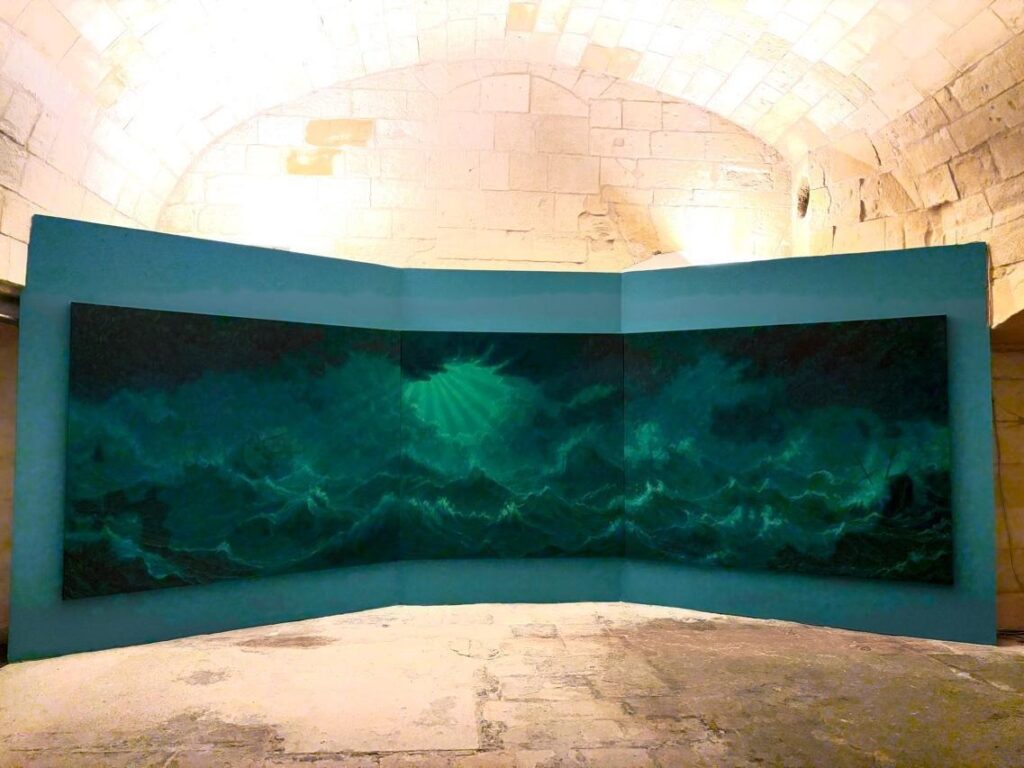
Finally, at the Malta Maritime Museum in Birgu, Peruvian artist Daniel de la Barra‘s hypnotic large-scale painting They Don’t Know the Way stages the Mediterranean not as a horizon of lyric possibility but as a theater of obscure forces, where darkness presses against the surface like history itself. The painting’s power resides in its refusal of daylight clarity: instead, it draws the eye into a nocturnal field where deep shadows consume distance, and the sea becomes less a site of passage than a zone of uncertainty, charged with memory, extraction, and loss. Against this dimness, the greens don’t soothe. They gleam in jewel-like registers—emerald, malachite, dark viridian—so that color feels simultaneously precious and unstable, as if the work was illuminated from within by something both seductive and perilous. The greens don’t open the image outward; they intensify its inward pressure, rendering the darkness thicker, more active, almost mineral. The painting transforms the landscape into a moral atmosphere: a field where beauty proves inseparable from concealment, and where the Mediterranean’s familiar promise of openness yields to something far more charged, secretive, and ominous.
What the Malta Biennale 2026 achieves, ultimately, is a model for how contemporary art platforms might operate beyond the extractive logic of the international biennial circuit. Rather than imposing a curatorial framework upon indifferent sites, Martinez and her team have created a genuine exchange between place and practice, allowing Malta’s complex historical position—as crossroads, as contested territory, as palimpsest—to inform, activate, and inflect the works themselves. This isn’t site-specificity as a curatorial strategy but as necessity itself: an acknowledgment that location doesn’t frame meaning—it authors it.
Malta Biennale 2026, on view through May 2026.
National Museum of Archaeology, Ta’ Kola Windmill, Grand Master’s Palace, Old Armoury of the Knights, Malta Maritime Museum — @heritagemalta
Fort St. Elmo — @fortstelmo.nwm
MUŻA – The National Community Art Museum — @muzamalta
About the writer: Eva Zanardi is an Italian writer, independent curator, and art advisor based in Malta. Her work focuses on post-war European abstraction, with particular expertise in Op Art, Kinetic Art, Concrete Art, Spatialism, and Programmed Art. She explores artistic lineages and the dialogue between historical movements and contemporary practice.
Zanardi previously founded and directed GR Gallery in New York and later established Visitor Center, a contemporary art space in Newburgh, NY. She has curated exhibitions internationally, including recent projects examining generational artistic influence.