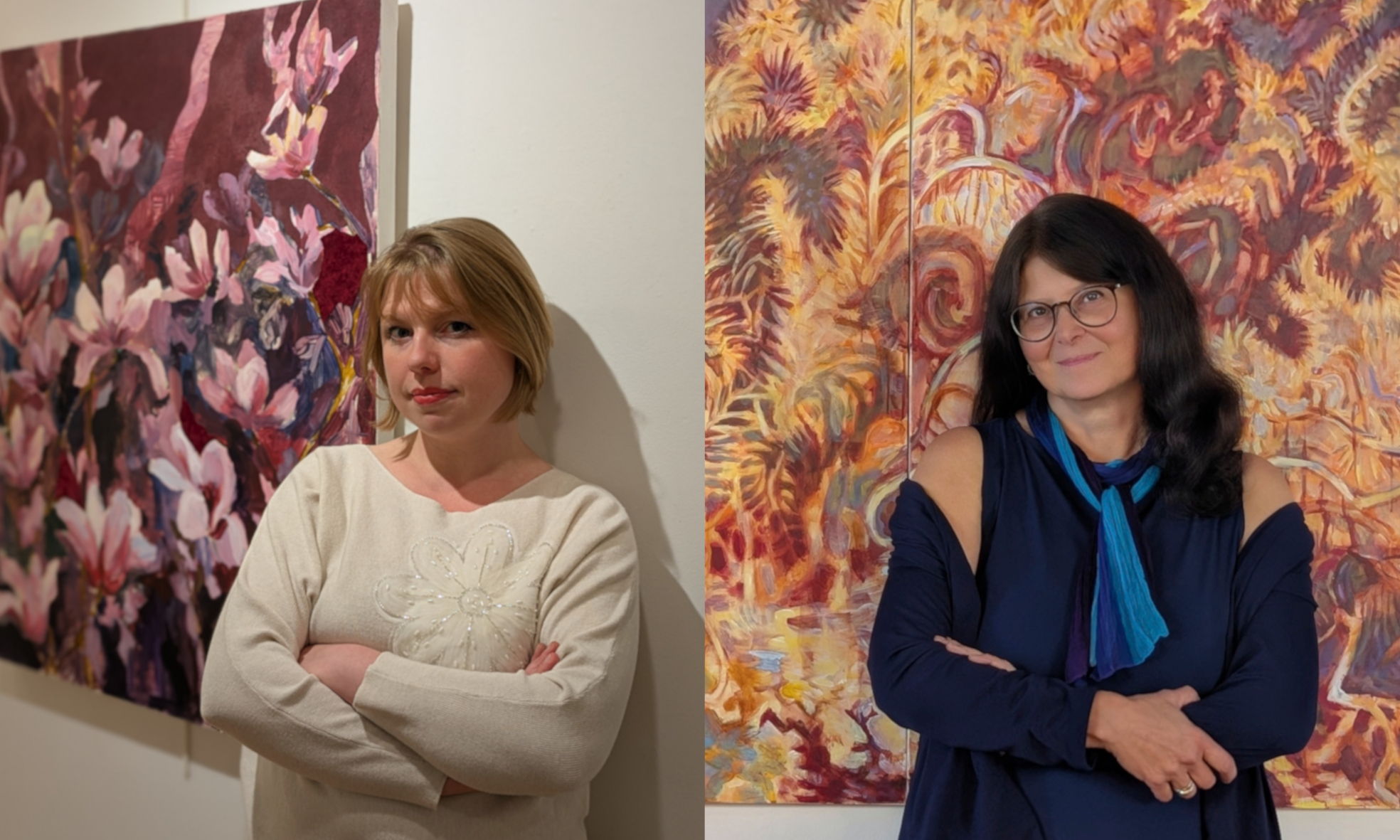
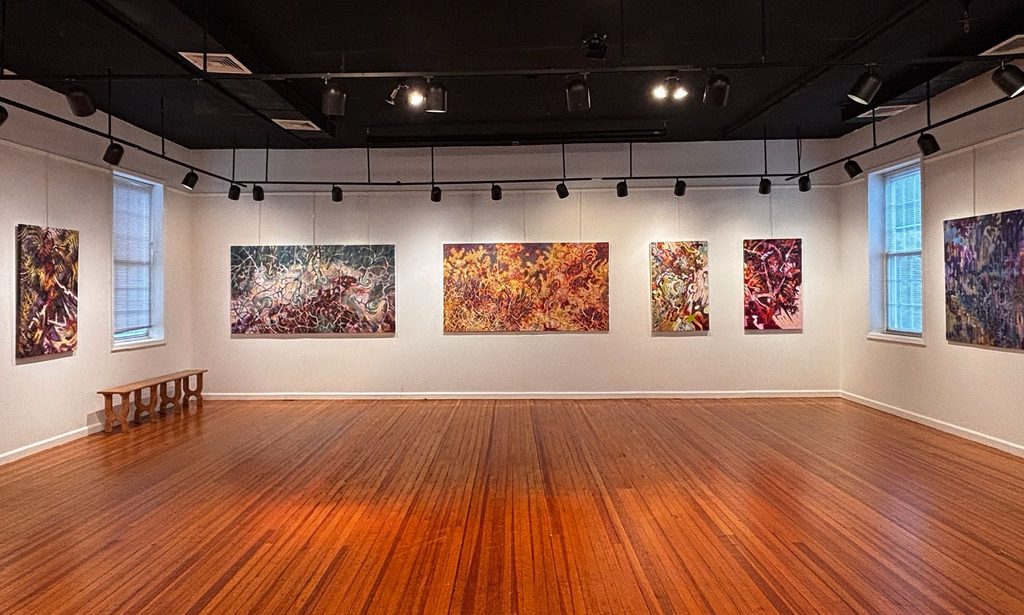
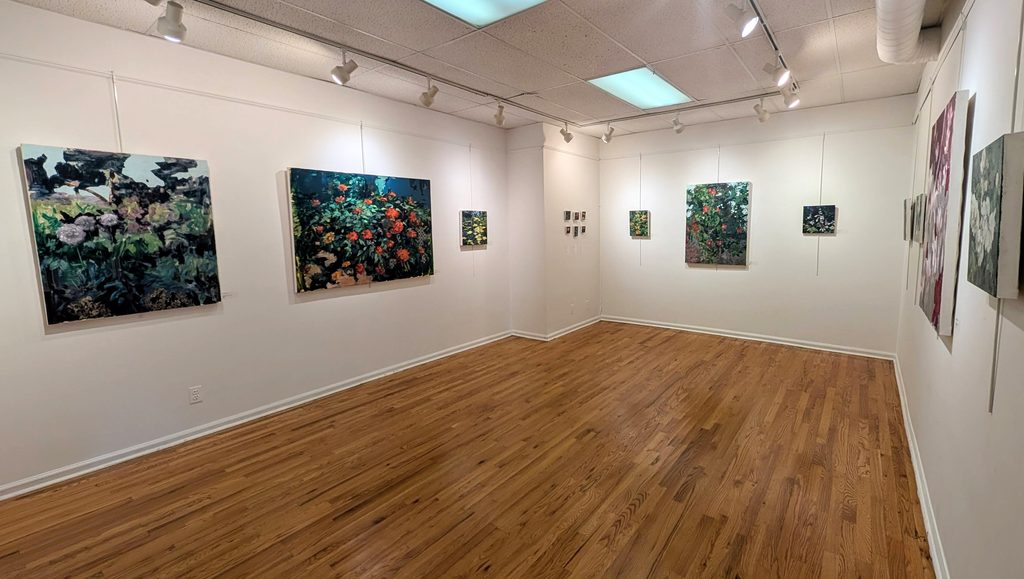
New Jersey’s Watchung Arts Center brings together two distinct solo exhibitions: Entropic Flora by Anna Shukeylo and Symphony for the Unnoticed by Tatyana Kazakova. Both artists weave between abstraction and realism to create intimate portraits of nature, but their styles and vantage points diverge in dynamic ways. Kazakova fills the sprawling upstairs gallery with large drawings and paintings that pack the space with thickets, foliage, and tangled old growth, inviting viewers to contemplate the boundaries between wild spaces. In the lower gallery, Shukeylo’s compositions erupt with vibrant gestural brushmarks that capture fleeting moments of blooming flowers at their peak splendor. In this conversation, Kazakova and Shukeylo discuss their work, studio practices, and thematic vantage points, revealing the very different paths they take to create their images of nature.
Your two solo shows inhabit two floors of the same building. They both explore nature and the passage of time, but from very different perspectives. How do you see your works speaking to each other across the space?
TK: Anna’s exhibition is on the first floor, filled with energy and life, with flowers in full bloom. On the second floor is my exhibition about the things we pass by without noticing: weeds, withered flowers, and impenetrable thickets. When we come to a wall of tangled plants, what happens next? Do we turn back, or do we try to find a way through? I am interested in the moment when we stop and really look at what is in front of us, like the edge of a field before a forest or the edge of a pond where water meets land. At this moment, we have a choice: forward or backwards. For me, this is both an ending and a beginning, frightening and beautiful. The two exhibitions form a conversation about the forms that nature can take on. Sometimes it catches our attention, and we cannot help but notice its splendor. Other times, we have to be the ones to discover what it may hide within its depths.
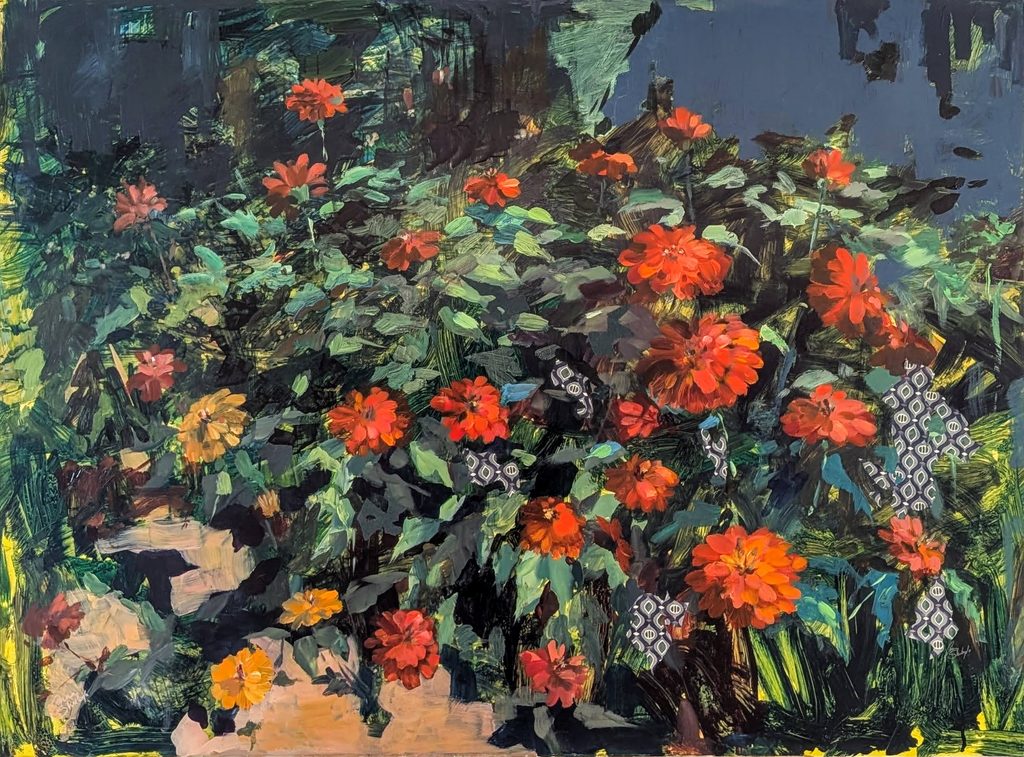
AS: I’m very much caught up in the process of actual painting, and my subject matter is typically the peak beauty of the nature I’m describing. In a way, we are working with the same subject but on a completely different timeline. My time tends to run fast, and the paintings are a moment in that time that passes within seconds.
The imagery in both of your bodies of work exists in the space between abstraction and natural observation. How does this interplay serve your work? How do you decide when to lean towards representation and when to let an abstract rhythm take over?
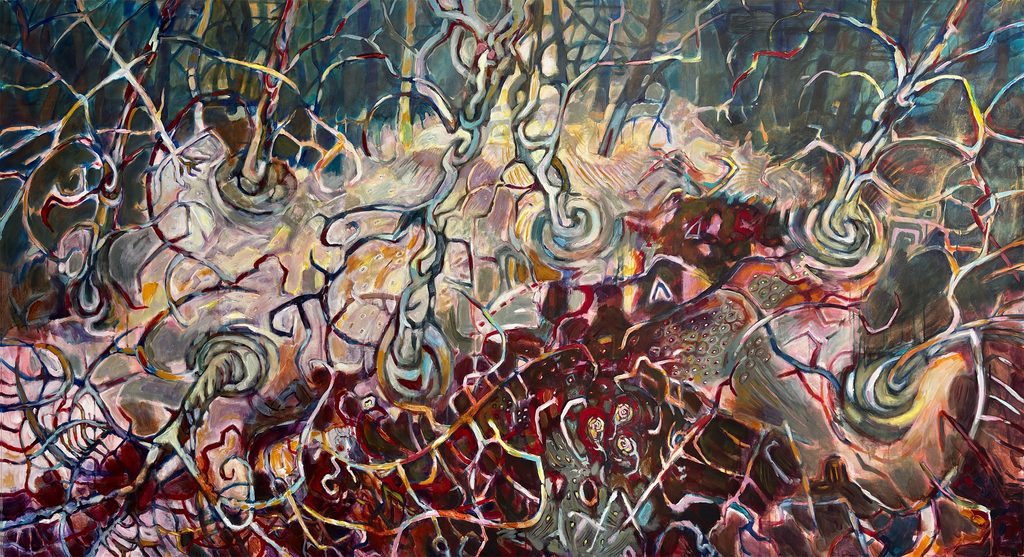
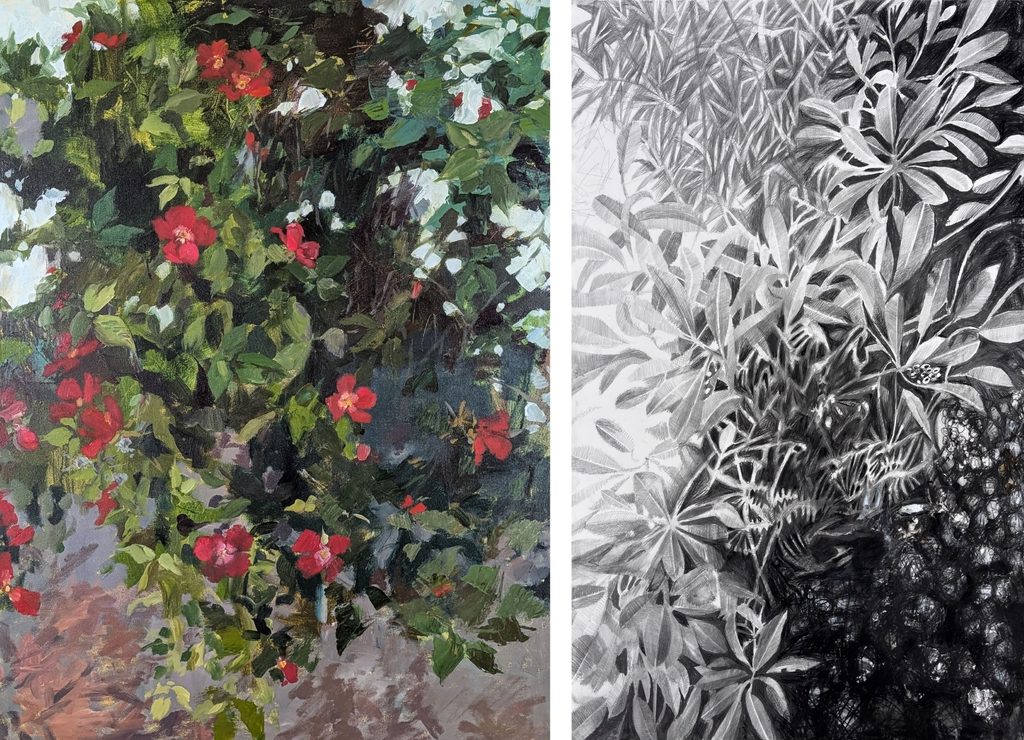
TK: I observe elements of nature, trying to remember their combinations, rhythms, and interactions. I make many sketches, and then in my studio I create new compositions from imagination. In this exhibition, my paintings are more abstract, while the drawings appear more realistic. The detailed elements of plants become abstract forms that create a game between black and white.
AS: For me, the abstraction is fundamental in the actual brushstroke. There’s something about stepping back and seeing a real, tangible image, but stepping up and completely losing it. I appreciate gesture, the immediacy of paint, and the network of abstract strokes that construct a realistic illusion.
Anna, you’ve mentioned that your floral paintings emerged during a dark winter as a way to organize chaos and ground yourself. Tatyana, you’ve spoken about painting as a necessary, daily practice for survival and healing. How does the physical act of making art anchor you emotionally and philosophically?
TK: I lost my son three years ago in an accident while he was hiking in the mountains. The only remedy I have found is making art. It helps me survive. I am constantly in the creative process, moving into my inner world and exploring it more deeply. Working in series allows me to stay with a subject and explore complex themes from different perspectives. The physical act of making art grounds me and gives me a strong connection to the physical world. I use my body, and this helps me stay in the present moment and quiet the unnecessary noise in my head. The paintings in this exhibition are part of my healing process.
AS: The series came out in the middle of a cold winter, and almost felt like a longing for spring, I had a deep desire to drown myself in the pleasure of painting flowers, but also organizing the absolute chaos of brushstrokes, a chaos I actually can control. I’m a full-time working parent of two little kids and have about a hundred side projects, so that’s the chaos I usually can’t control, but in my studio it’s very different and deeply grounding. I find painting both meditative and incredibly satisfying: diving deep into the magic of color theory, the tactility of the material (especially the frosted Mylar I often work on), and the mere pleasure of an image appearing out of nothing. This particular series of work is the most cheerful, allowing me to completely escape my own head.
I am interested in the differences between your two studio practices. Tatyana, you seem to maintain a steady, daily meditative routine, working and reworking your images over many months until they become complicated tangles of interlocking forms. Anna, you create your dense natural imagery by working in intense bursts, harnessing your energy into expressive brush marks. Does your process in the studio mirror the natural cycles you are depicting?
TK: I spend most of my time in my studio. Every day, I bring something new to the paintings and add to them—sometimes adding small details, and sometimes completely destroying a part of what I have already done. I would not call this process meditative, because sometimes it is difficult and even painful. But it gives me a sense of meaning. In this process, I can be myself without being afraid of being misunderstood. The most meditative parts of my practice are sketching and drawing from observation. My work in the studio is not always calming, but it is important for me to maintain discipline in working daily. Otherwise, I feel that something is missing.
AS: You’re absolutely correct; I do focus on that bright, spontaneous moment in nature that only happens at peak bloom. It’s like the moment when the Sun goes down, and right before everything goes dark, there is a brilliant flash of yellow or pink light. That’s beautiful and breathtaking. I tend to be a fast painter, and the freshness and spontaneity are definitely part of my pursuit.
You each use a variety of different mediums to create your work. How do the physical materials you use serve the mood and themes of your work?
TK: I follow what my work demands. Different materials allow for a wide range of expressions. I often use relief paste to create texture and depth. In my drawings, I use charcoal, ink, collage, graphite, and black pencils of different thicknesses and softness. This allows for a range of expressions, from quiet to loud within a restrained color palette. This exhibition also includes works in acrylic on paper and canvas.
AS: I’m trained as an oil painter, so I often use acrylic that way; however, I heavily rely on the versatility of acrylics. So in some cases I can go from watercolor techniques to oil-like techniques, and blend in mixed media without thinking twice. The introduction of fabric is all about pattern and regularity, which stands in contrast to the eclectic floral depictions in my paintings. Fabric serves as a visual anchor within the work.
Entropic Flora by Anna Shukeylo and Symphony for the Unnoticed by Tatyana Kazakova, curated by PE Pinkman, at Watchung Arts Center, 18 Stirling Road, Watchung, NJ 07069. On view October 3rd through 24th, 2026, Mon, Tue, Fri, Sat: 11AM – 1 PM.
Make your tax-deductible donation today and help Art Spiel continue to thrive. DONATE
About the artists:
Tatyana Kazakova is a multidisciplinary artist. She graduated from Moscow Printing Academy with an MFA in Visual Arts and continued her education at Muthesius University of Fine Arts and Design in Germany. As a member of the Russian Professional Artist Union and Bundesverband Bildender Künstler in Germany, she took part in several artist residencies. During these years, she actively worked with painting, woodcut, and etching. Tatyana greatly values intuition and spontaneity in her work and incorporates conceptual thinking into creative design projects.
Tatyana has been living in the US since 2000 and worked as a full-time senior graphic designer until 2020. Now Tatyana is a full-time artist and works in a studio in Montclair, NJ. In 2025, she held solo exhibitions at Grover House Gallery in Caldwell, NJ, and IMUR Gallery in Jersey City, NJ, and participated in several group exhibitions, including one at the Hunterdon Art Museum. @tatyana.kazakova.art
Anna Shukeylo is an artist, writer, educator, and curator working and living in the New York Metropolitan area. Her paintings have been exhibited nationally and internationally. Besides Entropic Flora, solo exhibitions include Kean University, NJ, Manchester University, IN, and CSA Gallery, Philadelphia, PA. She has taken part in numerous group shows that include Auxier/Kline, Equity Gallery, and Stay Home Gallery, among others. She is a full-time lecturer at Kean University in Union, NJ. She has written for Artcritical, Painters on Painting, Whitehot Magazine, and ArtSpiel. Her curatorial projects include The Clemente, The Arts Council of Princeton, and James Howe Gallery, among many others. @annashukeylo
About the writer: Claire Haik is a painter and printmaker whose work focuses on natural imagery and an examination of the hidden processes that exist beneath the visual exterior of nature. Haik received her Certificate of Fine Art in traditional oil painting from the Pennsylvania Academy of Fine Art and a Master’s degree from the School of Visual Arts in New York. Haik currently writes for Art Spiel, highlighting visual arts in Philadelphia. She has taught painting and drawing at Kean University, Wayne Art Center, Chester Springs Studio, and Fleisher Art Memorial . Her work has been exhibited in galleries throughout the Northeast. @clairehaik