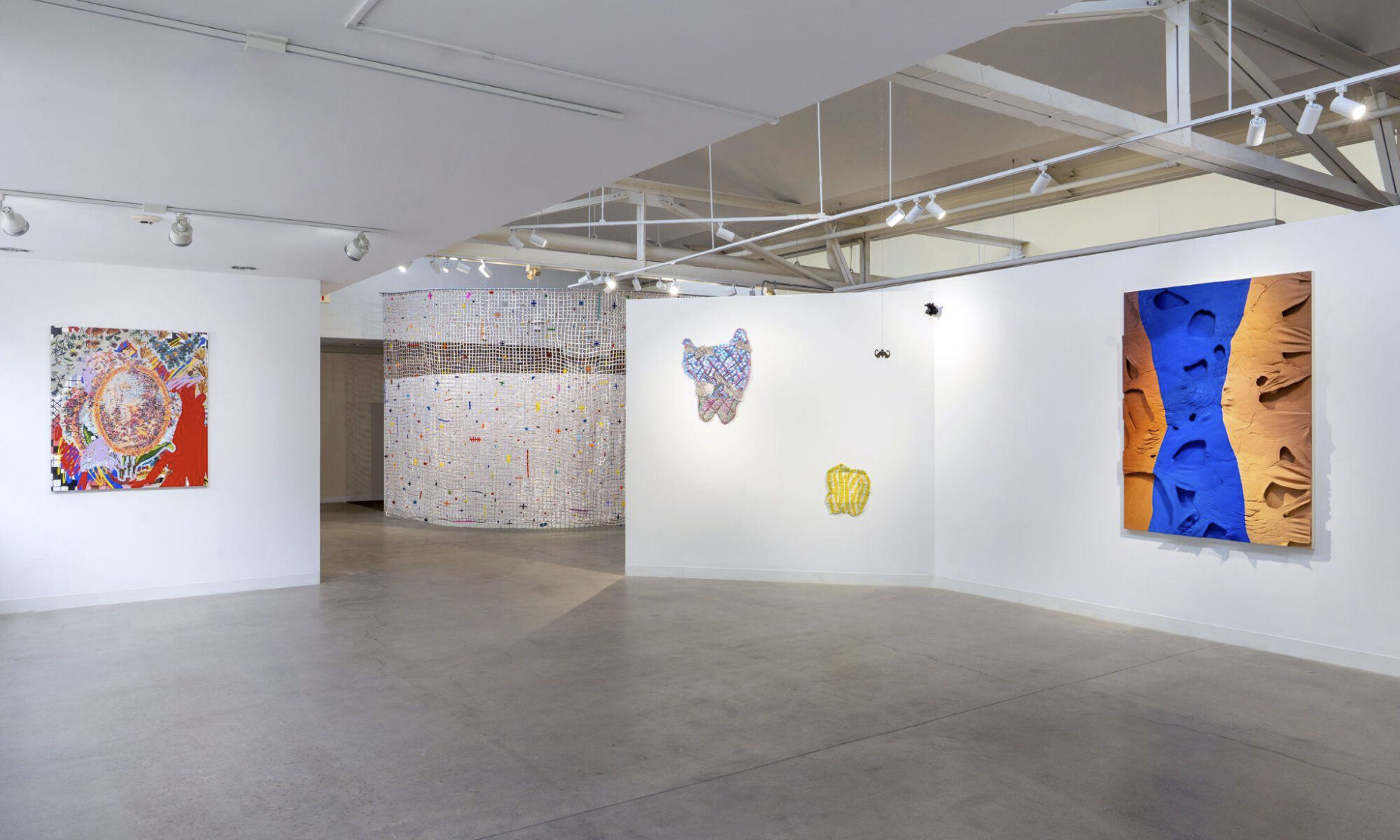
For Cutaway, curator Olivia Baldwin worked the way she does in her own studio — building from the ground up, beginning with the artists rather than a theme. She had followed Eleanor Anderson, J Stoner Blackwell, Lucy Kim, Kirstin Lamb, and Hai-Wen Lin for years, looking for where their materials might overlap and where they might productively rub against one another. Meeting with them, a shared concern surfaced: how each artist asserts and then loosens the limits of an object, a body, a pattern. Their means are strikingly varied — discarded plastic bags, cross stitch, dyed silk and chain, cast flounder and teeth, a kite pitched toward the upper windows — bound by saturated color and touch. The body recurs throughout, rarely pictured, more often left as a trace in the material. Baldwin discusses the show’s bottom-up beginnings, what its materials share, and the withholding behind its title.
The Women’s Studies Research Center is a place where scholars and artists work alongside each other, and the gallery is meant to reflect what the Scholars are doing. How did this show come together in that setting, and what was the vision you started with?
Our spring and fall shows in the Kniznick Gallery often focus on a particular issue, body of research, or history, especially where women and non-binary peoples’ experiences have been dismissed, misunderstood, overlooked, or understudied.
For this show, I wanted to take a bottom-up approach, more like the way I piece material together in my own studio practice. Cutaway began with the artists: Eleanor Anderson, J Stoner Blackwell, Lucy Kim, Kirstin Lamb, and Hai-Wen Lin. I had followed their practices for years and was eager to find the sweet spot between overlap and friction (materially speaking), to invite dialogue without constraining the work within too tight a framework.
In meeting with the artists, one of the key themes that emerged was how they assert and unravel boundaries and structures: the limits of an everyday object, the relationship to a cast or a record of a body, the intended use of a pattern or key, how an object is or has been understood in relationship to gender, and the tension between what something is, how it appears, and how it’s made.
The materials vary widely: discarded plastic bags, cross stitch, dyed silk with jewelry chain, cast flounder and teeth. You name vibrant color and tactility as what they share. Did you find that connection in the work, or were you looking for it from the start?
I have an affinity for color and am always excited to see artists using materials in innovative ways. I’m interested in how a work’s materiality contributes to its overall content and meaning. I knew the exhibition would have these characteristics, but I wasn’t certain how these aspects of the work would intersect.
While I was conscious of some relationships, others emerged when we installed the show. For example, Lucy Kim’s repetition of cast, almost chalky teeth of different scales in Tomorrow, Tomorrow (Leeza Smiles) echoes in J Stoner Blackwell’s white repetitive, rhythmic mark-making in Neveruses (Gaslog Gladstone). The tactility of their works guides us toward Kirstin Lamb, Eleanor Anderson, and Hai-Wen Lin’s work.

Anderson harnesses play and improvisation in works that are meticulously crafted: insulation, found objects, seed beads, fused glass. Where do you see the improvisation surviving in the finished pieces?
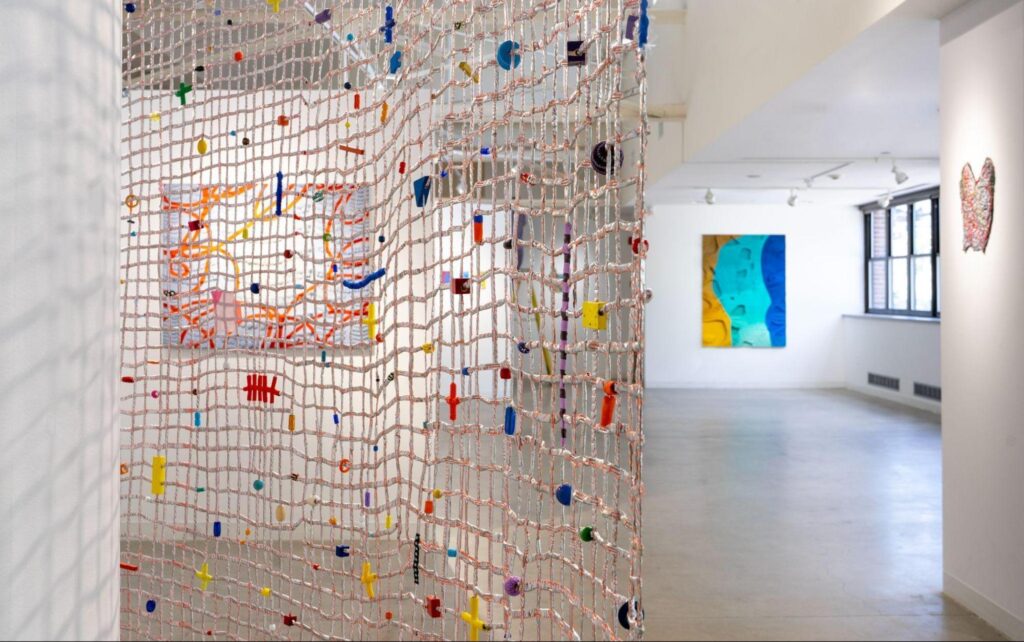
From afar, Eleanor Anderson’s Silver Lattice reads like a luminous, brightly accented silver net. But upon closer inspection, the form and its individual sections reveal themselves to be subtly irregular. Coupled with her diagonal orange stitches, these deviations mark the work’s hand-sewn construction. The form is adorned with colorful objects, both things Eleanor has found, like bits of fabric and small wooden blocks, and things she’s made, including densely beaded areas and colorful, translucent glass objects that mimic cross-sections of the silver structure.
The experience of encountering Silver Lattice, which stretches 22 x 10 feet and parallels the curve of a gallery wall, is one of discovery. Eleanor introduces the work’s brightly colored elements at varied intervals, inviting us to notice something new each time. The play and improvisation within the work isn’t merely a result of her process, but an invitation for the rest of us to look, notice, and participate in it.
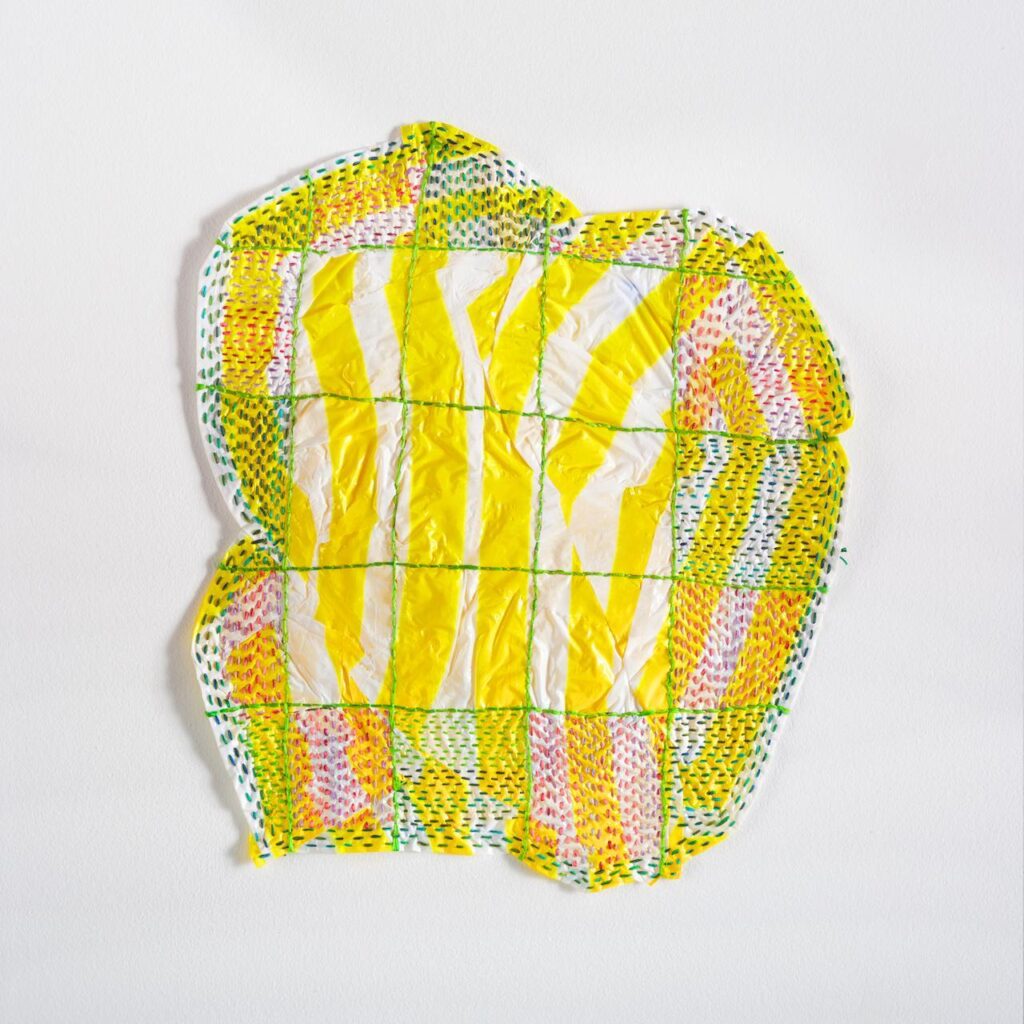
Blackwell’s work considers the gendered hierarchy of artistic media, and Lamb’s amplifies feminine lap craft and the political legacy of the decorative arts. Given Kniznick’s feminist mandate, what is the show arguing about where craft sits?
The show celebrates materiality, technique, and chance-based approaches to making, craft and otherwise. The work, and by extension, the show, acknowledges these histories and rejects binary, reductivist ideas about media and gender. The artists knowingly critique and disrupt these ideas, as in Kirstin Lamb’s use of cross-stitch patterns in her paintings, which simultaneously evoke digital pixels, and J Stoner Blackwell’s pointed use of plastic bags (garbage for some) to critique parallel material hierarchies. The show argues for an expansive relationship to material and craft.
A few years ago, J Stoner Blackwell gave a great interview on this subject for Vitamin T: Threads and Textiles in Contemporary Art, which you can access here.
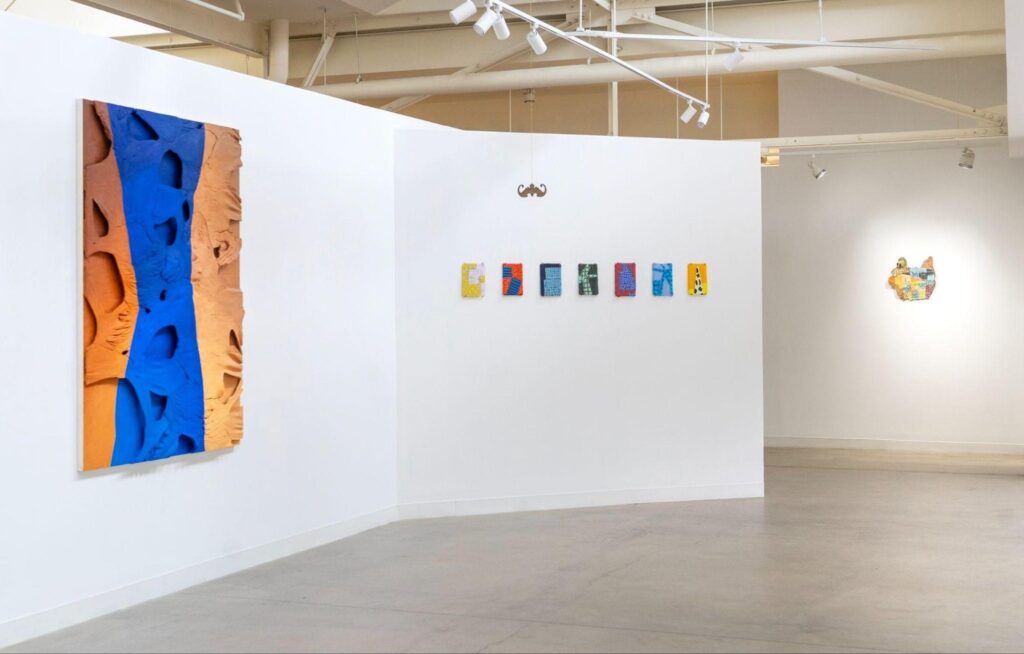
Kim casts flounder, teeth, and people. Blackwell’s are “lumpish, androgynous painting-objects.” Lin “borrows the vocabularies of garments” to “make refuge for errant bodies.” The body is present everywhere in this show and almost never pictured. What draws you to that?
When we invite materiality into the work, we invite bodies into the work. The materials the artists use, their histories and contexts, how they manipulate them, and how both artists and viewers relate to them physically inform how we engage with the work. At times an artist’s idea requires direct representation, but often, a material can act as a stand-in. Hai-Wen Lin’s October 8th 2:56-3:56 pm Wicker Park; a picnic together // we probably shouldn’t feed the sparrows records the presence of a body while simultaneously inviting participation through the hovering kite line, like an outstretched hand.
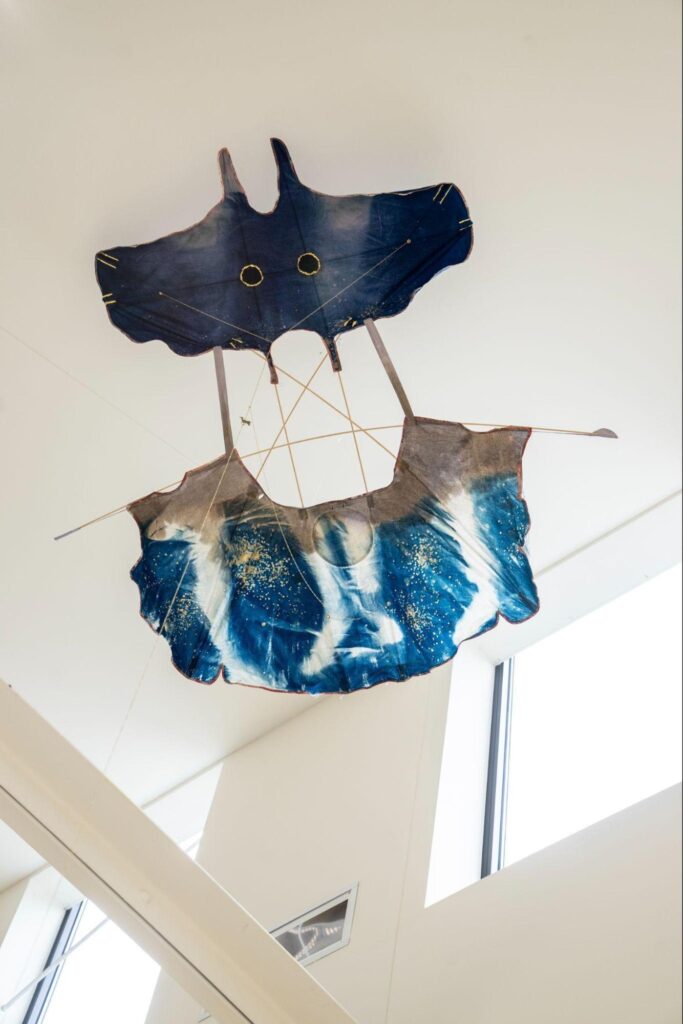
Lin’s kites are held by sky, and their material lists include wind, green grass, and hungry sparrows. How did the two of you handle bringing that work indoors?
From my first encounter with Hai-Wen Lin’s kites, I was moved and eager for the opportunity to show their work in the Kniznick. The gallery is housed in a former parking garage with a lofted area and upper windows, which we’ve underutilized in previous shows.
We were lucky that Hai-Wen could join us for the installation, and they were excited about suspending the kite next to the upper windows, from as high a point as possible within the gallery. It wouldn’t carry off quite the same way without the view of the sky and the natural light. While some elements of the work’s making are not physically present in our space, the work holds and records this context, just as its cyanotype records a body in the sun.
Hai-Wen has exhibited their kites in many contexts, including their current solo exhibition at the Museum of Art and Design, on view through October 4, 2026.
How did you arrive at the title, and what do you mean when you say that Cutaway withholds as it reveals?
Tal Pemstein, our 2025-2026 Louise Weinberg Arts Intern, who now lives in New York, was very involved in building the show, and the title came through our discussion of the artists’ use of negative space and how it performs and connects. I liked the idea of an intentional omission or gap, as well as a kind of sub-plot or diversionary element within the work, like a cutaway in a film. Many of the works hold several simultaneous investigations, declaring aspects of their construction while concealing others.
Cutaway, Eleanor Anderson, J Stone Blackwell, Lucy Kim, Kirstin Lamb, Hai-Wen Lin. On view through September 24, 2026, in the Kniznick Gallery, Women’s Studies Research Center, Brandeis University
Cutaway considers boundaries, containers, and their relative permeability. Eleanor Anderson, J Stoner Blackwell, Lucy Kim, Kirstin Lamb, and Hai-Wen Lin respond to and resist materiality, bodies, and consumption. Marked by vibrant color and tactility, their works convene with the sky, cast biological media, translate craft methods onto unlikely substrates, and embrace distortion. In the divots and recesses, these works direct us to the tensions inherent in both structures that support and distances that offer protection. Cutaway withholds as it reveals.
Cutaway is on view through September 24, 2026, in the Women’s Studies Research Center’s Kniznick Gallery, Brandeis University (515 South Street, Waltham, MA 02453). An artist talk and closing reception will take place on the final day of the exhibition, September 24. Visit https://www.brandeis.edu/wsrc/ for complete details. Cutaway is curated by Olivia Baldwin.
Instagram handles: @eleanor_anderson_studio, @jstonerblackwell, @slucykim, @kirstin.lamb, @hai_wen_lin, @brandeis_kniznick_gallery, @brandeis_wsrc, @oliviaebaldwin
About the curator: Olivia Baldwin is an artist, curator, and educator based in Providence, RI. She curates exhibitions for Brandeis University’s Kniznick Gallery and teaches studio art at Babson College. She has contributed to numerous artist-run projects and has held teaching positions at colleges throughout New England. She exhibits her work nationally and internationally, and holds an MFA from the University of Connecticut.
About the writer: Etty Yaniv is a Brooklyn-based artist, writer, curator, and founder of Art Spiel. She works in installation, painting, and mixed media, and has shown her art in exhibitions across the United States and abroad. Since 2018 she has published interviews and reviews through Art Spiel, often focusing on underrecognized voices and smaller venues. More about her art can be found at ettyyanivstudio.com and on Instagram @etty.yaniv