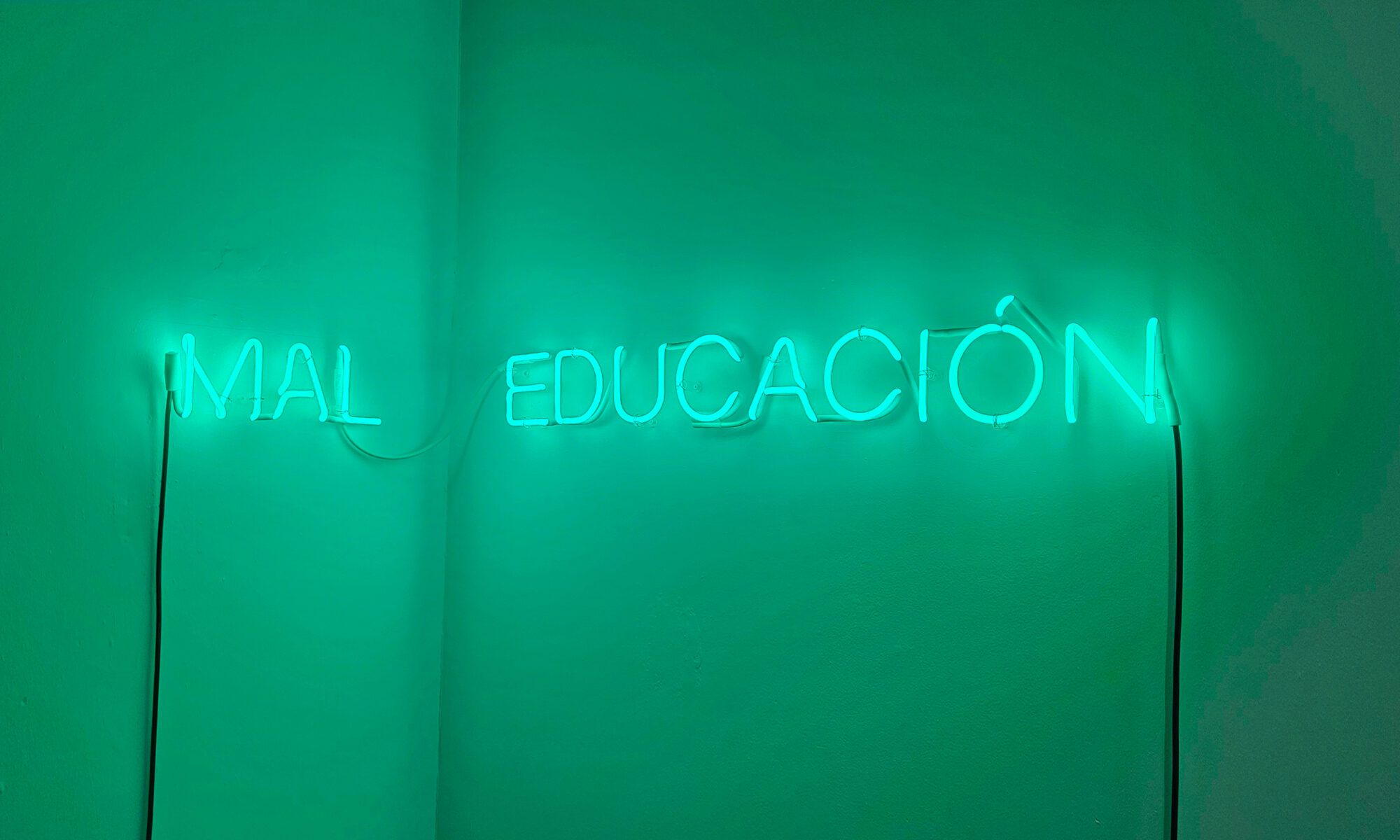
Crossing the threshold of the “Veieja Escuelera” exhibition at Synesthesia Gallery, Brooklyn, visitors find themselves enveloped in an eerie haze of green light that is both sensuous and disquieting. This is not the only defamiliarizing element since the floor is carpeted with artificial grass and the light works encompass phrases in multiple languages. On Anne Katrine Senstad’s turf, nothing is what it seems at first sight. A Norwegian artist living between New York and Oslo, she uses light both environmentally and sculpturally to expose the interdependence between perceptual experience, cognition, and ideological beliefs. Her practice engages both with the phenomenological inquiries of minimalist artists such as Dan Flavin and Robert Irwin and with the tongue-in-cheek propositions of Conceptual artists such as Joseph Kosuth and Bruce Nauman who have paired neon light with text to invite reflection on the function of art as sign.
The playground aesthetic of the exhibition is counterbalanced by phrases inscribed in neon light which command visitors’ attention right away. One text work in the far-right corner of the gallery reads MAL EDUCACIÓN (2023), a misspelling of Pedro Almodvar’s 2004 film title La Mala Educación (Bad Education), which condemned the debilitating impact of institutions of power. This is the work most closely aligned with the exhibition title, which evokes a misspelling of the Spanish phrase “old school” and alludes to a Mexican cartel with financial ties to the military industry. Through these purposefully imprecise linguistic terms, Senstad subverts the role of language as a normative tool used for reinforcing the status quo. Misspelled and split between two walls, the neon sign Mal Educación invites disjunctive readings, calling upon viewers to consider circumstances under which education stifles growth rather than cultivates it.
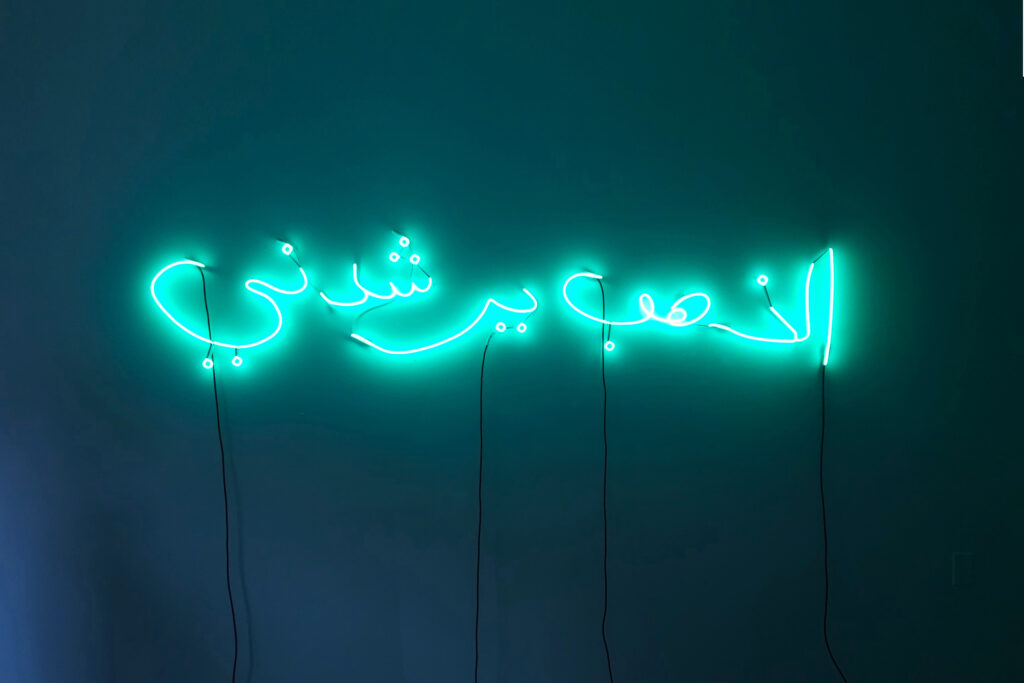
Questions about how we choose the values which serve as the backbone of our societies also arise in conjunction with Senstad’s neon text Gold Guides Me (2023), an Arabic version of an earlier work engaging with truisms. Looming large in calligraphic script, this work underscores the materialistic values prevailing in neoliberal societies while also referencing Islamic cultures where green is associated with Prophet Muhammad’s vision of paradise. Since 2014, the artist has been hard at work on Capitalism in the Public Realm, a research project which confronts viewers with ethical questions about social values. Avoiding didacticism, Sensad does not offer any answers of her own. She astutely suggests that “all that glitters is not gold,” just as the green glow of her neon works can prove both inviting and controlling. After a while, one becomes so used to it that it no longer feels alien but comforting. This should tell us something about how manipulative socio-political circumstances end up being taken for granted.
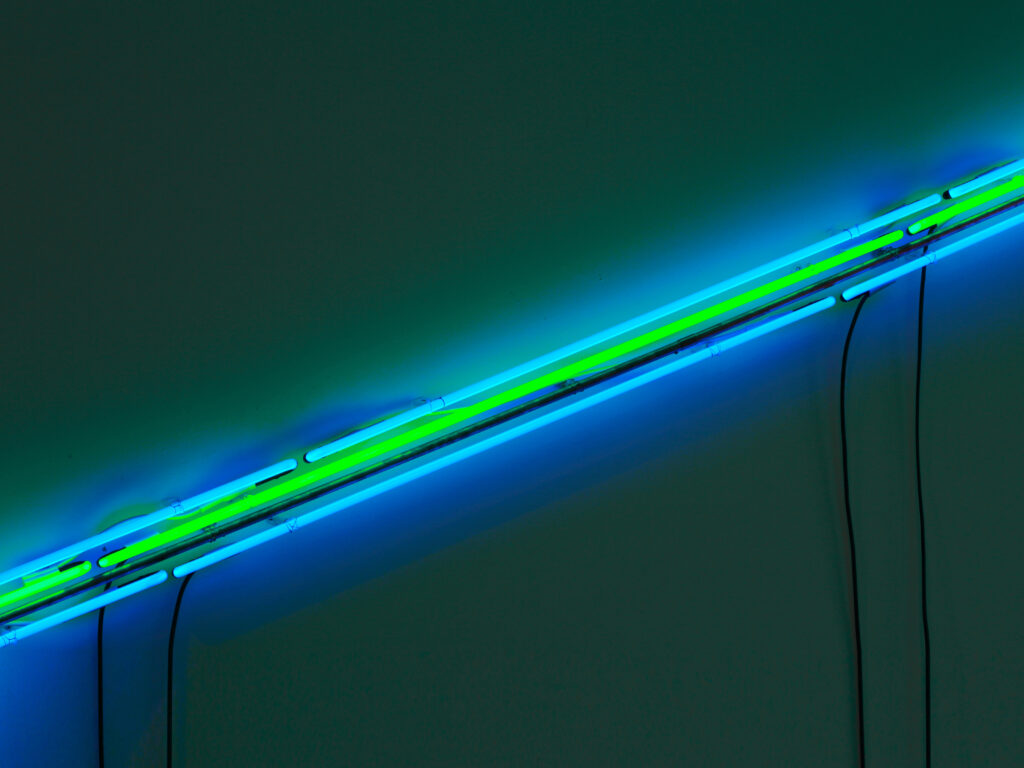
Senstad’s confounding perceptual and cognitive scenarios stimulate viewers to reassess how they foresee and become acclimated to change. Ascension/Descension Graph no. 11 (2026) calls attention to the quantification of wellbeing and prosperity based on stock market fluctuations. A diagonal set of luminous lines stretches across the wall, making one wonder whether it points to a declining or ascending trend. It is a deceptively simple sculpture featuring two sets of horizontally aligned light blue neon tubes which flank a central double axis composed of green neon tubes and a copper bar. The coupling of elements with different properties in the middle — one infused with light, the other reflective of it, one glowing with internal energy, the other one offering the potential for transmitting energy through its conductivity — reminds one of Joseph Beuys’s juxtaposition of contrasting materials.
Senstad’s work resonates with Beuys’s ideas in additional ways. Just like him, she finds materialistic culture to be the enemy of creativity and transformation. Senstad invited several musicians (e.g., Laura Wolf, MAYSUN, Bruno Coviello, MV Carbon, Sokio, Chuck Bettis, Gianni Intilli, Dawood Kringle) to perform in the exhibition space in order to explore the conditioning qualities of sound in relation to light. Through such partnerships, Senstad creates lines of information and energy transmission which address multiple sensory registers and trespass the boundaries between physics and metaphysics. Her neon portals set on cinderblocks also create opportunities for liminal encounters.
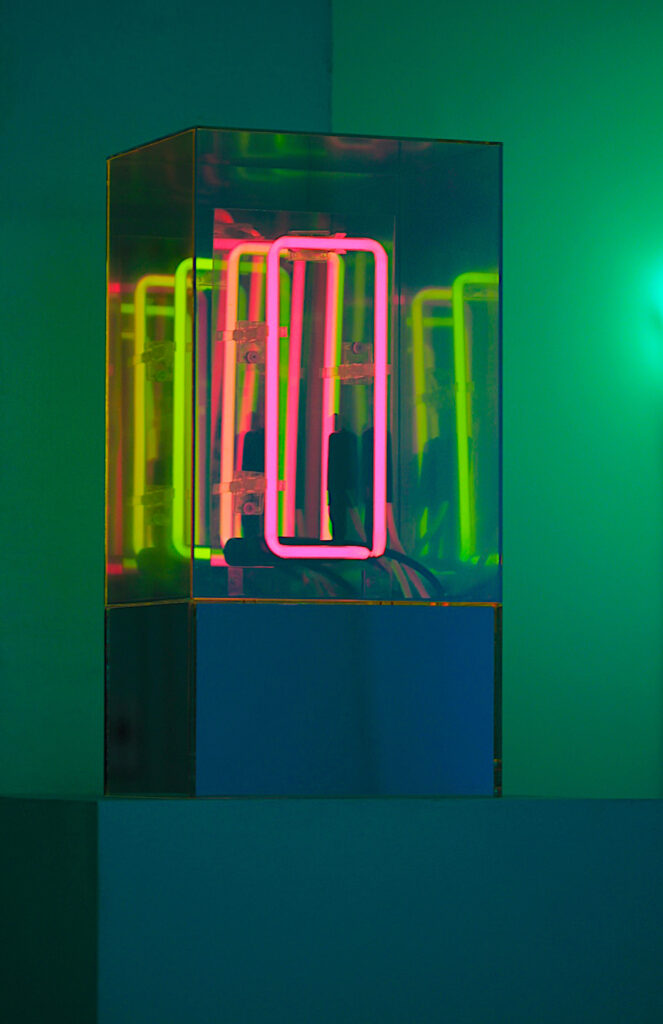
Part of a series called Portal for Perpetuity initiated by Senstad in 2019, these intimate sculptures infuse additional colors into the pervasively green environment. The neon portal located close to the window features two red neon rectangles encased in a mirror box, whereas the one standing across from it features parallel pink and yellow neon rectangles. Like Yayoi Kusama’s infinity mirror chambers, these works captivate visitors who gaze into their space and take selfies with them. The colorful neon tubes inside the portals form rectangular shapes with rounded corners, which bear striking similarities to the format of cellphone screens. Senstad alerts the public to technological traps enrapturing our attention while nonetheless suggesting that there are still ways to look beyond them. One of her exhibition mottos is William Blake’s statement about the self-enclosures people build to guard themselves against metaphysics. The other one is Walter Benjamin’s comparison of capitalism with “a religion which recognizes neither truce nor redemption.”
In “Veieja Escuelera,” artworks embodying aspirations towards peering beneath the visible surface of things are placed face to face with artworks underscoring the influence of materialistic values. Standing or sitting between them on the artificial grass covering the gallery floor, visitors are presented with ambivalent messages resulting from misspellings and multicultural references. During a summer marked by a World Cup championship, which has brought to the surface persistent intercultural tensions played out on the soccer field and beyond, the ludic and ironical implications of Senstad’s green environment cannot be lost on visitors. Will we be able to develop modes of perception which are not anchored around false expectations fueled by materialistic and antagonistic cultures? Or will we succumb to a descent into an increasingly chaotic world teetering on the brink of self-destruction? The artist seems to hold out hope that we can still retain agency and fuel societal change through defamiliarizing creative acts.
Make your tax-deductible donation today and help Art Spiel continue to thrive. DONATE
About the writer: Cristina Albu is an Associate Professor of Contemporary Art History at the University of Missouri – Kansas City. Her current research focuses on crossovers between art, technology, and cognitive sciences. She is the author of Mirror Affect: Seeing Self, Observing Others in Contemporary Art (Minnesota University Press, 2016) and co-editor (with Dawna Schuld) of Perception and Agency in Shared Spaces of Contemporary Art (Routledge, 2018). Her writings have appeared in scholarly anthologies and journals (e.g., Afterimage, Camera Obscura, Leonardo). Albu’s most recent book project is Affect, Intimacy, and Ecology of Mind in Neurofeedback Art (forthcoming with Routledge, 2026).