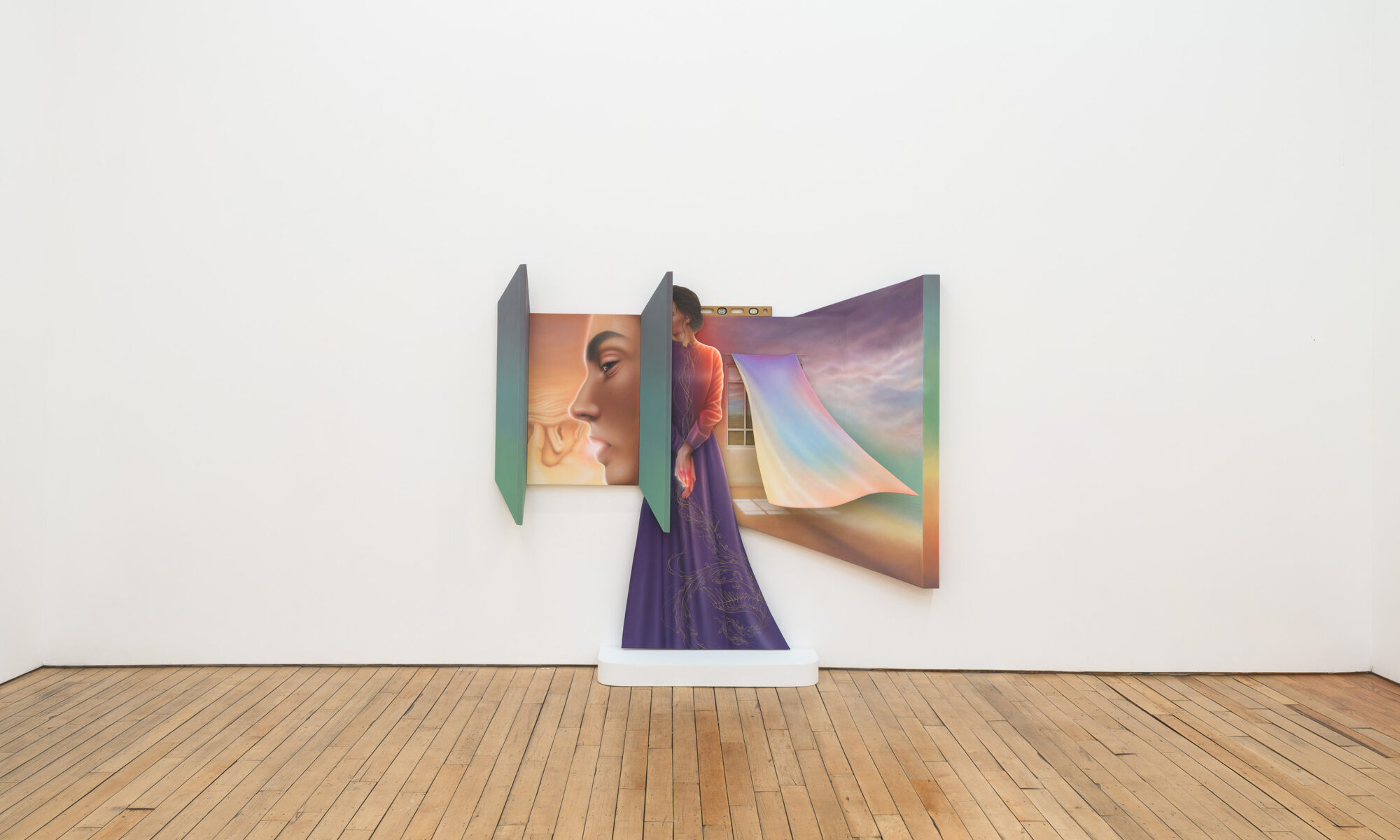
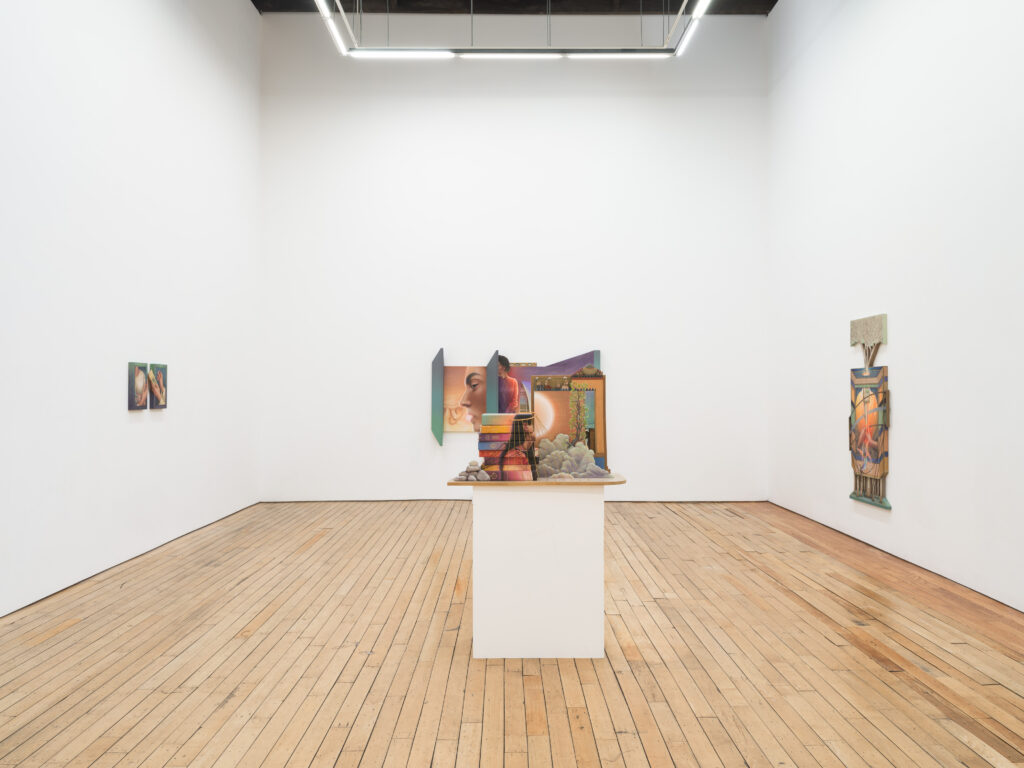
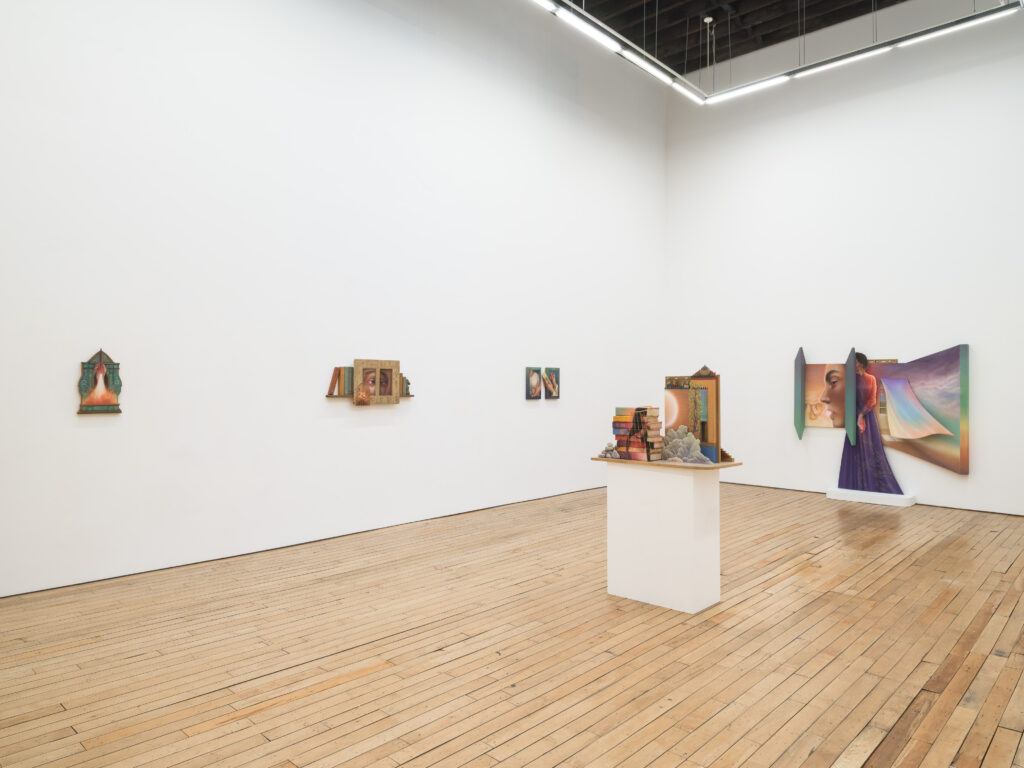
Altarpieces—historically sites of devotion, revelation, and spiritual certainty—become something altogether different in Arghavan Khosravi’s What Remains, currently on view at Uffner & Liu through July 2. The exhibition brings together large-scale wall works, a freestanding sculpture, and an intimate suite of new altar-inspired paintings that continue Khosravi’s ongoing exploration of the forces that shape women’s lives under political, cultural, and religious systems of control. Drawing equally from Persian miniature painting and medieval European iconography, the artist constructs layered worlds where architectural structures become psychological spaces, symbols migrate across histories, and moments of resistance emerge within conditions of constraint. Rather than offering resolution, the works linger in states of suspension—between freedom and captivity, memory and displacement, devotion and doubt.
The exhibition coincides with Khosravi’s inclusion in the Aldrich Decennial at The Aldrich Contemporary Art Museum, a survey highlighting artists who have shaped the state’s recent history. Across both presentations, Khosravi’s work engages questions of power, agency, and survival through richly layered visual narratives that collapse distinctions between past and present, personal experience and collective history. We spoke with Khosravi about the origins of the Altar Series, the role of personal narrative in this new body of work, and how What Remains reflects her ongoing investigation into the structures that continue to shape contemporary life.
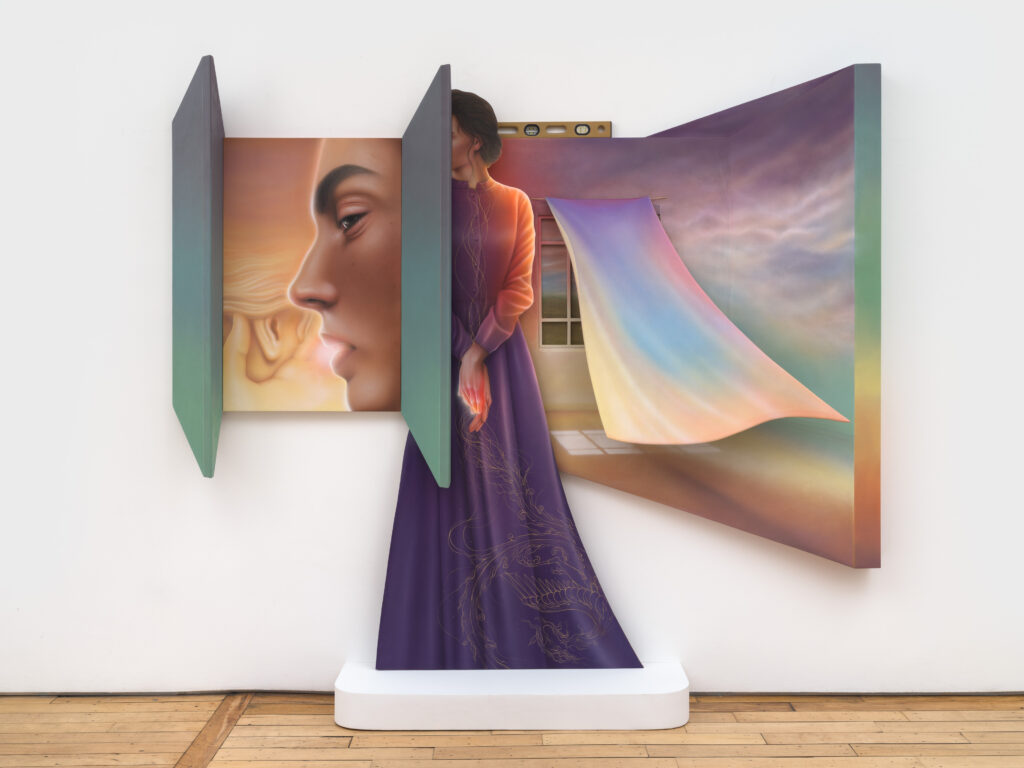
Your works often occupy a space between painting, sculpture, and architecture. Could you walk us through the physical construction of a piece — from its initial conception to the final object — and how decisions about hinges, compartments, mirrors, or protruding elements shape the meaning of the work as much as the painted imagery itself?
My creative process usually starts with looking at a lot of source images. Over the years, I have realized that I am more creative when my mind is in a reactionary mode, rather than when I am facing a blank canvas. I usually go through a wide range of sources: Persian miniature paintings, medieval and Renaissance paintings, contemporary art, fashion photography, and sometimes even images that appear in my social media feed.
Usually I have a concept, a mood, or a feeling in mind. Sometimes it is very vague, and sometimes it is more concrete. Then, while I am looking through images, I wait to see which image sparks something new that connects with what I already had in mind.
From there, I make several sketches and try different compositions. At that point, the work is still two-dimensional. Then I start thinking about whether the piece has the potential to become a multi-panel or three-dimensional work, and whether it needs compartments, hinges, mirrors, protruding elements, or other structures.
Once I have a clearer idea of the shaped panels and what I want to paint on each form, I begin fabricating the wooden structure. After that, I move into the painting process. Even though the work often begins from a planned sketch, I keep making decisions as I go. During fabrication and painting, I may adjust, add, or deviate from the original plan. So the final work comes out of that back-and-forth between the first sketch, the physical structure, and the painting itself.
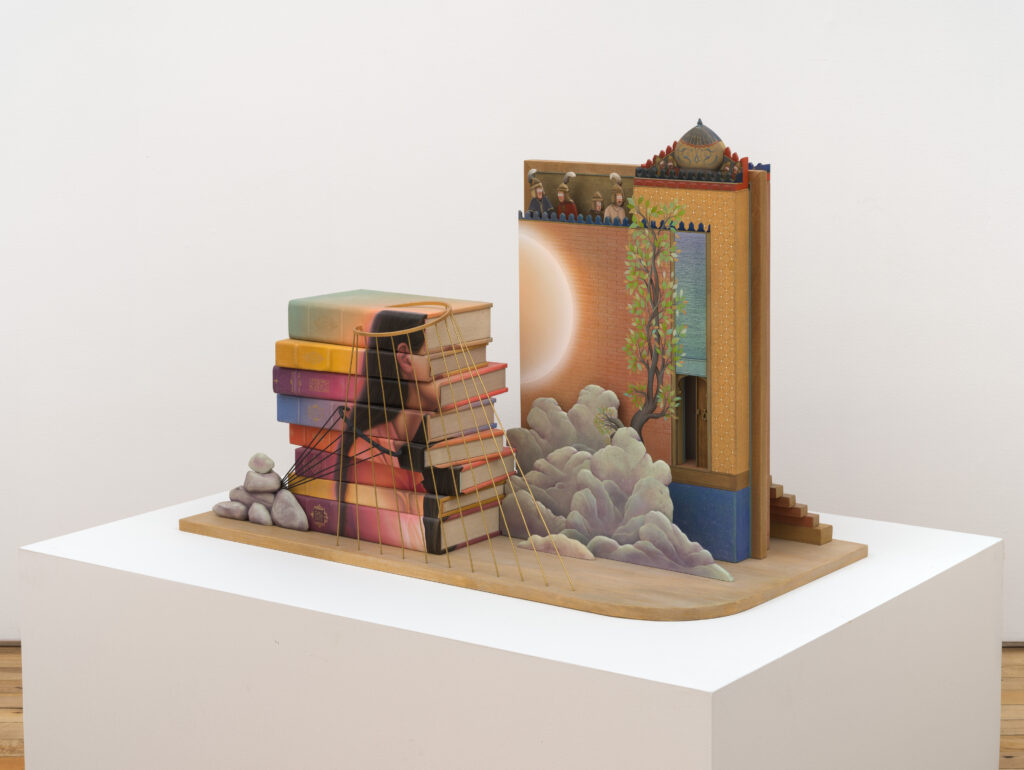
In recent works, you’ve incorporated found materials ranging from mirrors and book pages to contemporary objects like AirPods. What draws you to these readymades, and how do you think they function differently from painted symbols? Do they act as interruptions, anchors to lived reality, or perhaps as bridges between personal memory and collective history?
The use of found objects, or wood cutouts that mimic found objects, started more when my paintings moved from a flat surface into three-dimensional structures. Once the work started occupying space, I had to find ways to almost paint in space.
For example, if I have several layers and I want to draw a line from one panel to another, the most logical way for me to do that might be to use an actual cord, rope, or chain. In that sense, those materials are not just decorative additions. They become part of the drawing and part of the structure.
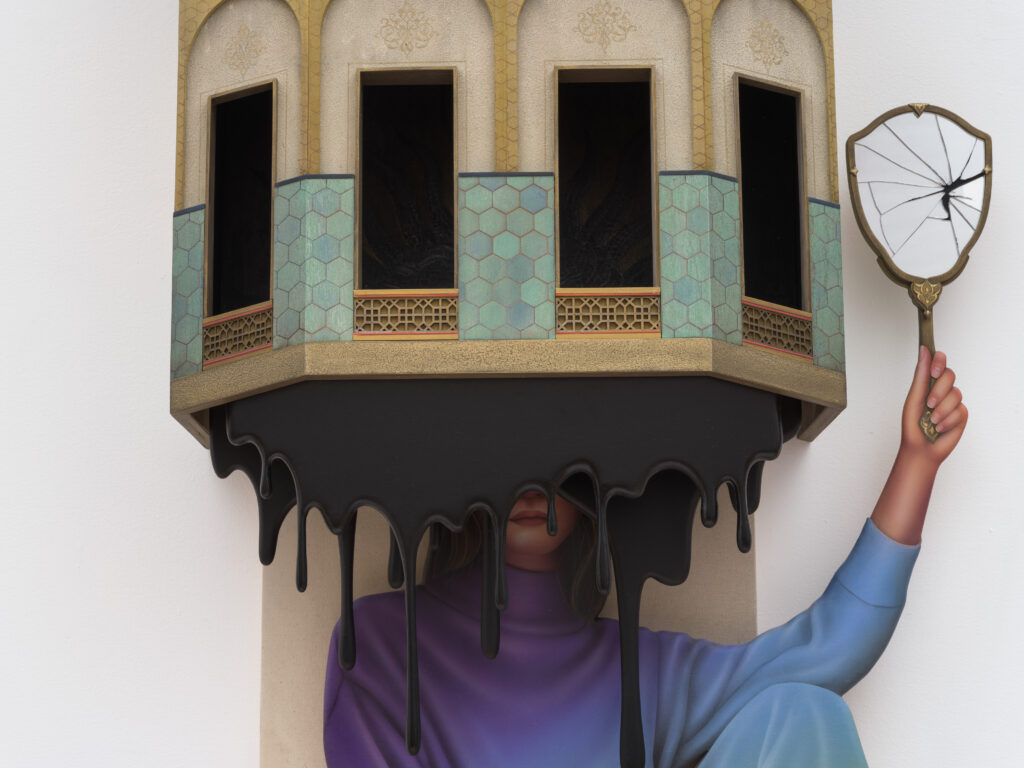
The same thing happens with mirrors. If I feel that a piece needs a reflective surface because I want the viewer’s face to become part of the work, then I use an actual mirror, often a broken one. In my paintings, faces and bodies are often cropped, obscured, or interrupted by other structural elements. The broken mirror lets the viewer experience something similar: they enter the work, but in a fragmented way.
88 x 26 1/2 x 7 3/4 in, 223.5 x 67.3 x 19.7 cm, photo courtesy of Uffner & Liu, New York
I am also interested in how a contemporary object can bring the work into the present. If I use something like an AirPod or headphone next to imagery that comes from Persian miniature painting, Greco-Roman sculpture, or medieval painting, that object creates a bridge between different times. It anchors the piece in the contemporary moment.
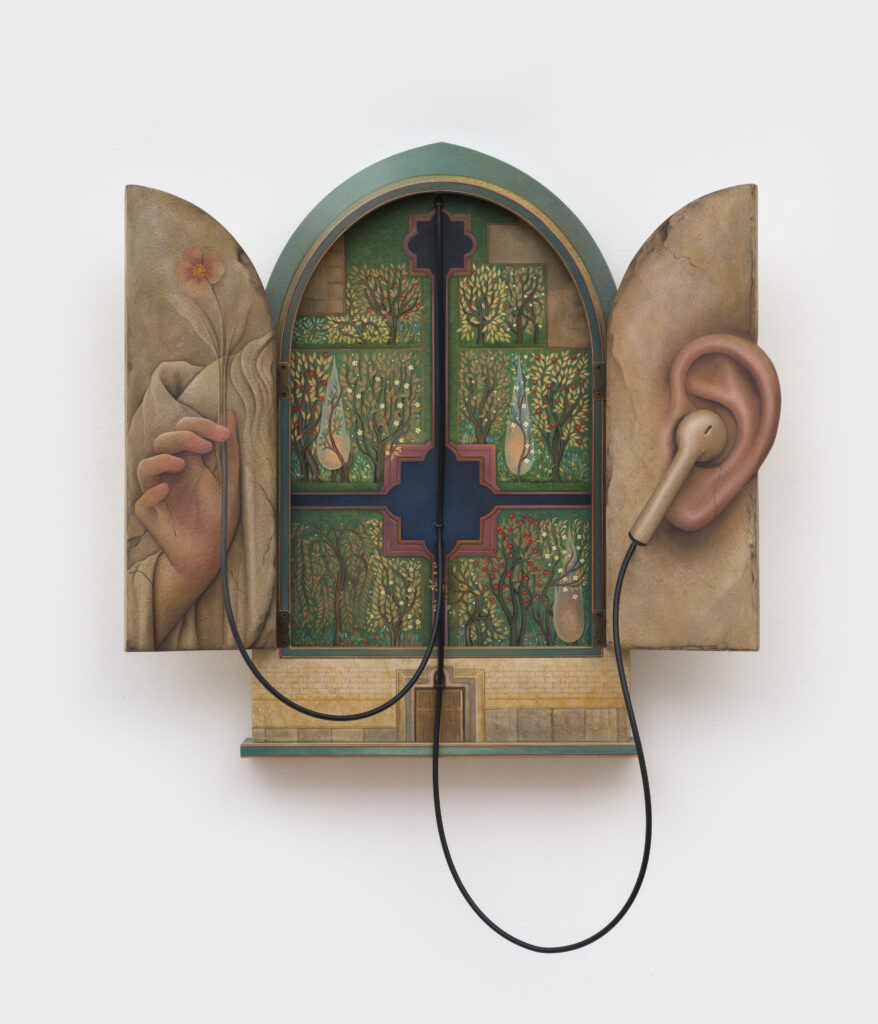
19 1/2 x 20 x 2 in, 49.5 x 50.8 x 5.1 cm, photo courtesy of Uffner & Liu, New York
You received your artistic training in Iran before continuing your education in the United States. Looking back, how do you think these two artistic and cultural environments continue to coexist within your work? Are there moments when they feel in harmony, and others when they remain in tension?
In Iran, I studied and worked in graphic design and illustration. My formal academic training in painting happened later, after I immigrated to the United States. So the two experiences were different not only because they happened in different countries, but also because I was studying different fields.
I sometimes think about how my work might have developed if I had studied painting in Iran. Because of censorship and limitations around freedom of speech and expression, I imagine I would have had to find more indirect ways to say certain things. Maybe the work would have looked different because of that.
In the United States, those limitations are not present in the same way, but another kind of complexity appears. You are no longer in that place, but you do not fully belong to the new place either. A part of you still belongs back home. I think many immigrants exist in that third space between their home country and their new home.
That feeling has entered my work in different ways. But at the end of the day, the constant is still me: my lived experience, the way I look at the world, and the way everything filters through me. That is what anchors the work, even when different cultural and visual references are present at the same time.
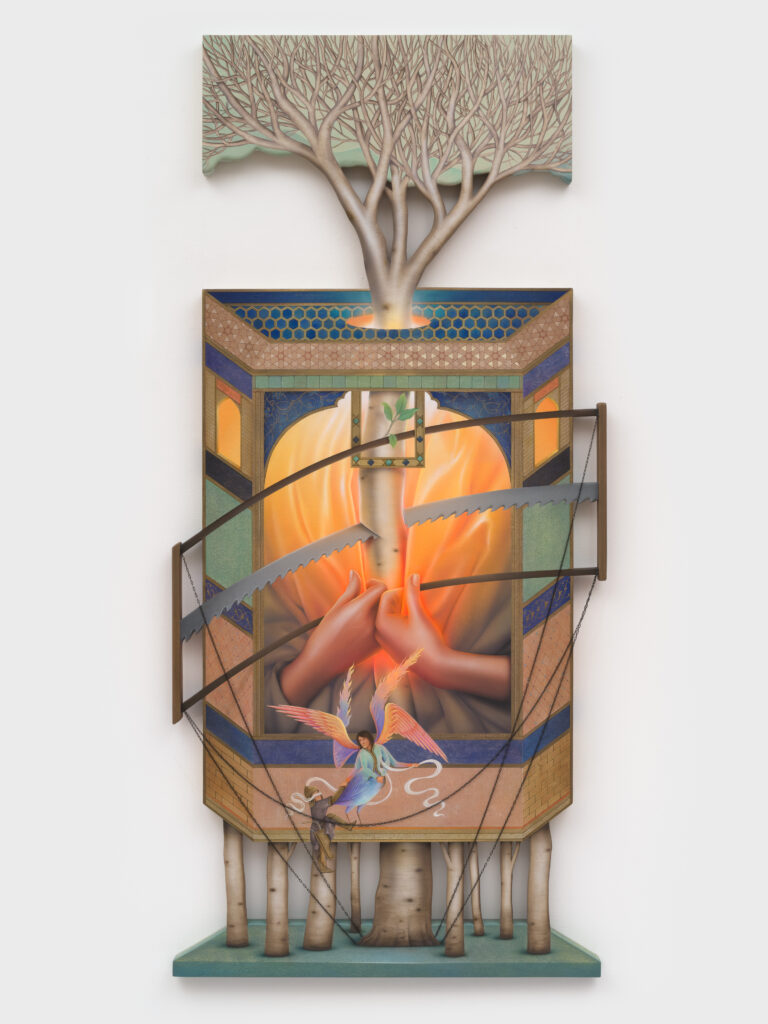
64 1/2 x 30 x 1 1/2 in, 163.8 x 76.2 x 3.8 cm, photo courtesy of Uffner & Liu, New York
Many of your works seem to inhabit a space between longing and displacement, particularly in their recurring depictions of architecture, domestic structures, and enclosed spaces. How has your understanding of “home” evolved since leaving Iran, and how has that evolution manifested itself visually in your work?
I think this connects to what I said in the previous answer about that third space. When I first immigrated to the United States, my memories and life experiences from Iran were still very fresh. My work was reflecting on things that felt more immediate and firsthand.
Over the years, because I was not able to travel back to Iran, my relationship to my homeland became more distant. I followed what was happening through friends, relatives, social media, and the news. So the distance was not only geographical. It also became a distance in time, memory, and psychological space.
Because of that, the work has become more inward and more internalized. The idea of home is no longer just about a physical place. It has become more like an emotional or psychological space. The architecture, domestic structures, and enclosed spaces in my work often come from that feeling. They can feel protective, but also restrictive.
I think the work carries the residue of both personal and collective experiences: the aftermath of growing up and spending much of my life under systems of power that tried to control the body, movement, and expression.
Although your work is not strictly autobiographical, versions of yourself frequently appear throughout it—whether through female protagonists, symbolic stand-ins, or literal reflective surfaces. Mirrors recur throughout the exhibition, physically inserting viewers into the work while also suggesting self-examination. What role does self-portraiture, in its broadest sense, play in your practice?
I do not consider my work strictly autobiographical, although each painting often starts from somewhere personal: a memory, a lived experience, or sometimes something I have absorbed on a more collective level. That is the point of departure. But the painting does not stay there. It expands from that starting point and hopefully touches on a broader experience.
So I would not call the works autobiographical, but they are personal at the start. Everything is still filtered through my own lens, so my lived experience definitely affects the outcome.
In terms of the female protagonists, I never use my own face as a reference. At the same time, I intentionally keep some characteristics close to my own race, gender, and age range. These figures are not portraits of me, but they can stand in for someone with similar experiences. Maybe they are close to alter egos, but not in a literal way.
That is also why their faces are often obscured, cropped, covered, or interrupted. Sometimes the face is visible because the expression needs to be part of the painting, but often I want the figure to move between an individual person and something more collective.
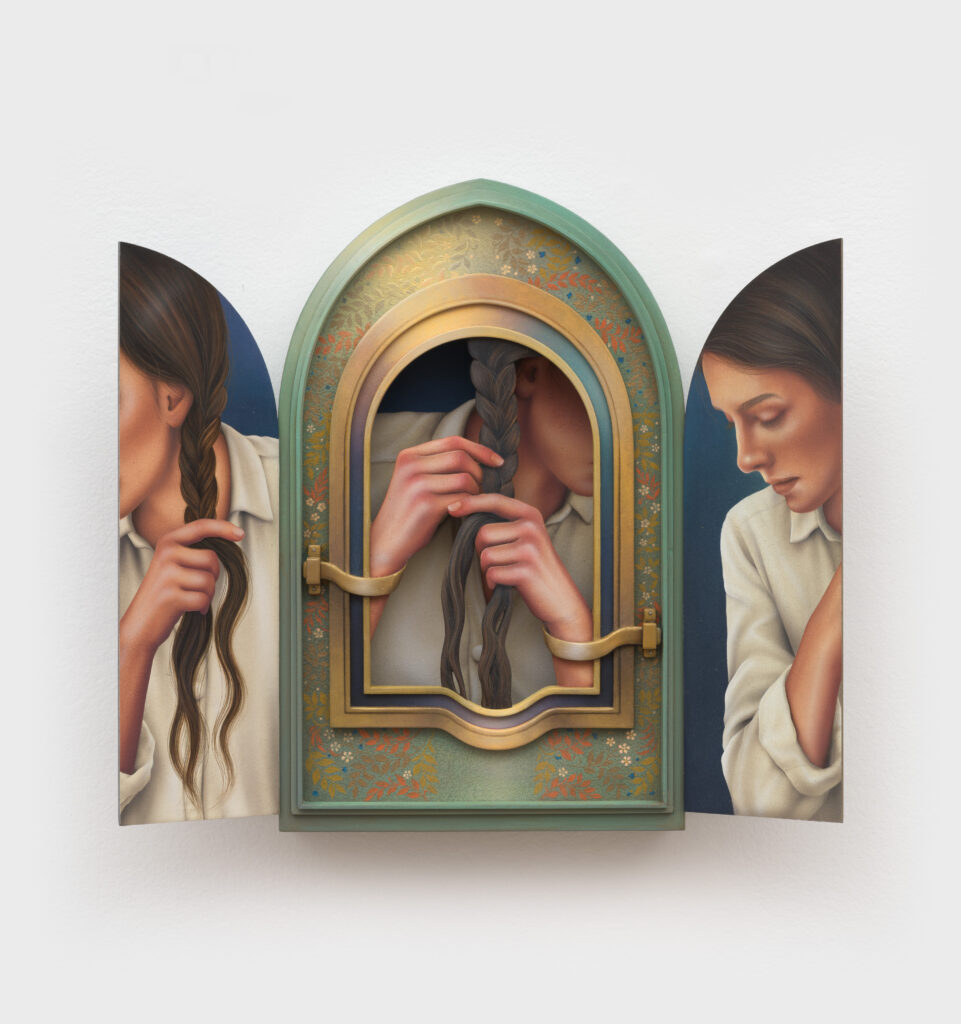
13 1/2 x 15 x 2 in, 34.3 x 38.1 x 5.1 cm, photo courtesy of Uffner & Liu, New York
Even when the female figures in my work are placed in confined or restricted situations, I do not want them to appear only as victims. I often try to give them a sense of calmness and control through their body language, and when their faces are visible, through their facial expressions. In some works, I also add sources of light at the tip of a finger, a hand, or near the mouth. For me, those moments suggest a kind of agency that is about to happen.
This is important to me because I want the figures to resist the situation that is imposed on them, rather than simply submit to it. I am also conscious of the way women from the Middle East are often represented in Western media as victims who need to be rescued. I do not want to cater to that idea. I also try to resist stereotypical visual codes associated with women from that region, whether through clothing, head covering, or other expected markers. I want the figures to feel closer to my own experience and mindset.
With mirrors, I am interested in bringing the viewer into that experience. The viewer becomes part of the composition for a moment, but usually through a broken or unstable reflection, not a clean one.
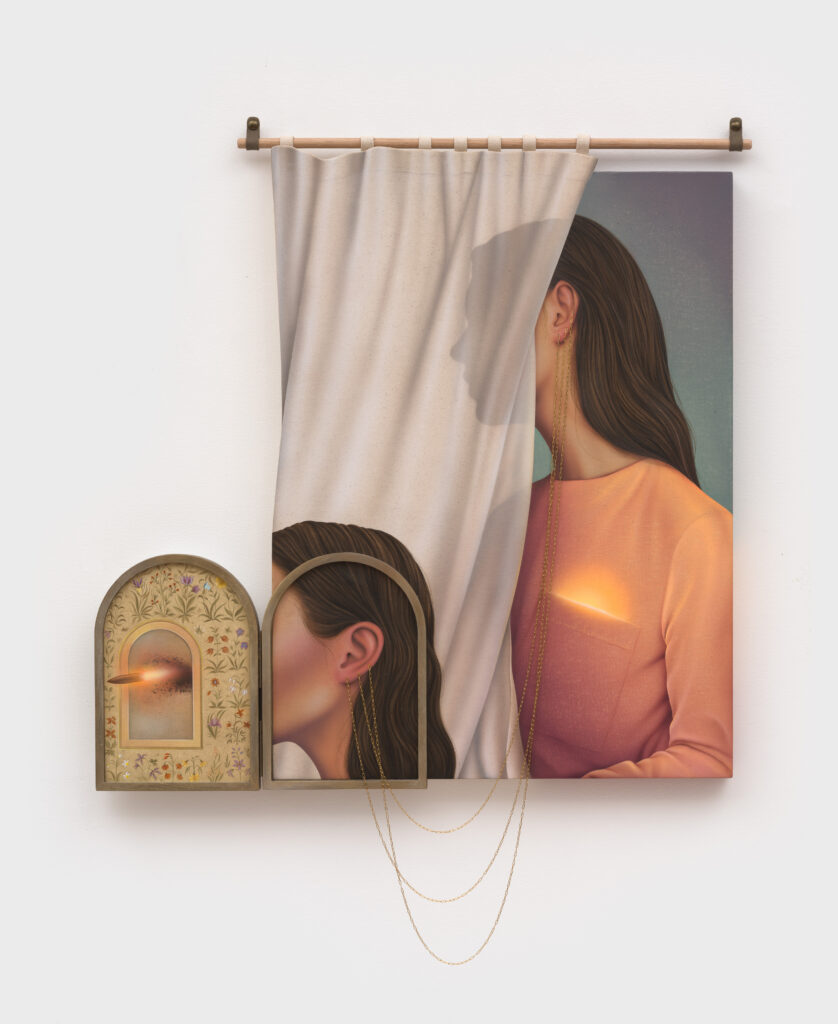
30 1/2 x 38 1/2 x 1 1/4 in, 77.5 x 97.8 x 3.2 cm, photo courtesy of Uffner & Liu, New York
The works in What Remains at Uffner & Liu feel particularly introspective, especially the new Altar Series, which you have described as emerging from your own psychological state rather than a predetermined narrative. What allowed you to approach these works differently, and what did this more intuitive, inward-facing process reveal that a more structured approach might not have?
The Altar Series started over a year ago, after I had made a body of work that was very large in scale and, by my standards, almost monumental and physically demanding. After that, I wanted to try something different. I often move between opposite poles in the studio, because it creates more dynamism and keeps the process interesting for me.
With these works, I wanted to look more inward rather than outward. I was thinking about the residue of being born and raised under a suppressive system, and spending most of my life in a place where power was trying to control movement, expression, and the body. Even though I do not live in that situation now and I am looking at it from a distance, those experiences are still etched in my psyche.
The format of the small altar pieces felt right for that. Historically, small altarpieces could be personal objects, sometimes carried by a person while traveling. I kept that intimate structure, but removed the religious connotation and brought it into a more secular context.
The scale also changed the studio process. Compared to the larger works, these pieces allowed me to move more quickly from a starting idea to a physical object. They did not need to begin with a fully predetermined narrative. They could begin from a feeling or mood, rather than a fully planned structure, and then develop through the process of making.
Your works in the Aldrich Decennial appear alongside a diverse group of artists working across generations and disciplines. Looking at the pieces you’ve included there in relation to those in What Remains, what continuities and departures do you see? Do they represent different facets of the same inquiry, or do they point toward a broader shift in your practice?
I see parallel concepts in both shows. Two of the pieces in the Aldrich Decennial are from the same Altar Series that appears in What Remains. I made them around the same time and with the same mindset, so they are very closely connected.
The larger piece in the Decennial also speaks to some of the larger anchor pieces in the Uffner & Liu show. So I do not see these two presentations as very different from each other, and I would not describe this as a broader shift in my practice.
Although much of the conversation around contemporary art remains centered on New York, you’ve built your practice while living and working in Connecticut. How has that environment shaped your work, and what role has the community of artists, writers, and institutions in Connecticut played in the development of your practice over the years?
I have been living and working in Connecticut for almost five years now, after a short period of having a studio in New York, and then working mostly from my living room during the pandemic. Connecticut is the longest I have ever lived in one place, so in a sense, the feeling of belonging has become a bit more concrete here.
The quietness and calmness of where I live have really helped me focus on my studio practice. Having a live/work situation has also helped me be more productive and enjoy the time I spend in the studio. This is also the first time I have had my own workshop, which has allowed me to build more complicated wooden structures and experiment in ways that I probably would not have been able to otherwise.
At the same time, I do not feel completely disconnected from New York. Especially after the pandemic, galleries and curators became much more used to communicating and doing studio visits online. So if you are not physically in New York, it does not necessarily mean you are detached from those conversations and connections. We also chose to live in Connecticut because New York is about a one-hour train ride away, so if there is an exhibition or event I want to see, I can go for the day and come back.
In terms of institutions in Connecticut, I think what the Aldrich is doing with the Decennial is very important. It amplifies the voices of artists who are not necessarily based in the expected art hubs, and it helps create a community for artists that would otherwise be harder to achieve.
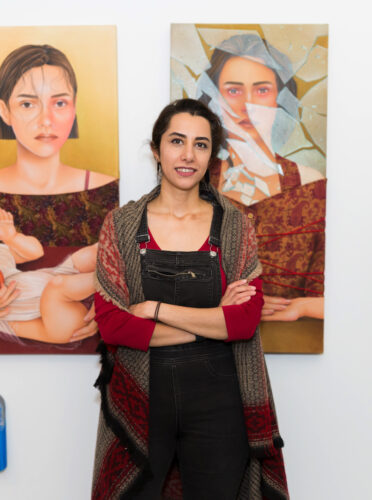
Courtesy Uffner & Liu, New York
What Remains at Uffner & Liu @uffnerliu
Featuring Arghavan Khosravi @arghavankhosravi
Runs through July 2, 2026