It has been over ten years since the last New York exhibition of the Chinese artist Zhang Huan, known for his edgy political performance pieces documented at the exhibition. What captured me on this visit was his ash paintings, which extended across the entire front hall of the gallery. It feels entirely appropriate that this social activist artist, who later turned to Buddhism, should exhibit these works in New York at such a tense moment. Ash, as a medium, touches on absolute destruction. It carries deep meaning in Buddhist practice, but these days it also pulls toward something harder to name: the daily accumulation of impure ash on the ground of cities being destroyed.
The ash works are created at Zhang Huan’s large Shanghai studio as communal productions. Each painting is generated from dry incense remnants collected in nearby Buddhist temples. These particles are sifted into multiple grayscale hues by a community of assistants who paste them onto a linen support to build up the final image. Zhang Huan directs this process through plans, drawings, and photographs, but the making is carried out by the group.
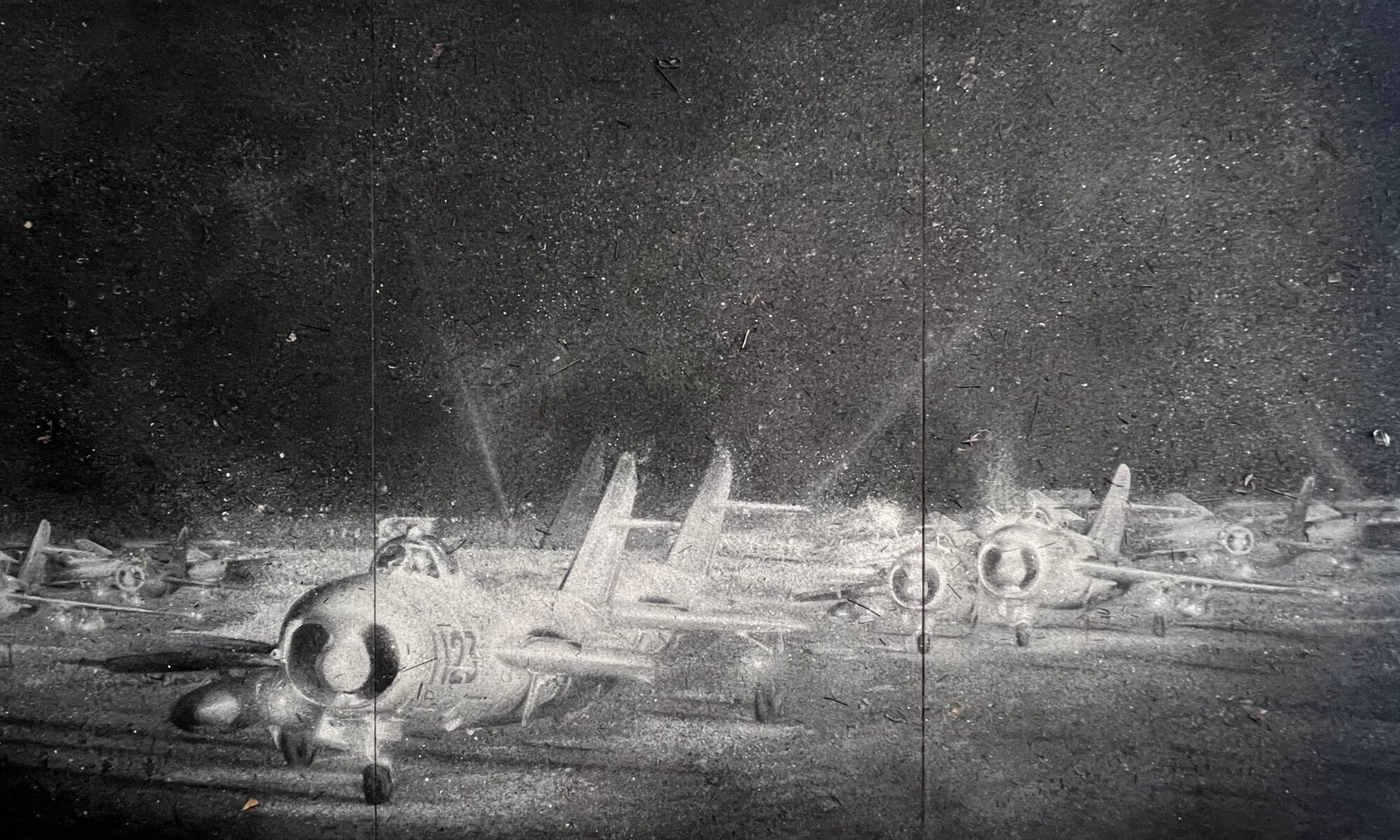
Three larger-than-life paintings anchor the exhibition — modest compared to works I have seen at Pace, yet still striking in their magnitude and in the degree of realism achieved entirely in gray. Night Vision (2011) is an enlarged rendering of a 1930s photograph from the artist’s collection: propeller planes standing at night in a quiet airport, searchlights aimed at the sky. The planes seem ominous, surrounded by lights flashing against the dark skies. Through Zhang Huan’s process, what was originally a documentary photograph becomes a monument to a past moment. Up close, the work grows even more impressive — the range of grays is extraordinary, producing an almost luminous surface. Nearer still, the ash reveals its texture: rugged, fabric-like, recalling the grand communal productions of medieval tapestry.
Between these monumental works, which, from a distance, resemble enlarged, grainy photographs, are smaller paintings made with the same technique, yet rendered more abstractly and impressionistically. Their scale makes them feel personal, and within that intimacy, the ash accumulates new layers of meaning.
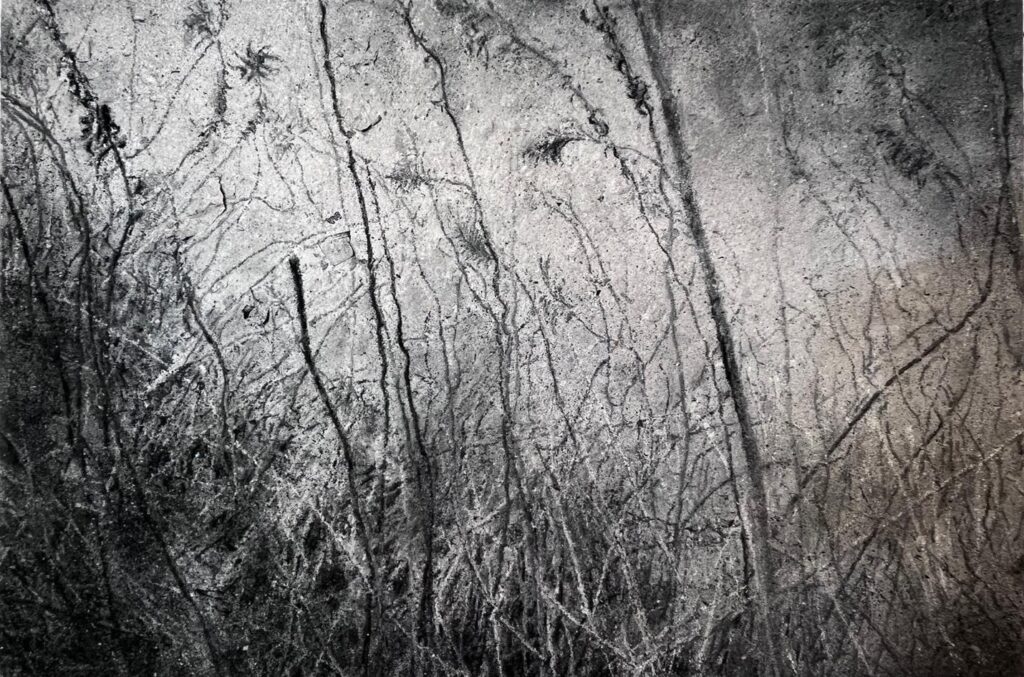
One smaller image of wildflowers in a field was especially arresting. The ordinary roadside flowers were captured past their prime — some stems erect, others tilted and bent, forming a wilted thicket against the sky, a skeletal reminder of what they were not long before, when they were still in bloom. The ash gives this everyday scene a powerful charge: organic life formed from burn.
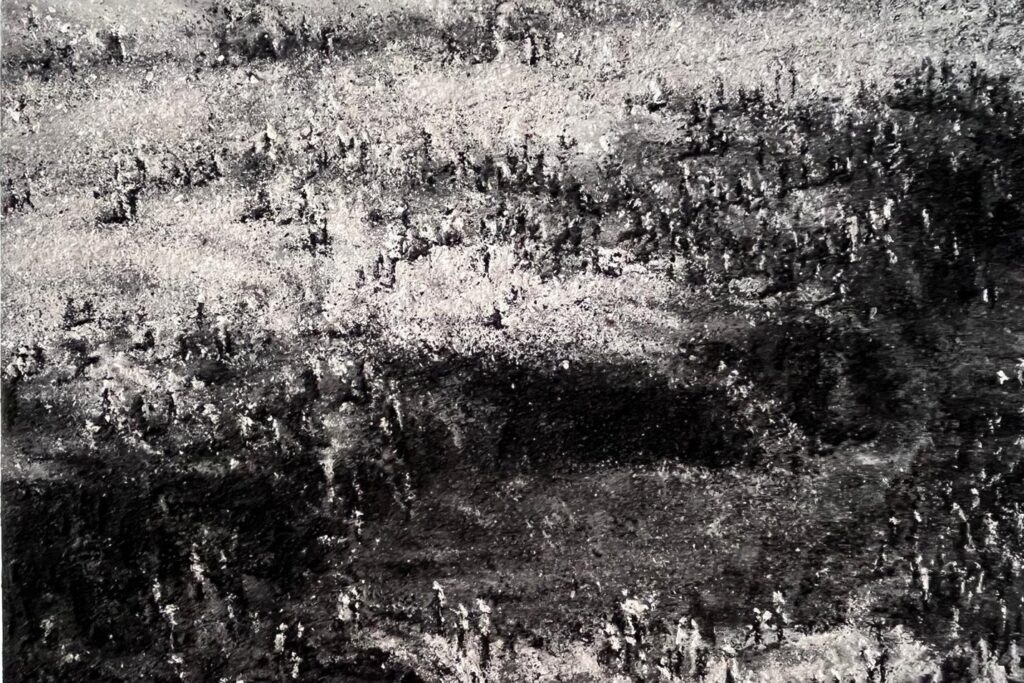
Another mid-sized work reads as near-abstract, when up close, with dark spots over wide bright bands, and a ragged surface of dusty soot with scraps of paper and plastic tape buried beneath. Stepping back, the dark spots resolve into figures moving through a barren landscape. Further still, a crowd gathers on soft hills; a deep, shadowed cliff opens beneath them, with more figures standing on its bank, gazing across. The scene has the scale of a historical painting — a biblical gathering, or a battle — but its impressionistic rendering keeps it open. Without a fixed outline, we sense the crowd in communication across the landscape and feel the presence of a story that remains unfinished.
A final mid-sized work reveals an almost abstracted dark foliage silhouette. Up close, it is chaotic — grayish particles adhered unevenly, cracks opened by scraps of discarded paper and junk. There is something quietly affecting this wounded surface. Together, these smaller works provoke a kind of rumination: on the space between bloom and death, silhouette and ground, air and water.
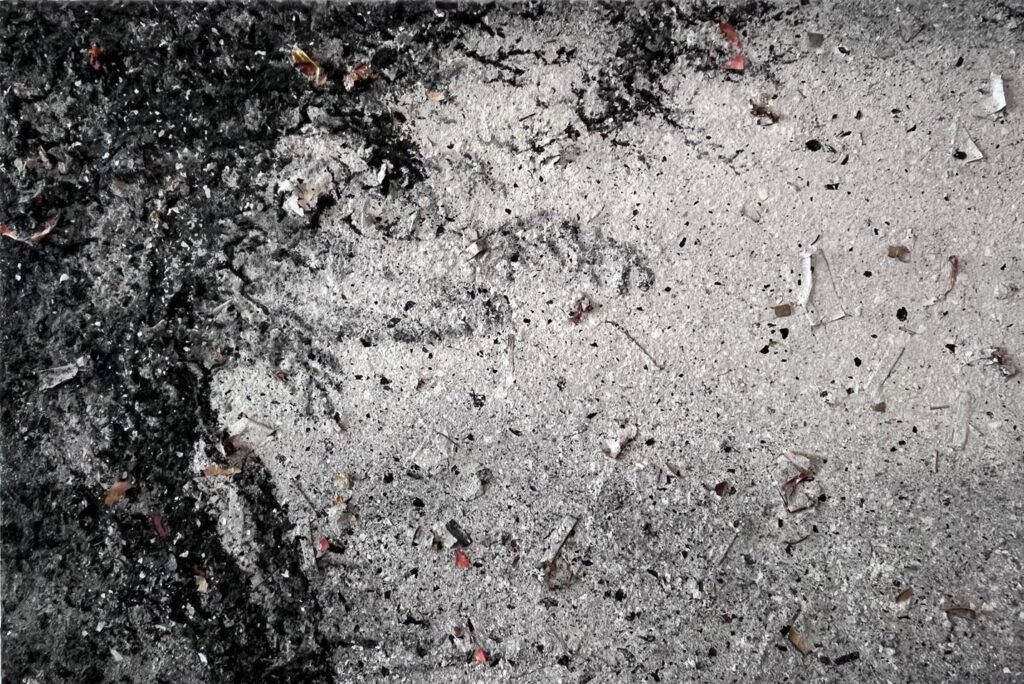
Yet both the large photorealistic works and the smaller fuzzy paintings layer and transform when closely observed. They provoke a sense of burn in the colorless appearance of bare carbon. Their imperfections — the cracks, the buried debris — appear like inevitable wounds in a laborious perfection opening onto a connection between the Buddhist intention and the current destruction not yet named.
Zhang Huan: Ash Paintings and Performances, at 125 Newbury Gallery, 395 Broadway, New York. On view through April 11th, 2026, Tue – Sat, 10 am – 6 pm.
About the writer: Michal Gavish explores in her art and writing the world of art inspired by science, which connects to her previous career as a PhD research scientist. Over the past years, she wrote regularly for SciArt Magazine and SF Art News. In addition, she published several peer-reviewed articles, including an art publication at UK Intellect Publications and many research articles for scientific journals, including Science magazine. She has been working as an artist and art writer since she received her MFA from the San Francisco Art Institute in 2008. In addition, she teaches college art and science and lectures extensively on art history and on art in the Middle East, including several series at the Jewish Museum in San Francisco. @michalgavish