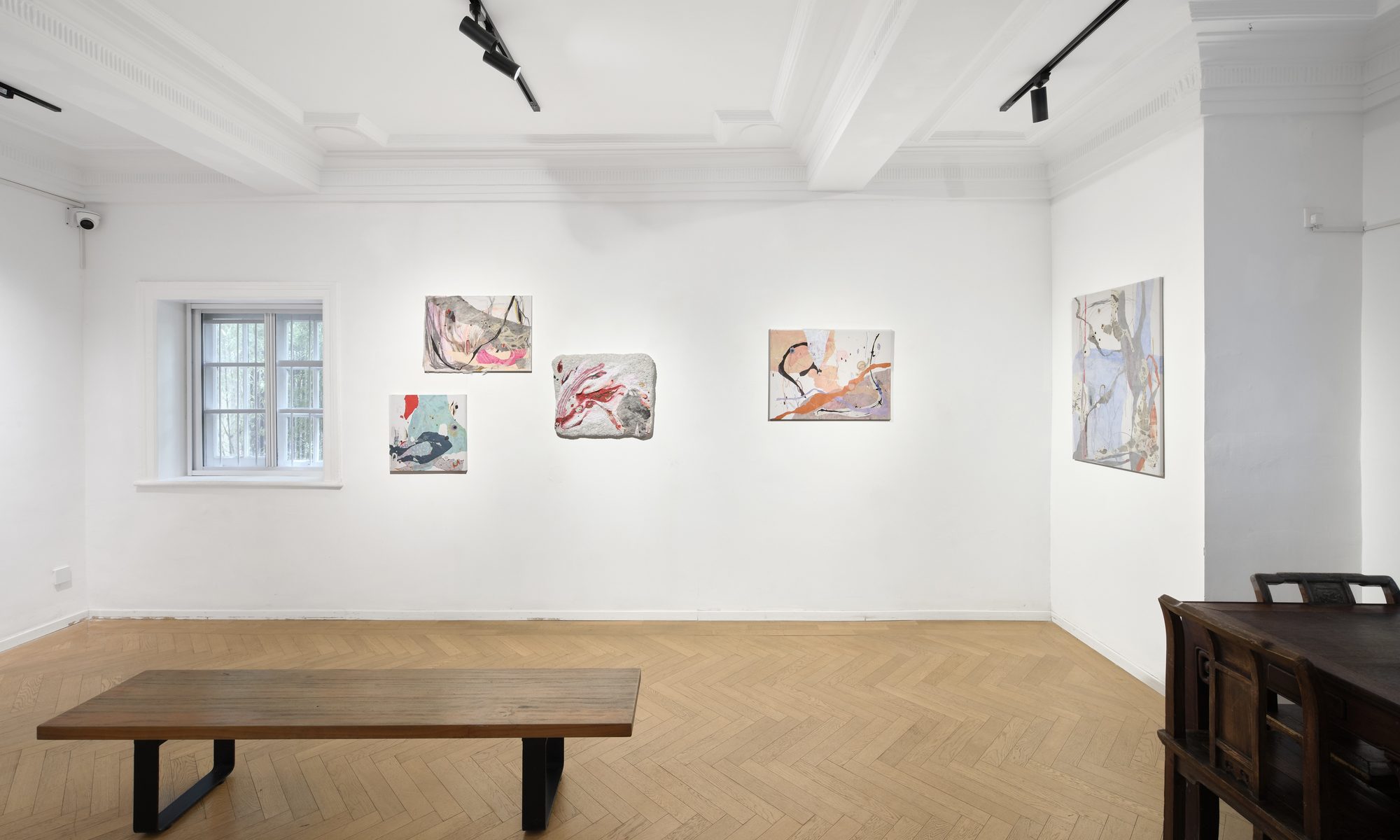
Women constantly fall, from rule, from discourse, from childbirth, from ecstasy, from sacrifice, from love, from anguish. We are still in the place of repeatedly coalescing to regain voice and visibility across political, economic, pedagogical, and creative fields. Comprehending it through cultural theorist and sociologist Angela McRobbie, we see that women are made to bear greater precarity, conditioned by institutions, by discourse, by an economy that asks for passion in place of pay; entering the creative fields comes with a demand to be self-managing, enterprising and unquestioningly cheerful about it. Women might be naturally leading the creative sector but meanwhile, fall heavily onto body, conditions and time, carrying its costs behind the facade of the neoliberal art industry.
Bringing together eight female artists, Sherly Fan, Yuqian He, Shengjie Jiang, Yunbo Jia, Joy Li, Angela Lyn, Xiangjie Rebecca Wu, and Yibei Zhang, After Throwing, a group exhibition curated by Shuhan Zhang and Luman Jiang at E.SCAPE Art Space in Shanghai, explores the unsettling complexities of womanhood through a multidisciplinary selection of installations, paintings, and sculptures. We are gently invited to the space for intervals of women, body, labour, and love. What we’re trying to grasp here is the energy traversing the body and the space, dispersed, broken down, disaggregated, and addressing itself to artwork here in a corporeal way, to closely register precarity as a feature of women, through their conditioned vulnerability and dependency. After Throwing puts itself forward here as the unfinished action and, meanwhile, entices us to chase whatever has been left.
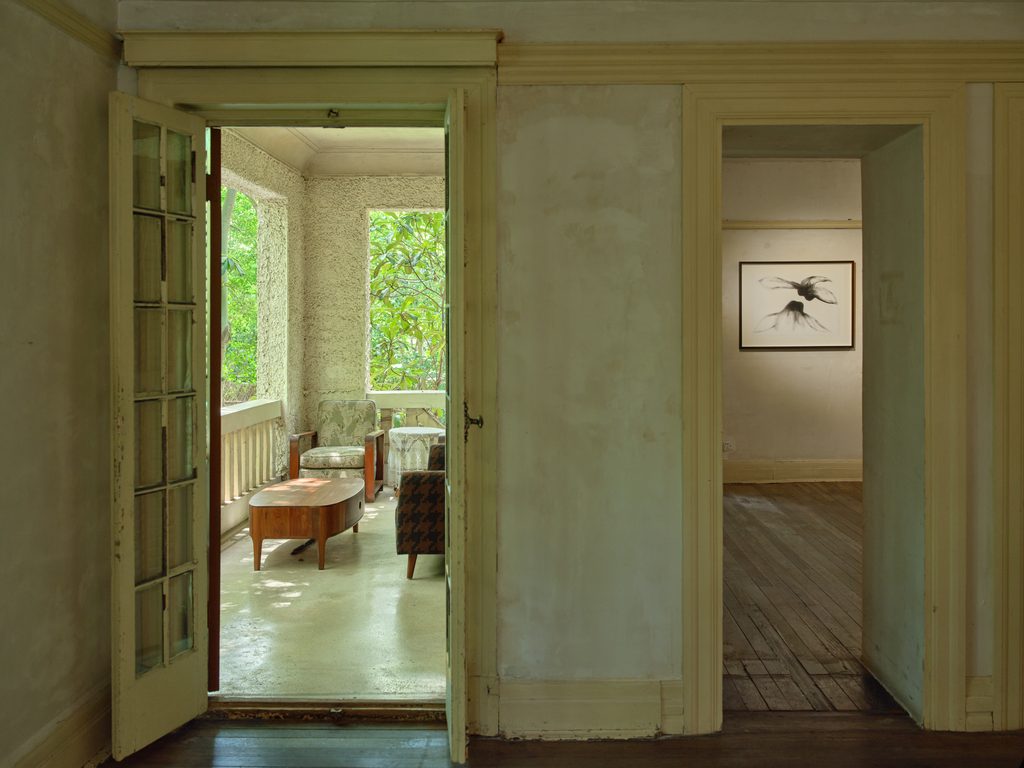
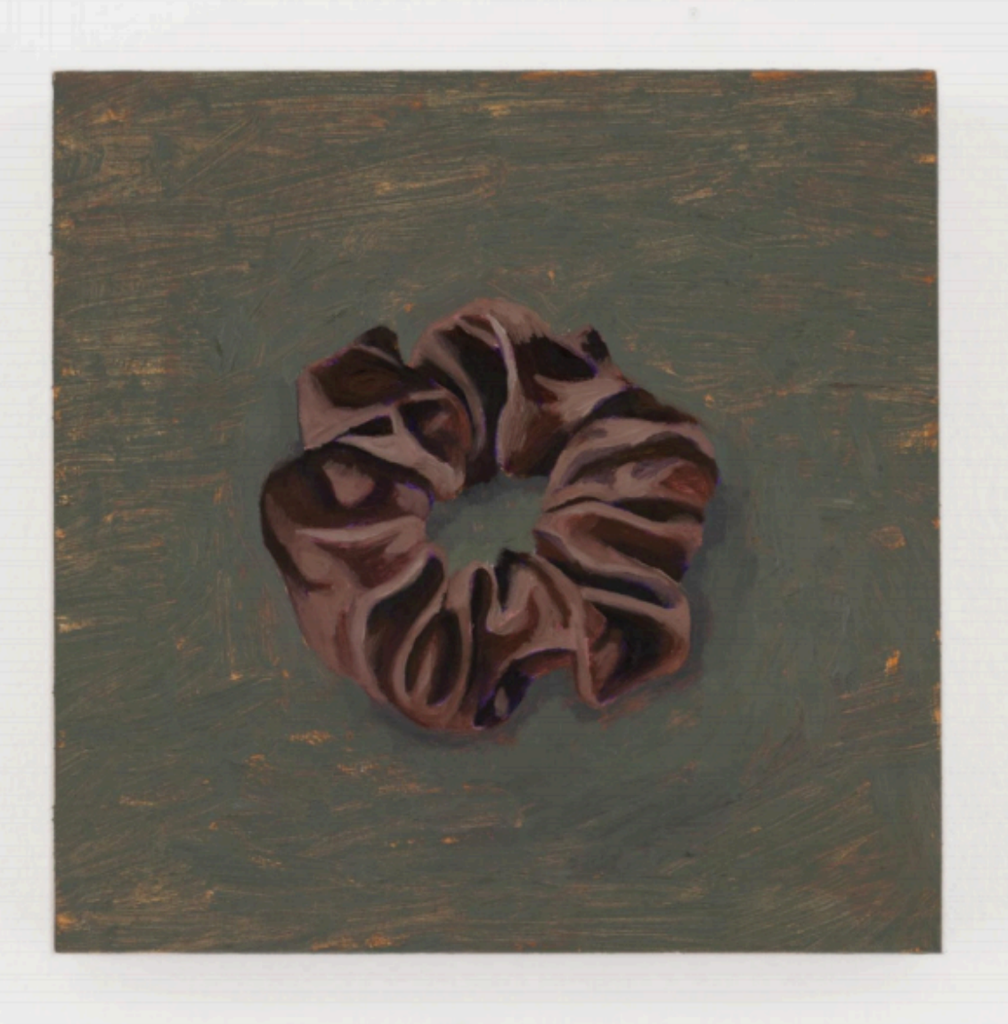
After Throwing takes place in a contemporary cultural venue renovated from a century-old, 1920s British garden villa. It intrinsically carries the traces of history, time, and nostalgia. In one part of the space, featured works by Xiangjie Rebecca Wu create an intimate domestic environment by nature, with the Lucky Cat and Chair seamlessly gathered into the space, tenderly composed here as though they had always belonged, embodied and affected by her own stories and trajectories. Further complementing the more figurative approach, Wu builds on close inspection of small objects that have been constantly worn out, used up, and, with the repetition of use and re-use, appear throughout our daily environment. The creases of Hair Tie are not even; in some of the folds, a faint whiteness shows through. It is our hand that grasps the surface of things again and again and runs our fingers over the familiar shape; we rub the things that are most worn and caress them. It is the part that has been worn thin by habit and graced with an irreplaceable affect. Hair Tie is exactly the instant where the trace of reiteration remains in the unnoticed object as a lingering remnant of feeling.
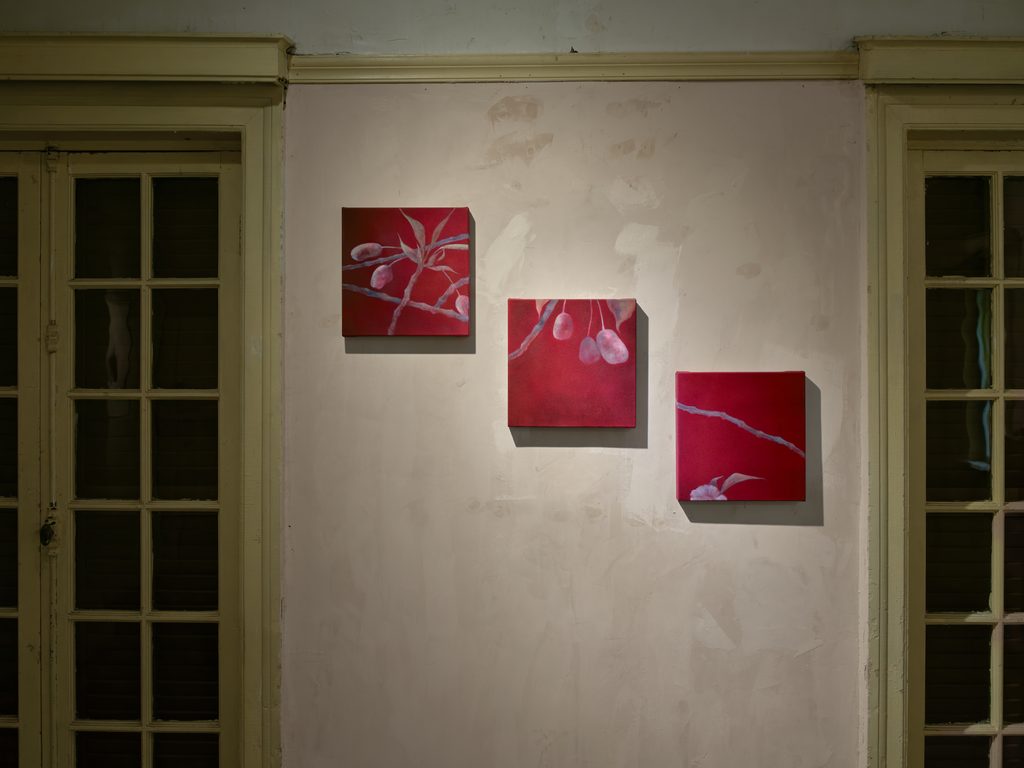
Pot by Shengjie Jiang adheres to a similar method: the melting honey on the silver spoon pauses in longing for the preservation of a particular taste, a smell that stays in a miniature of our nostalgic memory, continuing to fall back into that looping trace on our sensations. To take a closer look at Angela Lyn’s triptych, which records the thriving life process, the chronology from bearing fruit to blossom, emanating the process of growth, then inevitable falling apart. The falling is destined, but the idea, recorded through the making process, emerges in starts and stops, taking shape. In her later work, ancestral tears No. 21, is not so close to what we understand as the shape of a tear when one is in sorrow. As the Brazilian novelist Clarice Lispector put it,
“We are moist and salty beings; we are beings of seawater and tears.”
Looking only at what’s on the canvas, Yuqian He depicts a more abstract probing of the unsettling states of drowning and sleeplessness. Drowning is the paler of the two, built from washed blues and greys with threads of red running vertically like something bleeding through water. The marks are loose and searching, tangled lines that leave an unfinished space for experience.
Thinking through Donna Haraway, experience, like consciousness, is an intentional construction, an artefact of the first importance. Women have often engaged intimate traumas as productive points of exploration and intervention, weaving their own dreams and hallucinations, living along lines, connecting threads and sitting with the knots between artist, daughter, and mother, through the materiality of practice, labour and work. We are embodied beings as knowledge makers. Encounters, connections and relationships influence and impact the work we undertake; our love and passion are unpaid labour. We continually fall back to committed, everyday gestures, to full-body memory, rhythm and motion, to the endurance of the wholeness of the ‘entire people,’ men and women, minority and people of its diaspora.
Courtesy of E.SCAPE Space.
About the writer: Yueliu Huang (Ruby) (b. 2001) is a writer who lives and works in London. She holds an MSc in Culture and Society from the Department of Sociology, London School of Economics and Political Science. Her academic interests focus on Frankfurt School critical theory, cultural theory and continental philosophy. Her creative practice centres on artworks that elicit essences, everyday fragments and memory in resistance to the banality of reality.
After Throwing, E.SCAPE Art Space, exhibiting work by Sherly Fan, Yuqian He, Shengjie Jiang, Yunbo Jia, Joy Li, Angela Lyn, Xiangjie Rebecca Wu, and Yibei Zhang. On view from August 29 through October 7, 2026.
Reading List:
- J. Haraway, D. Reading Buchi Emecheta: Contests for ‘Women’s Experience’ in Women’s Studies. In Simians, Cyborgs and Women; Free Association Books / London, 1991.
- Lispector, C. The Passion According to G.H.; Penguin Books: London, 2014; ISBN 9780141197357.
- McRobbie, A. The Artist as Human Capital: New Labour, Creative Economy, Art Worlds. In Be Creative Making a Living in the New Culture Industries; Polity Press: London, 2016.