Let me tell you about a complicated woman.
Echo is a shrewd mountain nymph in Ovid’s Metamorphoses. She acts in the service of a god and out of loyalty to her fellow nymphs, but also takes pride in the cleverness she employs to outwit Juno, so Jove can do what he pleases with the forest creatures. She is punished for her cleverness by being condemned to never speak for herself, only to repeat the last words spoken to her. Despite her limitations, she still makes herself clear. Later, when Narcissus declares that he will die before the lovesick Echo possesses his body, she smolders, “…you can possess my body.” A body that will ultimately wither away in a cavern, leaving only a voice that seeks communication and relation; a voice that endures, because these desires endure.
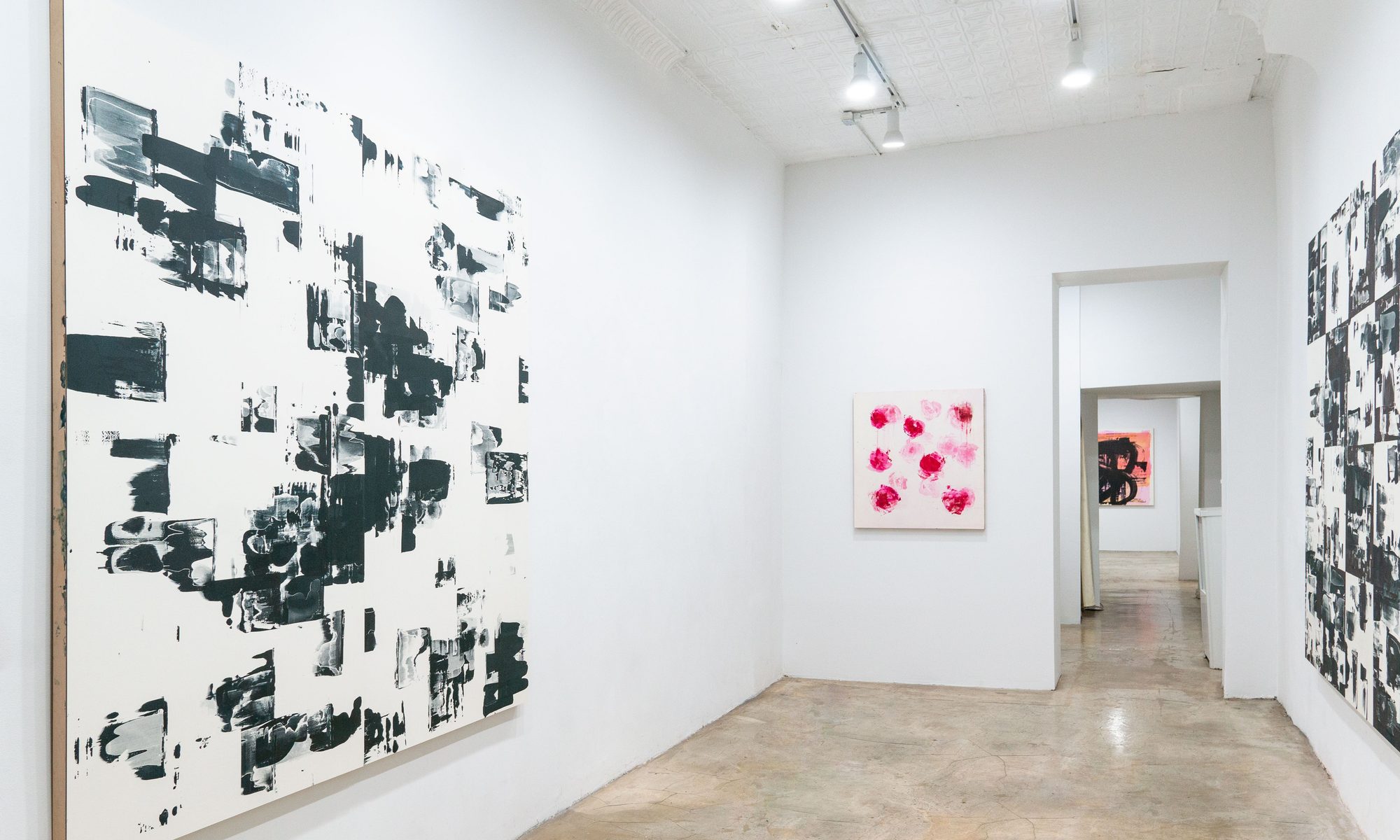
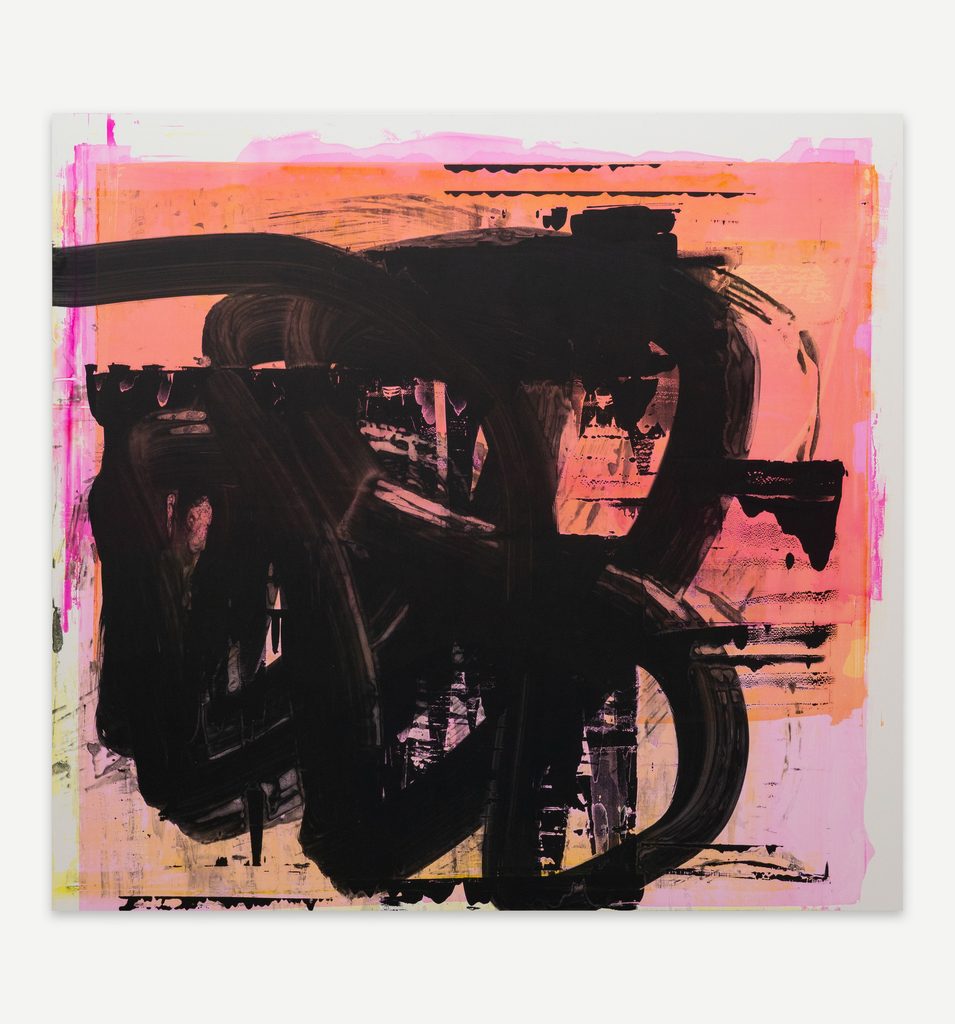
McQuillen’s recent “paintings”—created with squeegees and ink—consider what it means to make oneself heard and to engage in mythmaking on the level of frequency. And in Echo Resounds, her third solo exhibition at Massey Klein Gallery, she turns up the volume. Unlike in previous series, there are few gradients, minimal fades. Stylistically, pieces here are more bold, stark, vibrational, and demanding, in a word, loud. It is not the characters the pieces are named after—Echo, Rumor, Narcissus—who assert themselves, but the thrust of story; lives full of entanglement, confusion, violence, celebration, questioning, and change. Narratives are driven by love and folly, those things that make us and those things that so terribly undo us.
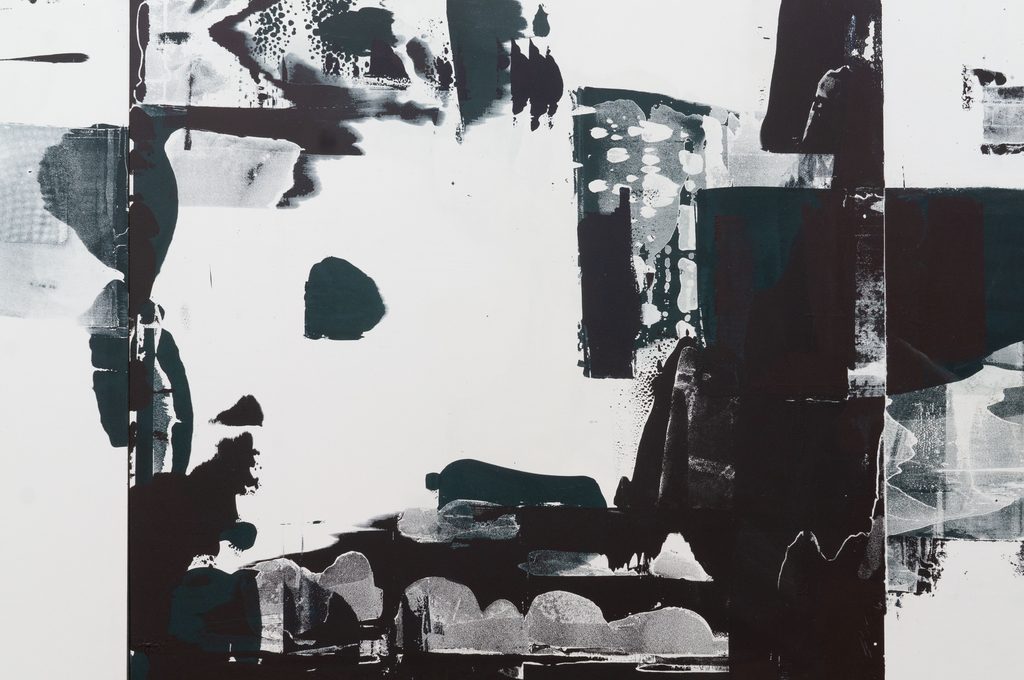
What attracts the artist to The Odyssey, The Iliad, and Metamorphoses are dialogues that grapple with the complexities of family, war, and virtue, that refuse to accept the world, or even identity, as simple or fixed. It is this openness that contemporary translators such as Emily Wilson and Stephanie McCarter seize upon, forcefully dragging Homer, Ovid, and their largely male translators, into the present. Ovid’s critiques of toxic masculinity date back to 8 CE (it is noteworthy that he was banished by Emperor Augustus), while today Wilson deliberately strips away centuries of patriarchal bias, misogynistic slang, and romanticized euphemism that have sedimented along the way. In Echo Resounds, McQuillen takes her position as an interlocutor, harnessing repetition, distortion, and amplification to join in exploring these human themes that have survived antiquity, offering alternative ways of thinking about how new relations create possibility. Speaking of the early poets, McQuillen says, “…there’s no way you could imagine that they’re just trying to say, ‘oh this is how it is forever.’ I think there is buried in art… there’s something buried in it that is pointing to some other way.”
Myths are translated, reinterpreted and argued with. This wrestling is what keeps them alive as they are continuously remade and differently inhabited over time. McQuillen’s work joins this lineage to reconsider the forces that push characters to the edge of story, creating the conditions for marginalization leading to reduction and silence. Ultimately, she seems to be interested in tracing the themes that help us confront who we still are, and who we could be. Instead of a flattering reflection in a still pool, she offers us a different kind of mirror, one that manifests the burning of desire, as well as the fear of being prey.
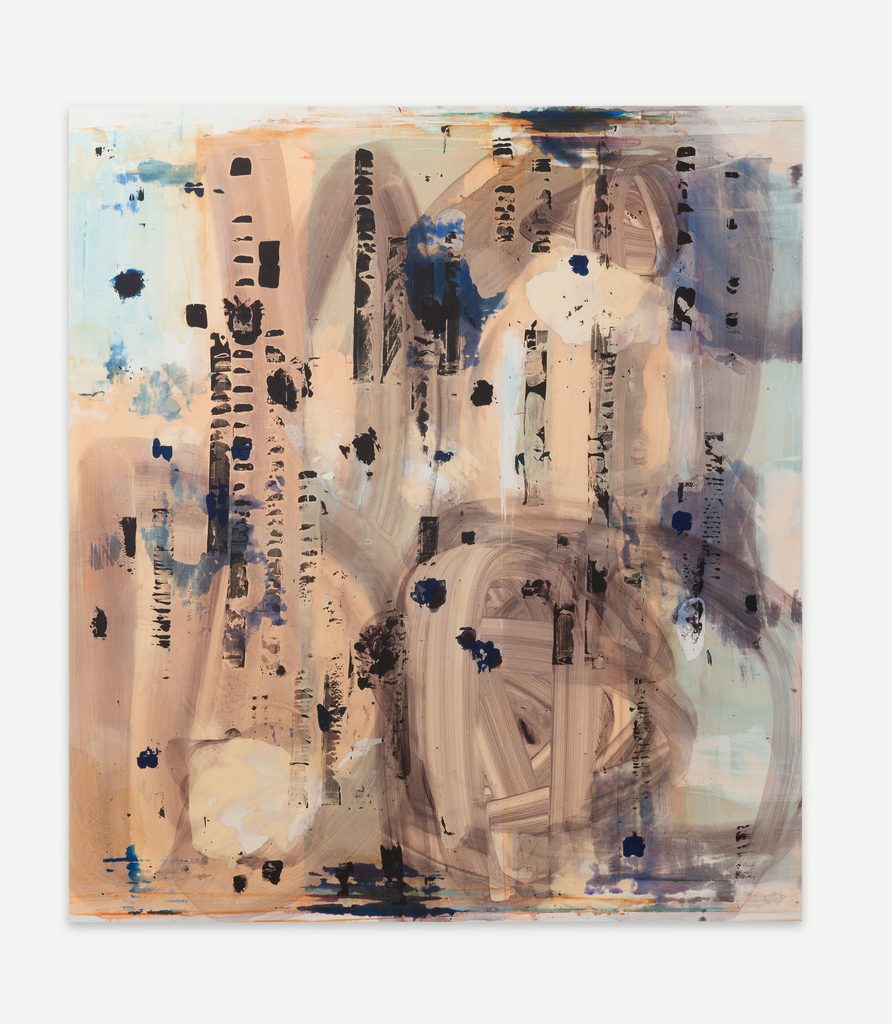
In Metamorphoses, when the water nymph Arethusa is pursued by a river god, she runs to her goddess in terror, who transforms her into an underground spring, facilitating her escape. Her freedom is temporary, as her pursuer, Alpheus, turns into water to forcefully mix with her stream. McQuillen’s Hollow Cloud places the viewer in the position of Arethusa, evoking the turbulence of water and sand, with the soft brown squeegee strokes moving anxiously across the rectangle. The surface itself amplifies the duality of space that is both freedom and entrapment, making us witnesses. In this way, each painting is not a completed story, but a radical act of listening, a pulling forward expressed as visual wavelengths. Listening is what turns communication into relation, requiring both a voice and someone willing to receive it.
Speaking to McQuillen, it is immediately apparent that a great amount of passionate reading has gone into this body of work. This did not begin in the studio, but at her family home in Rhode Island, spilling into the final months of her father’s life. Formerly suspicious of language’s ability to articulate overwhelm, reading out loud with others changed McQuillen’s perspective. It became a powerful social activity of embodying rhythms and visualizing metaphors: “It feels like [my dad] and my mom and I, we all had these shared images in our mind that we’ve read together.” In an economy of distraction, cultivating this kind of shared, deep attention begins to feel radical: a way of remaking our relations, and perhaps ourselves. Taken as an ethical imperative, it also requires a different kind of discursive space.
Upon her father’s passing, McQuillen began giving tours of select vases in the collection of Greek Antiquities at the Metropolitan Museum of Art, extending storytelling devices to include these historical artifacts. She asks not just what “art” tells us about these themes, as if these were autonomous objects that declare how things were, but what becomes possible when we attend to the entanglements of human lives, histories, and sounds; from researching the names of potters and their workshops to delving into the complex conversations around smuggled fragments. These insights deepen encounters, transforming them into communion. And this invitation, bringing together ancient artists, modern antique dealers, contemporary students, curators, friends, and strangers, expands into a community of both the living and the dead.
This is what it means for art to be loud, not to demand attention, but to extend the range across which a voice might travel. Her Met tour begins with the Hirschfeld Krater, a monumental ancient Greek terra cotta vase c. 750-735 BCE–a bottomless ancient vessel associated with mourning. Mourners would pour liquid offerings into the top, passing straight through to the ground to symbolize a direct connection with the dead. Her tour ends with a vase depicting Hermes, the messenger god; a facsimile of that vessel holds her father’s ashes. Between those two encounters, she highlights depictions of the things that make life feel intensely alive: desire, violence, fame, beauty, sex, drugs, nudity, and humor. But death is not the end, nor is the grief it stirs. Grief is an ongoing articulation. For McQuillen, it is not sad, but the “grappling with something that’s really hard to understand.” It is not always a site of action, of closure, but rather one of hesitation, growth, and transformation. And even loudness. This is where McQuillen the host and McQuillen the artist converge.
Kate McQuillen’s Echo Resounds, at Massey Klein Gallery, 124 Forsyth St, New York, NY, 10002. On view through October 24th, 2026. This is the artist’s third solo exhibition with the gallery. IG: @masseykleingallery
Make your tax-deductible donation today and help Art Spiel continue to thrive. DONATE
About the writer: Amanda Nedham is a Canadian artist, curator, educator, and current PhD candidate in the Department of Religion at Rice University in Houston, Texas. Her work explores intersections between drawing, mysticism, ethics, and environmental humanities. It conceives of drawing as a catalyst, collaborator, and conjurer that sets the conditions for one to be in relation with what exceeds them, exploring a multiplicity of agencies and temporalities that hinge on the mark. Nedham received a BFA in Printmaking from OCAD University, where she was the medal recipient, and an MFA in Painting from the Rhode Island School of Design, where she received a Presidential Scholarship. Her work has been exhibited across North America and in Europe. She has published one book, My Boyfriend is a Peacekeeper, tracing the history of Canadian Peacekeeping through imagined love letters and drawing.