Situation
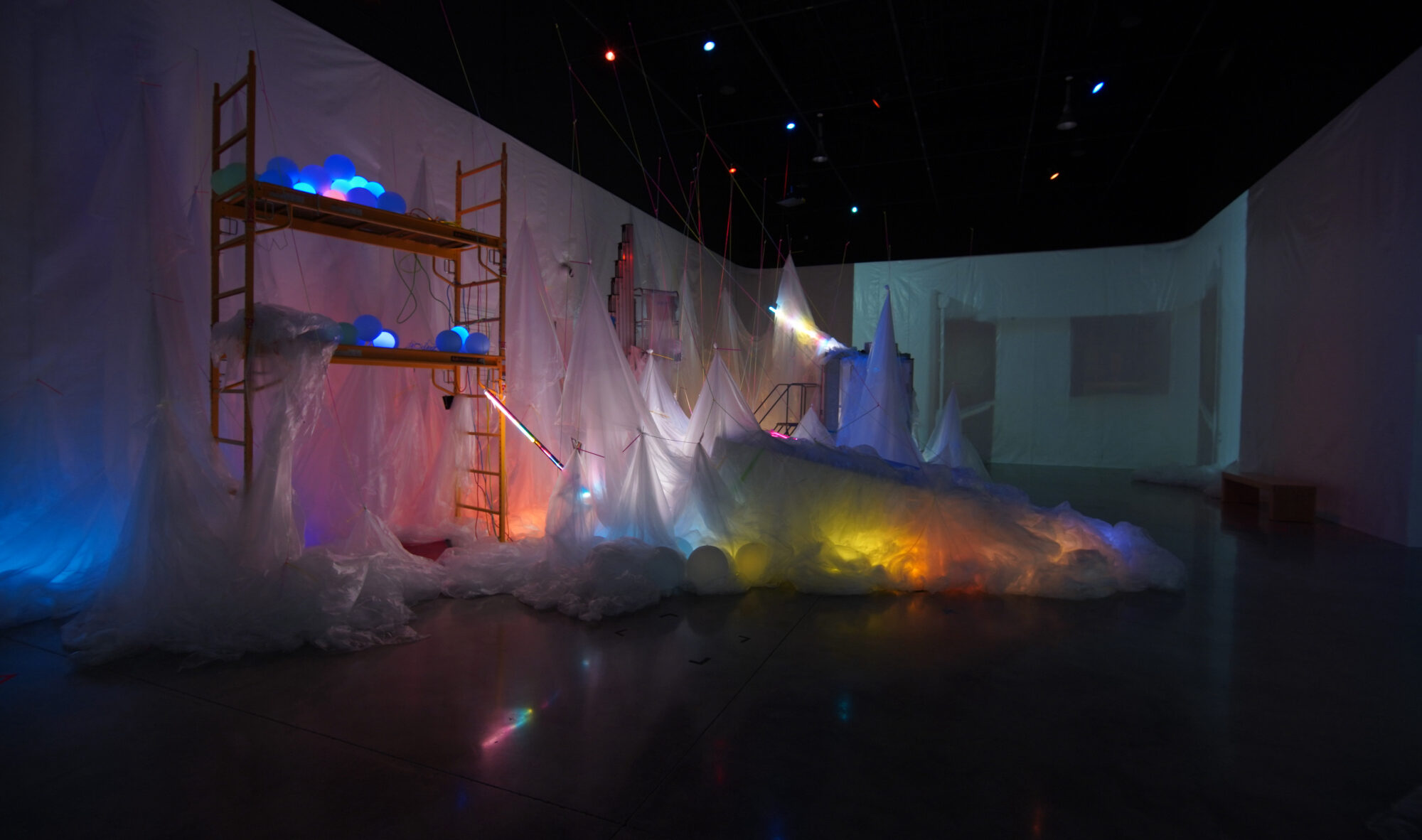
The duo Treizman + Zurilla has created a paradoxical situation at The Frank C. Ortis Art Gallery in Pembroke Pines, Florida. There are no paintings hanging on the walls or sculptures on pedestals; only the remnants of an undefined and colossal event. It is perhaps the belated fulfillment of a premonition that adopts the exhibition space as a medium for art, transforming the White Cube into a site-specific installation.
Monumentalizing the Trace, the title of Treizman + Zurilla’s exhibition, suggests the scene of a shipwreck: the aftermath of a disaster that never took place. Even so, the intrigue of the vestiges and the suspicion of what is real remain. The debris — ladder, panel, scaffolding, forklift, ropes, wrappers — suggests that something happened, which is enough to keep searching and gathering evidence.
Strictly speaking, in Monumentalizing the Trace, art and event remain embedded within the exhibition device itself. Rather than offering certainties, the project raises expectations about a devastating incident whose nature and origin have not been revealed. The rest is an accumulation of wreckage that serves as a testament to a four-handed process.
Exchange and Balance
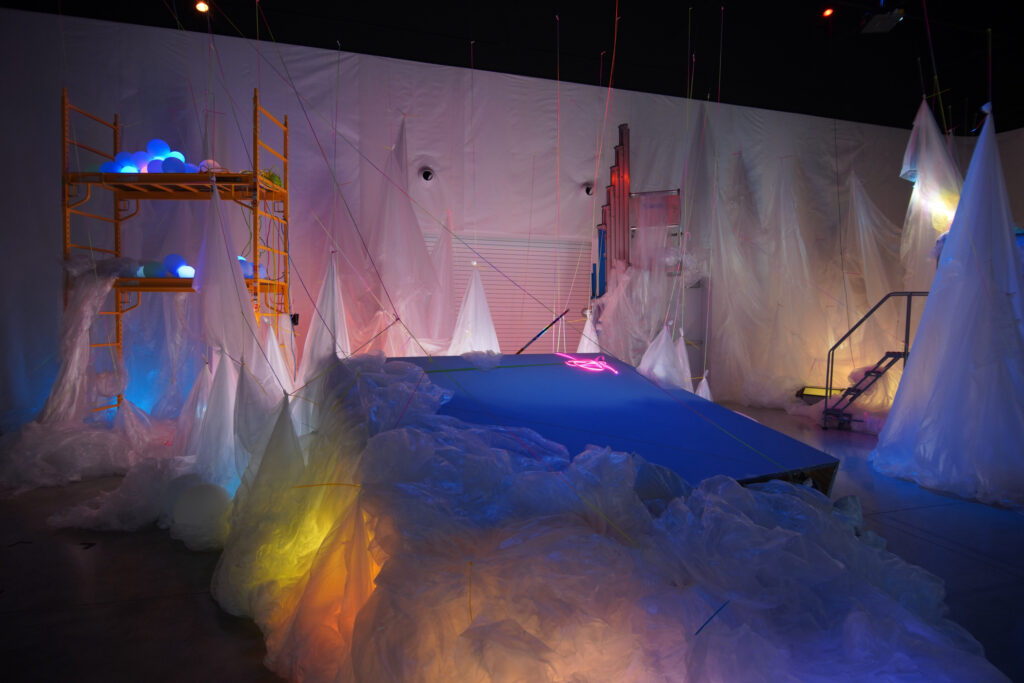
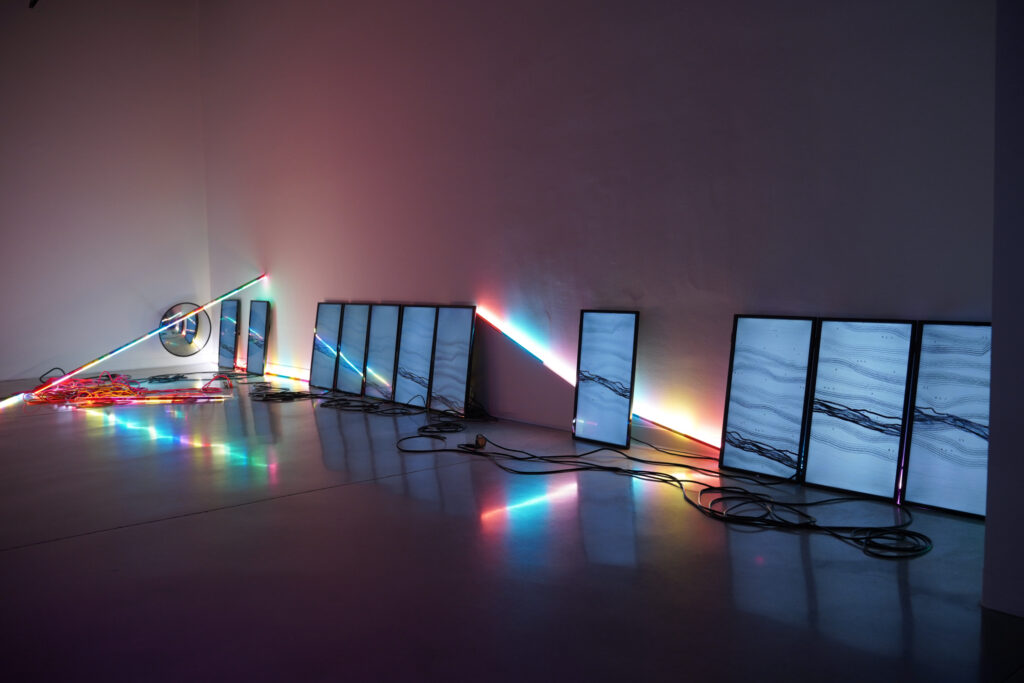
Treizman + Zurilla have built an immersive environment with projections, translucent surfaces, light tubes, and veiled structures. The result is a landscape of fragments, whose meaning and concatenation demand attention and discernment. Here, the White Cube is a platform for exploration open to dialogue. The staging — curated by Sophie Bonet — brings together the remains of the conversation between the two artists.
Each brings her own to this creative exchange. Denise Treizman (b. Santiago, Chile; based in Miami, FL) contributes a playful impulse and the reuse of mass-produced objects. Julia Zurilla (b. Caracas, Venezuela; based in Miami, FL) contributes her research on memory, silence, and displacement, using analog and digital media. In the process, roles are interchanged in search of balance.
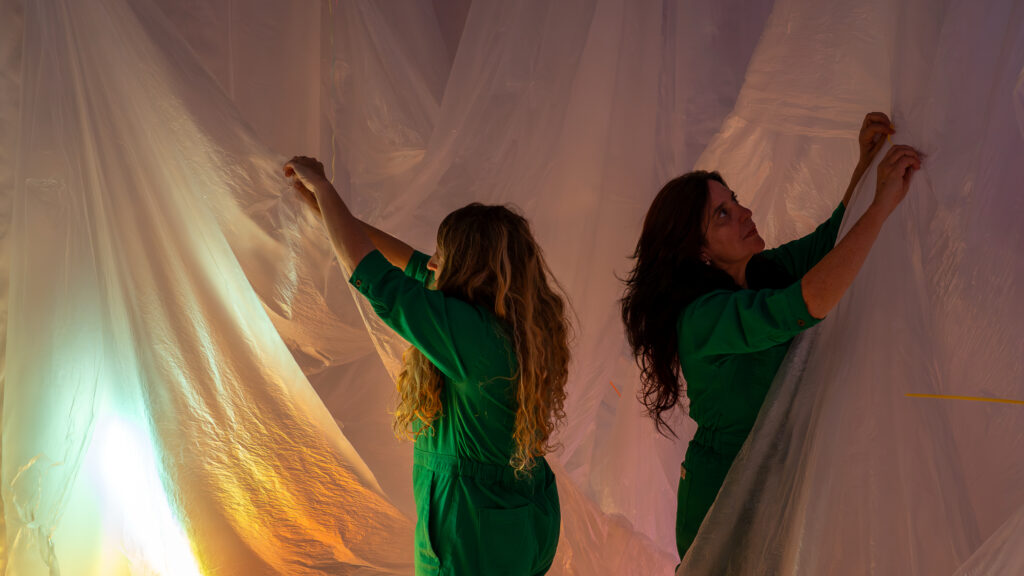
They began their collaboration during the 2023 Satellite Art Show. Since then, they have created immersive installations such as Coincidentia Oppositorum (2023), Dream Catcher (2024), and Luminous Vacancy (2025). Both express a shared interest in exploring the meeting point between opposing notions.
With these precedents, Treizman + Zurilla confront the challenge posed by the exhibition Monumentalizing the Trace. The project is organized into four areas, each of which recreates the same event at different moments. Along the way, certain objects and structures may virtually reappear in the video footage that accompanies the tour.
The Journey
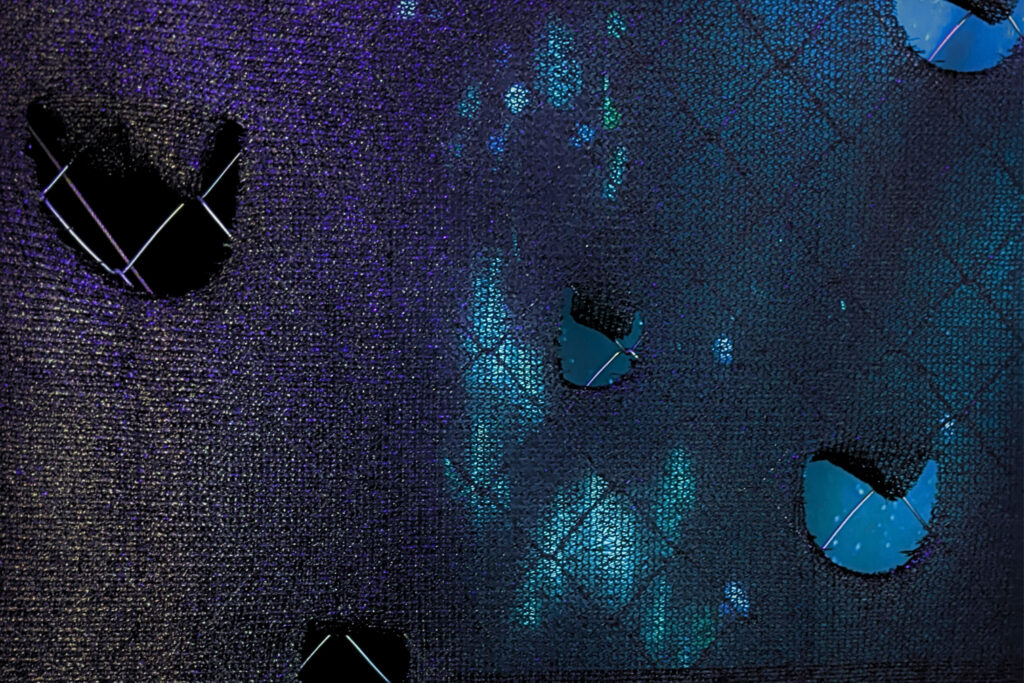
The itinerary begins in a small video room, the entrance of which is blocked by a security gate and a punctured tarp. However, one can peer inside through the holes. From within, images reach us of a submerged world with traces of moisture and water bubbles.
The tour continues with a sequence of monitors, neon lights, and mirrors; literally a first horizon almost at floor level, where streaks of colored light alternate with black-and-white lines of water that jump from one monitor to another.
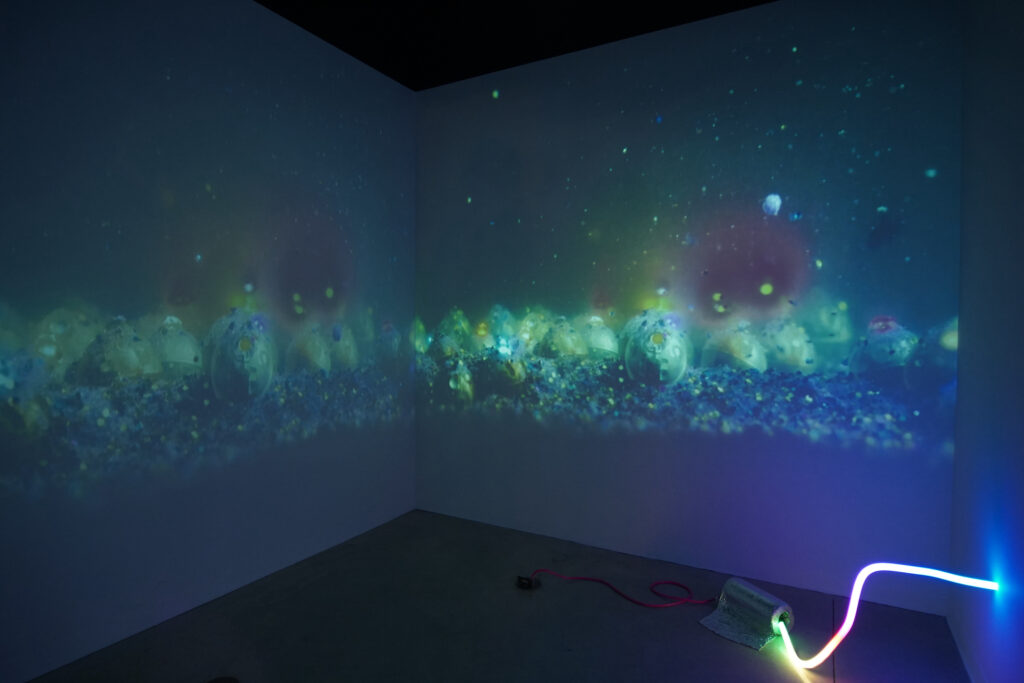
This is followed by a central space of larger dimensions, featuring perimeter projections, light spheres, structures, ropes, and large sheets of translucent plastic. The walls are screens that reproduce the cycle of flooding and draining of the dammed water.
On the way back, crossing the intermediate area toward the exit, there is another video room with subaquatic images and neon lights with exposed wiring. At this point — and even without knowing what really happened — the most fruitful takeaway is the experience of the tour itself. After this, any presumption or conjecture is possible.
Sediments
Viewed as a whole, Monumentalizing the Trace is like a grand diorama composed of successive scenes and designed to welcome the curious crowd that has come to witness the unusual event. Faced with the apparent magnitude of the occurrence, Treizman + Zurilla rescue the value of the trace as a symptom of a past state or condition, whose legibility depends on a sudden contact with the present moment, the “here and now.” After all, looking from a distance is not the same as being inside, wandering without a map in a disaster zone.
The contrast between the spectacular nature of the staging and the relative modesty of the resources employed defines a crucial issue. Memory is not only about the relics of a grand past. In fact, the exhibited structures and devices come from a close reality devoid of memory, accustomed to premature obsolescence. Consequently, any current object or event can also become material for research and an object of art.
Far from a melancholic discourse and the cult of the ruin, Treizman + Zurilla propose the activation of an alternative narrative based on the sediments of an untimely event. Regardless of what actually happened within the spaces of The Frank C. Ortis Art Gallery, the exhibition vindicates the profound meaning of the fragment in shaping memory, whether personal or collective. The important thing is to return to the minuscule details, inspect the gaps in the shadows, and examine the blind spots. In the end, everyone can piece together the broken parts and deduce their own narrative.
All photographs were taken by Rafael Núñez and are courtesy of the artists.
Treizman + Zurilla: Monumentalizing the Trace will be on view at The Frank C. Ortis Art Gallery, 601 City Center Way, Pembroke Pines, Florida, through August 29, 2026. Gallery hours are Wednesday through Sunday, 11 AM–5 PM. Instagram: @thefrankpembrokepines
Make your tax-deductible donation today and help Art Spiel continue to thrive. DONATE
About the Writer: Félix Suazo is an independent curator and art critic based in Miami, Florida. He holds a degree in Art from the Instituto Superior de Arte de La Habana and a Master’s in Museology from the Universidad de Valladolid. He is an active member of the International Association of Art Critics (AICA). He regularly collaborates with prestigious editorial platforms such as ArtNexus, Arte Al Día, and La Escuela. You can find more information about his work at @fsuazof.