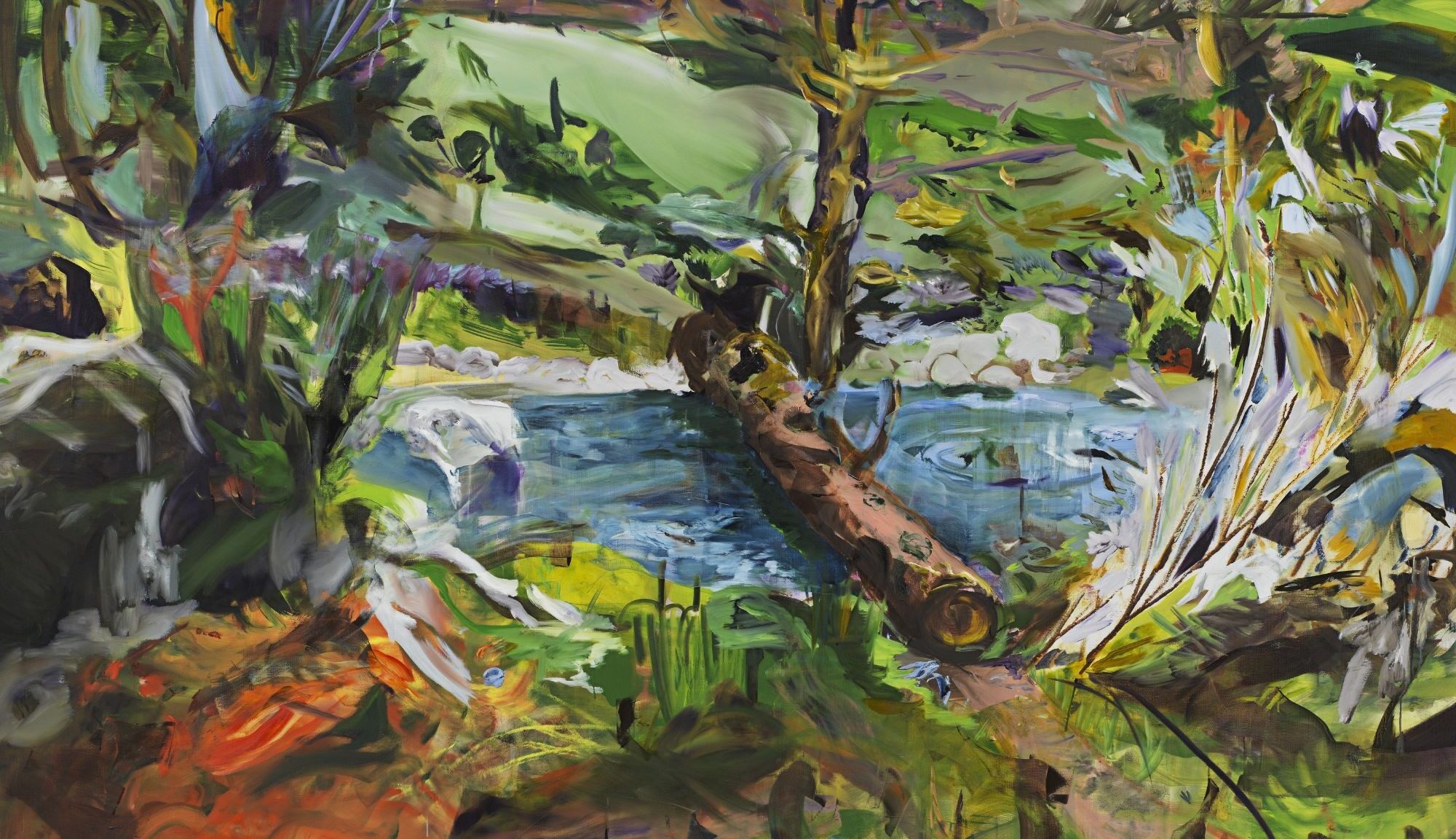
Entering the first room of the gallery, one is instantly struck by the richness of movement in Cecily Brown’s paintings. Several recent works, drawn from nature walks, centre on the motif of a log laid across a blue stream. This fairy-tale imagery, bordering on kitsch, was borrowed from a jigsaw puzzle Brown was completing at the time. Yet the jagged shrubbery and turbulence surrounding these scenes point towards something darker.
Although Brown has been based in New York for over three decades, the English landscape remains central to her work. She grew up in the Surrey Hills, just outside London, a designated Area of Outstanding Natural Beauty. She now speaks with amusement about how her younger self once viewed being from ‘suburban’ Surrey as faintly embarrassing, only for its landscapes to remain deeply embedded in her interior world.
Brown’s homecoming exhibition at the Serpentine unfolds against the animated backdrop of Hyde Park – dog walkers, open grassland, squirrels darting through trees, and ring-necked parakeets perched overhead. Taking inspiration from its surroundings, the exhibition places park life and nature at its emotional core while bringing together significant works spanning more than two decades.
In the adjacent room, another recent painting, less densely worked than many of the others, appears to depict a close-up of two carcasses, perhaps a white dove and a rabbit. Brown has been painting “bunnies” since the late 1990s and says they continue to feature in all her work, albeit subsumed within the layers. Moving from one room to another, I find myself searching for these hidden bunnies amid the frenzy of brushstrokes, only to unearth fragments of other forms: an indigo-blue umbrella in one painting, the vague outline of two deer overlapping in another, and a Disneyesque white creature reclining, which could be a sleeping lamb – or even a bunny.
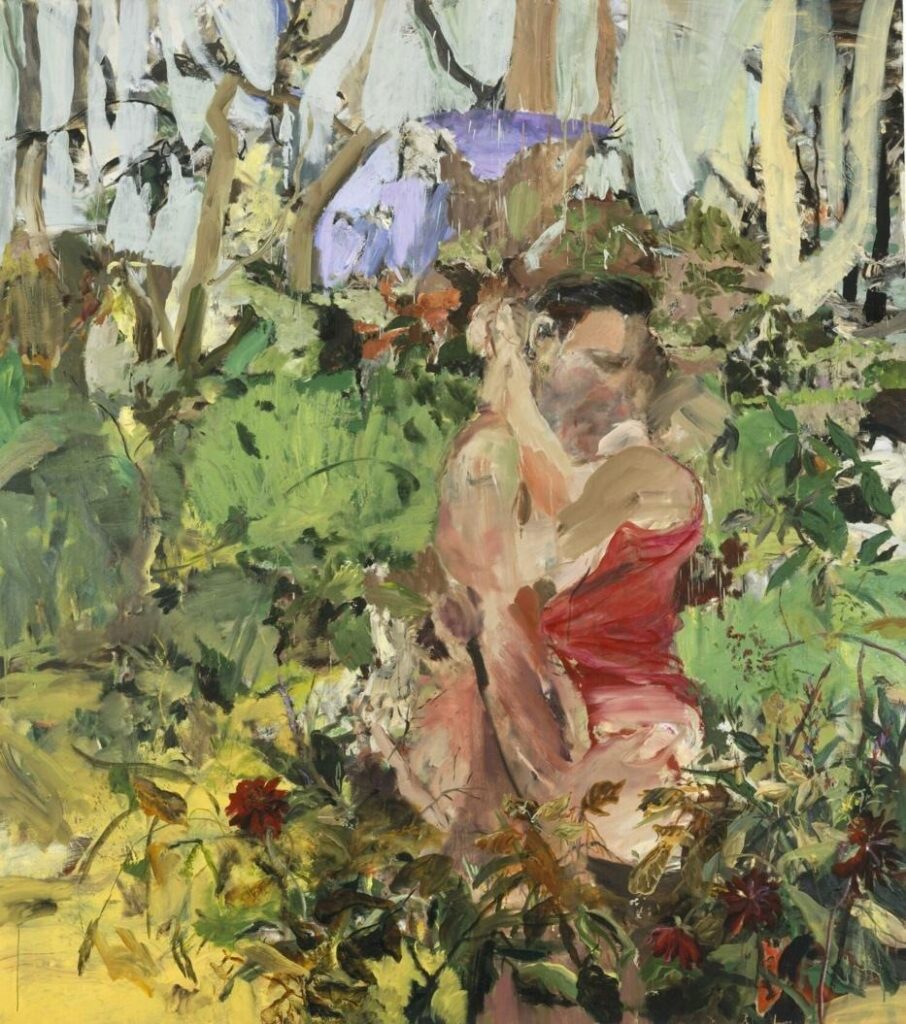
In the following room, in Couple, a much earlier work, smudges of human flesh dissolve into one another amid erratic foliage and deep red dahlias, conveying a raw erotic intensity. There are other amorous couples throughout the exhibition, some snuggled up inside small boats; another, their foreheads resting against each other, sharing a quiet moment of intimacy amid a densely woven tangle of near-abstract forms suggesting woodland. Yet none matches the sensual charge of Couple.
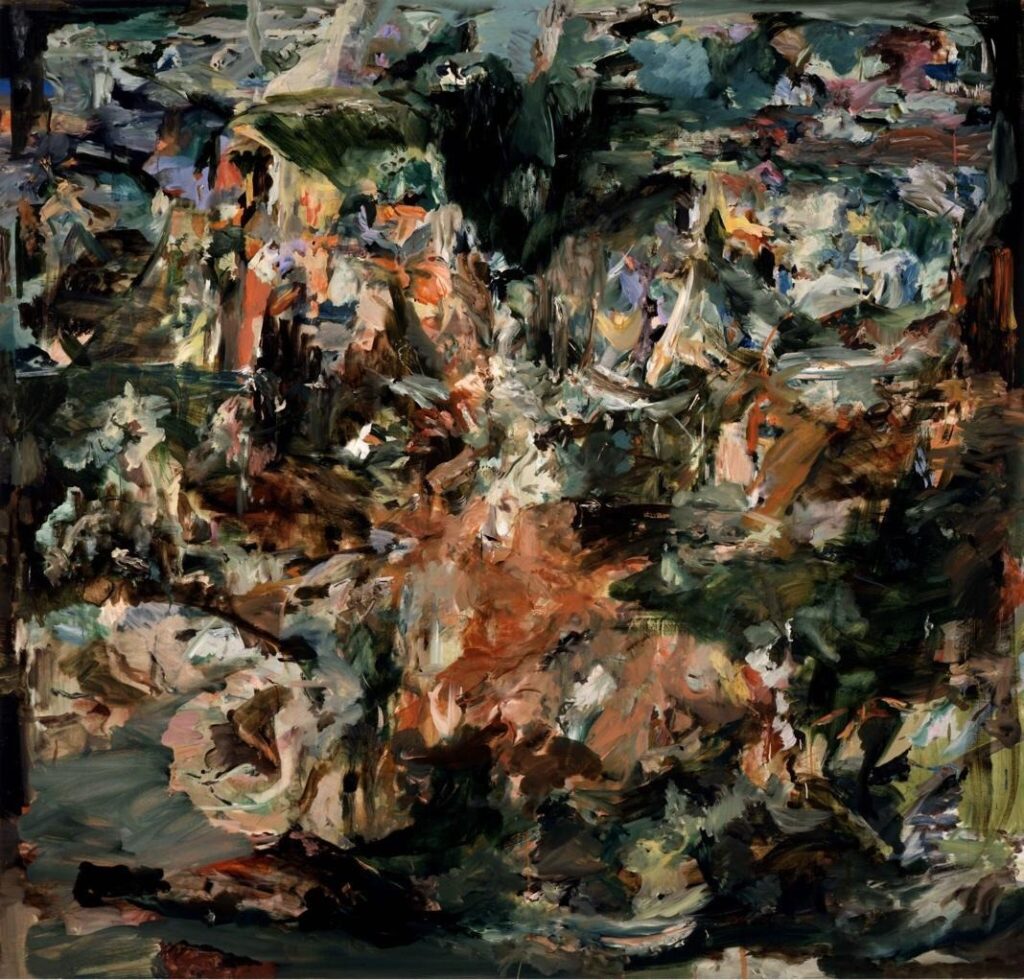
References to art history frequently surface in Brown’s work. In a reenactment of a bacchanal, a wild celebration in honour of Dionysus, the Greek god of wine, Brown loosely echoes the classical pastoral settings of Titian and Peter Paul Rubens’ bacchanals: tall, slender trees stand on either side of the canvas while fragments of bodies and landscape intermingle beneath an open blue sky. Yet because her composition hovers on the edge of abstraction, its figures barely distinguishable, the painting is animated by a more immediate sense of movement and hedonistic chaos.
Entering the chapel-like central room of the gallery, its walls covered with paintings of varying sizes and some monotypes, one encounters a wide range of approaches: some works more figurative, others leaning into abstraction; some loosely configured, others more tightly worked, as though Brown were expanding, then contracting, her pictorial language to test its possibilities. The cumulative effect is one of simultaneity, as though multiple modes of seeing are unfolding at once.
Rather than making preparatory sketches for her paintings, Brown copies whatever catches her fancy from other people’s illustrations to understand the images better, likening the process to a musician performing a cover version of someone else’s song. Some of these images later resurface in her paintings. In the final room, a selection of such drawings is displayed in a glass vitrine, many depicting scenes from well-known children’s books, including Three Kittens in a Boat and Orlando (The Marmalade Cat). This offers an insight into Brown’s picture-making process.
Circling the exhibition several times, I begin to notice fragments of other figures emerging within the landscapes – the smiling face of a child or the legs of someone on a swing. These add a layer of uncanniness to the restless interplay of beauty and menace that runs through Brown’s landscapes.
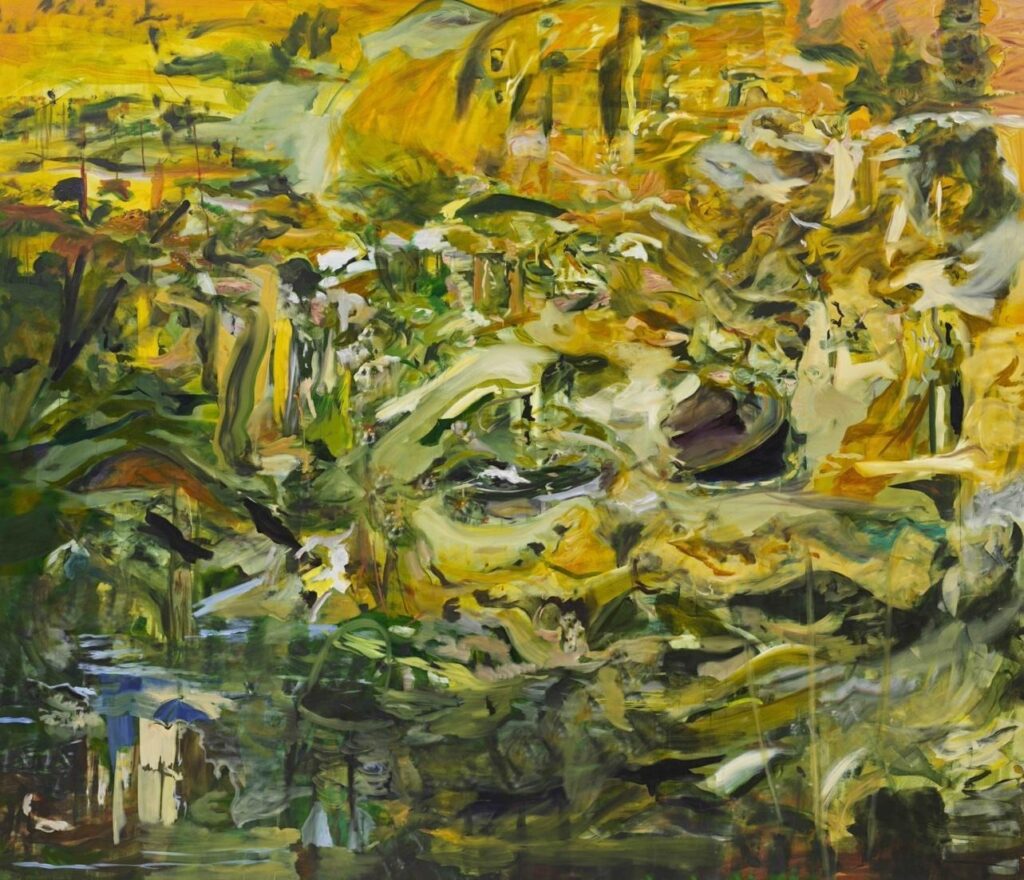
Brown described incorporating motifs like ‘the log laid across a stream’ into her newer compositions as a way of resisting the pull towards pure abstraction. Yet it is in large-scale abstract works, notably Study for Sarn Mere 3 and A Round Robin, that she is at her most brilliant, constructing almost pantheistic configurations which the eye struggles to leave behind: intricate networks of marks and gestures which generate the illusion of perpetual movement. Everything appears interconnected and in constant flux, much like life itself.
Cecily Brown: Picture Making is on view at the Serpentine South Gallery in London from March 27 through September 6, 2026. @serpentineuk
Make your tax-deductible donation today and help Art Spiel continue to thrive. DONATE
About the writer: Selin Tamtekin is a British-Turkish novelist and art writer based in London. Her art writing has appeared in The Markaz Review, Cornucopia Magazine, Whitehot Magazine, and elsewhere.
Her two novels, written under the pseudonym Deniz Goran, are The Turkish Diplomat’s Daughter (2007) and The Fugitive of Gezi Park (Ortac Press, 2023).