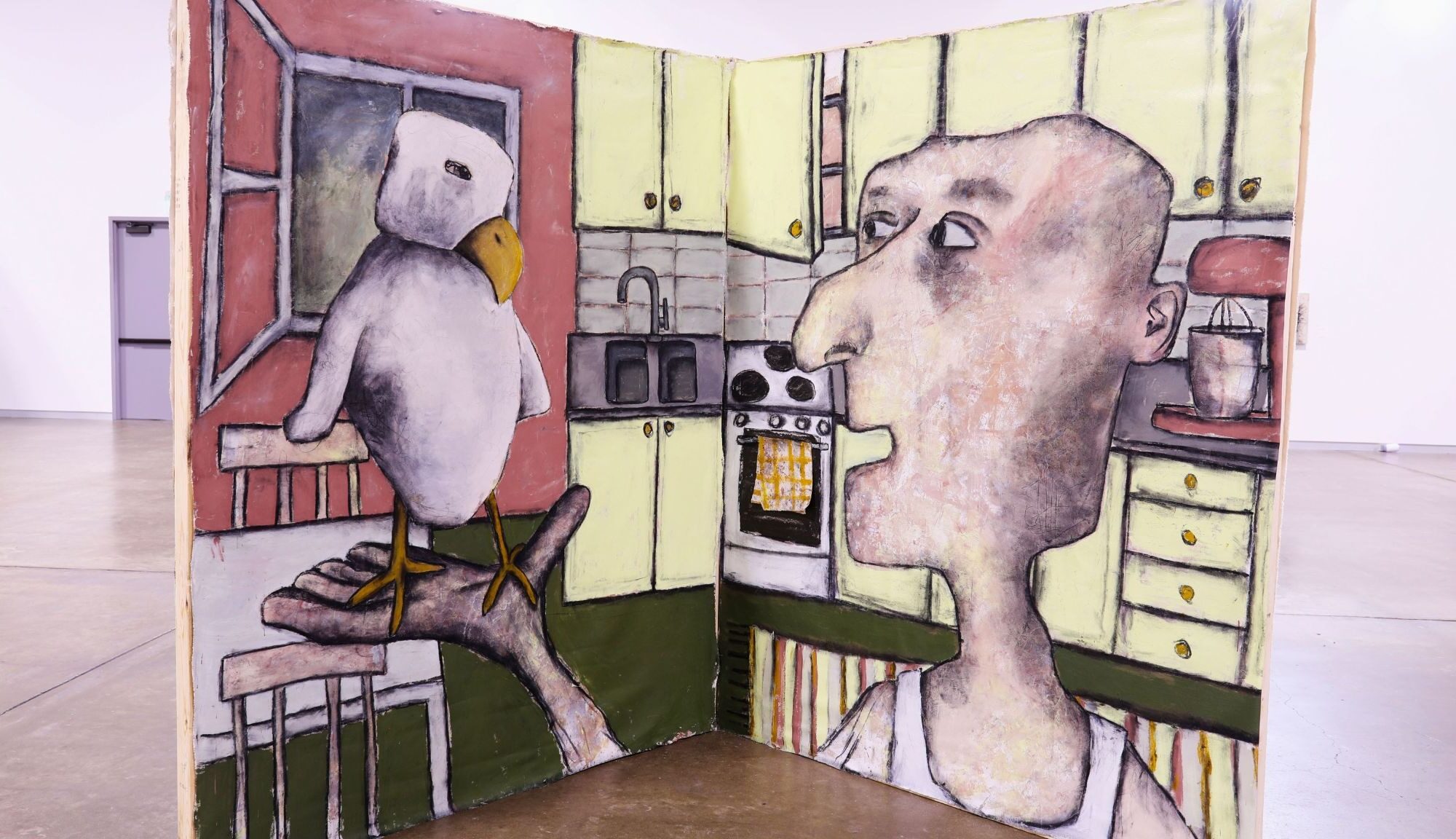
Emelie Stenhammar’s works echo the aims of Elizabeth Murray to reshape our relationship with painting. Cozy rectangular formats are denied. Twisted Perspective prevails. Both artists’ depictions of domestic spaces reflect a mutual fondness for cartoons and whimsy. Stenhammar paints compelling allegory about the human condition, with a compassionate gaze akin to that of Kathe Kollwitz.
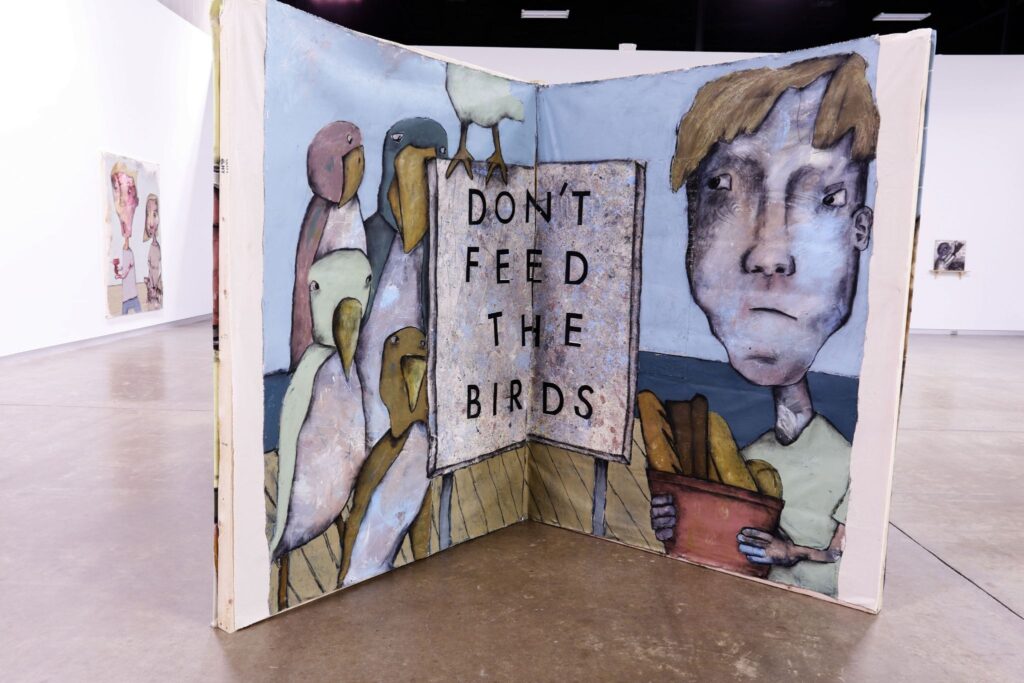
Some of the artist’s human-size constructs invite viewers to walk right into a painting’s own physical space. We are cornered, with imagery on the left and right. A bird’s monocular vision would be helpful here, but humans don’t have it. Our head turned one way in Don’t Feed the Birds, we stand beside a boy holding an offering of bread. Turning our eyes the other way, we stand beside a flock of hungry birds. Stenhammar builds clever wall projections, like stage sets, providing painted space that illustrates interior and exterior scenes, for example, of a humble house. Viewers stand at a closed front door on one side of a large panel, and in the same home’s welcoming kitchen on the opposite side of that panel.
Emelie Stenhammar uses a gentle parental touch in the treatment of her flawed figures. The artist’s take on the human condition is without either Ensor’s pessimism or Rockwell’s optimism. Her figures go through the motions of coping. They tend lawns and maintain cars. Occasionally, in the midst of tedium, they have glimpses of the extraordinary. Apparitions? Visitations? Something happens to leave them dumbstruck, with eyes suddenly wide open, their focus directed outside the frame. We are not privy to what they see, except for the occasional appearance of a lone bird. It is the traditional symbol of winged messengers that bring “aha” moments to earth. Like Caravaggio, Stenhammar has an affinity with the teachings of Ignatius of Loyola, who taught more about miracles as personal private epiphanies rather than empirical physical manifestations.
Stenhammar’s palette is muted for settings, objects and clothing. Vibrant colors appear only on flesh. In her hands, the “envelope,” as she describes skin, features complexions more inflamed than unblemished. Bruised or mottled epidermic conditions of the artist’s large faces and twig-like limbs are further agitated because she paints with fingers more than brushes. Stenhammar compares the skin of the human envelope to the enveloped skin of stretched canvas. It is an appropriate analogy for a once practicing dermatologist.
The artist’s medical education was driven by filial imperatives and allegiance. Over time, she found the personalities and lives of her patients far more interesting than the subject of dermatology. After twenty years’ practice in her native Sweden, the UK, and the US, Stenhammar decided to follow her dream and make art instead. Her paintings respond to the human condition with a sympathetic diagnosis, and a healthy dose of irony.
How Unexpected/Blessed Are the Unsatisfied is the grand tour de force in this mammoth exhibit. It is like a life-sized theater in the round, featuring two-sided views of three subjects: an exterior entry of a modest house, and interior views of the kitchen and bathroom. In How Unexpected, a large seagull seems on the verge of making an announcement, while perched emphatically in the palm of a bemused homeowner. The unusual experience unfolds in an otherwise ordinary 1960’s yellow kitchen. Perhaps a TV dinner is heating in the oven.
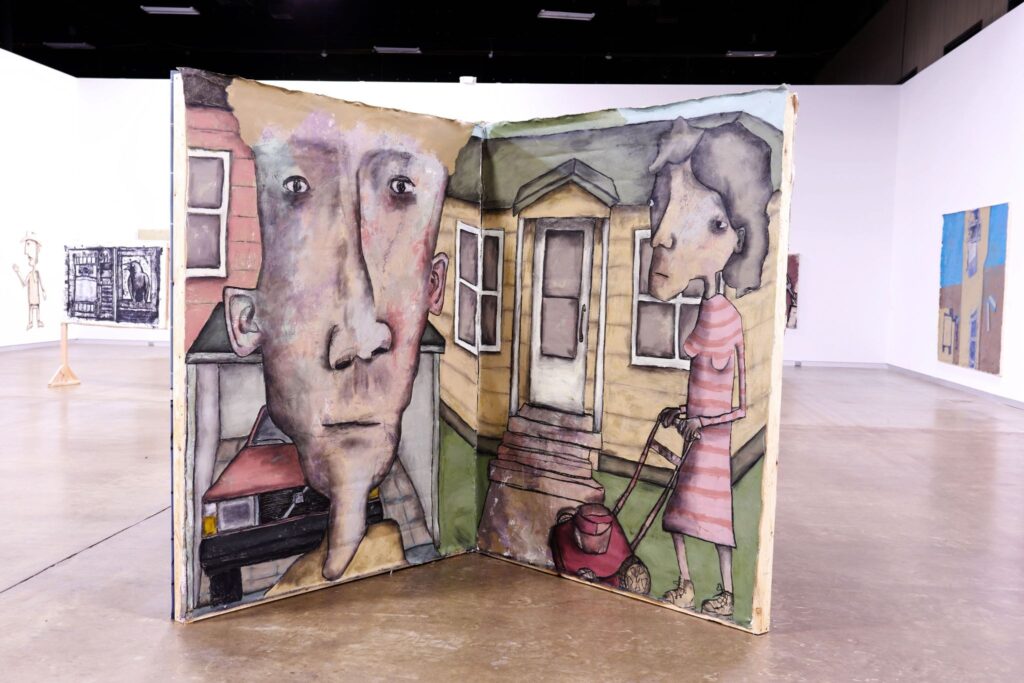
Blessed Are the Unsatisfied is a kind of William Hogarth allegorical tableau. A neighbor stares into space, dumbfounded, frozen still in his driveway. A faded red Volvo is parked half-in, half-out of the garage. His neighbor dutifully mows her lawn, peering down to assure a straight line cut. She pays no mind to the dumbstruck man. After all, it’s not her epiphany or vision that’s being experienced. The man’s big head recalls ancient Sumerian votive statues, with eyes wide open in the presence of the deity.
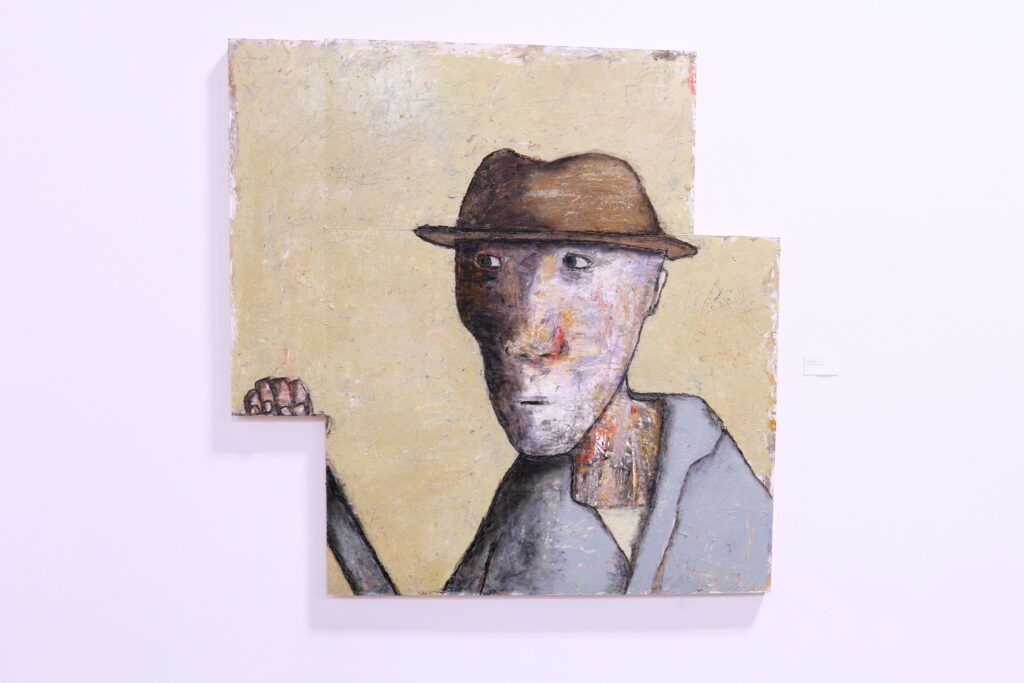
Come and See shows us a man apparently worried or confused by his own epiphany. The mystery occurs just outside the frame of the painting, just out of the viewer’s periphery. We see only the startled man. Come and See notches the frame at upper right so that the gallery wall itself acts like an imposing arrow, pointing toward a worn fedora’s brim. The little hat seems like feeble protection for a human head. A notch at the painting’s lower left offers a supporting ledge or mantel, perhaps for an unsteady, skeptical fellow.
Don’t Feed the Birds is a poignant testament to a common human dilemma. Prompting a moral decision, a posted sign clearly instructs all readers of an official order. A maverick flock of hungry birds surrounds and perches on the warning sign itself. A generous boy tentatively holds a large container of assorted breads, a kind offering to the winged visitors. His teeth are clenched so that his mouth is a closed single downward turned line of frustration. The boy is caught in the jaws of a quandary. Like Hamlet, he’s damned if he does and he’s damned if he doesn’t. The social imperative is that he obey the public order. But he has a choice. Should he feed the hungry birds, or obey the sign’s abstract concept?
The exterior and interior spaces occupied by Stenhammar’s figures are modest, time-worn, abodes. The occupants seem to have done their best toward reasonable upkeep, but one suspects there was never a true right-angle in any structure depicted. Doors and windows don’t rest flush in any jamb. Kitchen cabinets are askew, and no countertop is level. We expect objects to slide off to the floor of a space that looks like a ventured but lopsided version of Cezanne’s universal perspective. Use of a T-Square on the structure will find no honest horizontal or vertical line. In Stenhammar’s skewed suburb, already off-balance residents become even more disoriented during encounters with things unexpected, paranormal, or perhaps divine. The timid actors in her narratives stand on shaky ground already.
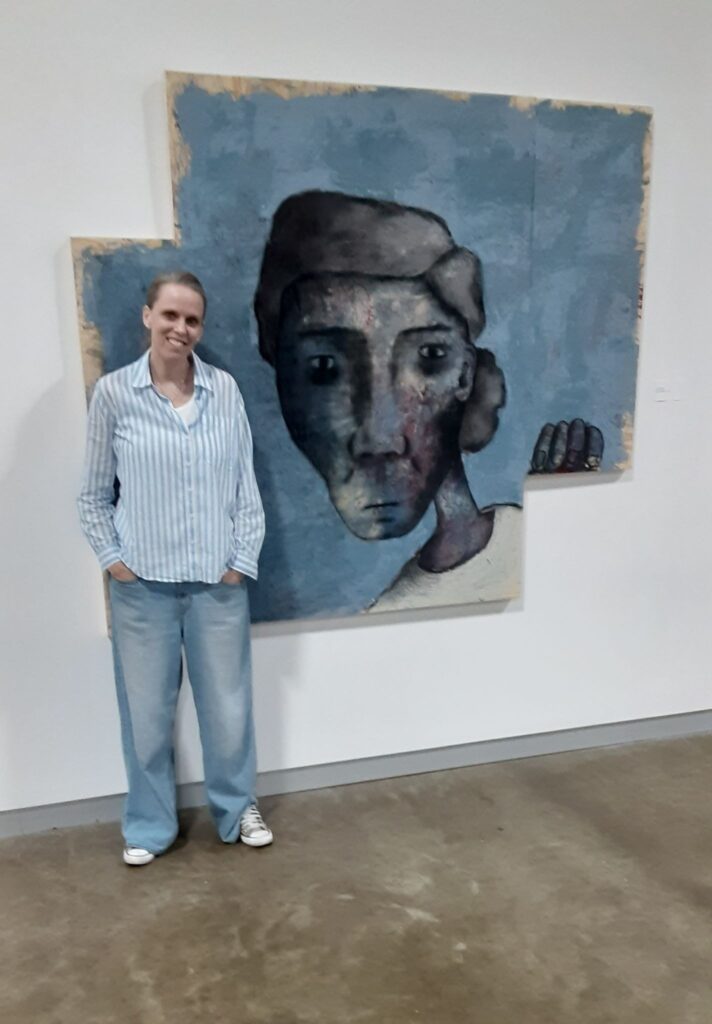
Emelie Stenhammar, How Unexpected, Arlington Museum of Art, Arlington, Texas, June 5-July 26, 2026.
About the writer: Thomas (TD) Motley is a Fort Worth artist and author. Motley’s novels include The Art of Farming: Sketches of a Life in the Country and the sequel, Planting & Painting the Landscape (Aug. 2026 release).