Would you have believed the sun revolved around the Earth? Possibly, since that was the ironclad determination of the bureaucracies in the 16th century. Slavery legally existed in the United States for centuries before there was even the slightest abolitionist movement. Which brings to mind, why do we adhere to beliefs today simply because they are propagated by governments and institutions?
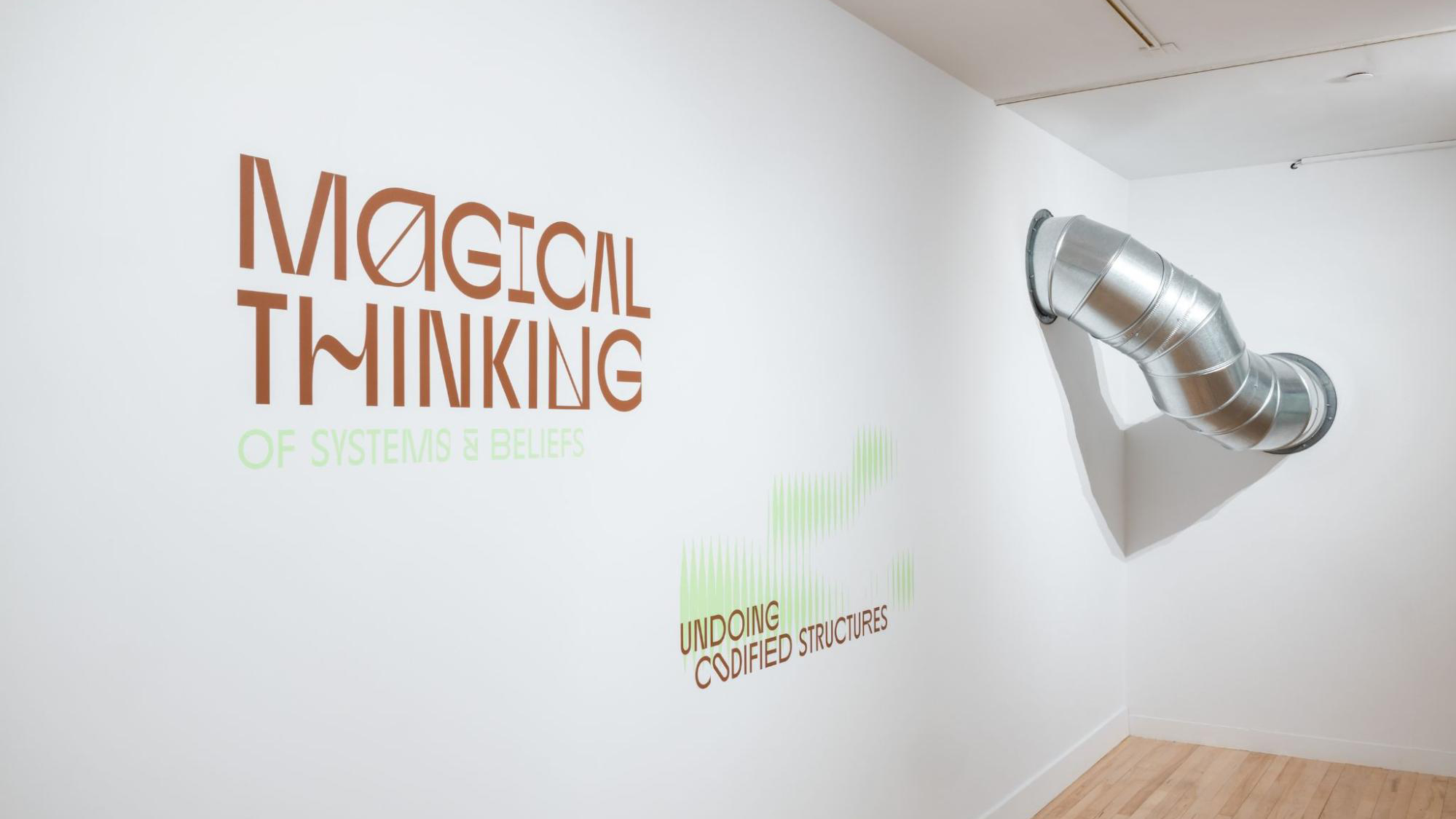
Enter the School of the Museum of Fine Arts at Tufts. You pass the fiberglass rhinoceros guarding the entrance, through the chaos in the lobby, immersed in the creativity of art school, and you arrive at the Tufts University Art Galleries/Boston (TUAG/Boston). On view is Magical Thinking Of Systems and Beliefs, a radical group exhibition curated by the astutely innovative Laurel V. McLaughlin, is now installed.
This show highlights works by the multidisciplinary artists manuel arturo abreu, DB Amorin, Jonathan González, fields harrington, Africanus Okokon, and sidony o’neal, who challenge the concept that what we accept as truth is very often manipulated to serve those in power.
The six artists who occupy two galleries in the exhibition emanate from diverse global south ancestry and hail from New York City to the West Coast. They use research as a medium while being both savvy to traditional and technological methods of innovation. They represent a scholarly progressive methodology of working that utilizes several art forms to produce extraordinary performances, visual installations, and sound pieces. Their art, though vastly different, challenges the perception that the instilled beliefs that embody the systems of the status quo cannot be questioned. These beliefs are often protected from what is construed as superstition or magical thinking arising from alternative cultures.
What is referred to as magical thinking is often reduced, at best, to delusion and, at worst, symptoms of mental illness. This diminishment was often fueled by Western colonization and the obsessive avarice to not only control land, valuable natural resources, and populations, but to ensure there was no alternative article of faith that challenged their dominance.
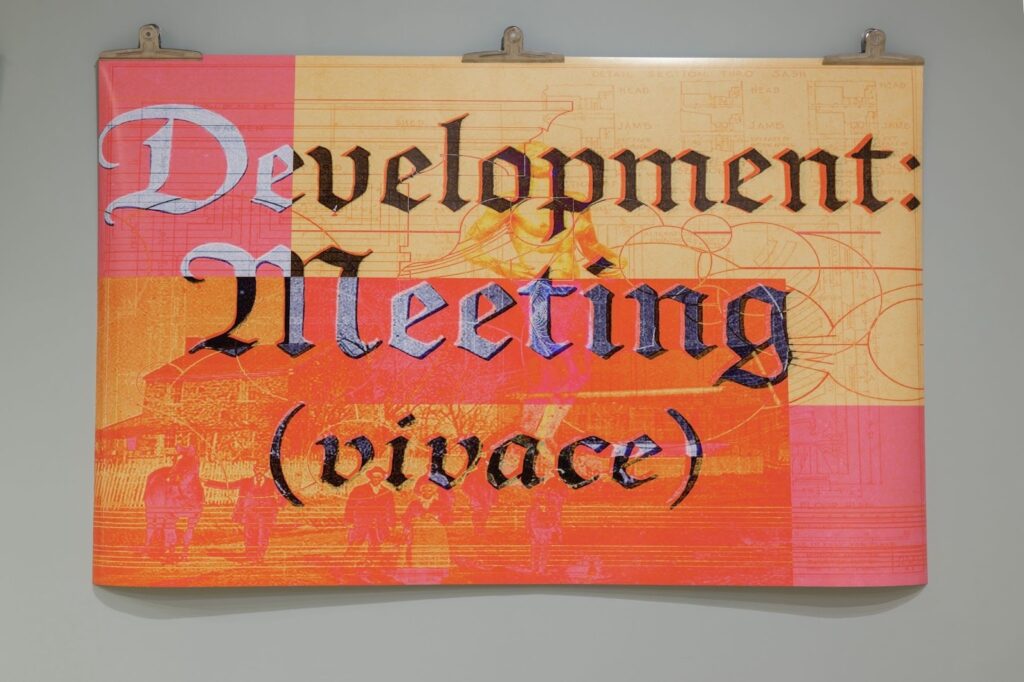
As you spend time in the two galleries, each work challenges the integrity and morality of what we adhere to as truth while questioning why some beliefs are castigated as magic or superstition. Some highlights are fields harrington’s gleaming silver aluminum air vent that addresses the theft of cancerous tissue from a black woman, Henrietta Lacks, that was used to create the HeLa Cell, the first immortal cell used to develop lifesaving vaccines. Another highlight is Jonathan González’s installation, Suite for a Minor Meeting, comprised of a print series, studio work, and performance that pays tribute to the cultural contributions of black artists who, over centuries, confronted the atrocities of slavery and segregation.
A performance on February 28, commissioned by The Museum of African History, Boston/Nantucket (MAAH), that accompanies the installation was presented at the historic African Meeting House, on Beacon Hill, Boston, MA.
Adjacent to González’s installation is sidony o’neal’s mechanical sculpture, Colonel Lagrimas, modeled on the Pankha Fan. Used in South Asia in the 6th century, it required a member of a lower caste to constantly move a tightly woven decorative fiber, back and forth, to provide refreshingly cool air to personages from a higher caste. This was later adapted by British colonialists when they occupied India.
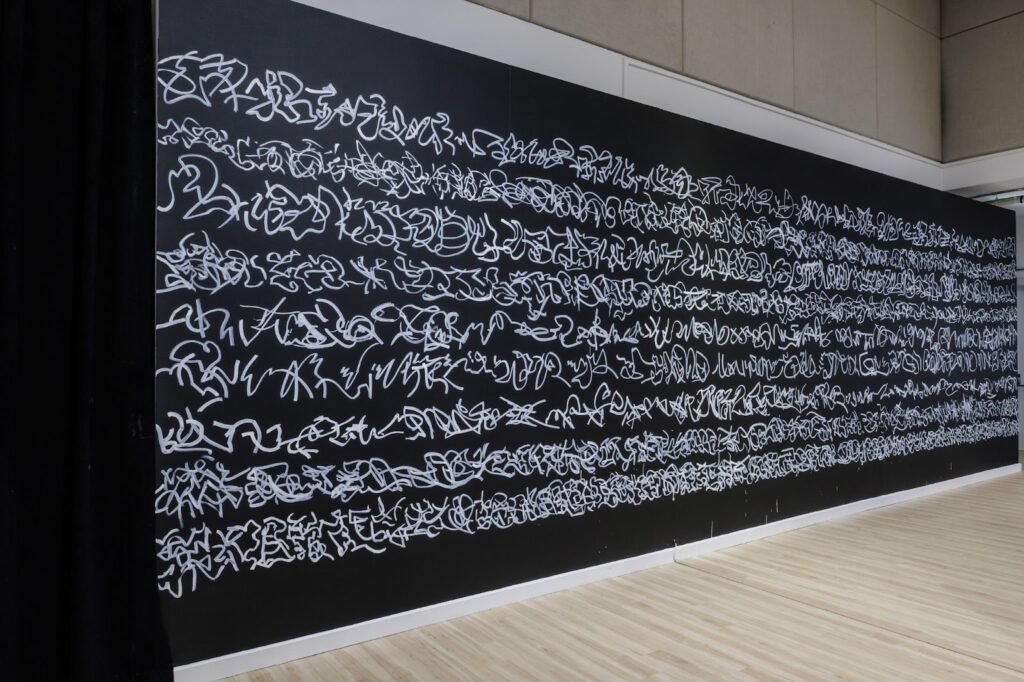
Describing himself as a non-disciplinary artist for using materials found in his environment, manuel arturo abreu, as part of his installation, covers a wall in asemic writing, a type of wordless calligraphy that mimics script. The mural has a sense of spiritual graffiti that simultaneously represents a powerful homage to the decaying records of Dominican civil familial archives.
Africanus Okokon uses his acumen in technology and invention to bring haunting, interactive images to life as he addresses the disappearances of Nollywood actors.
Born in Hawaii, DB Amorin’s relationship to the sea is innately embedded in his being. He sees the Pacific as technology and a signifier of colonialism, indigenous forms of knowledge, and visual cultures. These examples are only a taste of each installation.
As a unified presentation, Magical Thinking of Systems and Beliefs provides a visual discourse for our tumultuous times. It is an in-depth, beautifully organized cultural exhibit that exposes many unconscious and conscious disparities and assumed principles, through traditional and contemporary mediums. The exhibit is on view through April 19, 2026.
About the writer: Sara Farrell Okamura is an artist, educator, and writer with over 40 years of experience. She has received grants from the Illinois Arts Council, MASS MoCA, Assets For Artists, Project, A.R.T. Fund, Martha Boschen Porter fund, and Mass Cultural Council. She will have a solo exhibition at LABspace in Hillsdale, NY, in May 2026 and will participate in a group exhibition at Brickbottom Gallery in Somerville, MA. In addition to Art Spiel, she has written reviews for Brooklyn Rail, Boston Art Review, and Hyperallergic.