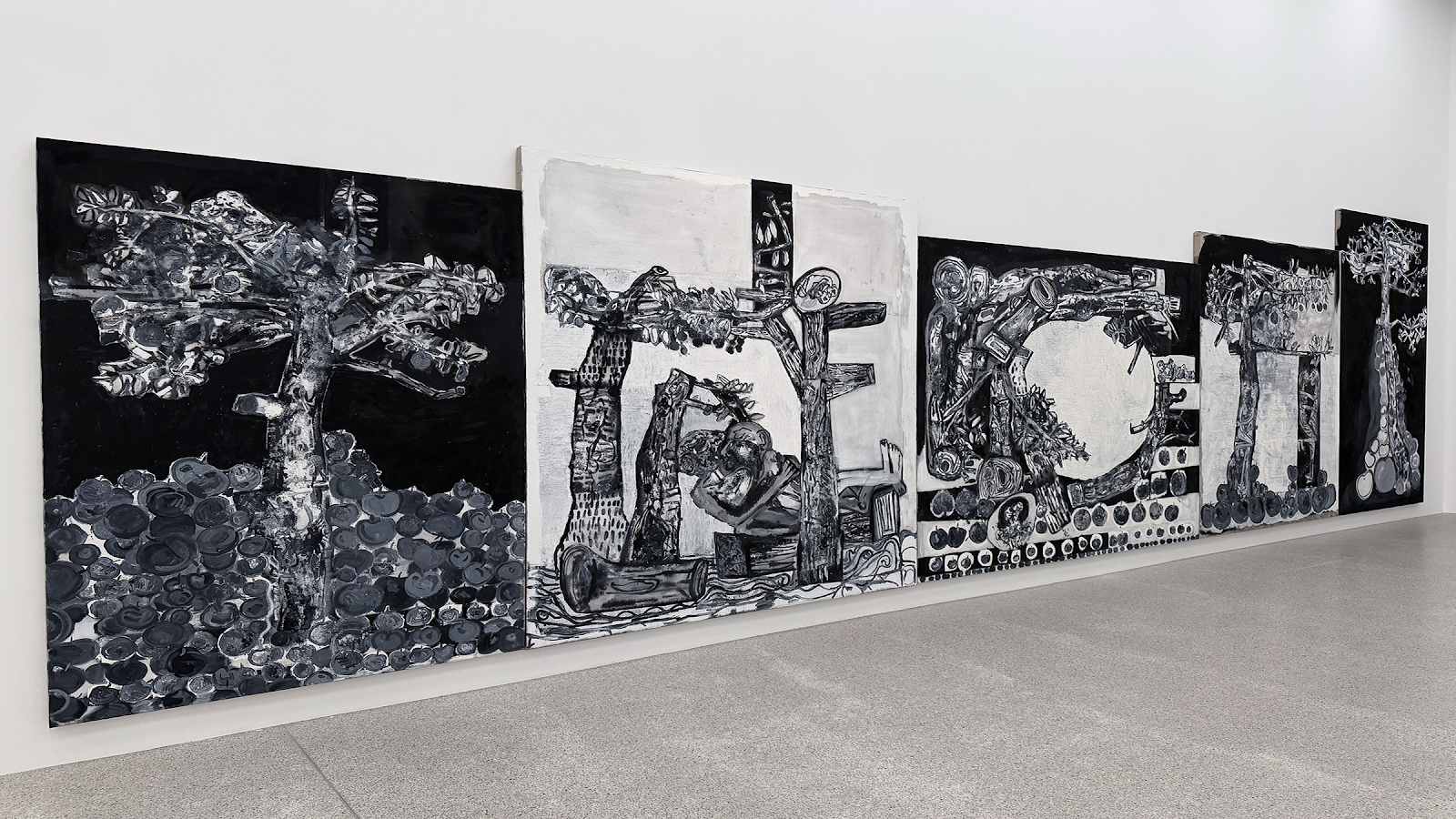
Tobias Pils’s paintings do not give themselves up quickly. It took me two long visits to begin to grasp his extensive solo exhibition at Mumok, curated by Manuela Ammer across two floors and ten years of work. The show traces a practice rooted in personal experience and daily life, charting a shift from floor to easel painting and revealing how drawing and painting remain in constant dialogue throughout. The layout rewards sustained attention and makes the changes over time visible. I viewed the exhibition in reverse, starting with the floor of Pils’s most recent works.
Continue reading “Tobias Pils: Shh at Mumok Vienna”Matthew Wong – Vincent van Gogh: Painting as a Last Resort at Albertina

Matthew Wong and Vincent van Gogh shared more than a self-taught path into painting. Both began relatively late, worked in compressed time spans, and turned to painting as a lifeline. The superb exhibition Painting as a Last Resort, now on view at the Albertina Museum in Vienna, brings their work into intimate and revealing dialogue. The exhibition presents approximately 44 paintings and 12 works on paper by Wong alongside a smaller selection by van Gogh. Organized in collaboration with the Van Gogh Museum in Amsterdam, Kunsthaus Zürich, and the Matthew Wong Foundation, the exhibition gives Wong space to be seen on his own terms. His paintings feel jittery, open, and emotionally charged.
Continue reading “Matthew Wong – Vincent van Gogh: Painting as a Last Resort at Albertina”Assembled Worlds: Hannah Höch at Lower Belvedere

“I wish to blur the firm boundaries which we tend to delineate around all we can achieve,” Hannah Höch once said, challenging the rigid limits that society often imposes on creativity, identity, and social roles. This sentiment resonates deeply throughout the Assembled Worlds exhibition at Vienna’s Lower Belvedere, curated by Martin Waldmeier from the Zentrum Paul Klee in Bern. This major showcase of Höch’s work in Austria feels long overdue, bringing together around 80 of her photomontages, alongside paintings, drawings, prints, and archival materials. Together, they offer a vivid glimpse into her groundbreaking contributions to 20th-century art.
Continue reading “Assembled Worlds: Hannah Höch at Lower Belvedere”Splendor and Misery at Leopold: New Objectivity in Germany

”BRUTALITY!
CLARITY THAT HURTS […]
BRUSH AS FAST AS YOU CAN –
TRY TO CAPTURE RACING TIME“
—–George Grosz
Nearly a century after the Weimar Republic’s brief, chaotic existence, curator Hans-Peter Wipplinger presents Splendor and Misery: New Objectivity in Germany at Vienna’s Leopold Museum. This comprehensive exhibition, the first of its kind in Austria, brings together around 150 works—100 paintings, 40 works on paper, photographs, and archival materials—from international museums and private collections. Born from the ashes of World War I, Neue Sachlichkeit offered a stark, unsentimental portrayal of reality, capturing both the hardships and the hopes of the “Golden Twenties.” The show features a lineup of key figures of modernism, such as Max Beckmann, Otto Dix, George Grosz, and Christian Schad, alongside lesser-known artists such as Heinrich Maria Davringhausen, Karl Hubbuch, Grethe Jürgens, Lotte Laserstein, Felix Nussbaum, Gerta Overbeck, Rudolf Schlichter, and others, who each captured the era’s spirit with an unflinching eye.
Continue reading “Splendor and Misery at Leopold: New Objectivity in Germany”Nicola Ginzel: How Do You Restructure Form?
Featured Project

In March 2020, Nicola Ginzel arrived at the Q21 Art Residency at the Museumsquartier in Vienna, Austria. This residency, which hosts international artists and selects one American artist every two months with the support of a Fulbright Scholar Grant, is designed to foster creative exchange through collaboration, networking, and studio visits.
Continue reading “Nicola Ginzel: How Do You Restructure Form?”Tell me, where did you START? Conversations with Designer Robert Stadler

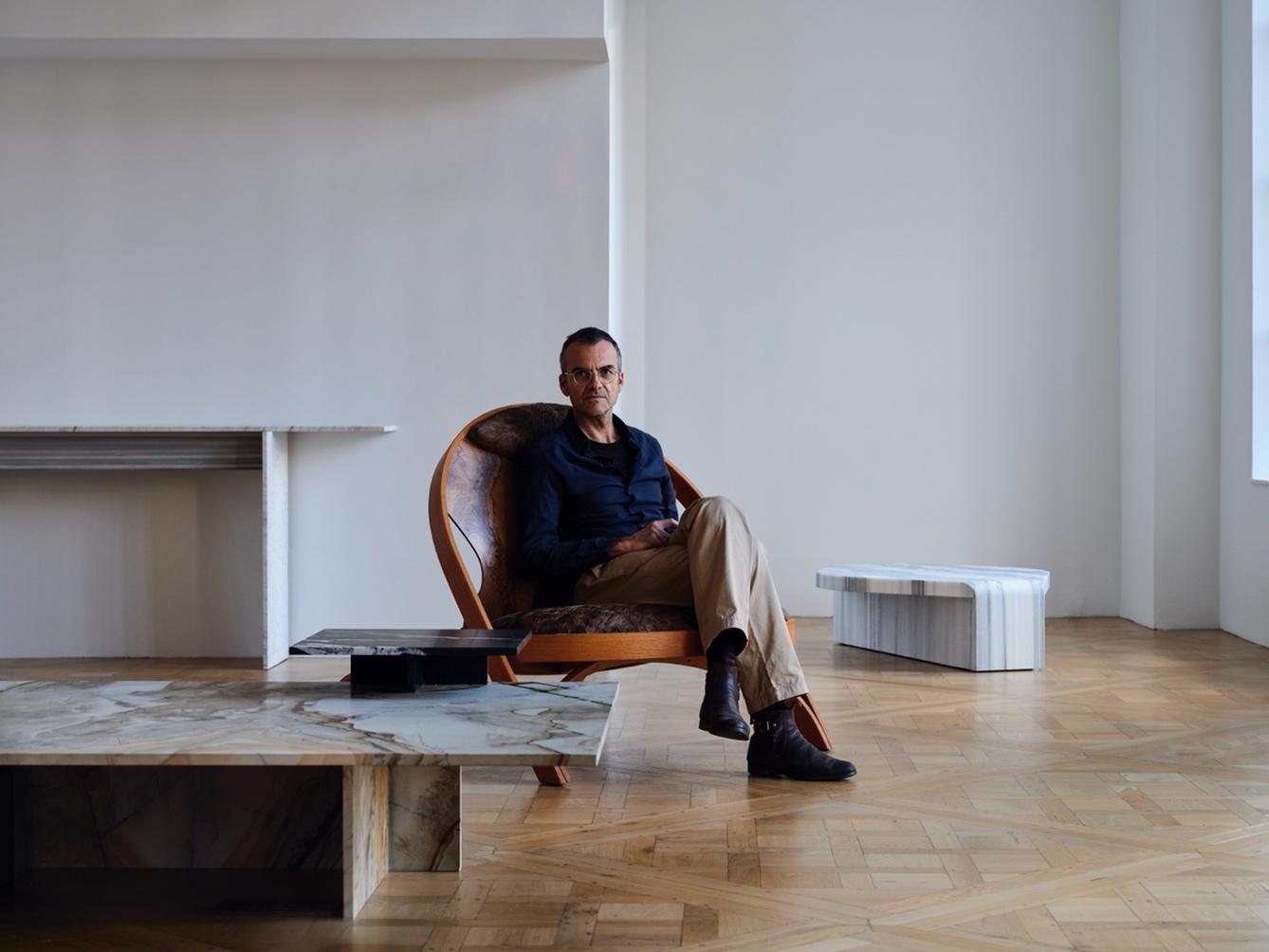
Before my first Facetime conversation with the Austrian designer Robert Stadler, I had looked through images of his works but I did not know much about Stadler himself. Going into our first ‘meeting’ I wanted to get to know him, his personality. What kind of questions could I ask him? What would be the mood of our dialogue? Would we get along? Would Stadler be stiff and severe? Humorless? Well, I had no need to worry. From the moment we greeted each other, his personality came through. Stadler is soft-spoken, easy to laugh, kind, open to converse on whatever topic, and most importantly does have a sense of humor that seeps into most of his work.
Continue reading “Tell me, where did you START? Conversations with Designer Robert Stadler”