What starts as an open call and a group text to trusted friends becomes, two years later, an exhibition that feels inevitable. Seven Women Chase Icebergs, on view at The Re Institute in Millerton, NY, brings together seven painters whose friendships span decades and continents: Rome, Skowhegan, Triangle, Braziers. Organized by Brooklyn-based artist Brenda Zlamany — creator of The Itinerant Portraitist and a painter whose practice has long centered on community as both subject and method — the show grew from a month-long residency at Pouch Cove, Newfoundland, where the group painted, hiked, shared meals, and chased icebergs along the edge of the Atlantic. We spoke with Zlamany about friendship as curatorial logic, landscape as psychological mirror, and what it means to build something together at the edge of the world.
The proposal was written in under an hour, submitted just before the deadline, and somehow it worked. What do you think made it land — and what were you hoping for when you hit submit?
As artists, we apply for many things that we don’t get. My batting average is probably one in five. When I saw the Pouch Cove open call, two things caught my attention immediately: a landscape I’d never experienced, and the fact that it required a group. That second part was a challenge and an opportunity at the same time. Much of my work involves community — The Itinerant Portraitist is fundamentally about bringing people together — so assembling a group of painters I’d known for decades and pointing them at the edge of the Atlantic was not just appealing but natural.
I wrote the proposal in under an hour. I don’t always do exhaustive research in advance of an application — there’s no guarantee, and too much planning can talk you out of taking the leap. I invited the first group of talented women who answered my text, hit submit, and forgot about it entirely. The application was due in July 2023. The residency wasn’t until May 2025.
When we were invited, I was surprised. Looking back, I think what made it work was that the friendships were real and the concept was simple: women who had known each other since Rome in 1980, since Skowhegan in 1984, since the Braziers International Artists’ Workshop in 1997, going somewhere remote together to see what the landscape and being together would do to the work.
These friendships stretch back decades — Rome, Triangle, Braziers, your portrait projects. How does that shared history change what happens when seven painters are suddenly in the same remote landscape?
When you’ve known someone for forty years, when you’ve painted their portrait, when you’ve critiqued each other’s work across decades, you don’t have to be careful.
I was the gravitational glue — I had history with everyone, but not everyone knew each other. Some were meeting for the first time. That asymmetry was actually interesting: I could see connections between people and practices that they couldn’t yet see themselves, and that became part of the curatorial work later.
Gill Ord is someone I met at Anthony Caro’s Triangle Workshop in 1990, and she’s been an inspiration to me because of her involvement with the Braziers International Artists’ Workshop — a community built entirely around artists supporting artists. That ethos runs through much that I try to do, from The Itinerant Portraitist to this residency. Every woman in that group had sat for my portrait project at some point. The invitation wasn’t random.
As the group evolved — some original members had to drop out due to other commitments — I found myself adding artists whose practices were more diverse. What started as a more figurative, landscape-driven group changed to painters who pour, painters who work from direct observation, painters who are almost completely abstract. Karen Marston was already at Pouch Cove working independently and joined us along the way. By the time we arrived, we had a real range, and the differences made it interesting. Everyone in the group had a long commitment to the work and a deep respect for each other’s practice.
The group shifted between the residency and the show. How did that affect what ended up on the walls, and what held the project together through those changes?
The structure held it together. We had open studios several times during the residency, including a final open studio where all the work was seen together and an exhibition at the end. I organized critiques with specific focuses: one session was about sharing materials and how we each used them, which was fascinating for a group of painters who had been out of school for a long time. We went out into the landscape, painted side by side, shared ideas. We chased the icebergs. All of us were there painting, hiking, braving the elements.
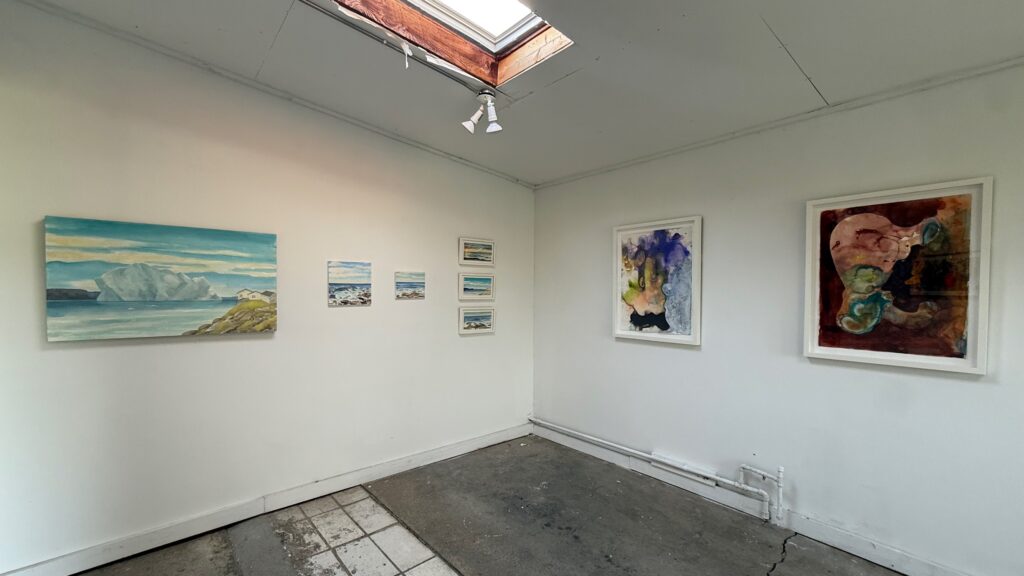
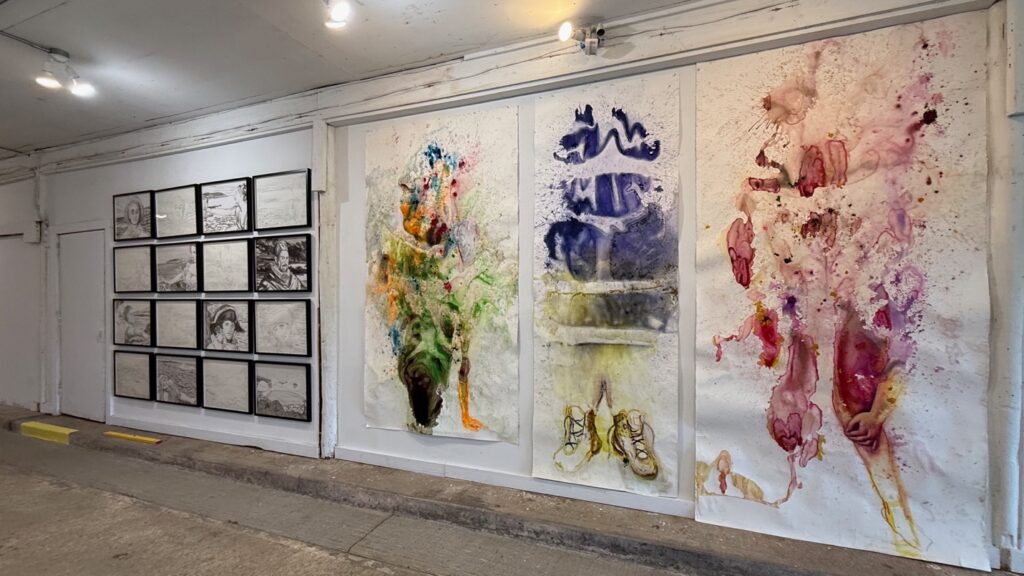
But what really surprised me was the installation. By the time we got to The Re Institute on exactly our one-year anniversary, it was like seeing the work for the first time. I had significant anxiety about whether it would hold together — seven distinct practices, a year’s distance from the landscape, work made in very different emotional states. And then something happened on the walls that I hadn’t fully anticipated: the work spoke to each other in ways that had been difficult to see in individual studios.
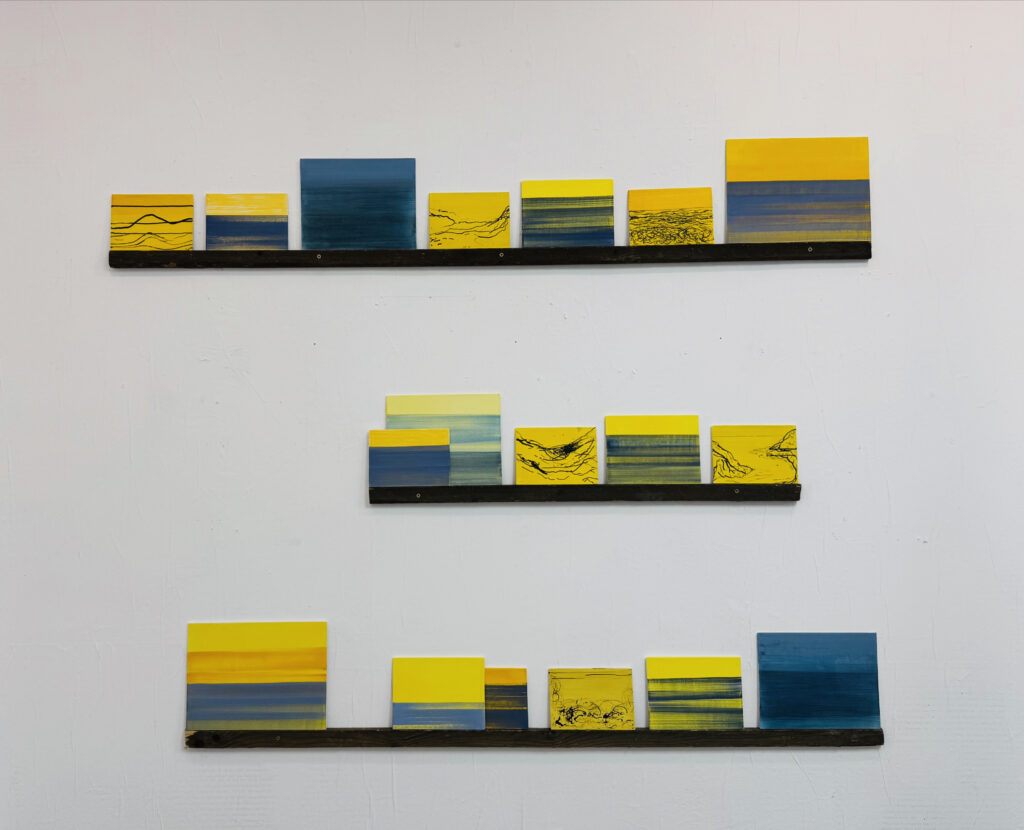
I made a deliberate decision to mix genres — no figurative ghetto, no abstract ghetto. I played with scale. Daisy Craddock’s small flower paintings were hung near Barbara Friedman’s massive scrolls, and we watched the yellow dandelions dissolve into Barbara’s yellow drips, splatters, and pours. I hung my Rake’s Progress series alongside Gill’s seemingly more abstract paintings, and suddenly you could see the horizon line running through both.
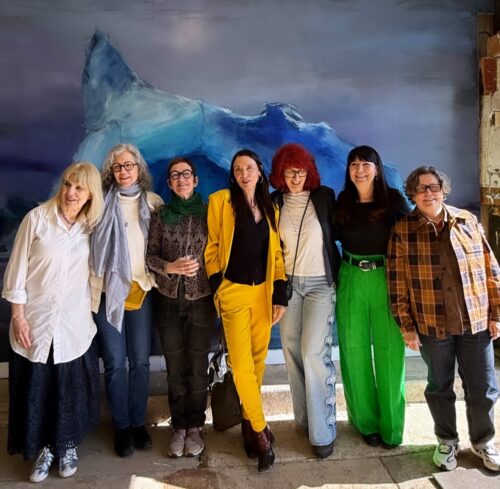
One of the criteria for the show was that everyone exhibit work made in Newfoundland, but Karen had left most of her work there. So I came up with the idea that she should paint a large iceberg mural directly on the barn wall and Henry Klimowicz agreed. I was thrilled when she said yes! She had spent a great deal of time painting icebergs, and approached it with a wonderful energy and confidence.When you enter the barn, you see Karen’s iceberg mural against the bright green of the grass outside. Two landscapes, one image.
Can you walk us through a specific moment in Newfoundland — a painting session, a hike, the iceberg — that crystallized something about the work or the place?
I don’t think it was a single moment — it was more like a gradual accumulation that I only understood in retrospect. What I remember is the women showed up wanting to connect. I believe there’s a real hunger for that, especially at a moment when parts of the art world can feel transactional. We fell into sharing meals together every night almost immediately, taking turns cooking, hiking together in the mornings.
The show features seven distinct practices responding to the same landscape. How did you navigate that range as curator — and how does your own series, A Rake’s Progress, sit within it?
As a curator, my instinct was to let the differences speak. What I was looking for in the installation was not harmony but dialogue — places where very different practices would inform each other unexpectedly.
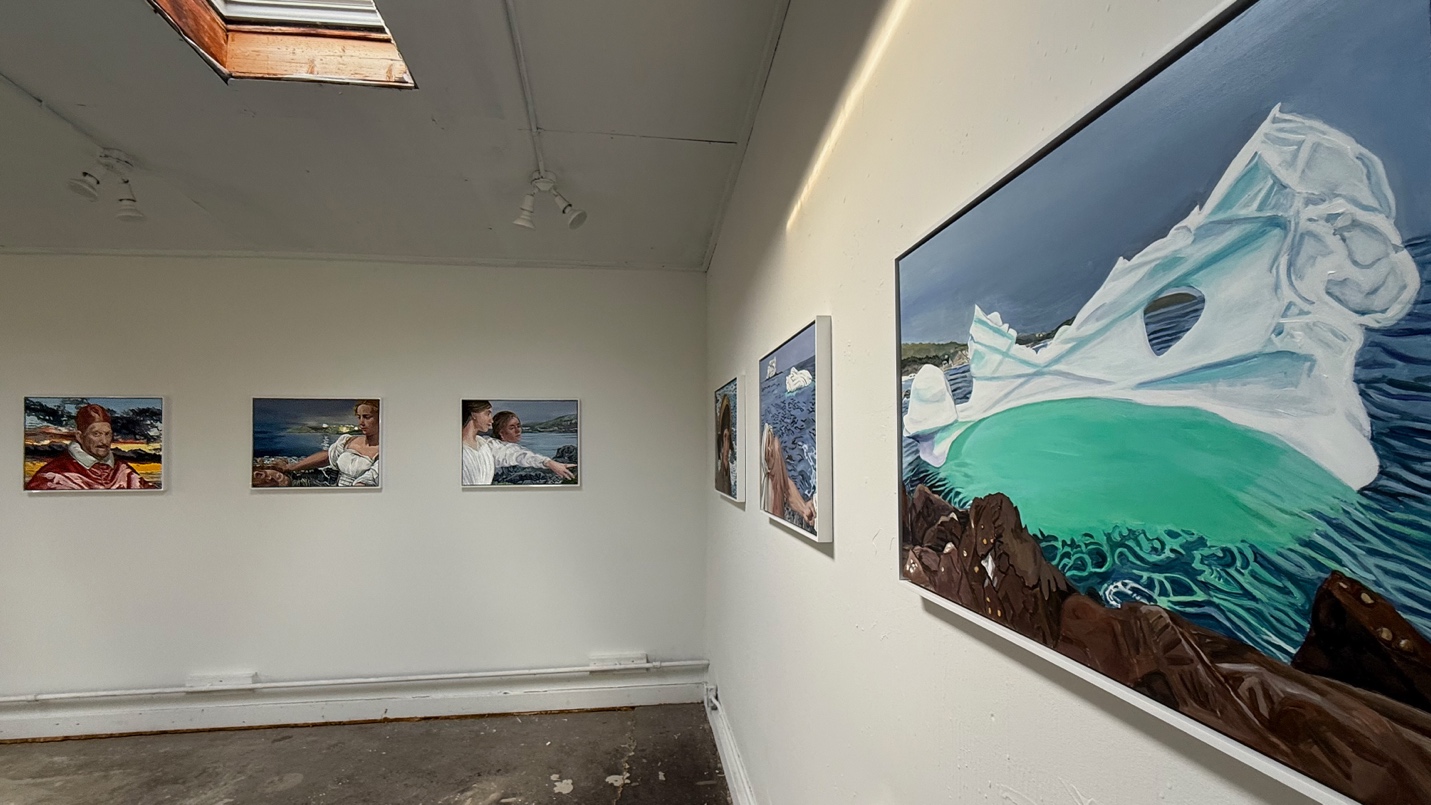
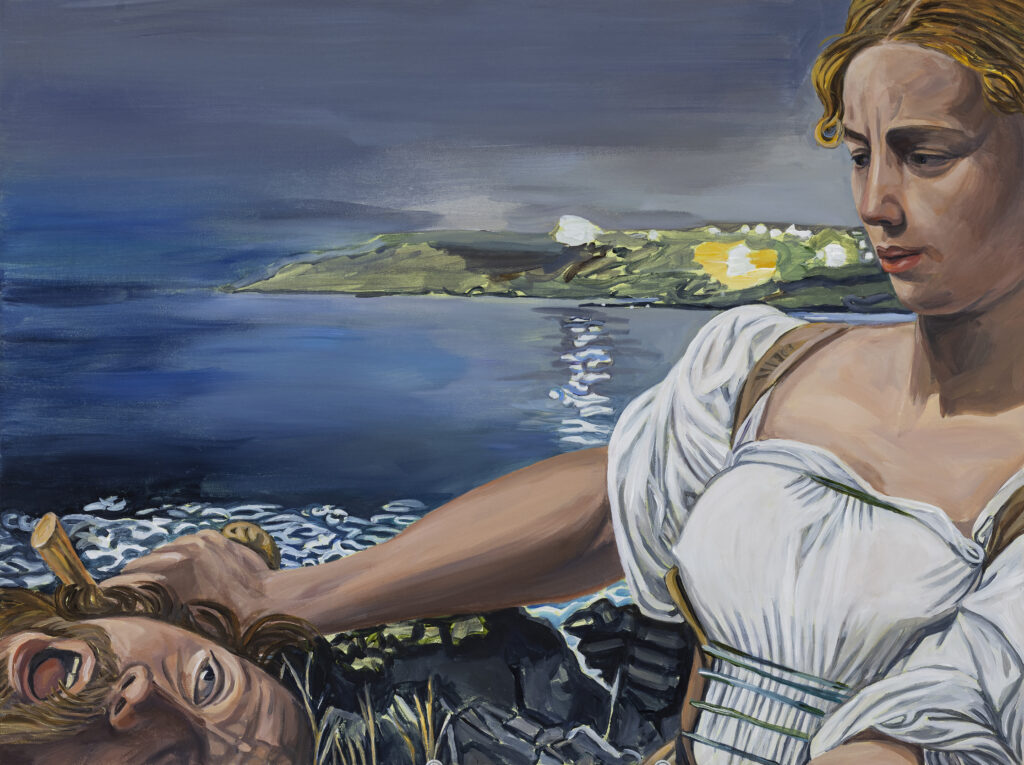
My own series sits at the figurative end of the spectrum, but it’s not really landscape painting in any traditional sense. A Rake’s Progress is eight paintings made in just under a month — a psychological journey through the landscape using figures from art history as mirrors for my own internal weather.
It began with discomfort. I am a native New Yorker. I don’t hike alone. From that unexpected first painting, the series grew almost like a diary.
Each painting began with plein aire watercolors. Back in the studio, I would ask myself a simple question: How do I feel about this place today? Then I would search art history for a figure who embodied that state.
Sunrise Welcome is Madame X raising a glass to the coastline at daybreak. It’s a toast to the adventure. A tentative embrace.
The Reflection came when I realized I was living between two identities. I love cities. I was also beginning to fall in love with the rocky coast. The painting became a portrait of that duality.
Then something else happened. The work started going well. Maybe a little too well. The Hero is Napoleon — secure, triumphant, perhaps a little insufferable. The conqueror of my own fears.
By the time we left in search of icebergs, the series was changing again. In À votre bienveillance, I become Marat. It is less about death than surrender — a letting go of control, certainty, and ego.
And then came Ghostberg.
I had seen dozens of icebergs in Newfoundland. Majestic ones. The kind Church or Friedrich would have painted. But I realized I wasn’t that iceberg. I was the trickster. The funny one. Almost Mickey Mouse. Not majestic, but unmistakably present. Turquoise is my birthstone color — and that iceberg with the turquoise pool felt strangely familiar.
In Ghostberg, the figure disappears entirely. The artist is no longer depicted. She has become the landscape.
The artists’ quotes suggest very different responses to the same landscape — vertiginous, festive, personal, elemental. Did you anticipate that range, or did it surprise you?
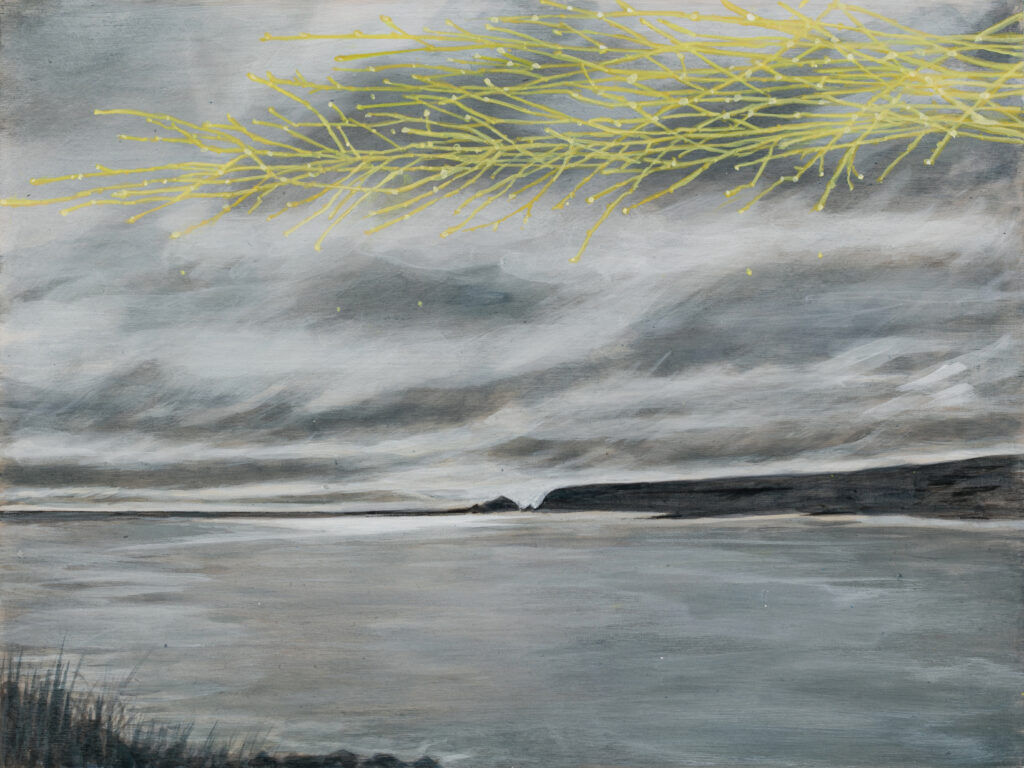
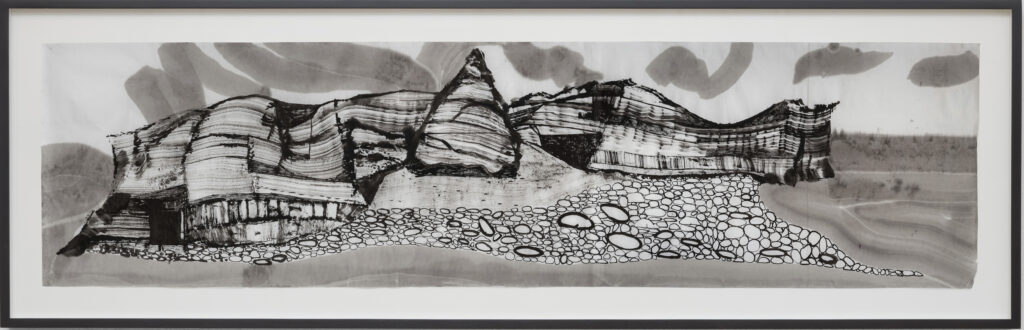
I anticipated it — because I knew these women. Trine Bumiller had just lost her mother, and Newfoundland, sitting just across the Atlantic from her mother’s native Denmark, became something deeply personal for her, a landscape of grief and memory. Barbara Friedman worked late into the night pouring paint and coaxing figures out of the effluvium — fundamentally abstract but haunted by the figurative. Daisy Craddock was out in gale-force winds with her gouache, wrestling with the savage beauty of the rocks and tuckamores. Elisabeth Condon was rediscovering mountain-water painting, layering ink and mulberry paper in response to the primordial cliffs. Gill Ord was walking the East Coast Trail, collecting seafaring light, painting with twigs as she responded to the weathered timber of old fishing stages.
What surprised me was how much we pushed each other. The environment was unusually generous — no competition, just curiosity. I had never heard of Yupo before Barbara mentioned it, and within days I was doing a series of ink drawings on it. That kind of cross-pollination doesn’t happen in individual studios. It happens when you’re all in the same place, sharing meals, sharing materials, watching each other work.
But the moment that crystallized my own work came early, in my studio. I had made an awkward first painting — Pierrot standing in the landscape, uncomfortable, out of place. I didn’t fully understand why I’d painted it. Elisabeth Condon came in, looked at it, and said: “Stranger in a strange land.” That became the title and kicked off A Rake’s Progress. At that moment I realized the series would be a self-portrait — not just one painting, but a journey. Everything that followed came from that.
What we created in that month is a remarkable body of work. The place demanded nothing less.
Next I realized the landscape wasn’t really the challenge. The challenge was me. Reckoning at the End of the Day places me in the role of Pope Innocent X, sitting with my own doubts, fears, competitiveness, and insecurities. Cutting Loose is Judith slaying Holofernes — not someone else, but the parts of myself that were getting in the way of the work.
The Re Institute is housed in a barn on a forty-acre working farm in Millerton. What does that setting do for the show — and what are you hoping visitors take away when they make the trip out?
The setting is everything. Henry Klimowicz has built something at The Re Institute that operates on the same philosophy as this project: an artist creating a space and an opportunity for other artists, with real generosity and commitment. This is my second show with Henry — the first was right after Covid, when I showed six hundred portraits from The Itinerant Portraitist. That show was also about community. Henry understood immediately what this one was about too.
The barn itself is a 1960s hayloft on a working farm. It’s rough, it’s generous. There are individual sections within a large continuous space. The architecture suited us perfectly — a group of artists who share a common experience but have distinct, independent practices. You move through the space and encounter one conversation, then another, then another.
The show is as much about the work as it is about the experience. What I hope visitors take away is that it matters for artists to build communities, to create opportunities for each other, and to be generous.
In the beginning, we started a WhatsApp group called Pouch Power Women, and even now, a year later, if someone spots a spectacular iceberg on a Twillingate Facebook page they’ll share it with the group and we’ll all weigh in. That’s what happens when you’ve seen icebergs together. Once you’ve stood at the edge of the Atlantic and watched one pass — ancient, indifferent, luminous, alive — something shifts. You’re not the same painter you were before. As a group we experienced that transformation together.
Make your tax-deductible donation today and help Art Spiel continue to thrive. DONATE
About the artist: Brenda Zlamany is a Brooklyn/Calabria-based painter whose work reimagines portraiture as a civic and psychological act. She is the creator of The Itinerant Portraitist, an ongoing global project spanning more than 3,000 portraits. Her work has been exhibited internationally, including at the Brooklyn Museum, the Taipei Museum of Contemporary Art, and the National Portrait Galleries in London and Washington, DC. Her paintings are held in the collections of the Cincinnati Art Museum, the Virginia Museum of Fine Arts, Yale University, and The Rockefeller University, among others. She has completed major institutional commissions for Yale and Rockefeller University, and her work has been reviewed in The New York Times, The New Yorker, and Artforum. She is the recipient of a Pollock-Krasner Grant and a NYFA Fellowship, and a two-time Fulbright Scholar, most recently awarded a fellowship to Italy, 2026–27. Her portrait of David Hockney is currently on view at the Laing Art Gallery in Newcastle.
About the writer: Etty Yaniv is a Brooklyn-based artist, writer, curator, and founder of Art Spiel. She works in installation, painting, and mixed media, and has shown her art in exhibitions across the United States and abroad. Since 2018 she has published interviews and reviews through Art Spiel, often focusing on underrecognized voices and smaller venues. More about her art can be found at ettyyanivstudio.com and on Instagram @etty.yaniv