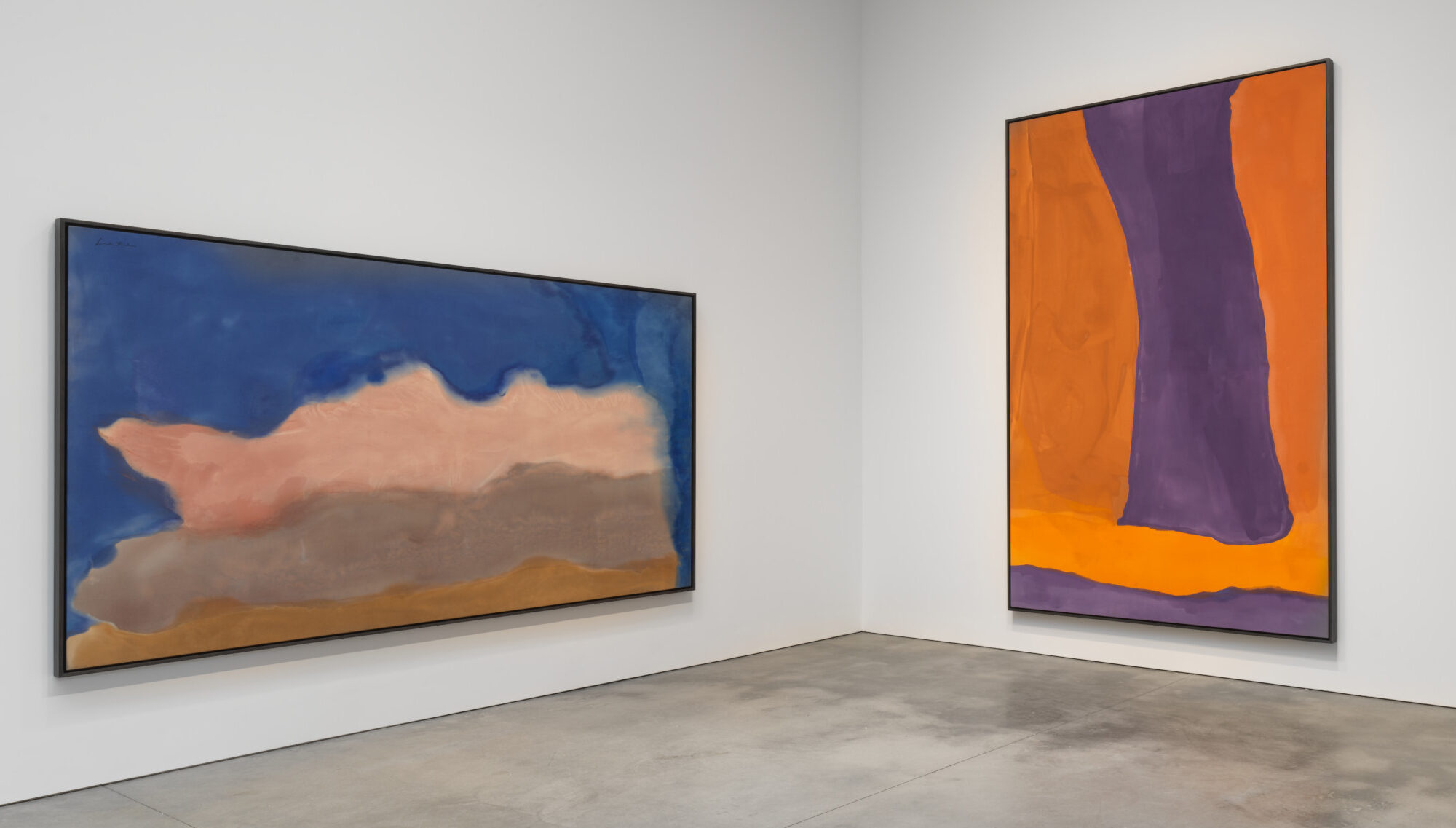
Helen Frankenthaler’s show at Gagosian New York, The Moment & The Distance is a beautiful retrospective survey of her work. The title is inspired by a mid-career essay by Barbara Guest that encapsulates the essence of Frankenthaler’s work. In the 1975 essay Guest defines Frankenthaler’s oeuvre in terms of music. She reflects that while there is beautiful “humming” in Frankenthaler’s early work, over her career it becomes “song”. As her work matures, Guest argues, Frankenthaler becomes more decisive, methodical and assured in her practice, less spontaneous or reliant on happy accidents. Beyond demonstrating the present moment in the paintings, she walks the effortful distance to “consolidate her terms”.
Barbara Guest, a poet and writer, and Helen Frankenthaler, painter, were colleagues and friends. In their respective art practices, they share an artistic sensibility in their feminine and bold use of color, perpetual habit of taking intuitive flight and landing, and interest in gleaning spiritual insights from nature. Guest’s poetry is often inspired by visual art, and her writings are incredibly colorful and abstract, beautifully complementing Frankenthaler’s work.
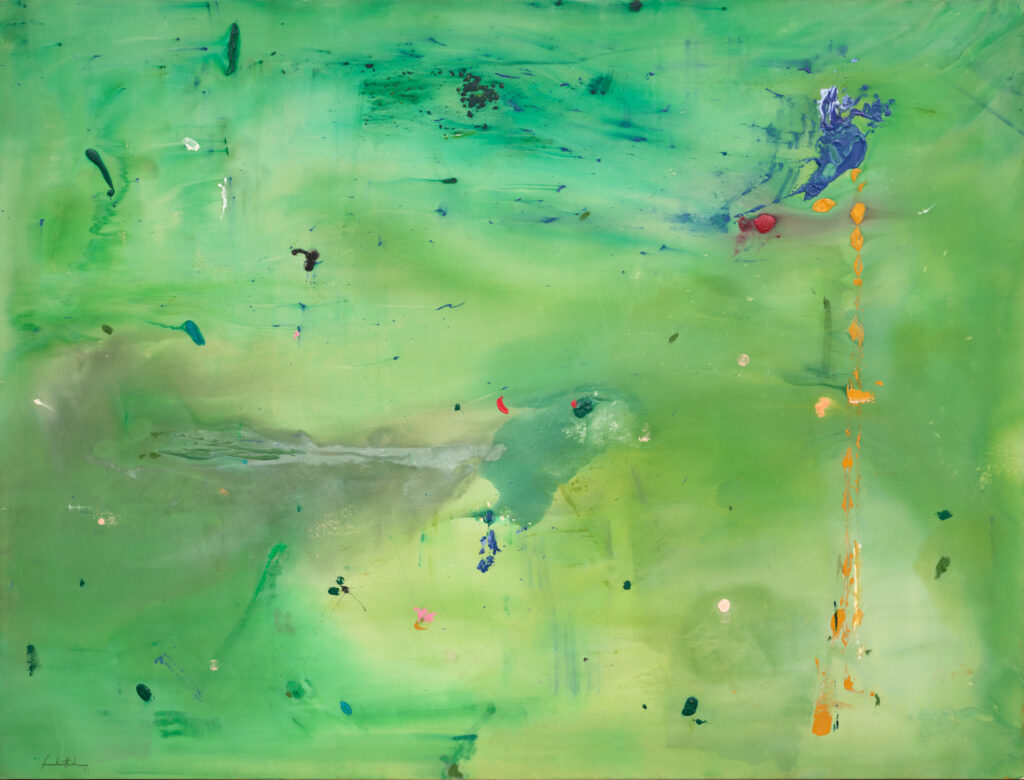
In Barbara Guest’s poem Noisetone, she refers to the impact of the color green. “An artist may take introspective refreshment from green […] The spirit is lifted among primary colors.” Refreshing one’s self with green is a beautiful image, drinking it in from interacting with a watered lawn or a Crème de Menthe, as the poem suggests. Frankenthaler’s A Green Thought in a Green Shade (1981) embodies precisely this possibility. The viewer can drink in her overwhelmingly large painting, which immerses you in translucent layers of apple, lime, forest, and lawn green. Across its surface, splashes in red, yellow, white, black, blue, pink and green swim atop and between layers, sometimes sitting dryly on the surface, and at other times smudged, liquid, applied into wet layers. The effect recalls Monet’s waterlilies, Rothko’s color fields, and Pollock’s drips at once, yet remains distinctly Frankenthaler’s own. The painting prompts the viewer to consider pictorial space as thought. It presents an assured thought, with a rain of playful speckles across its surface that may be doubts, feelings, tiny movements floating, appearing and dissolving across a vast and steady green truth. In her poem Roses, Guest writes that “there are certain illnesses that require air, lots of it.” Frankenthaler’s A Green Thought provides plenty such breathing room.
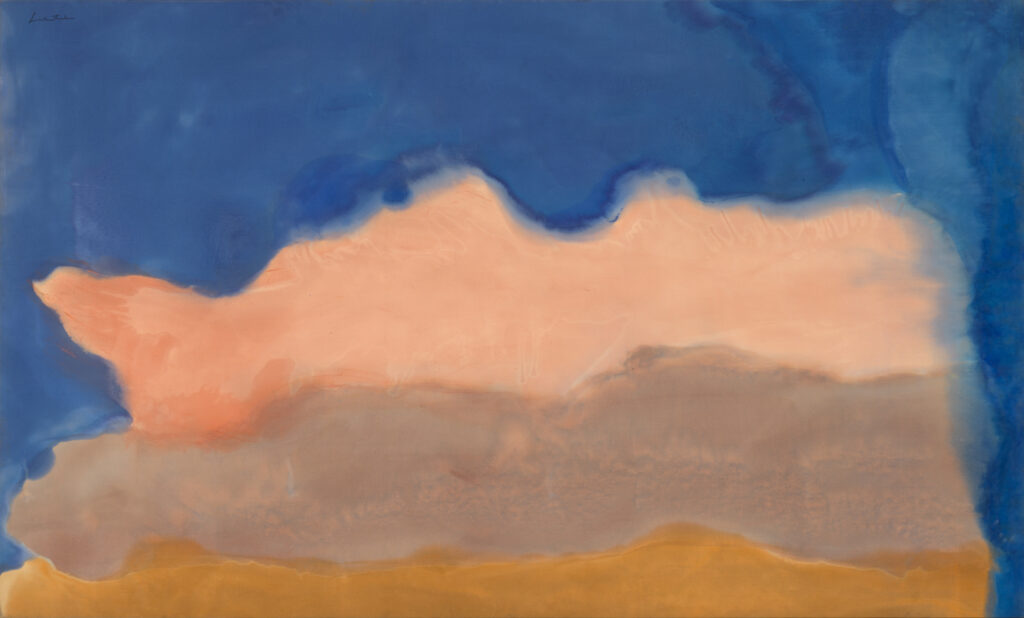
While green refreshes, colors lift the spirit in multitude ways. Moontide (1968) fills the soul with strong, silver energy, without ever depicting the moon. A royal blue background frames two organic pale pink and gray forms stacked atop each other, laid on a golden brown earth. The painting buzzes with the aura of a moonlit night in the vastness of the sea, an illuminating effect. Guest uses a similar device in Wild Gardens Overlooked by Night Lights in which building up a delicately colored seaside scene stirs an inner wind, evoking feelings in a way a song might.
Such moments help illuminate Guest’s claim that Frankenthaler’s work hums. These early paintings possess a vibratory quality. Influenced by Kandinsky, Klee and Surrealism, they revel in spill, accident, and improvisation felt in the body. Their lines wobble, their stains wander, self-consciously. In these early choirs of humming, Frankenthaler takes risks in her pouring technique that speak to tie-dying and marbling, uses bold colors, and revels in the joy of spill before habit sets in.
Helen Frankenthaler Foundation, Inc. / Artists Rights Society (ARS), New York
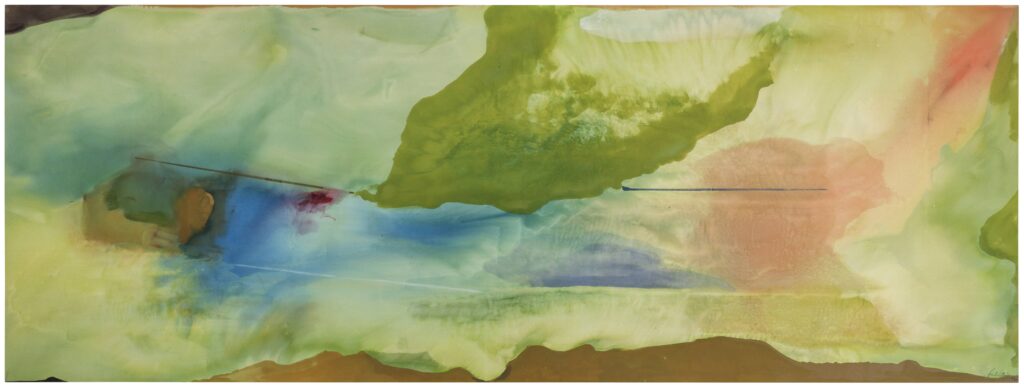
In Noisetone, Barbara Guest writes that “colors often break themselves into separate hues of noisetone […] Nine rows of color. ” This poem suggests that the color world splits, as if through a prism, into nine basic hues, and that these colors can be attached to different sounds. This evokes different shades of white noise (purple, pink, brown, etc) as well as the synthesthetic association between notes and colors. This connection offers a useful entry point into Helen Frankenthaler’s Hint from Bassano (1973). One of Frankenthaler’s so-called “cineramas,” a symphony of poured colors evokes a deep peace, a feeling of balance. The pourings of salmon pink, lime green and sky blue complement the pastel green shades and browns framing the canvas, inviting smaller visitations of red, black, white, and deep green. The harmonious balance achieved here, and Guest’s poem, are both reminiscent of analog color TVs displaying the ‘No Signal’ screen. A glitchy, scrambled rainbow accompanied by snow-like sounds reflects disconnection from network. While seeming chaotic, given liberty from a channel, the television picks up a balanced connection to all random colors and sound signals nearby, displaying them equally, and like Frankenthather’s Bassano, emitting back a balancing wash to the viewer.
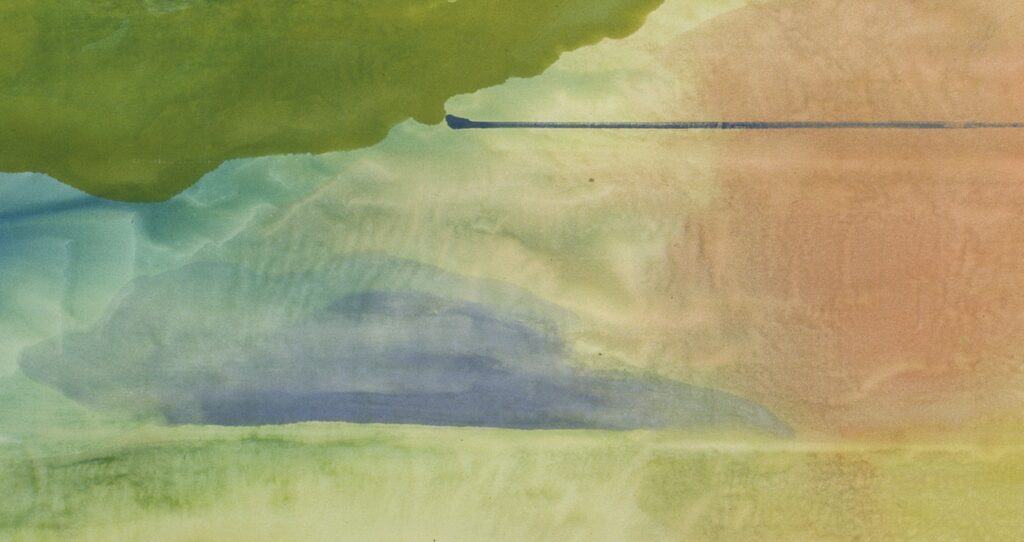
Helen Frankenthaler Foundation, Inc. / Artists Rights Society (ARS), New York
The painting possesses an inexplicable magic found in her strongest works: it transcends the limits of its medium. Its transcendence may arise from this balance itself. Diluted and denser clouds of pigment gather into expansive fields that in parts flatten and in others deepen, opening deep pools of impossible space. Color and density juxtaposition certainly contribute to this phenomenon, yet the effect feels greater than the sum of its formal components, opening mysterious vortexes into the beyond. This holographic space appears almost audible, with alien sounds emanating from the unknown.
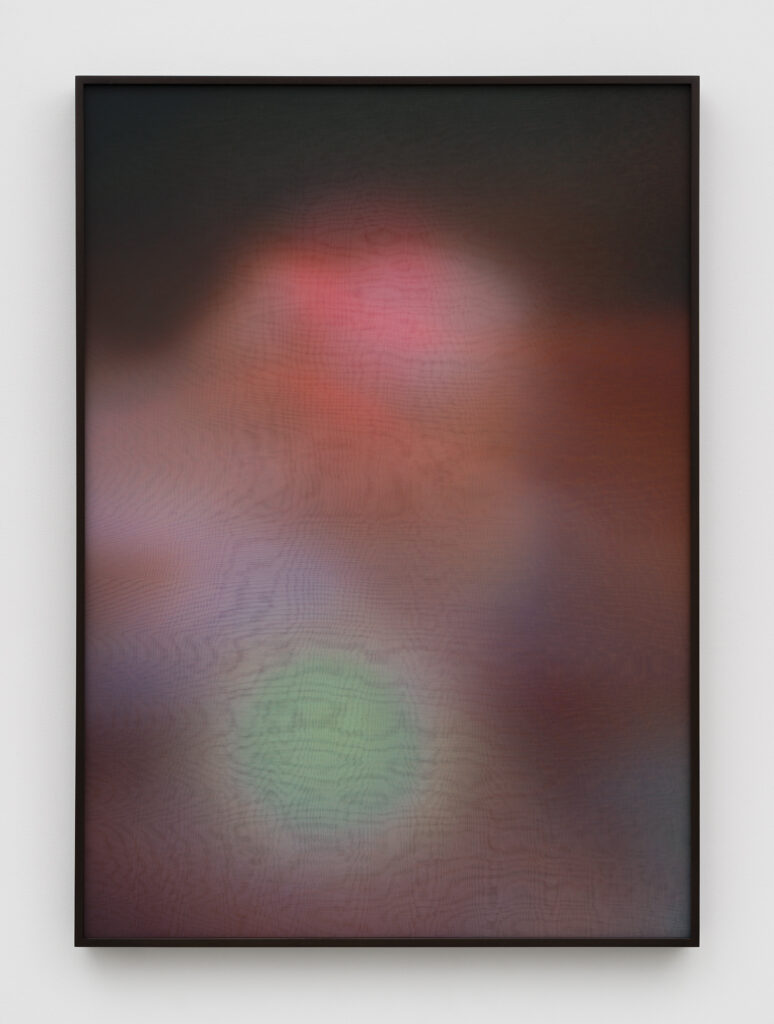
59 x 42 x 2 in. Courtesy of the artist and Chapter NY, New York. Photo: Charles Benton.
A similar optical magic appears in Rosha Yaghmai’s recent show at Chapter NY. Drawing on Frankenthaler’s legacy, she delves further into transcendental color effects by stretching organza over cotton painted with ink and acrylic to create a holographic effect, which she calls ‘afterimages’. These auras appear to pulsate, eliciting a synesthetic, multisensory response.
Generations of artists around the world have learned from Frankenthaler’s iconic and generous methodology, pushing it further into present day art discourse. To name several current contemporary shows in the New York area that evoke Frankenthaler’s work, Adam Rabinowitz, Francine Tint, Trevor Warren, Katherine Bernhardt, and Konstantina Krikzoni all explore various techniques and essences of Frankenthaler’s work in diverging contemporary practices.
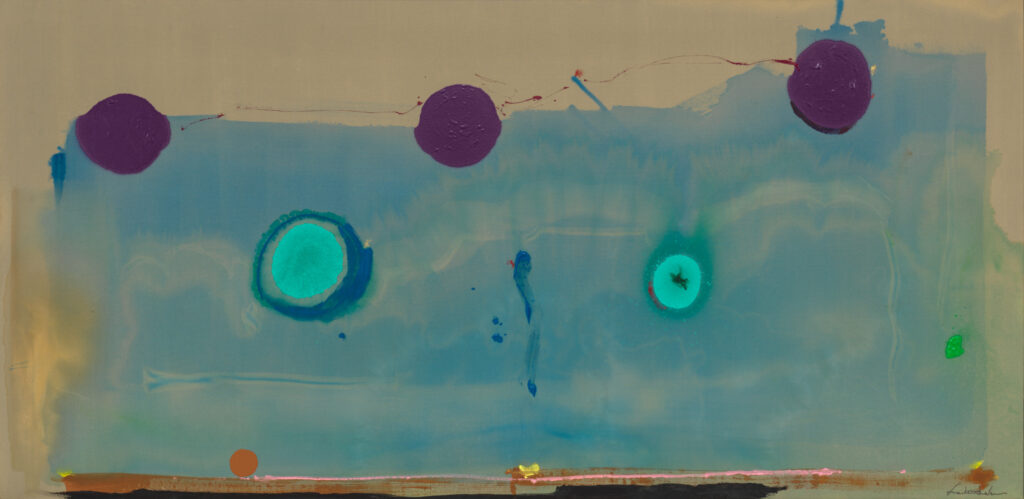
By the 1970s and 1980s Frankenthaler’s compositions become increasingly orchestral. Color spreads confidently across the canvas. She navigates and drives the chaos by masking, revealing, planning. By the 80s and 90s, her works are dense, the canvas painted with control in opaque layers that intermingle with her spills. In these works, success happens in the juxtaposition between heaviness and lightness, transparency and opacity, floating and sinking, while here her composition and paint application is reminiscent of Hodgkins’ work, who rose to the peak of his artistic career in the 80s.
Of this era of work in the show, Water Shadows (1988) is particularly beautiful. Cheerful turquoise and eggplant purple circles bob atop a translucent swimming-pool blue, demarcated by a small brown circle that anchors them down, that together appear to compose a song about the sensation of floating.
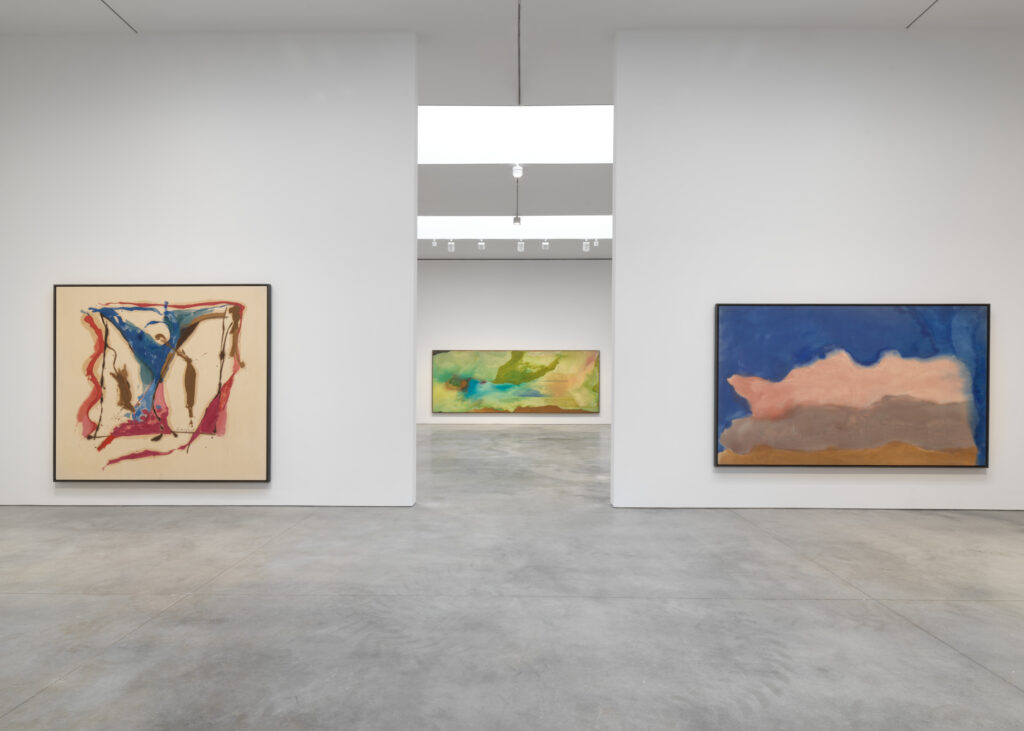
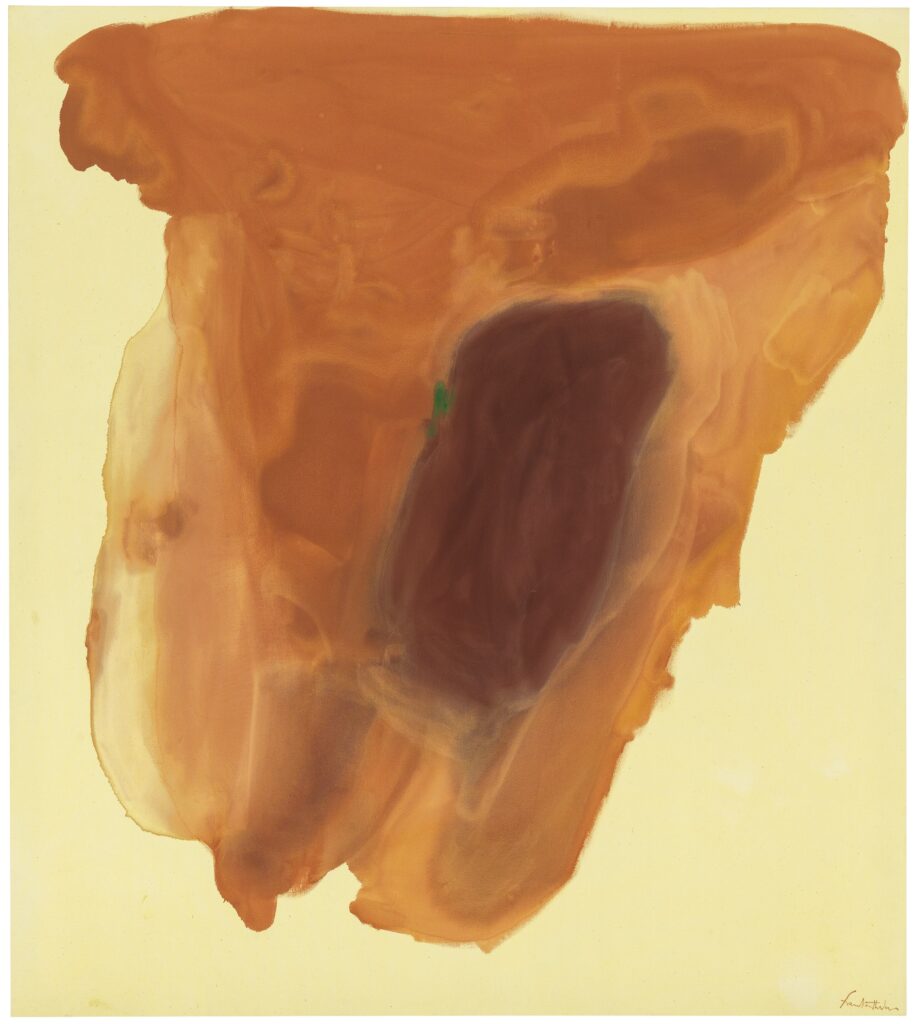
Inher poem Dissonance Royal Traveller, Guest continues to access spirituality using color. She reflects, “In the middle the world is brown; on the opposite side of the earth an aroma of scarlet. This accompanies our hearing music; the sleeve of heaven and the hoof of earth loosed from their garrison.” Frankenthaler’s What We Really Are, We Really Ought To Be (1972) epitomizes this poem. This piece bookends the show, beautifully placed alone in an open showroom for intimate contemplation. The thought that arose when I first encountered it was, “this makes my heart feel good.” A chocolate brown pool sits in the image’s center, surrounded by a larger scarlet lake. The combination feels nurturing, creating a warm underground passageway to inner truth. That a color combination can make us hear music and unite the heavens and earth feels a lot like what can be experienced when confronted by Frankenthaler’s musical paintings. Moreover, this particular painting’s title urges us to step into our body and fully inhabit ourselves, encouraged by a small green line in the left of the painting, that kindly offers us refreshment.
The Moment & The Distance is on view at Gagosian, 522 West 21st Street, New York, NY 10011, through July 2, 2026. Gallery hours are Tuesday through Saturday, 10 a.m.–6 p.m.
About the writer: Sivan Lavie is a poet, visual artist, arts writer and curator based in New York City. Sivan is an arts writer for Whitehot Magazine, Art Spiel and Interlocutor Magazine. She published chapbooks with Inkfish Studio and Earthbound Press, her poetry and short stories appear in Hobart Pulp, SPECTRA Poets, SUDS Zine, KEITH LLC and Happy Apples Press. @s.i.v.a.n.w.o.r.l.d @tinnitus.curator
Make your tax-deductible donation today and help Art Spiel continue to thrive. DONATE