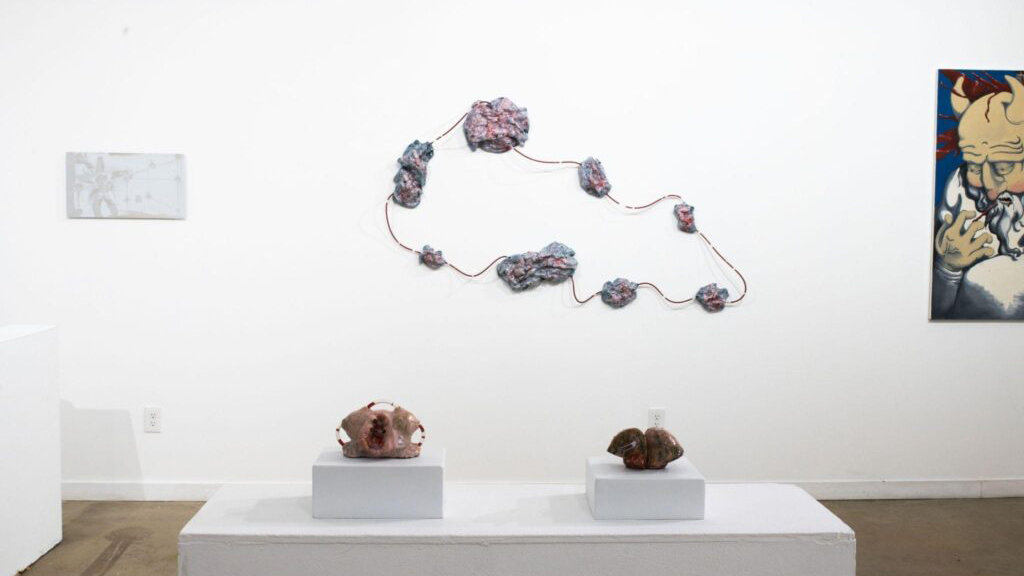
Derrida once pursued the question of hospitality. Can you welcome someone whose name you do not yet know? Can you open the door before knowing who is arriving? If you can, the welcome is sincere; if you cannot, hospitality has already become part of border management. Unconditional hospitality is therefore always impossible: if the host retains sovereignty, they cannot be fully open; if they become fully open, they are no longer the host. The name thus becomes the first step in the subject’s enclosure. This exhibition is built precisely upon this impossibility.
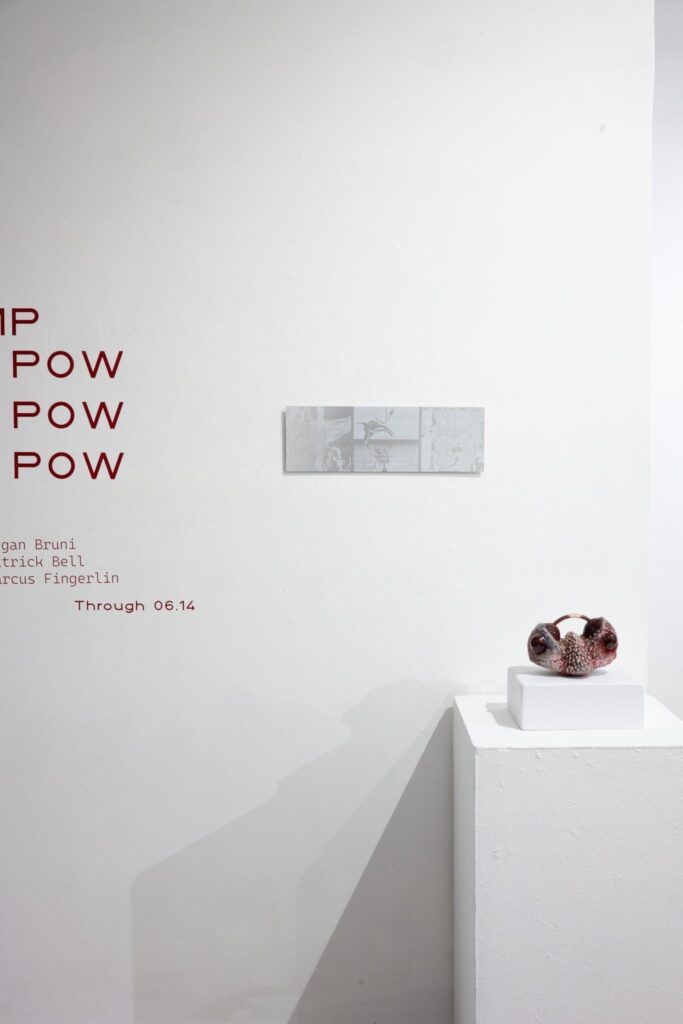
Pow Pow Pow.
The artists of Art Collective LAMP gave it this name, smiling, full of energy. The name appears before the works, before the bodies step into the room. Three blows, rhythmic, feverish, a feint, gathering and clutching the unsettling question that this encounter once again opens: what if the “door” has already been open for too long? What if, by the time the guest arrives, the host has long forgotten who opened the door? In the works of Marcus Fingerlin, Patrick Bell, and Logan Bruni, their respective winding narratives share this structural condition. Through a direct act of throwing, the exhibition knocks upon the other side of a cycle of power generated by internal violence flowing outward. Violence is not a guest ringing the doorbell and waiting outside; long before the room existed, it was already warm and well-fed within.
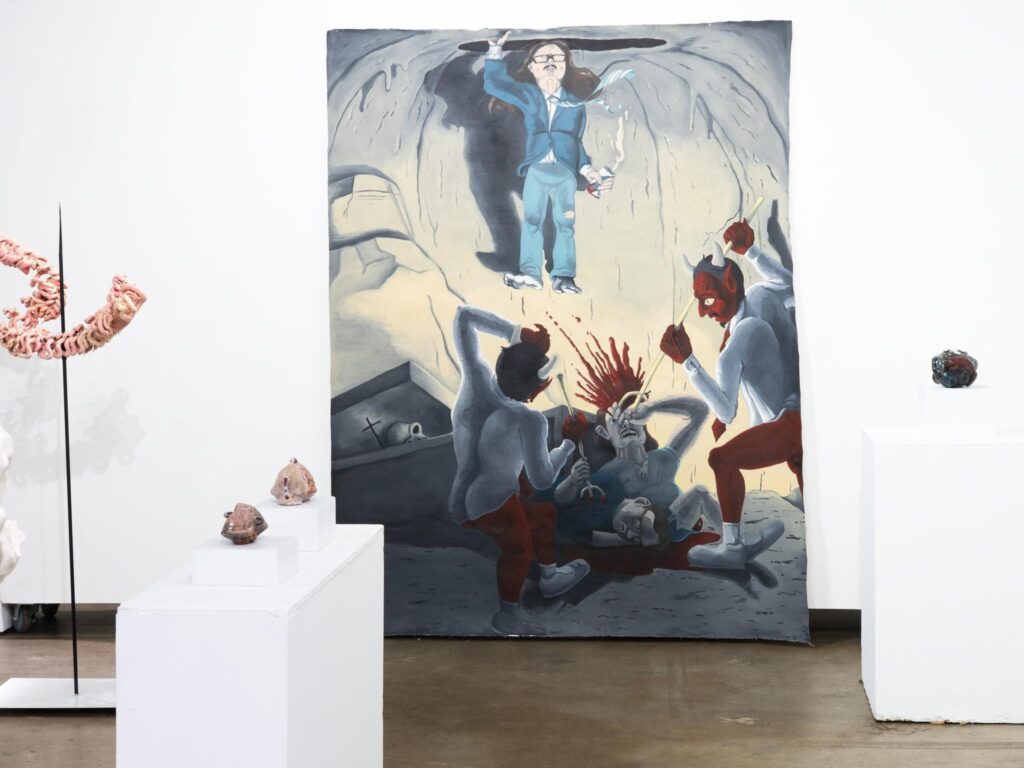
Fingerlin’s paintings depict the aftermath of hospitality. One of the largest works, The Descent, hangs almost floor-to-ceiling: a man in a blue suit stands at the top of the canvas, long-haired, elevated, holding something downward toward the scene below him—his posture neither triumphant nor distressed, simply positioned above. Beneath him, blue-grey bodies collapse and tangle across the ground, red demonic figures moving among them, small crosses scattered in the wreckage. In The Blade, a marble-pale, smooth body stands at the center while bright red demonic forms approach from all sides. The demons do not appear as intruders. They resemble lawful heirs. Derrida points out that the ultimate consequence of unconditional hospitality is the relinquishment of sovereignty. Fingerlin’s canvases are pervaded by a strange, almost administrative stillness that hangs over the ambiguity of the host’s identity—a scene following the transfer of authority. Who is welcoming whom? Or, rather, is there even a host present at this moment? Yet danger has long since taken root; the subject, moving from the process of losing itself to having already lost itself, nevertheless remains standing.
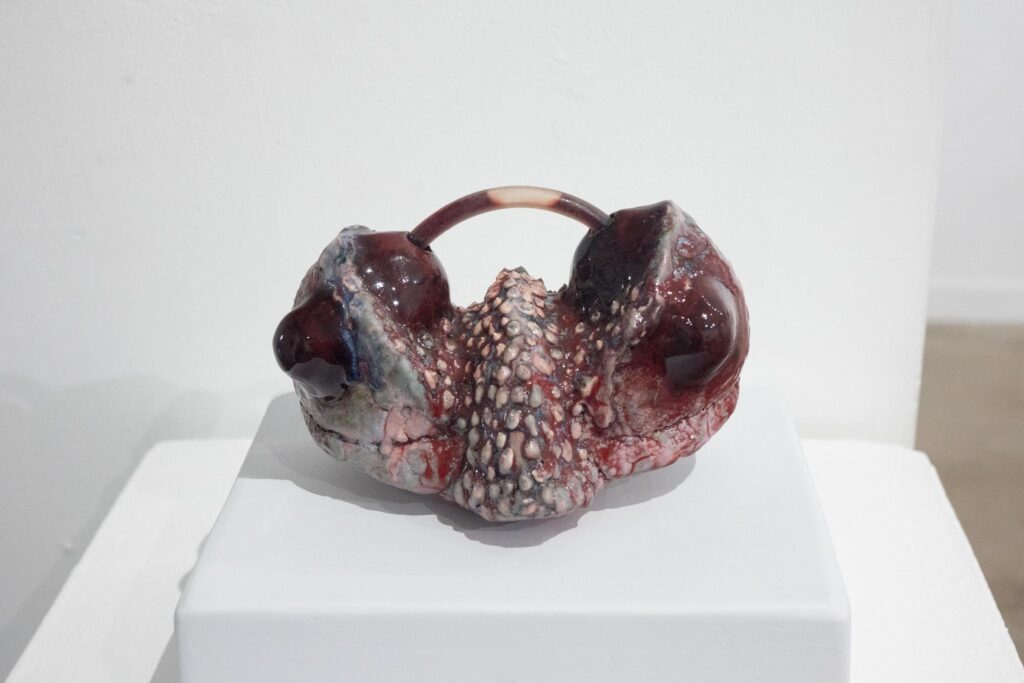
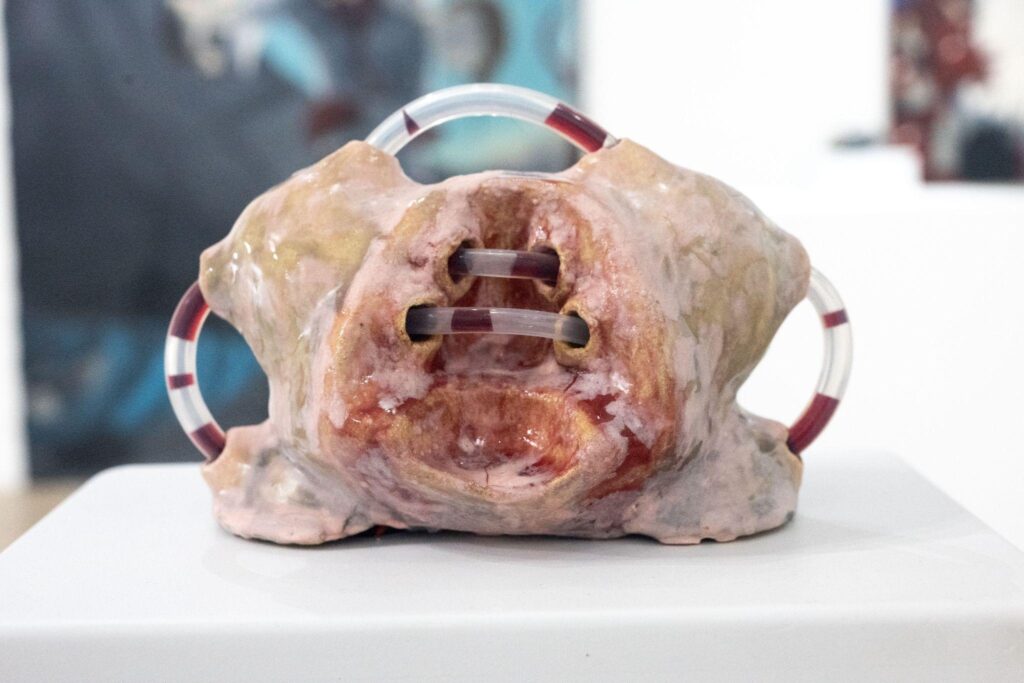
Bell’s work follows on from Fingerlin’s; as a struggle waged before sovereignty has been fully relinquished, it reveals the violence accumulated through the process of physically manifesting and solidifying the very agony of a situation that cannot be sustained yet is forced to continue. Ceramic forms curl upon their pedestals, deep burgundy and bruise-like flesh tones pressing against one another; the way the moist glaze captures light resembles an organ storing bodily fluids, with a slender tube extending from the surface, through which a crimson liquid circulates. This renders it uncertain whether it is entering the body or growing from within it. On the nearby wall, seven blue-grey, organ-like ceramics are connected by the same tubing into an open circuit, thus turning the body’s internal maintenance mechanisms inside out. Why is it still operating? Why is it relocating its operating system to the outside? Thin tubes criss-cross the organs, intensifying and entangling ever more, heedless of the self-repair required in the face of fear; laid bare, the tubes become an extended argument, proving their host identity to illness and deformity, succumbingly. The internal repair, intended as proof of autonomy, gradually becomes the disease itself, retreating amidst the constant bodily transformations brought about by exposure in the presence of sovereignty.
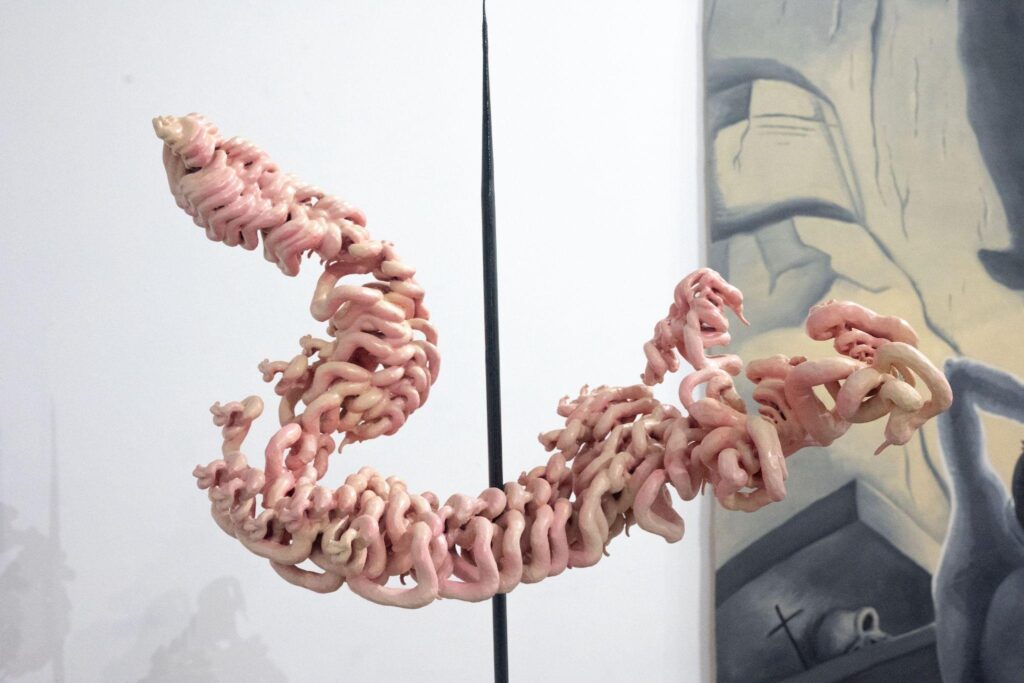
Bruni’s rod sculptures arrive. Each consists of a metal rod rising from an aluminum base and piercing a body: one a cracked white ceramic aggregate sphere, one a suspended pink spine-like form winding horizontally through space, and one a flattened bone-white spinal extension opening outward around the point of penetration.
Equally unsettling are the bases of each piece; the original motifs of every 3D-printed sculpture are etched into the metal surface, resembling a form of religious language that has long since passed its prime, yet continues to expand. These patterns do not belong to the moment of creation; they belong to the stories that followed—to the ever-proliferating annotations, retellings, mythologizations, and rewritings.
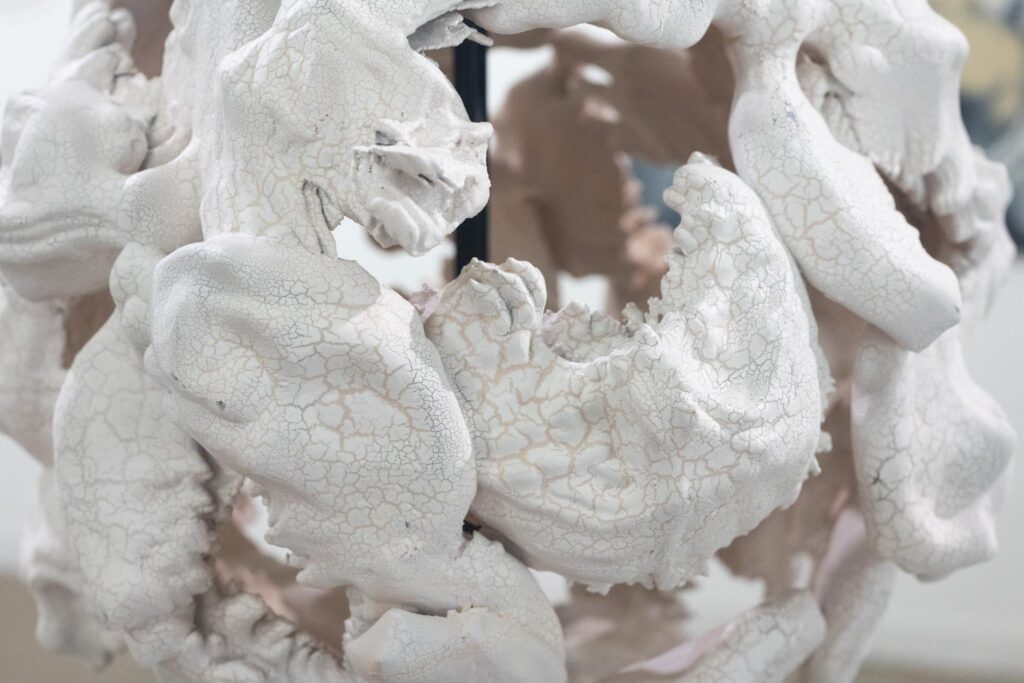
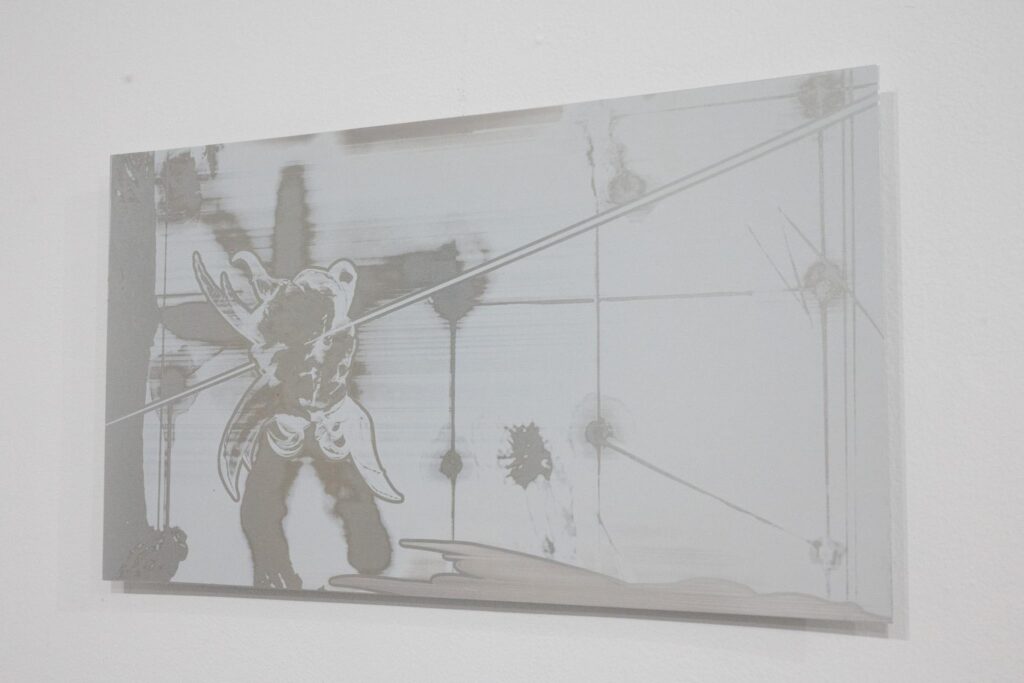
Why does every story ultimately require a body? Why does every narrative ultimately wish to occupy space? Why must grace always seek a body? The image lies horizontally on the ground. The physical desire of narrative itself pierces flesh just as these metal rods do—or has the body itself grown out from within the narrative? Derrida’s question returns once again. Only this time it becomes even more cruel. If the guest has already lived here from the very beginning, if it has already reconfigured the architecture, then from what moment did the host begin believing that this house belonged to them rather than to that fiction of sovereignty? At this point, the exhibition also raises a question worth pursuing. If the subject never possessed the key, if violence never comes from outside, then who keeps opening that door?
Pow, Pow, Pow.
The works of all three artists conceive of violence as a force that exists prior to the subject. At the end of this hospitality, the body remains warm, in a room that remains ever open, tended to by a host who has never held the key. Yet when all is understood as intrusion, does the subject not, conversely, begin to rely on intrusion to affirm itself? The absolute openness posited by Derrida does not truly lead to freedom; arising from the abolition of all boundaries, the subject loses the capacity to refuse and, consequently, the capacity to bring the welcome unto an end. Thus, the body turns inwards, seeking new foreign bodies, whilst the narrative seeks new dwellings.
Make your tax-deductible donation today and help Art Spiel continue to thrive. DONATE
About the Writer: Rui Jiang is an independent curator and writer working between Baltimore and New York. She holds a Master’s degree in Curatorial Practice from Maryland Institute College of Art. Her research moves between semiotics, intimate gestures, and shifting dialogues, examining how art forms deconstruct and reconstruct within a polycentric field. She investigates the tensions embedded in exhibition-making—complicity, reflexivity, and the shifting power dynamics that shape artistic discourse. Through interdisciplinary approaches, she experiments with curatorial strategies that challenge linear narratives, embrace contradictions, and reimagine the relationships between artists, audiences, and institutions. @secretary37_