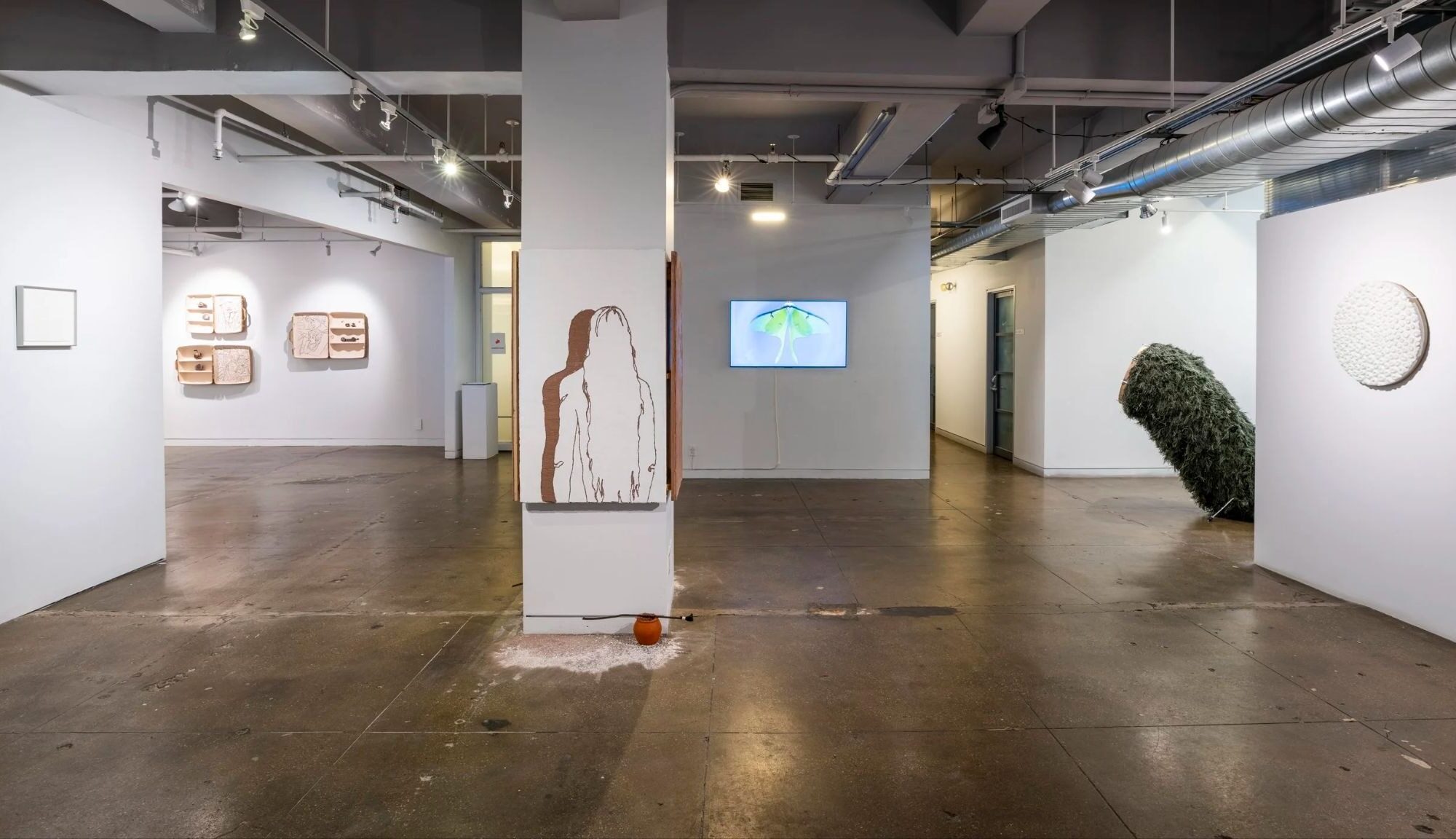
When one thinks of nature, the first thing that comes to mind would be a park filled with leafy trees or perhaps a bouquet of vibrant flowers. With EFA Studio’s newest exhibition, After the Rains, artists challenge the idea of how nature can be represented.
Focusing on the deep intentions behind the material alongside how to engage the viewer through sound, video, and even performances, this group show serves as a reminder to use experiences and relationships to reconnect with nature and repair connections within the cycle of renewal.
Curated by Deric Carner and Michael Eckblad, the exhibition uses nature to reflect on how our actions as a species have affected the environment around us, implicating the viewer in the moral consequences of our relationship with animals, people, and the natural world.
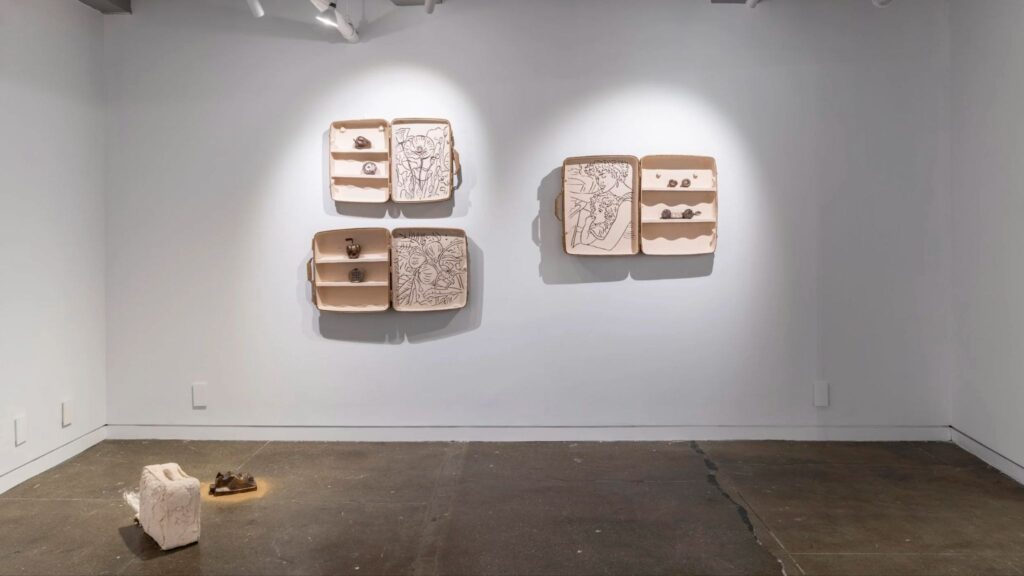
Abdi-Boragi’s Trace I: Sand Luggage series was captivating because of its unconventional material. At first glance, one might assume the sandy texture was achieved using glass beads. Upon further inspection, the suitcases are indeed the real deal, coated with sand.
The combination of the dense, heavy bronze phone (Distance: Lemon Receiver & Speaker) with the fragile, soft sand feels oddly homey. Part of what gives this a distant, childhood-memories feeling is the finger-drawn portrait of the mother and her child.
Together, it arguably can be a physical representation of emotional baggage. However, with the bronze phone and receiver, it feels more like a reminder to keep in contact with family. The phone feels heavy; it could have sunk into the sand, but the sand is solid enough to withstand it. Perhaps the relationship between the mother and the child has soured over the years, hence the phone takes the form of a lemon. Or perhaps the lemon signifies more, or may be a fun take on a phone. The baggage calls up a stronger sense of longing for home.
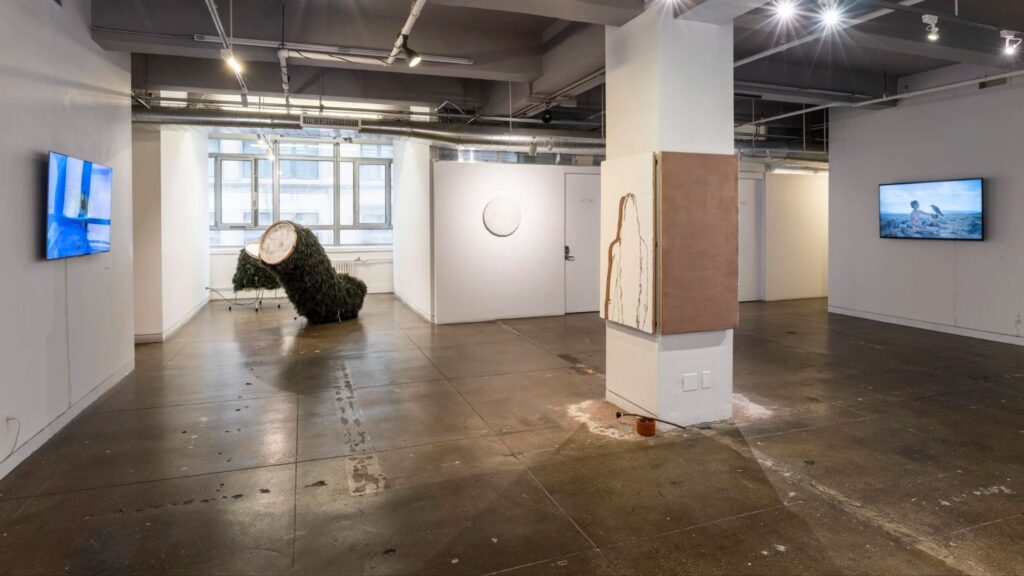
Facing each other from across the room are Virginia L. Montgomery’s Moon Moth Transcend Black Hole, and Susan Silas’ I to Eye. Both videos focus on the relationship between humans, animals, and morality. Through Montgomery’s surrealist take and Silas’ more literal take, both contemplate the consequences of one’s actions.
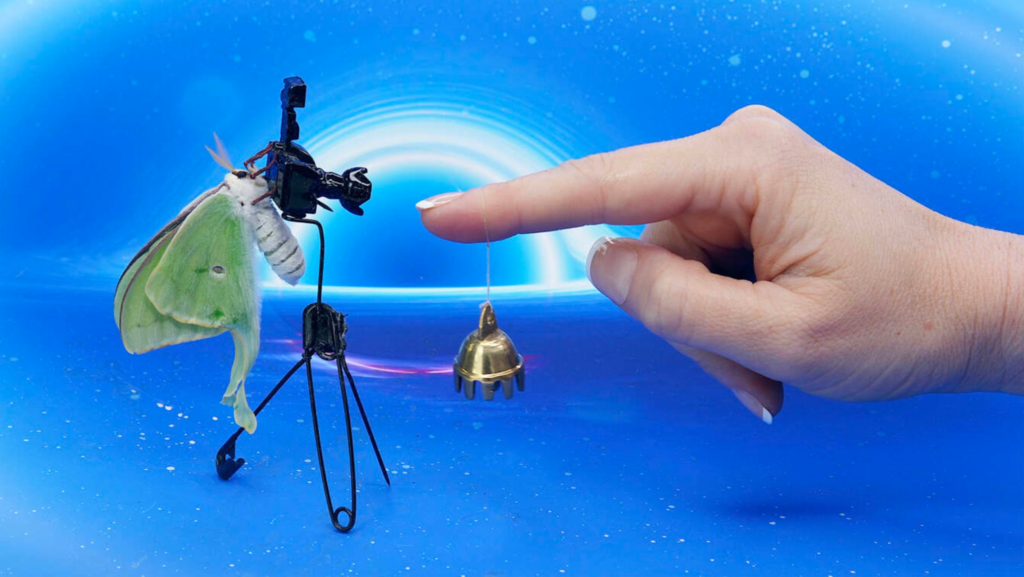
Originally commissioned by the Moody Arts Center at Rice University in 2025, Montgomery’s video follows a luna moth that navigates its environment inside a black hole while quarreling with the challenges posed by the butterfly effect and Emmy Noether’s Theorem of symmetry.
Concisely, the butterfly effect is the theory that every small action one makes has a ripple effect on the future. Similarly, Noether’s Theorem states that when there is continuous symmetry, there is a law of conservation at play. This law of conservation, to put it simply, means there is a constant that will not change.
In a way, it’s similar to trying to change one’s fate. It calls into question just how much our environment results from our actions, good and bad, and how much is nature acting on its own accord.
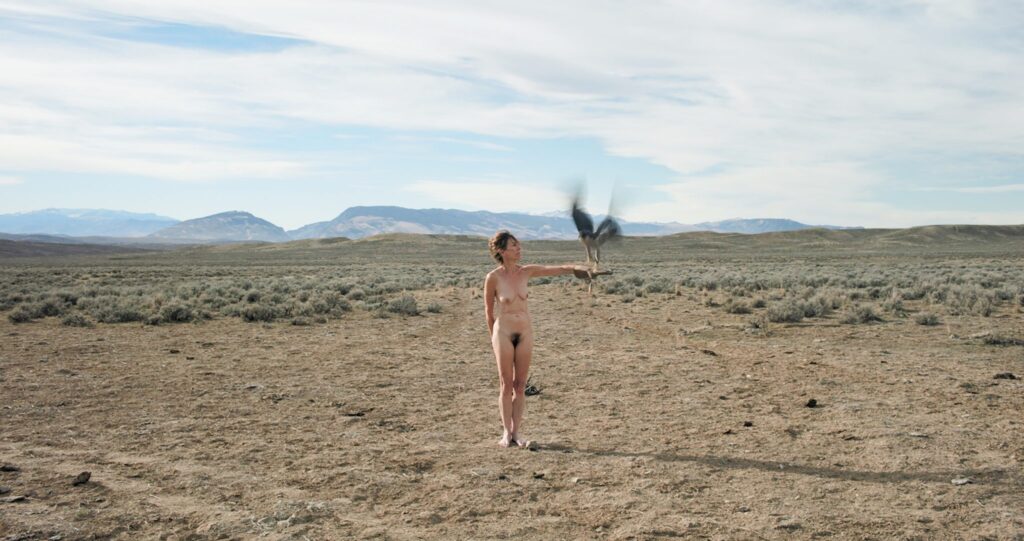
As humans, arguably, we put our ambitions above all else, including the environment, and nature has consequently suffered. In I to Eye, Silas puts humanity in the position of the woman, vulnerable and attempting to reconcile our bond with nature. Throughout the film, the woman and the falcon lock eyes, staying close. Wordlessly, they seem to find delicate peace.
The video powerfully forces the viewer to ponder if the results of our current economic gain are worth the destruction of our planet. Nature, represented by the falcon, remains perched on her hand, yet with a tangible unease as it constantly shifts rather than sitting still. Nature seems wary of whether humanity will continue to harm it and when. Despite it all, both the woman and the falcon are still able to be together in such proximity and vulnerability. Both humans and nature can fall at the whim of the other. Only nature needs humans to quit their constant search for greed to fix their side of the relationship, and to be at equilibrium at last.
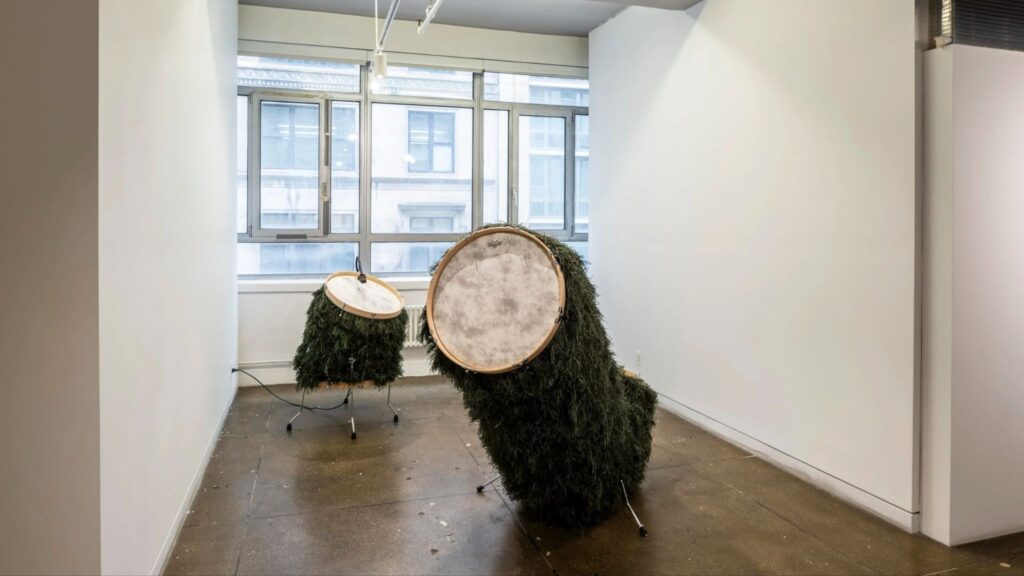
Curiously hidden in a corner by the window are two drums covered in camo fabric: Beneath the Surface: Transcendental Rhythm in 6/8, seeking connection and Gravitational Grit. The drums together feel as if nature is returning to a man-made object, similar to how in apocalypse movies, overgrown plants infest dull skyscrapers. Almost as if nature is trying to reclaim what is lost, or a drum one can find in a forest.
At first glance, the first question that comes to mind is, “Are these drums functional? Who is meant to play them?” Although one cannot do so, it does not mean it doesn’t make any sound. If you get up close to Gravitational Grit and lean close to it, you can hear a muffled radio. When asked which channel was playing, Romero answered 97.9 FM, a Latino radio station.
Heavily inspired by his Boruica culture, Romero situates the sounds of the island amidst the spotlight for American audiences. In being the bridge between these two cultures, his work acts as a translation between nature and humans.
Whether it is Abdi-Boragi using sand to paint landscapes that call the viewer home, or Randi Renate reminding us of the urgency of our coral reefs by replicating the math of hermit crab shells, nature guides us through life’s difficulties and urges us to return to simplicity.
After all, humans are still animals, even if we are living in a concrete jungle.
After the Rains at EFA Studios:323 West 39th Street, 3rd Floor, New York, NY 10018. On view through July 24th, 2026, curated by Michael Eckblad and Deric Carner. Tue–Fri, 12–5 PM
After the Rains, at EFA Gallery featuring EFA Member artists Armando Guadalupe Cortés @armandogcortes and Susan Silas @susansilas in conversation with Yale MFA alumni artists Selva Aparicio @/selvaaparicio, Bianca Abdi-Boragi @biancaabdiboragi, Von Coffin @coffin1001, Virginia L. Montgomery @virginia.l.montgomery, Randi Renate @randiirenate, and Raúl Romero @rauoool.
Curated by: Michael Eckblad @michaeleckbladand Deric Carner @ithoughtiwasreal, Abbey McBride (@abbey.mcb), Virginia L. Montgomery (@virginia.l.montgomery).
Make your tax-deductible donation today and help Art Spiel continue to thrive. DONATE
About the writer: Sara Aparicio is a Queens-based mixed-media artist and writer. She is currently studying for her BFA in Fine Arts at the Fashion Institute of Technology. There, she also contributes to FIT’s newspaper, W27, as both an editor and a writer. Occasionally, she dabbles in writing poems about what occurred in her life. Similarly, the subject of her artwork primarily focuses on creating accurate representations of her Colombian and Puerto Rican heritage, whilst also raising awareness of issues not spoken about through advocacy in the form of paintings, drawings, collages, and sometimes prints. Her poems and artwork have been published in both an edition of Forest Hills Community Building’s newspaper, The Orbit, and SUNY’s literary magazine, Gandy Dancer. Since 2023, her art has been showcased in Free Arts NYC’s annual Youth Showcase. Sara’s most recent exhibition was at a local show with A-VENT-SPACE. You can find more of her artwork on her Instagram page: @sara.aparicio.studio